
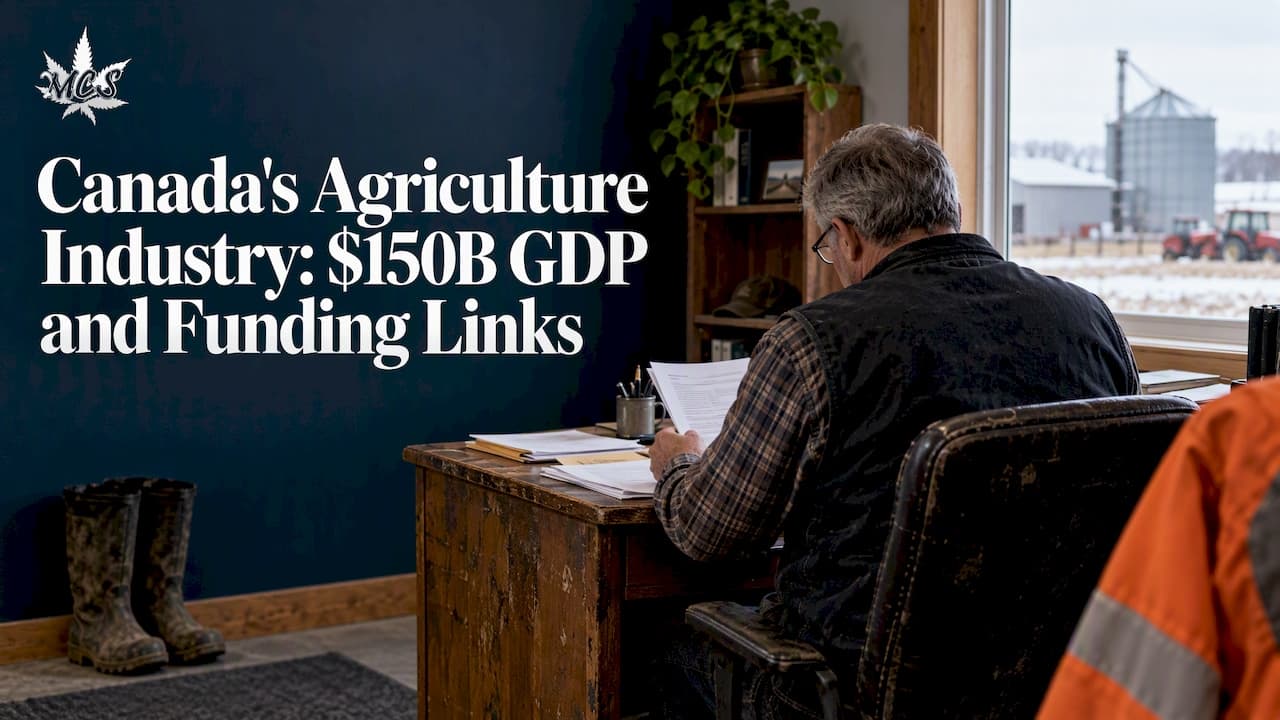
The agriculture industry spans primary production, food and beverage processing, and retail and food service, and together these layers generate about $150 billion in GDP and support roughly 2.3 million jobs, or about one in nine positions nationwide. Agriculture and Agri-Food Canada and Statistics Canada track this scale closely, and federal climate programs increasingly tie funding eligibility to the environmental practices producers adopt on their land.
TL;DR:
- Processing now accounts for more GDP and jobs than primary agriculture, with $35.8 billion and 318,400 roles compared to $31.7 billion and 223,000 in farming.
- About 56 years is the average age of Canadian farm operators, emphasizing the need for succession planning and attracting new entrants.
- Environmental practice adoption, such as cover cropping and nitrogen management, is increasingly tied to funding eligibility and long-term farm sustainability.
- Supply chain disruptions, pests, and market volatility remain major risks, leading many producers to diversify crops, markets, and income sources.
Table of Contents
- Sector snapshot: components, commodities, and economic footprint
- Who works in agriculture: workforce and demographics
- Environmental practices and climate action on the farm
- Funding, programs, and risk management for producers
- Where to find authoritative agriculture data
- Education, training, and career pathways in agriculture
- Trends and challenges: consolidation, technology, and market pressure
- Regulatory environment and compliance in agriculture
- How trade policy and export markets shape the industry
- Key challenges beyond labor: supply chains, pests, and volatility
- A practitioner's view on where the data points next
- A specialty-crop resource for home and licensed growers
- FAQ
- Sources
Sector snapshot: components, commodities, and economic footprint
Primary agriculture, the farms and ranches that grow crops and raise livestock, accounted for $31.7 billion in GDP and 223,000 jobs, while food and beverage processing added a larger $35.8 billion in GDP and 318,400 jobs. That split matters: processing now outweighs primary production in both output and headcount, a shift that reflects decades of value-added investment downstream of the farm gate. Retail and food service layer additional economic activity on top of these figures, though the bulk of reported indirect and induced impact runs through input suppliers, processors, and distributors rather than storefronts.
Major commodity groups include grains and oilseeds, red meat and dairy, horticulture, and an expanding category of protected cultivation such as greenhouse vegetables and indoor-grown specialty crops like CBD. Regional concentration remains pronounced, with grain production clustered across the Prairies and horticulture weighted toward central and coastal provinces.
- Primary agriculture: $31.7 billion in GDP, 223,000 jobs
- Food and beverage processing: $35.8 billion in GDP, 318,400 jobs
- Combined agri-food system: about $150 billion in GDP, 2.3 million jobs
Exports reached $100.3 billion in 2024, with the United States absorbing about 61.9% of that total, a concentration that leaves the sector exposed to shifts in a single trading relationship.
Who works in agriculture: workforce and demographics
Farm operators are aging. The 2021 Census of Agriculture puts the national average operator age at roughly 56 years, a figure that shapes nearly every conversation about succession planning and long-term labor supply.
The average Canadian farm operator is about 56 years old, which means a meaningful share of current operators will exit the industry within a working generation, raising the stakes for new entrants and transition planning alike.
Seasonal and temporary foreign workers fill labor gaps that domestic hiring cannot cover, particularly in horticulture and livestock operations with sharp seasonal peaks. This reliance creates planning complexity around housing, transportation, and program compliance that many operations manage year after year.
- Census data track operator counts, farm numbers, and age distribution by region.
- Seasonal and temporary foreign worker programs remain central to harvest-season staffing.
- Job seekers and employers can find labor-market resources through provincial agriculture ministries and sector councils.
Environmental practices and climate action on the farm
Beneficial management practices, often shortened to BMPs, describe the on-farm techniques that reduce environmental impact while often improving long-term productivity. Cover cropping protects soil structure between cash crops, nitrogen management matches fertilizer application to crop need rather than calendar habit, and rotational grazing lets pastureland recover between grazing cycles.
The On-Farm Climate Action Fund, part of the broader Agricultural Climate Solutions initiative, carries about $704.1 million in support for these practices, with funding extending through 2028 and expansions announced for the 2025 to 2028 period.
- Identify which BMPs apply to your soil type, crop rotation, and existing equipment.
- Review eligibility criteria before applying, since program rules shift between funding rounds.
- Document baseline practices so improvements are measurable when funding applications ask for evidence.
Pro Tip: Start a simple practice log now, even before applying for funding, since most programs ask for a baseline record that is far easier to produce in real time than to reconstruct later.
BMP adoption increasingly determines which funding streams a farm can access, and operations that lag on documented environmental practice risk being screened out of future rounds entirely.
Funding, programs, and risk management for producers
The Sustainable Canadian Agricultural Partnership, known as Sustainable CAP, is a $3.5 billion, five-year federal-provincial-territorial agreement running from 2023 to 2028. It prioritizes climate resilience, innovation, market development, and sector resiliency, and it includes a $250 million Resilient Agricultural Landscapes Program aimed at soil health, biodiversity, and water resilience.
Business risk management programs round out the support system. AgriInvest functions as a self-managed savings account for small income shortfalls, AgriInsurance covers production losses from weather and pests, AgriStability addresses larger margin declines, and AgriRecovery responds to extraordinary disaster events.
- Sustainable CAP: $3.5 billion over five years (2023 to 2028), cost-shared with provinces and territories.
- AgriInvest, AgriInsurance, AgriStability, and AgriRecovery together form the core business risk management suite.
- Provincial agriculture ministries administer the local application points for most of these programs.
Producers typically start with their provincial ministry website, since program intake and deadlines vary by jurisdiction even when the federal framework is shared.
Where to find authoritative agriculture data
Three sources anchor most credible agriculture research. Agriculture and Agri-Food Canada publishes sector overviews and GDP breakdowns best suited to understanding economic scale. Statistics Canada maintains the Census of Agriculture, the definitive source for operator demographics and farm counts. Sector-specific program pages document funding amounts and eligibility rules directly.
The agri-food system generated about $150.8 billion in GDP in 2024, a figure close enough to the longer-run $150 billion estimate that both describe the same broad scale rather than conflicting data points.
- Use AAFC sector pages for GDP, employment, and trade figures.
- Use Census of Agriculture tables for operator age, farm counts, and regional breakdowns.
- Watch for definition changes between census years before comparing figures directly across time.
Education, training, and career pathways in agriculture
Entry routes into agriculture careers run through several channels: college diploma programs in agribusiness or crop production, formal apprenticeships tied to specific trades, university degrees in agricultural science or agribusiness management, and on-farm training that builds practical skill alongside an experienced operator.
Demand is shifting toward hybrid skill sets. Precision agriculture knowledge, familiarity with environmental BMPs, and basic business or market analysis now matter alongside traditional production skills, since retail and processing buyers increasingly set the standards that shape what gets grown and how.
- College and university programs provide formal credentials in agribusiness, agronomy, and food science.
- Apprenticeships and on-farm training build practical skill without the time commitment of a full degree.
- Provincial labor programs and sector councils post job listings and upskilling resources for both new entrants and career changers.
Trends and challenges: consolidation, technology, and market pressure
Farm consolidation continues as smaller operations merge into larger ones chasing equipment efficiency and input-purchasing power, a trend that reshapes rural labor markets and land ownership patterns alike.
Technology adoption is accelerating across precision agriculture, with GPS-guided equipment, drone-based field scouting, and soil sensors feeding data back into planting and fertilizing decisions. Controlled-environment production, including greenhouse and indoor growing, is expanding alongside this data-driven shift.
- Consolidation concentrates land and equipment investment in fewer, larger operations.
- Precision tools and drones generate field-level data that supports tighter input management.
- Rising input costs and supply-chain disruption push many producers toward diversified suppliers and on-farm storage as resilience strategies.
Regulatory environment and compliance in agriculture
Agriculture operates under a layered regulatory system that touches food safety, environmental protection, and animal welfare simultaneously. Food safety rules govern everything from on-farm handling practices to processing facility sanitation, and compliance requirements scale with the size and type of operation, a small direct-market vegetable grower faces different obligations than a federally inspected meat processor.
Environmental regulation covers water use, nutrient management, and pesticide application, with rules varying by province and by watershed in some cases. Many of these rules intersect with the funding programs described earlier: a farm seeking Sustainable CAP support for nutrient management upgrades is often already operating under provincial nutrient management regulation, and the two systems are designed to reinforce each other rather than conflict.
Traceability requirements have grown more prominent as well, particularly for livestock and specialty crops destined for export markets, since importing countries frequently require documentation that a Canadian food safety inspector can verify. Operations that export, even occasionally, need to understand both domestic compliance rules and the import requirements of their destination market, since a shipment can be held or rejected for paperwork gaps alone.
Staying current with regulatory change matters because standards shift in response to trade negotiations, food safety incidents elsewhere in the world, and evolving environmental science. Producers who treat compliance as a fixed checklist rather than an ongoing practice tend to find themselves scrambling when a rule changes mid-season.

How trade policy and export markets shape the industry
Export markets are not a side note to the agriculture industry, they are a core part of its economic structure. The sector exported about $100.3 billion in goods in 2024, and the United States alone accounted for roughly 61.9% of that total, a concentration that makes trade policy shifts in that single relationship disproportionately consequential.

Tariff changes, sanitary and phytosanitary requirements, and shifting trade agreements all ripple through farm-gate prices with a lag that can catch producers off guard. A tariff imposed on a specific commodity can depress domestic prices almost immediately as exportable supply backs up into the local market, while a new market access agreement can open demand that takes a season or more to translate into planting decisions.
Diversification beyond a single trading partner is frequently discussed as a risk-management strategy, though building new export relationships takes years of relationship-building, inspection compliance, and logistics investment, it is not a switch producers can flip in response to a single bad trade year.
Currency movements compound trade exposure as well, since a stronger domestic dollar makes exports less competitive even when underlying trade terms stay the same. Producers and processors who sell internationally tend to watch exchange rates alongside commodity prices, because the two together determine actual returns far more than either figure alone.
Key challenges beyond labor: supply chains, pests, and volatility
Labor shortages draw the most attention, but they are far from the only pressure on the agriculture industry. Supply chain disruption, whether from shipping delays, input shortages, or processing bottlenecks, can turn a strong growing season into a weak financial one if product cannot move efficiently from farm to buyer.
Pest and disease pressure adds another layer of unpredictability. A single pest outbreak can force costly intervention or reduce yield significantly in a single season, and shifting climate patterns are expanding the range of some pests into regions that previously saw little pressure from them.
Market volatility ties these threads together. Commodity prices respond to global supply shocks, weather events on the other side of the world, and speculative trading, often with little connection to a given farm's own costs or yield that season. Input costs, fuel, fertilizer, and equipment among them, move on their own cycles that rarely align neatly with commodity price swings, squeezing margins when the two move in opposite directions.
Producers increasingly manage these risks through diversification, whether across crops, markets, or income sources, and through the business risk management programs described earlier in this article. None of these tools eliminates volatility, but together they reduce the odds that a single bad season becomes a business-ending one.
A practitioner's view on where the data points next
The numbers are useful, but the practical lesson is simpler: documented, consistent practice beats sporadic effort, whether that means tracking input use or logging BMP adoption before a funding window opens. Our growing guides on nutrient management and cannabis deficiency diagnosis apply the same principle to specialty crop cultivation. Readers looking for more detail can follow our ongoing coverage on the blog.
— Dino Grow Master
A specialty-crop resource for home and licensed growers
Readers exploring protected cultivation and specialty crop production may also be growing cannabis at home or under license. We at Montreal Cannabis Seeds focus on Canadian climate conditions, pairing a germination guarantee with cultivation guides built for local growing challenges.

- Browse Feminized Seeds for reliable, female-only genetics.
- Check Autoflower Seeds for faster, lower-maintenance cycles.
- Compare strain options before choosing a production path.
Visit our full catalog to find seeds suited to your growing setup and climate.
FAQ
What is in the agriculture industry?
The agriculture industry includes primary production such as crop and livestock farming, food and beverage processing, and the retail and food service activity that brings products to consumers. Together these layers generated about $150 billion in GDP and supported roughly 2.3 million jobs, with processing alone contributing more GDP and jobs than primary farming.
What are the top agriculture companies?
Rankings of leading agriculture companies vary by source and by whether they measure revenue, production volume, or market capitalization, and no single authoritative list is maintained for this purpose. Readers researching specific companies should consult sector-specific business directories or financial reporting rather than a general industry overview.
What is the meaning of agricultural industry?
The agricultural industry refers to the full economic system built around producing, processing, and distributing food and related goods, from farms and ranches through processors, distributors, and retailers. It is distinct from "farming" alone, since farming describes only the primary production stage within this larger system.
Which job is best in agriculture?
There is no single best job in agriculture since the right fit depends on interests and skills, ranging from hands-on crop and livestock production to agronomy, precision agriculture technology, and agribusiness management. Demand is rising for roles that combine traditional production knowledge with environmental management or data analysis skills, reflecting the sector's shift toward precision tools and BMP-linked funding.
Sources
- Agriculture in Canada — sector overview (Agriculture and Agri-Food Canada)
- Canadian Agriculture at a Glance (Statistics Canada)