
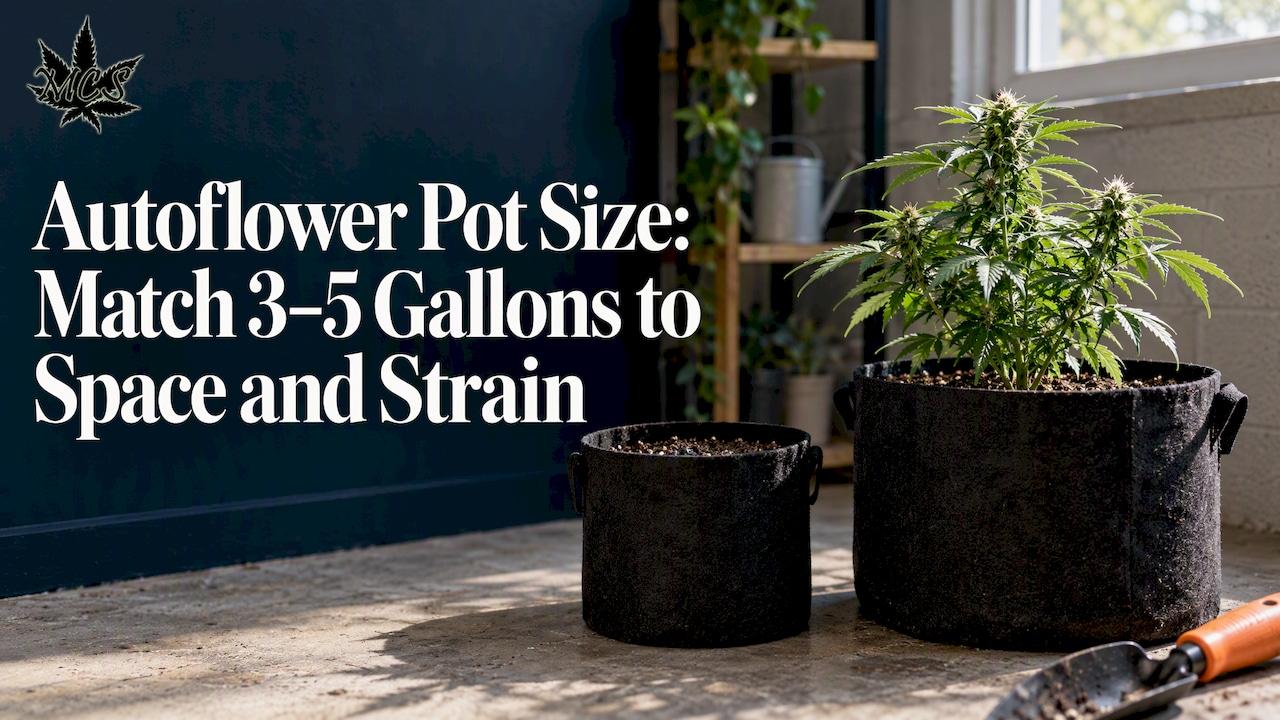
For most autoflowers, the best pot size is 3 to 5 gallons (11–19 L). Lean toward 3 gallons for compact strains and small tents, and toward 5 gallons for taller strains or single-plant finishes. Whichever you choose, the pot also sets how often you water and how evenly the root zone stays moist, so pick it with your watering habits in mind.
TL;DR:
- A 3 gallon pot suits plants 12 to 24 inches tall and shared tents; 5 gallons fits 24 to 42 inch plants grown alone.
- Choose 5 gallons if you water once daily or travel; smaller pots dry faster, while oversized wet medium can saturate roots.
- Fabric pots promote branching roots but dry faster; plastic holds moisture longer, and either material needs drainage holes to prevent saturated roots.
- Plan roughly four to nine 3 gallon plants per square meter, versus two to four in 5 gallon pots; vigorous strains need more space.
- Start seeds in their final pots to avoid transplant stress, but water seedlings in a small circle because large containers can stay too wet.
Table of Contents
- At-a-glance pot size guide for autoflowers
- Why pot size changes roots, height and yield
- How to choose by grow space and strain
- Pot materials and shapes
- How pot size sets your watering routine
- Transplanting and starting autoflowers
- How many autoflowers fit per square meter
- A grower's take on pot size
- Where to find autoflower seeds and strain height details
- FAQ
- Sources
At-a-glance pot size guide for autoflowers
Growers commonly map pot volume to finished plant height, and that mapping is the fastest way to choose a container. Use this list as a quick reference, then read the sections below for the reasoning.
- 1 gallon (about 4 L): suits plants that finish around 6–12 inches. It dries out fast and leaves little room for error.
- 3 gallons (about 11 L): the usual choice for plants in the 12–24 inch range.
- 5 gallons (about 19 L): the usual choice for plants reaching 24–42 inches.
- Very large pots are mainly suited to very large plants, often grown outdoors.
A smaller pot can suit compact autos, small tents and layouts with several plants sharing one canopy. It keeps each plant's footprint small and dries down quickly, which is forgiving if you tend to overwater.
A 5-gallon pot is the better pick when you run one or two plants and want each to finish at full size, or when your strain is known to stretch. Larger containers earn their place outdoors, where plants can spread without a ceiling.
Two warnings apply at the extremes. A 1-gallon pot can work for a tiny plant, but it swings between wet and dry within a day or two, and the roots run out of space early. An oversized pot may hold water for a long time, so an autoflower's root system may sit in saturated medium while using only part of the volume.
Why pot size changes roots, height and yield
The root zone is a balancing act between oxygen, water and nutrients. University of Guelph researchers describe it that way in their work on root zone management for controlled environment cannabis, and they point out that choosing a container volume is fundamentally an irrigation management decision, because the pot defines the physical boundary of the root system. That framing is useful. You are not just picking a bucket for roots to fill; you are choosing how much water the plant can store and how quickly that water disappears.
A container that is too small may restrict root growth, which can limit the plant's ability to take up water and nutrients. You also lose your safety margin: a small pot can go from comfortable to bone dry in a single warm lights-on period, and each swing costs the plant energy that would otherwise go into flowers.
An oversized container can create the opposite problem. The medium may stay wet too long, leaving roots in saturated mix. Growers often report that bud development suffers under these conditions, and the plant spends its short life cycle managing stress instead of building flowers. Autoflowers have a fixed window, so lost time cannot be recovered by waiting.
Rutgers researchers studying hemp found that consistent matric potential in the root zone is what matters most for yield. Over-saturating the medium, or letting it dry to extremes, stresses the plant and reduces floral biomass regardless of pot size. In plain terms, matric potential describes how tightly the medium holds its water, so a steady value means the roots never face a flood or a drought.
That finding reframes the whole question. Pot size is not a magic number; it is a tool for keeping moisture steady. A 5-gallon pot kept consistently moist beats a 3-gallon pot that swings between soaked and parched, and the reverse is equally true. The trade-off comes down to a choice. A smaller pot gives you faster dry-down and easier correction when you overwater. A larger pot gives you more root volume and longer gaps between waterings, but it punishes heavy hands. Decide which risk you are more likely to run into, and let that guide you toward the lower or upper end of the 3–5 gallon range.

How to choose by grow space and strain
Start with measurements, because the plant has to fit before anything else matters. Measure the vertical clearance between your pot surface and your light, then subtract the distance the light needs to stay from the canopy. Next, measure the floor space each plant can claim. The Master Gardeners of Ontario fact sheet advises choosing strain and pot size based on whether you grow indoors or outdoors and on your available vertical clearance. For indoor grows, it recommends strains that stay under your light height to avoid burning or fire risk.
Then estimate how tall your strain will finish. Strain pages usually list a finishing height, and our guide on what autoflower means explains the growth behavior behind those numbers. Once you have a height, a simple heuristic helps: choose a pot size that suits the strain's expected growth and your available space. It is a rule of thumb, not a law, but it lines up well with the ranges above.
- Compact auto, under 24 inches: choose 3 gallons. This also suits tents where every inch of headroom counts.
- Average to taller auto, 24 to 42 inches: choose 5 gallons. The larger root volume supports the extra growth and gives you a wider watering window.
- Very large outdoor autos: consider a larger pot, where the plant has room to spread.
- Several plants in one tent: favor smaller pots. More plants at 3 gallons share a canopy evenly and tend to finish at a similar height.
- One or two plants: favor 5 gallons. Each plant can fill out, and a single large canopy does not compete with neighbors.
If you are torn between two sizes, ask how reliable your watering routine is. A grower who checks plants twice a day can run 3 gallons comfortably. A grower who checks once a day, or travels, is usually safer in 5 gallons, because the extra volume buffers missed days.
Pot materials and shapes
Material changes how a pot behaves as much as volume does. Leafly's overview of choosing the right container notes that fabric pots increase root density through air pruning but dry faster, while standard plastic pots dry slower and cost less. Pot geometry and perforation also affect drainage and air-filled porosity.
Fabric pots are popular for good reason. Roots that reach the porous wall stop growing outward and branch instead, which builds a denser root ball. The medium also dries from the sides, so fabric needs a more active watering schedule, especially at peak flowering when plants drink the most. Pair fabric with the 5-gallon size if you want a longer gap between waterings, or with 3 gallons only if you can water daily without fail.
Plastic pots hold moisture longer. They are easy to move, easy to clean and forgiving for growers still learning how their plants drink. The trade-off is less air pruning, so roots can circle the walls. Plastic can work well for people who want to avoid constant watering, as long as the drainage holes are adequate.
Terracotta and ceramic pots may be less convenient to move or lift for weight checks. Fabric and plastic are other options to consider.
Tall versus squat matters too. Pot shape affects how the medium is distributed. Consider the drainage and moisture behavior of your mix when choosing between tall and squat shapes.
Whatever you pick, confirm that every pot has drainage holes. Poor drainage can leave excess water in the container and stress the roots.
How pot size sets your watering routine
Once you choose a pot, your watering rhythm follows. Larger pots stretch the interval between waterings but raise the risk of prolonged saturation. Small pots need lighter, more frequent waterings. The goal in both cases is the steady moisture window described in the Rutgers research: never flooded, never parched.
Several cues help you hit that window:
- Pot weight: lift the pot right after a full watering, then again when it feels light. Water when the weight sits closer to the light end, not the heavy one.
- Finger or probe check: a dry surface does not necessarily mean a dry root zone. Check the medium below the surface before you decide.
- Plant posture: leaves that droop from overwatering feel heavy and curl downward, while thirsty leaves look limp and papery. Learn which you are seeing before you act.
Feeding follows the same logic. Plants in smaller pots may go through wet and dry cycles more quickly, while larger pots may hold moisture longer. Adjust feeding and watering to what you observe. Adjust nutrient strength with this in mind, and see our autoflower feeding schedule for concentration guidance that pairs well with these routines.
Pro Tip: Water until a little runoff appears, then wait until the pot feels clearly lighter before the next watering. Lifting the same pot every day teaches your hands what "ready" feels like faster than any meter.
Transplanting and starting autoflowers
The strongest advice for autoflowers is to start them in their final pot whenever you can. Their life cycle is short, and any check to the roots costs growth that never comes back. Skipping the transplant removes that risk entirely.
If you do need to move a plant, keep these points in mind:
- Transplant very early, at the seedling stage, when roots are small and recover quickly.
- Give the plant a larger container, following the grower guidance on transplant steps.
- Water gently afterward and keep conditions steady while roots settle.
Starting in the final pot has one catch: a seedling in a big container of wet mix can stay too moist. Water in a small circle around the stem at first and widen it as roots spread. For timing and step-by-step instructions, we cover the details in our post on transplanting autoflowers.
How many autoflowers fit per square meter
Pot size sets the footprint each plant needs. As a working guide, 3-gallon plants can sit closer together, roughly four to nine per square meter depending on strain vigor. At 5 gallons, plan on about two to four per square meter, since each plant fills more space. Plants in 10-gallon pots or larger need room to spread and rarely belong in a tent.

For common tent sizes, a 60×60 cm space holds one or two plants in 3-gallon pots, a 90×90 cm space holds about three or four, and a 1×1 m space holds about four to six. Keep in mind that these are starting points. Vigorous strains need more room, and overlapping canopies block light and trap humidity.
If you want to push a layout further, our store blog already covers canopy strategies such as SCROG and sea of green in depth, so check there before planning a dense setup.
A grower's take on pot size
The two mistakes I see most are oversized pots and inconsistent watering, and they usually travel together. A grower buys a huge container hoping for a huge plant, then waters on a schedule instead of by weight, and the roots sit wet for days. My preferred compromise is 5 gallons in fabric for a single plant I plan to finish, and 3 gallons in plastic for anything sharing a tent. Before you commit, check the finishing height on the strain page, then match the pot to that number.
Where to find autoflower seeds and strain height details
Pot choice works best when it matches the strain, and strain pages are where finishing height lives. We carry autoflower seeds and mixed packs, with pages that describe typical height and finishing behavior, so you can pair each plant with a pot before you buy.

- Browse our autoflower seeds category to compare heights.
- Compare our autoflower seeds if you want to test different strains in different pot sizes.
- Use our grow supplies guide when planning your setup.
FAQ
What size pot is best for autoflowers?
A 3 to 5 gallon (11–19 L) pot is the generally accepted sweet spot for indoor autoflowers. Use 3 gallons for plants in the 12–24 inch range and 5 gallons for plants reaching 24–42 inches, as Leafly's growing guidance describes.
Is a 5-gallon pot too big for an autoflower?
Not usually. A 5-gallon pot suits taller autoflowers and single-plant grows, and it gives you longer gaps between waterings. It becomes too big only when the plant is a compact strain and your watering is heavy, because the medium may stay saturated.
Can I grow autoflowers in 3 gallon pots?
Yes. Smaller pots are a popular choice for compact autos, small tents and multi-plant layouts. Just watch moisture closely, since smaller pots dry out faster, especially in fabric.
Can I grow autoflowers in 1-gallon pots?
You can, but it is a hard way to grow. A 1-gallon pot swings quickly between wet and dry and limits root growth, so it is better suited to very small plants and experienced growers who water often.
Sources
- Propagation and Root Zone Management for Controlled Environment Cannabis Production
- CONTAINER SHAPE AND IRRIGATION MANAGEMENT EFFECTS ON HEMP PRODUCTIVITY AND CANNABINOID CONTENT
- How & When to Transplant Cannabis Plants | Leafly