
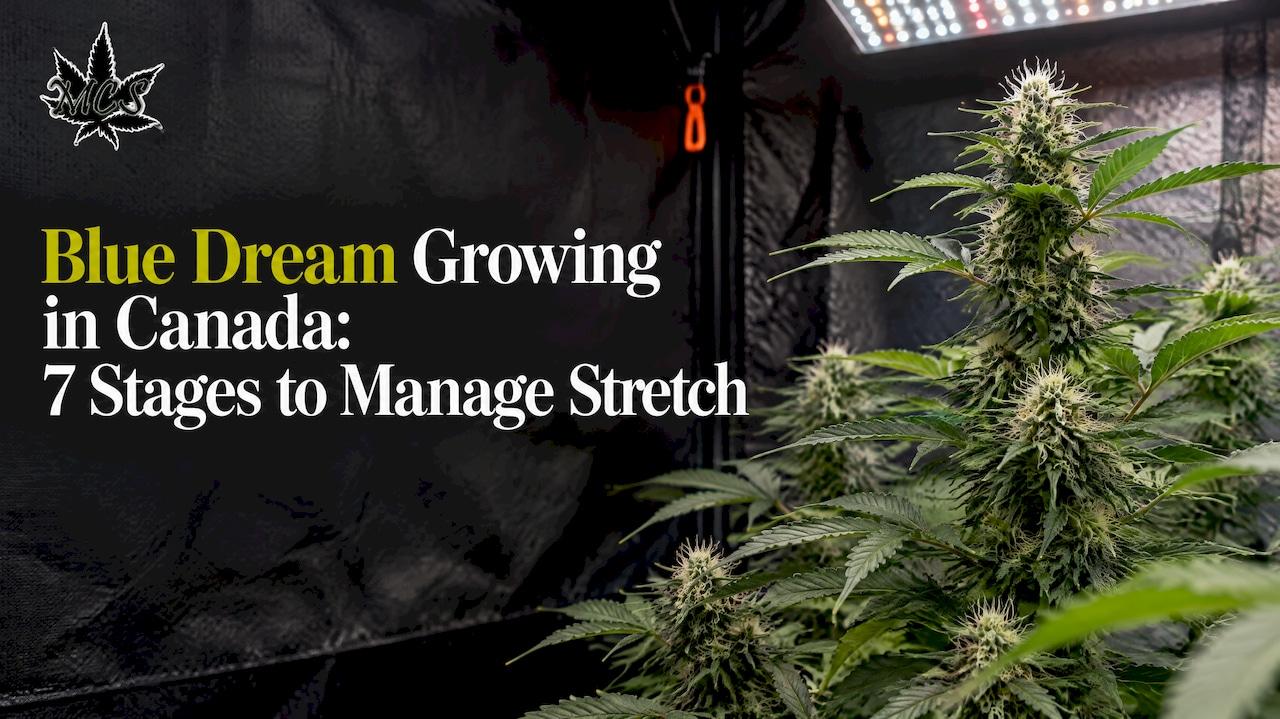
Blue Dream is a reliable, moderately easy to grow, high-yield sativa dominant hybrid that rewards attention during its stretch phase. Photoperiod plants typically finish flowering in 8 to 11 weeks, and the single decision that affects outcomes most is how tightly we manage stretch and airflow once flowering begins.
TL;DR:
- Photoperiod plants usually flower for 8 to 11 weeks, while autoflowers finish in roughly 10 to 12 weeks from seed to harvest.
- Limit vegetative growth to five or six weeks in low tents; Blue Dream can double in height during its first week of flowering.
- Use low stress training during vegetative growth, then thin lightly in early flower and maintain airflow to reduce moisture trapped in dense colas.
- Harvest when most trichomes are cloudy with some amber; clear heads indicate the plant needs more time, while later harvests may reduce aromatic compounds.
- Canadian federal rules cap home cultivation at four plants per household, and provincial rules still apply; use authorized seed sources.
Table of Contents
- Quick Facts and Specs at a Glance
- Week-by-Week Grow Diary: Photoperiod and Autoflower Timelines
- Indoor Setup Essentials Tuned to Blue Dream
- Outdoor Growing Notes and Climate Considerations
- Harvest Expectations and Basic Post-Harvest Pointers
- Common Blue Dream Issues and Quick Troubleshooting
- Why Dino Grow Master Recommends MCS for Blue Dream Seeds
- Who Blue Dream Suits and Who Should Look Elsewhere
- Get Blue Dream Seeds Built for Reliable Germination
- FAQ
- Sources
Quick Facts and Specs at a Glance
Blue Dream traces its lineage to a Blueberry and Haze cross, which explains its sativa leaning structure and the long internode spacing growers notice during the stretch phase. Indoors, photoperiod plants generally flower for 8 to 11 weeks, while outdoor harvests tend to land in late September through October depending on latitude and local daylight patterns.
- Genetics: sativa dominant hybrid (Blueberry x Haze lineage)
- Indoor flowering: roughly 8 to 11 weeks
- Outdoor harvest: typically late September to October
- Height: tall, with pronounced vegetative and early flower stretch
- Yield: moderate to high, with final numbers shaped by light, training, and pot size
Under federal rules, adults may grow up to four cannabis plants per household, and seeds should come from legal or authorized sources while growers follow their province's specific rules. That ceiling matters for planning: with only four plants permitted, getting veg length and training right on each one counts for more than it would in a commercial setup.
Week-by-Week Grow Diary: Photoperiod and Autoflower Timelines
A representative photoperiod run gives us a useful map, even though every tent and every light produces its own variations.
- Weeks 1 to 3 (vegetative): seedlings establish roots and first true leaves; keep lights on an 18/6 schedule and resist feeding at full strength too early.
- Weeks 4 to 6 (late veg): this is where final plant size gets decided. A longer veg period produces a taller plant with more bud sites, so growers working in limited vertical space may want to flip to 12/12 by week 5 or 6.
- Week 1 of flower (stretch begins): expect the most dramatic height gain here, often doubling or more. This is the window where airflow and support structures matter most.
- Weeks 2 to 3 of flower: stretch slows, and pistils emerge at bud sites. Nitrogen needs begin dropping as phosphorus and potassium needs rise.
- Weeks 4 to 6 of flower: bud sites fill in and colas start to take visible shape. This is a good checkpoint for light defoliation if lower growth is shading bud sites.
- Weeks 7 to 9 of flower: trichome production accelerates and aroma intensifies. Watch for amber trichomes starting to appear among the mostly cloudy heads.
- Weeks 9 to 11 of flower: final ripening. Trichome color and pistil color guide harvest timing more reliably than the calendar at this point.
Seedbank grow diaries consistently show Blue Dream finishing near the 10-week mark when vegetative size and light intensity are well matched, though total grow length including veg can stretch past 15 weeks for growers who extend vegetative time for a larger finished plant.
Pro Tip: Log stretch height weekly during the first two weeks of flower. If a plant doubles in height by week two, flip earlier next time to keep it within your tent's ceiling.
Autoflower versions of Blue Dream skip the photoperiod switch entirely, running on an internal clock from seed to harvest in roughly 10 to 12 weeks total. That compressed timeline suits growers with shorter available grow windows or those who want a second or third harvest in the same season. For a fuller breakdown of how photoperiod, autoflower, and fast versions compare on timing and yield trade-offs, that comparison is worth reading before choosing a seed type.
Indoor Setup Essentials Tuned to Blue Dream
Blue Dream's stretch and sativa-leaning structure call for setup choices that differ from a compact indica run.
- Light intensity: aim for strong light delivery through flower, since cumulative supplemental lighting has been shown to increase flower yield and water-use efficiency as totals rise, though very high cumulative light can shift terpene concentrations in some programs.
- Pot size: match container size to veg length. Plants vegged past four weeks generally need larger pots (think 5 to 7 gallon range) to support the root mass that drives Blue Dream's above-average yield potential.
- Nutrients: taper nitrogen as flowering begins and lean into phosphorus and potassium support; heavy late-flower nitrogen tends to delay ripening and can affect final flower density.
- Training: low stress training during veg and a single round of light defoliation in early flower typically produce the most even canopy without stressing the plant during its sensitive stretch window.
- Environment: target temperatures in the mid-70s Fahrenheit during flower with relative humidity stepped down through the cycle, finishing lower in late flower to support dense bud development and reduce rot risk.
Outdoor Growing Notes and Climate Considerations
Outdoor Blue Dream responds strongly to daylength, so timing the start of the season correctly keeps flowering on schedule rather than letting the plant run too long into fall.
- Planting window: start after the last frost risk passes in temperate climates, giving the plant a full season of natural light before days shorten enough to trigger flowering.
- Sun and support: Blue Dream's height and branch spread do well with full sun exposure and benefit from staking once buds add weight to the colas.
- Pest and mildew exposure: outdoor plants face more variable humidity and open-air pest pressure than indoor setups, so good airflow between plants and routine checks on dense bud clusters reduce mold risk.
- Photoperiod versus autoflower outdoors: photoperiod Blue Dream suits growers with a long, stable season, while autoflower versions make more sense in shorter or less predictable climates where a fixed, shorter timeline reduces risk.
Harvest Expectations and Basic Post-Harvest Pointers
Trichome color is the most reliable harvest signal for Blue Dream: a mostly cloudy trichome head with a modest amount of amber generally signals peak readiness, while mostly clear trichomes mean the plant needs more time.
- Trichome cues: clear means early, cloudy means near peak, amber signals a shift toward more sedating effects.
- Yield range: flowering duration and light intensity are significant predictors of final yield, and Blue Dream's moderate to high yield potential depends heavily on both factors staying dialed in through the full cycle.
- Harvest timing and quality: pulling slightly earlier tends to preserve a brighter terpene profile, while waiting longer shifts the effect profile and can reduce some aromatic compounds.
For the drying and curing steps that lock in flavor and potency after the chop, our drying and curing guide covers the process in detail rather than repeating it here.
Common Blue Dream Issues and Quick Troubleshooting
Blue Dream's dense colas and vigorous growth create a few predictable friction points worth watching for.
- Bud rot risk: dense colas trap moisture, so thinning lower growth and maintaining steady airflow through the canopy before week 6 of flower meaningfully lowers rot risk.
- Nutrient lockout signs: yellowing that doesn't match a clear deficiency pattern often points to pH drift rather than a missing nutrient, so check runoff pH before adding more feed.
- Stretch-driven canopy problems: if one run stretches past the tent's usable height, shortening vegetative time by a week or two on the next run usually solves it.
Pro Tip: Check runoff pH before changing feeding ratios. A lockout symptom that looks like a deficiency is often a pH problem in disguise.
For issues beyond quick fixes, our broader grow troubleshooting content on the blog walks through more complex diagnostic steps.
Why Dino Grow Master Recommends MCS for Blue Dream Seeds
This guide draws on years of hands-on cannabis cultivation experience, including multiple Blue Dream runs tracked from seed to harvest. We stand behind Montreal Cannabis Seeds (MCS) as a dependable source because every seed we sell comes with a germination guarantee and support from a team that understands Canadian growing conditions. For legal sourcing steps, our buying guide for Canadian growers covers what to check before placing an order, and our support team is available for strain-specific questions.

Who Blue Dream Suits and Who Should Look Elsewhere
Blue Dream fits growers with some prior experience who want strong yields and a sativa-leaning effect without the steepest learning curve. Beginners short on space or time, or anyone facing a compressed outdoor season, often get a smoother result from an autoflower or fast-version strain instead. The trade-off is straightforward: Blue Dream asks for a bit more patience during stretch in exchange for a notably generous harvest.
— Dino Grow Master
Get Blue Dream Seeds Built for Reliable Germination
We carry Blue Dream feminized seeds for growers who want the classic photoperiod timeline described above, along with an autoflowering Blue Dream option for shorter grow windows.

- Every seed order ships with our germination guarantee.
- Our support team answers strain-specific questions before and after your order.
- Our legal sourcing guide walks through what to check before buying seeds anywhere in Canada.
Browse our full seed catalog to find the Blue Dream variant that matches your space, season, and timeline.
This article is general information, not a substitute for advice from a qualified lawyer. Consult a qualified legal professional about your own circumstances before acting on anything here.
FAQ
How easy is Blue Dream to grow?
Blue Dream suits growers with some prior experience more than first-time growers, mainly because managing its vigorous stretch during early flower takes attention. With proper airflow and training, it performs reliably and rewards the extra care with above-average yields.
Does Blue Dream make you high?
Yes, Blue Dream is a THC-dominant strain grown for its psychoactive effects alongside a sativa-leaning profile. Effects and intensity vary by plant, growing conditions, and harvest timing, so exact potency isn't a fixed number.
Is Blue Dream an upper or downer?
Blue Dream is generally considered more uplifting and energetic than sedating, consistent with its sativa-dominant genetics. Effects vary by individual and by how the plant was grown and harvested.
Is Blue Dream an indica or sativa?
Blue Dream is a sativa-dominant hybrid, bred from a Blueberry and Haze cross. That heritage shows up in its tall growth structure and pronounced stretch during flowering.
Sources
- Canada
- Home cultivation across Canadian provinces after cannabis legalization - PMC
- Vegetative and reproductive stage lighting interactions on flower yield, water use efficiency, terpenes, and cannabinoids of Cannabis sativa | Scientific Reports