
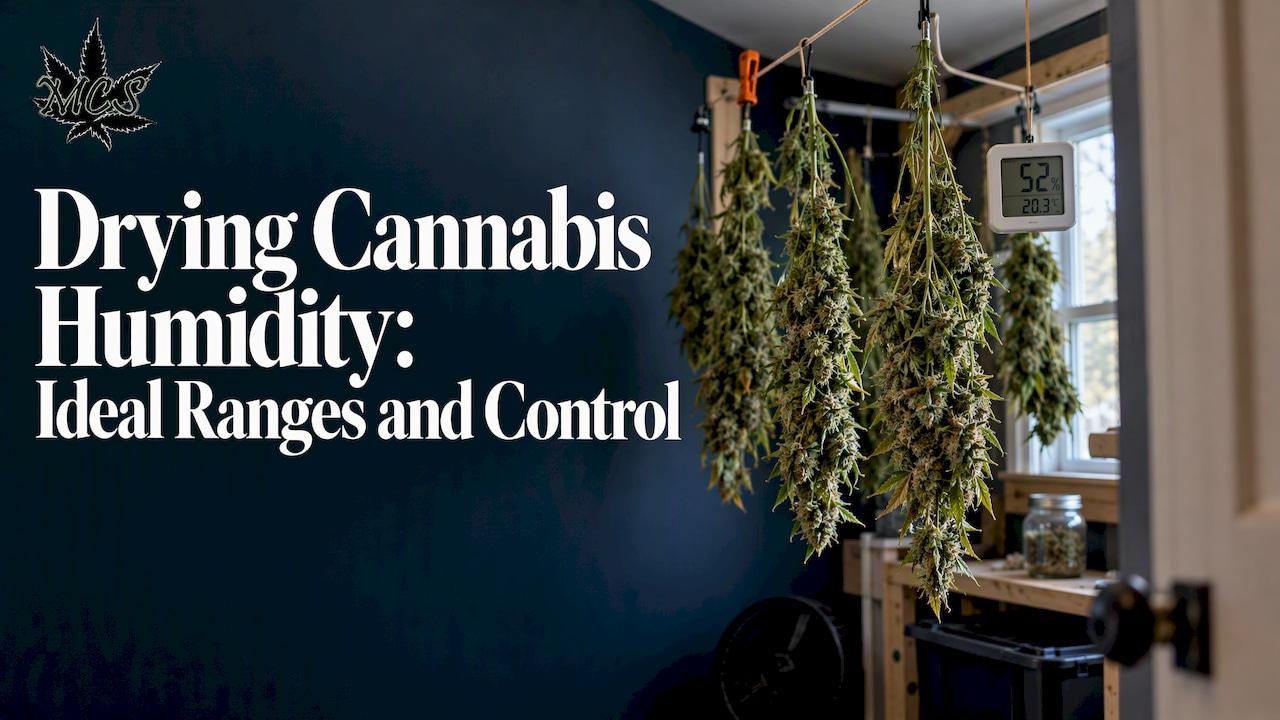
For most home growers, the best humidity for drying cannabis is a relative humidity (RH) of roughly 50% to 60% at about 15 to 21°C (60 to 70°F), held steady for five to seven days. Published guidance clusters around that band: one cultivation consultancy cites 50 to 55% RH early in the dry, settling near 60 to 62% as the buds approach the curing stage. Below that band, aroma is lost. Above roughly 65%, mold becomes a realistic threat. This article covers the numbers, the reasons behind them, and the practical ways to hold them in a Canadian house, where outdoor air swings from damp autumn to bone-dry January.
The store blog already covers the wider drying and curing process. This guide narrows in on one variable, humidity, because it is the one that most often decides whether a good harvest stays good.
TL;DR
- Aim for 50 to 55% RH and 15 to 21°C during the first days of drying, then let the room settle near 60% as the stems begin to snap.
- Below about 50% RH, buds dry too fast and lose volatile terpenes; above about 65%, the risk of Botrytis and Aspergillus rises sharply.
- Water activity, not the snap test alone, is the better measure of stability, and a steady room at 60% RH is the practical proxy for it.
- A dehumidifier, gentle air movement and a calibrated hygrometer matter more than any single number.
- Genetics matter too: dense, mold-prone plants need tighter control than airy, resistant ones.
Table of Contents
- Why humidity decides the outcome
- Moisture content versus water activity
- Humidity targets by stage
- Temperature and humidity work as a pair
- Controlling humidity in a Canadian home
- Spotting trouble early
- Does burping jars still matter?
- How genetics affect humidity risk
- Our perspective
- Choosing seeds that suit a damp or dry harvest
- A simple humidity routine to follow
- FAQ
- Sources
Why humidity decides the outcome
Freshly harvested flower is mostly water. One analysis of drying and storage conditions notes that fresh cannabis inflorescences hold roughly 78 to 80% moisture, and that this high moisture content leads to rapid deterioration of valuable secondary metabolites if it is not managed. Drying is therefore a race with two competing risks.
The first risk is speed. If water leaves the bud too quickly, the outside dries while the inside stays wet, chlorophyll breaks down unevenly, and volatile terpenes evaporate along with the moisture. The result is hay-like aroma and harsh smoke.
The second risk is time. Wet plant tissue is an ideal home for yeast and mold. Plant pathology research from the University of British Columbia, published in Frontiers in Microbiology, found that total yeast and mold levels in high-THC flower are influenced by genotype, environment, and both pre- and post-harvest handling. Buds that look spotless at harvest can still carry latent fungal populations, so drying works as an active pathogen-control stage rather than a passive waiting period.
Relative humidity sits between those two risks. It governs how fast water leaves the plant and, once the room stabilizes, how much water stays behind.
Moisture content versus water activity
Two terms are often confused. Moisture content is the total amount of water in the flower. Water activity (aw) measures how much of that water is free to support chemical reactions and microbial growth. Two samples can share the same moisture content and behave differently on the shelf.
The Dr. Greenhouse article explains that the ASTM International Cannabis Committee recommends water activity between 0.55 and 0.65 during drying and curing, which corresponds to an equilibrium RH of 55 to 65%. The practical consequence is simple: by controlling the room's relative humidity, a grower controls the water activity of the flower. Most common spoilage molds need water activity above roughly 0.65 to 0.70 to thrive, while a value around 0.60 to 0.62 is low enough to hold them back and high enough to keep terpenes in place.

That is why the snap test, bending a stem to see whether it cracks, is a useful signal but a poor measurement on its own. It reflects how the stem feels, not how much free water the bud holds. A stable 60% RH environment does the more important work.
One regulatory detail is worth knowing. The same source notes that Health Canada has required 9% moisture content at the end of drying, a figure many practitioners consider low, while growers commonly target 11 to 14%. That requirement applies to licensed producers. A home grower is not bound to hit a lab number, but the debate confirms the point: over-drying is a real quality problem, not a safe default.
Humidity targets by stage
The ranges below combine the research figures with the consensus of grower guidance. Treat them as a starting plan, then adjust to the room and the strain.
| Stage | Typical timing | Target RH | Target temperature | What to watch |
|---|---|---|---|---|
| Initial dry | Days 1 to 3 | 50 to 55% | 15 to 21°C (60 to 70°F) | Heavy moisture release; mold risk highest |
| Slow dry | Days 4 to 7 | 55 to 60% | 15 to 21°C (60 to 70°F) | Small stems begin to snap, outer buds feel dry |
| Stabilizing | After stems snap | 60 to 62% | 18 to 20°C | Equilibrium; stop active drying |
| Storage | Weeks onward | 58 to 62% inside the container | Cool, dark | Stable readings, no condensation |
The 15 to 21°C range and the 5 to 7 day window come from the Dr. Greenhouse review of drying science, which also reports a final equilibrium of 60 to 62% for curing. A McGill University thesis on post-harvest processing, Optimizing post-harvest processing of cannabis for smokable products, points to 62% RH as a balance between reducing microbial risk and avoiding the harshness of over-dried product.
Is 60% humidity too high?
Not for the later stages. Sixty percent is the figure that repeatedly appears as the settling point. In the first 48 hours, though, a room at 60% or above slows drying when the plant is releasing the most water, which is exactly when airflow and dehumidification are most valuable. Early in the dry, the lower end of the range is safer.
Is it a problem if humidity falls below 50%?
It can be. The research summary above ties readings below 50% to rapid desiccation, which evaporates terpenes and produces harsh smoke. In a Canadian winter, heated indoor air frequently sits well under 40% RH, so a drying space in an unhumidified house may need a small humidifier or a closed, insulated tent to slow the process.
Temperature and humidity work as a pair
Relative humidity is relative to temperature. Warm air holds more water, so the same amount of moisture reads as a lower percentage at 24°C than at 16°C. A room that shows 55% RH at 21°C will read higher if it cools overnight to 15°C, even though no water was added.
Two practical effects follow. A warm room dries buds faster, and speed above the target window costs aroma. A cold room, with RH creeping toward 65% overnight, invites mold. Stability across the full day matters more than a perfect reading at noon. For that reason, a drying space inside the heated part of the house, away from exterior walls and basement floors that cool unevenly, tends to behave better than a garage or shed in October.
The research on cultivar-specific drying approaches for medicinal cannabis evaluated controlled-atmosphere drying chambers precisely because stable conditions help preserve cannabinoids and terpenes. A home grower cannot replicate a laboratory chamber, but a small tent or closet with a monitored sensor imitates its logic.
Controlling humidity in a Canadian home
Outdoor conditions across Canada vary by season. Autumn harvests in much of the country arrive with damp, cool air, so dehumidification is the usual need. Winter harvests, common for indoor growers, bring the opposite problem of dry air.
When to use a dehumidifier
A dehumidifier is the most reliable tool for a damp season. The McGill research summary notes that moisture release is heaviest in the first 48 hours, so the strongest dehumidification belongs at the start and can taper off as the dry slows. The Dr. Greenhouse article points out that dehumidification becomes especially important when ambient humidity runs above about 60%. Keep the unit's airflow from blowing directly onto the buds, because a direct stream dries the surface unevenly.

Air movement without direct drafts
Gentle circulation prevents pockets of stagnant, humid air around dense colas. Plant pathology guidance on hang-drying suggests that air movement is essential to lower tissue water activity quickly enough to outpace microbial reproduction, and that the first 72 hours are the riskiest because the foliage can release a spike of airborne spores. A small fan pointed at a wall or the ceiling, so the room air moves without hitting the flowers, is the usual approach. A carbon filter on an exhaust helps keep odour contained, which matters for discretion in shared housing.
Raising humidity when the air is too dry
If a winter room sits below 45%, options include a small humidifier on a timer, a tray of water placed away from the plants, or reducing ventilation. Raise humidity gradually and recheck after an hour. Overcorrecting is a common way to push the room from too dry straight into mold territory.
Choosing and checking a hygrometer
The numbers above only help if the sensor is honest. According to a humidity-control FAQ from a curing-pack manufacturer, inexpensive consumer hygrometers can be inaccurate for the precision that drying and curing demand, and a salt-solution check is the usual way to calibrate them. Because that source also sells humidity products, it is best used for the calibration method rather than product advice.
A simple salt test works as follows:
- Place a tablespoon of table salt in a bottle cap and add a few drops of water until it forms a damp slurry, not a puddle.
- Put the cap and the hygrometer together inside a sealed zip bag or jar, away from sunlight, for several hours (many guides suggest eight or more).
- A saturated sodium chloride solution holds the air at about 75% RH, so the reading shows how far the sensor is off.
- Apply that offset mentally to future readings, or replace a unit that is far off.
Two sensors in different corners of the room give a better picture than one. A reading taken near the intake and another beside the buds will often differ by several points.
Spotting trouble early
Signs that humidity is wrong tend to show within the first few days.
- Too humid: a musty or grassy smell that does not fade, stems that bend instead of snapping after a week, damp spots inside dense buds, grey fuzz or white webbing.
- Too dry: crisp, crumbly outer buds within two to three days, a sharp hay smell, brittle stems, and little aroma when a bud is broken apart.
- Uneven: dry outside, damp core. This usually follows a fast dry and calls for a slower, cooler, steadier room, not more heat.
Buds showing grey mold or fuzzy growth should be discarded. Smoking or ingesting mold-contaminated flower can be harmful, and anyone with a respiratory condition or a weakened immune system should be especially careful and speak to a physician or pharmacist about the risk. Cannabis that looks borderline is not worth the gamble.
Does burping jars still matter?
Opening jars daily to release moisture is a long-standing habit. The McGill study, as summarized in the research provided, found no significant difference in moisture content, cannabinoids or terpene stability between manually burped samples and those sealed with stable humidity control at 62% RH. The implication: once the flower has reached equilibrium, repeated opening adds handling without clear benefit, and a stable container environment does the job.
That does not make the first days of jar storage careless. If buds go into a container while still too wet, a high reading will appear within hours. In that case, the better fix is to return them to the drying room for a day or two, not to rely on burping alone.
How genetics affect humidity risk
Not every plant presents the same problem. Dense, resinous buds trap moisture deep inside and need slower, better-ventilated drying. Looser, more open structures release water more evenly. The Frontiers study mentioned earlier found that genotype influences yeast and mold levels, which suggests that strain choice is the first line of defence long before harvest.
Growers in humid regions, or anyone who has lost a crop to mold, can read the store's guide to mold-resistant strains for successful growing. Fast-finishing plants are another option for damp autumns, because harvest comes before the coldest, wettest weeks. Autoflowering plants are covered in what autoflower means.
Our perspective
At Montreal Cannabis Seeds, we sell seeds chosen for Canadian conditions, and we hear the same story from growers each fall: the plant did everything right, then the drying room let it down. A tidy harvest in a basement at 70% RH can lose weeks of work in 72 hours.
Our view is that humidity management starts before germination. Selecting genetics suited to the climate, spacing plants for airflow, and planning the harvest window around the weather all reduce the humidity problem the grower will face later. A dense, late-finishing plant in a damp region asks for a great deal of equipment. A well-matched strain asks for less.
We also advise treating the drying room like part of the grow, with its own sensor, its own notes and its own routine. Logging RH and temperature twice a day for a week teaches more about a specific house than any chart. Our support team can discuss which of our feminized, autoflower and fast-version lines suit a particular harvest window, and our germination guarantee exists so that the crop begins from reliable footing.
— Dino Grow Master
Choosing seeds that suit a damp or dry harvest
A grower with a cool, humid basement and a grower with a heated, dry apartment have different needs. For readers selecting genetics with the harvest season in mind, these categories are the usual starting points:
- Fast version seeds are photoperiod genetics that finish sooner, which can help bring a harvest ahead of the wettest weeks of autumn.
- Autoflower seeds finish on their own schedule indoors and out, which suits smaller drying spaces because plants are typically compact.
- Feminized seeds remove the need to cull males and give a predictable number of flowering plants, so the drying space can be planned in advance.
Every product page carries detailed strain information, and shipping across Canada is fast and discreet. The full catalog, including the Quebec line, is on the Montreal Cannabis Seeds home page.
A simple humidity routine to follow
- Before harvest: clean the drying space, test and calibrate the hygrometer, and set up the dehumidifier or humidifier. Run the room for a day to see where it settles.
- Harvest day: trim away large fan leaves and hang branches with space between them. Crowded hanging creates humid pockets.
- Days 1 to 3: hold 50 to 55% RH at 15 to 21°C, with gentle air movement and darkness. Check twice a day.
- Days 4 to 7: allow RH to rise to about 58 to 60% as the water release slows. Test small stems for a snap, not a bend.
- Stabilizing: move trimmed buds into containers filled about two-thirds, with a calibrated sensor inside. Aim for 60 to 62% RH.
- First week of storage: check readings daily. A reading above 65% means the buds need further drying; below 55% means they went in too dry.
- Long term: keep containers cool and dark, and check them weekly at first, then monthly.
Record each reading. A paper log of date, RH, temperature and smell takes seconds and makes the next harvest easier.
FAQ
What is the ideal humidity for drying cannabis?
Most guidance points to 50 to 55% RH in the first days, then 58 to 62% as drying slows. The common temperature range is 15 to 21°C. The goal is a gradual dry over about five to seven days that ends with a stable, mold-resistant equilibrium.
Should a dehumidifier be used when drying cannabis?
Yes, in many Canadian homes, especially in autumn or in basements where ambient RH exceeds 60%. The first 48 hours release the most moisture, so that is when a dehumidifier does the most good. Once the dry slows, it can run less often to avoid over-drying.
Is 75°F too hot for drying cannabis?
It is on the warm side. At about 24°C, buds dry faster and lose more aroma, and RH readings drop unless moisture is added. Staying within 15 to 21°C (60 to 70°F) gives a slower, more flavourful result.
Is 60% humidity too high for drying cannabis?
Not as a settling point. Around 60% is the range most sources associate with a stable, safe equilibrium. It is less suitable for the first 48 hours, when a drier room of about 50 to 55% moves water out of the buds more quickly and lowers mold risk.
Should cannabis be completely dry?
No. Bone-dry flower has lost terpenes and burns harshly. The target is a controlled residual moisture that corresponds to water activity near 0.60 to 0.62, not zero water.
Sources
- Drying Cannabis: Is There a Science Behind the Art? (Dr. Greenhouse)
- Optimizing post-harvest processing of cannabis for smokable products (McGill)
- Total yeast and mold levels in high THC-containing cannabis inflorescences (Frontiers in Microbiology)
- The influence of drying and storage conditions on the volatilome and cannabinoid content (PMC)
- Cultivar-Specific Drying Approaches for Medicinal Cannabis (PMC)
- Integrated Management of Pathogens and Microbes in Cannabis under Greenhouse Conditions (PMC)
- Cure Puck FAQ