
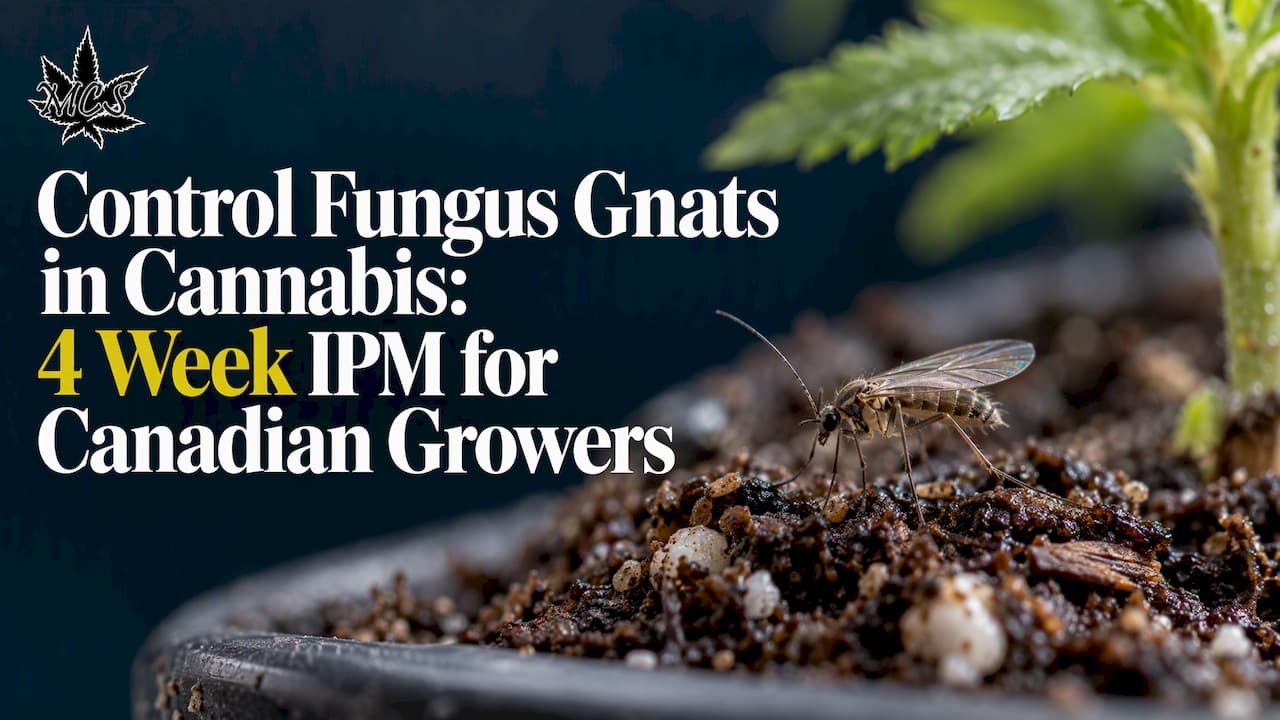
Fungus gnats threaten cannabis primarily through their larvae, which feed on fine root hairs and open the door to root pathogens, while the adults you see hovering over the soil are mostly a nuisance that signals a larval population underneath. The first move is monitoring with yellow sticky cards, letting the top 1 to 2 inches of growing medium dry between waterings, and starting a larval treatment such as a Bti drench or beneficial nematodes while cleaning up any spilled media nearby.
TL;DR:
- Keeping the top 1 to 2 inches of growing media dry between waterings can significantly reduce fungus gnat larvae survival and population growth.
- Using yellow sticky cards weekly alongside potato or carrot slices every 3 to 5 days provides effective monitoring of adult and larval activity.
- Biological controls like Bti drenches every 5 to 10 days or nematodes lasting 10 to 14 days are essential; handling products properly boosts their effectiveness.
- Combining cultural controls, such as improving drainage and sanitation, with targeted larval treatments prevents recurrence more reliably than relying solely on biological agents.
- Multiple treatment cycles are necessary to fully break the gnat life cycle, as adult females continue laying eggs in moist soil until conditions are changed.
Table of Contents
- What fungus gnats are: life cycle and identification for growers
- Signs of fungus gnat damage on cannabis plants
- Monitoring and diagnosis: traps, larval checks, and thresholds
- Prevention and cultural controls: the foundation of IPM
- Biological controls: Bti, nematodes, predatory mites and beetles, and how to use them correctly
- Quick treatments and a sample staged control plan
- Practical application notes and grower-tested handling tips
- A pragmatic checklist for beating fungus gnats
- FAQ
- Sources
What fungus gnats are: life cycle and identification for growers
Adult fungus gnats are small, dark, mosquito-like flies about 2 to 4 millimeters long with long legs, a slender body, and a distinctive Y-shaped wing vein pattern visible under magnification. They fly weakly and tend to run across the growing medium or crawl up pot sides rather than flying far, which is why you often see them clustered near the soil surface instead of buzzing around the canopy.
The larvae are the stage that actually damages your plants. They are legless, translucent to whitish worms with a visible black head capsule, typically growing to about 5 to 6 millimeters, and they live exclusively in the top layers of moist growing media, where they feed on fungi, organic matter, and plant roots.
The full life cycle from egg to adult runs through four stages: egg, larva, pupa, and adult. Depending on temperature, a complete generation can finish in a few weeks, and because adult females lay eggs directly into moist media, populations can build quickly under favorable conditions. The larval stage is the one that matters most for crop protection, since that is when feeding damage and pathogen transmission actually happen; adults mainly reproduce and alert you to the problem.

Shore flies are commonly confused with fungus gnats but look and behave differently: they have shorter, stockier bodies, hold their wings flatter, and fly with more vigor. Shore fly larvae also feed on algae rather than roots, so confirming which insect you are dealing with changes which control strategy makes sense.
Signs of fungus gnat damage on cannabis plants
Seedlings and young clones are the most vulnerable stage in a cannabis grow room. Larval feeding on fine root hairs shows up as stunted growth, yellowing lower leaves, and wilting even when the medium still feels moist, because the damaged root system can no longer take up water efficiently. Cuttings that should be rooting often fail to establish, and seedling losses can climb quickly if larval populations go unchecked during that fragile early window.
In mature plants, the symptoms are subtler. Vigorous, well-rooted cannabis can tolerate a modest larval population without visible stress, so a few adults hovering near the pot surface are often just a nuisance rather than a sign of economic damage. The distinction matters: adults alone rarely justify aggressive treatment, but a rising trap count paired with slowed growth or wilting points to a larval problem worth addressing.
Fungus gnat larvae also create wounds in root tissue that make plants more susceptible to secondary pathogens like Pythium and Fusarium, which cause root rot and damping-off. If you notice a sudden onset of wilting, root discoloration, or a sour smell from the growing medium alongside gnat activity, you are likely looking at a combined pest and disease issue rather than either one in isolation. For a baseline on separating nutrient stress from pest or water-related symptoms, our guide to cannabis deficiencies walks through what deficiency symptoms actually look like.
Monitoring and diagnosis: traps, larval checks, and thresholds
Consistent monitoring is what separates a minor gnat presence from a full infestation, and it starts before you see visible plant damage. Yellow sticky cards placed horizontally at the soil surface are the standard tool for tracking adult activity, since UC IPM identifies them as an effective way to catch adults as they emerge and move across the media.

To check for larvae directly, press a raw potato or carrot slice into the top of the growing medium and leave it for 1 to 2 days; larvae are attracted to the starch and will cluster on the underside when you lift the slice, giving you a direct read on larval density rather than just adult counts.
A workable monitoring routine includes:
- Place one yellow sticky card per several pots or per bench section, checking and replacing cards weekly.
- Press a potato or carrot slice into each problem pot every 3 to 5 days during an active treatment cycle.
- Log trap counts and larval checks by date so you can see whether numbers are rising or falling.
- Treat a sustained increase in trap counts, combined with any larvae on slice checks, as the signal to start or intensify control measures.
Keeping a simple log matters more than most growers expect. Without a record, it is easy to misjudge whether a treatment worked or whether the population simply dipped on its own between checks.
Prevention and cultural controls: the foundation of IPM
Cultural control is the least glamorous part of fungus gnat management and also the most important. According to Clemson's extension guidance, allowing the top 1 to 2 inches of growing medium to dry between waterings is critical to reducing larval survival, since both the larvae and the fungal food sources they rely on depend on consistently moist conditions.
A practical sequence for tightening up cultural practices looks like this:
- Adjust your watering schedule so the surface layer dries visibly before the next watering, rather than watering on a fixed calendar.
- Improve drainage by increasing the perlite or other coarse component in your media mix, which speeds surface drying without stressing roots.
- Consider bottom-watering trays for propagation flats, which keeps the surface drier while still supplying moisture to developing roots.
- Remove spilled media from benches and floors immediately, since loose, moist soil outside of containers is a prime breeding site.
- Eliminate standing water and visible algae growth on trays, saucers, and irrigation equipment, since algae is both a larval food source and a sign of excess moisture.
- Dispose of heavily infested media away from the grow space rather than reusing it.
Physical surface barriers add another layer of protection once the moisture and sanitation basics are in place. A top dressing of coarse sand or expanded materials like Growstones creates a dry barrier that makes it harder for adults to lay eggs successfully, and placing geotextile fabric under benches helps catch spilled media before it becomes a breeding ground on the floor. Clemson's guidance notes that these physical and environmental fixes are a cost-effective complement to biological controls and help prevent reintroduction from media that has already hosted a population.
Pro Tip: Check the moisture of your media with a finger, not a glance. The surface can look dry while the inch below stays saturated, which is exactly where fungus gnat larvae thrive.
Biological controls: Bti, nematodes, predatory mites and beetles, and how to use them correctly
Biological control agents are a core part of fungus gnat management, but they work best when you understand their limits. Bacillus thuringiensis israelensis, or Bti, is a naturally occurring bacterium that produces toxins specific to fly larvae, including fungus gnats, without harming plants or most beneficial insects. According to NC State's HortScans guidance, Bti applied as a drench provides effective larval control and is commonly reapplied at 5 to 10 day intervals, since it does not persist or reproduce in the growing medium.
Entomopathogenic nematodes, specifically Steinernema feltiae, offer a different mode of action: they actively seek out larvae in the media and infect them with a lethal bacterium. Research summarized by UC IPM indicates these nematodes typically act within 1 to 2 days of contact and remain active in moist media for about 10 to 14 days, which gives them a longer working window than Bti before reapplication is needed.
Handling living biological products correctly affects whether they work at all:
- Apply nematodes immediately on receipt rather than storing them for later use.
- Avoid high-pressure sprayers and filters finer than 50 mesh, since both can damage or strain out the organisms before they reach the media.
- Keep the growing medium moist but not waterlogged during and after application to support nematode movement and survival.
- Never mix Bti with copper or chlorine-based fungicides or fertilizers, since those compounds can inactivate the bacterial spores.
Predatory mites and rove beetles, which hunt gnat larvae and pupae directly in the media, tend to perform best in larger propagation trays or greenhouse-style setups with continuous, undisturbed media. In small containers or dense, trichome-heavy cannabis canopies, their mobility and establishment can be inconsistent.
That inconsistency is worth taking seriously. A review published in Frontiers in Agronomy notes that biological control agent efficacy can be reduced in cannabis production compared with other crops, and recommends treating BCAs as one piece of a broader integrated program rather than a standalone fix. Dense glandular trichomes and cannabis's particular growth habit can interfere with how well some natural enemies move through the canopy, so monitor your results rather than assuming any single biological agent has solved the problem.
Quick treatments and a sample staged control plan
Neither approach touches the larvae already in the media, so pair any adult knockdown with a larval treatment.
For larvae, a hydrogen peroxide drench is a fast, low-residue option that kills larvae on contact when poured through the top few inches of media, though it has no residual effect once it dries. A Bti drench offers more lasting suppression on a 5 to 10 day reapplication schedule, while nematodes are the better choice when you want a single application that keeps working for 10 to 14 days without repeat labor.
A practical four-week plan might look like this:
- Week 1: Deploy sticky cards, dry back the surface layer, and apply a Bti drench or nematode application to all affected containers.
- Week 2: Recheck sticky card counts and run a potato slice test; reapply Bti if using that route.
- Week 3: Continue cultural drying and sanitation, reapply treatment if trap counts have not clearly dropped.
- Week 4: Confirm success with low trap counts and no larvae on slice checks before scaling back monitoring frequency.
Pro Tip: Do not judge success after a single treatment cycle. Fungus gnat populations often include overlapping generations, so one application kills existing larvae but not eggs laid just before treatment.
Practical application notes and grower-tested handling tips
Living biological products reward careful handling. Apply nematodes the day they arrive rather than storing them, keep application pressure low, and remove fine filters from your sprayer so the organisms survive the trip into the media.

Compatibility matters just as much as timing. Never combine Bti with copper or chlorine-based fungicides or fertilizers in the same drench, and when you are unsure how two inputs interact, test the mix on a small, expendable batch of plants before treating your whole room.
Crop health plays a quieter role in pest resistance than most growers expect. Vigorous seedlings with strong root systems tolerate minor larval feeding far better than stressed ones, which is one more reason starting with verified, reliable genetics matters. Our grow guides cover supporting cultivation practices that keep young plants ahead of pest pressure from the start.
A pragmatic checklist for beating fungus gnats
The routine that prevents and controls fungus gnats most reliably is dry surface media paired with early, consistent monitoring, not any single spray or biological product. Growers who skip the drying step and rely entirely on Bti or nematodes usually see the population return within weeks.
Three mistakes show up again and again: watering on a fixed schedule instead of checking the media, reusing visibly infested soil without disposing of it properly, and giving up on a biological treatment after one application instead of following the labeled reapplication interval. Each is an easy fix once you recognize it.
Document what you try and when, then adjust based on what your sticky cards and potato slices actually show you. Fungus gnat pressure varies enough by setup that the plan that works in one grow room needs tweaking in another.
— Dino Grow Master
FAQ
How can I get rid of fungus gnats on my cannabis plant?
Start by letting the top 1 to 2 inches of growing medium dry between waterings, since fungus gnat larvae need consistent moisture to survive. Add a larval treatment such as a Bti drench, reapplied every 5 to 10 days according to NC State's guidance, or beneficial nematodes for longer-lasting suppression.
What kills fungus gnats immediately?
Yellow sticky cards and a light pyrethrin surface spray reduce adult numbers quickly when the spray is used exactly as labeled.
Will fungus gnats eventually go away?
Not reliably on their own, since adult females keep laying eggs in moist media as long as conditions favor them. Drying the surface layer and combining cultural sanitation with a larval treatment is what actually breaks the cycle rather than waiting it out.
How can I get rid of fungus gnats on my plants?
The same integrated approach applies across houseplants and cannabis: dry the top of the media, remove standing water and algae, and target larvae with Bti or nematodes rather than only spraying adults. Monitoring with sticky cards and potato slices confirms whether the treatment is actually working.
Sources
- Fungus gnats (UC IPM)
- Integrated pest management strategies for fungus gnats (Clemson LGPress)
- Review: biological control in cannabis (Frontiers in Agronomy)
- Control of fungus gnats in greenhouses with Vectobac (NC State/HortScans)