
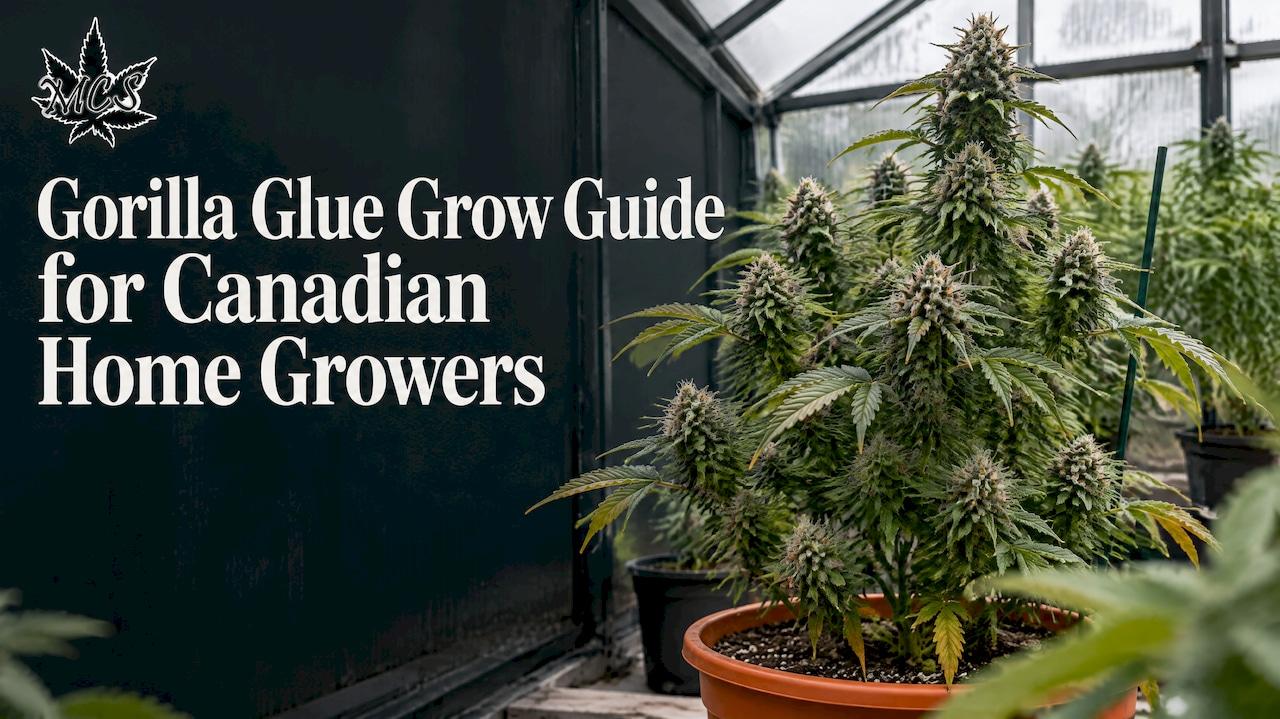
Gorilla Glue, usually sold as Gorilla Glue #4 or GG4, is a vigorous, resin-heavy photoperiod plant that finishes in roughly 8 to 9 weeks of flowering and rewards growers who plan for its height, its appetite and its sticky harvest. It is not difficult in the sense of being fragile. It is demanding in the sense of needing space, headroom and a deliberate drying routine. This guide covers those specifics for Canadian home growers, who work with a four-plant household limit and a short outdoor season.
TL;DR
- GG4 flowers in about 58 to 63 days according to High Times' strain profile, grows medium to tall, and yields medium to high.
- Height is the main problem: the plant stretches after the light flip, so headroom and a canopy plan matter more than any single nutrient.
- A University of Guelph study found that a 13-hour day instead of 12 raised GG4 yield by 1.50 times, so it is worth testing in a controlled room.
- Canadian law allows 4 plants per residence, not per person, so each plant should be a deliberate choice.
- Gorilla Glue Autoflower genetics are available as a shorter, smaller route for growers short on space or season.
Table of Contents
- What Gorilla Glue #4 is and why growers want it
- Before you buy: the four-plant rule
- Choosing a version: photoperiod GG4 or Gorilla Glue Autoflower
- Managing height: the real challenge
- Light, temperature and the 13-hour question
- Feeding and watering a hungry plant
- A realistic timeline for indoor growing
- Growing Gorilla Glue outdoors in Canada
- Harvesting, drying and the sticky trim
- Perspective: how we see Gorilla Glue for Canadian growers
- Gorilla Glue genetics at Montreal Cannabis Seeds
- Common mistakes with Gorilla Glue
- FAQ
- Sources
What Gorilla Glue #4 is and why growers want it
GG4 became known for resin. The name is commonly explained by the way trichomes coat the buds and the leaves so heavily that scissors stick together during trimming. Trichomes are the tiny glandular hairs that carry cannabinoids and aromatic terpenes, and a plant that produces them in quantity gives the grower dense, frosty flowers and a messy trim.
The lineage is usually given as Chem's Sister, Sour Dubb and Chocolate Diesel. Two points are worth knowing before ordering seeds. First, the original plant circulated as a clone, so seed versions are crosses or reworked lines and do not behave like identical copies of that cut. Second, the plant has also been marketed under the name Original Glue, so listings can differ in naming. Pheno variation exists in any seed-grown population, and a first run with several seeds shows what your particular room does with the genetics.
For the grower, the practical profile is consistent across most descriptions. SeedFinder's entry for a feminized GG4 lists a photoperiod plant of medium to tall height, an 8 to 9 week flowering time and above-average yield with dense, resinous buds. High Times' profile gives the same flowering window in days and notes that the plant suits both indoor and outdoor growing, with environmental control especially useful indoors.
Before you buy: the four-plant rule
Before planning a canopy, confirm what the law allows. Under federal rules, adults of legal age may grow cannabis for personal use, subject to provincial, territorial and municipal restrictions. Health Canada's guidance on growing cannabis at home sets the limit at four plants per residence, not per person, and says seeds and seedlings must come from a legal source. The minimum age is 18 or 19 depending on the province, and some provinces add their own conditions, as Ontario's cannabis laws page shows for 19 and over and for sourcing starting material from the provincial retailer.
Provincial rules differ, and some provinces restrict home cultivation more tightly than the federal baseline. Check your province's current page before buying anything. If you hold a medical registration or production licence, different limits apply, and that is a question for Health Canada or your licensed practitioner rather than a seed guide.
Four plants is a useful constraint for a plant like GG4. A tall, high-yielding plant is a good use of a slot, but two tall plants in a small tent can fill the space and leave nothing for a fourth. Decide the number of GG4 plants from the height of the room, not from the number of seeds in the pack.
Choosing a version: photoperiod GG4 or Gorilla Glue Autoflower
The classic GG4 is a photoperiod plant. It stays in vegetative growth under long days and flowers when the light cycle is shortened. That gives control over size, since a grower can keep it in veg until it is the right height for the room. It also means a longer total cycle and a larger final plant.
An autoflower version flowers by age and not by the light schedule, so the plant stays smaller and finishes sooner. For readers deciding between them, our comparison of photoperiod, autoflower and fast version strains covers the trade-offs in depth. In short: choose photoperiod if you have headroom and want the largest harvest from a plant, and choose autoflower if space is tight, you want a short cycle or you are growing outdoors where the season is limited.

Seed type matters too. Home growers working with a four-plant cap generally avoid spending a slot on a male, which is why most buy feminized seeds for a plant like this.
Managing height: the real challenge
The most common warning about GG4 is height. Soft Secrets' growing guide calls the extraordinary height the plant can reach the major challenge for growers and recommends canopy-spreading methods such as SCROG. That advice reflects what most growers experience: GG4 grows fast in veg, then stretches again after the switch to flowering.
A few planning points, kept narrow because we cover training methods in separate posts:
- Measure the room first. Count the distance from the pot rim to the light, then subtract the space the lamp needs. The plant will not stop where you want it to.
- Flip early. Because stretch continues after the flip, many growers start flowering while the plant is well below its final height, rather than waiting until it looks big.
- Plan the canopy before flowering. A flat canopy gives even light on the lower sites and shortens the plant's competition with itself. Training should be finished before flowering, not during it.
- Use a large pot. A big plant with a big root zone is easier to feed consistently than a big plant in a small container.
Outdoors the same logic applies in another form: the plant needs room, support and a position that does not shade neighbours.
Light, temperature and the 13-hour question
In flowering, GG4 handles strong light well, and the ranking guides cluster around the same targets. One cultivation summary suggests daytime temperatures of 70 to 80°F (21 to 27°C) and light intensity of 800 to 1000 µmol/m²/s during flowering. Treat those as a sensible working range rather than a rule, and watch the plant for signs of heat or light stress before pushing intensity.
The more interesting finding is about day length. A 2024 study from the University of Guelph compared 12-hour and 13-hour days on two high-THC indoor cultivars. The Cannabis Research Centre summary reports that GG4 yielded 1.50 times as much flower at 13 hours as at 12, without lower cannabinoid concentrations and without delaying the start of flowering. The researchers suggest that growers experiment in their own environments to see whether a 13-hour day works without disrupting flowering.
A cautious way to apply that:
- Treat it as a test, not a guarantee. The study was conducted in a controlled setting, and your tent, lamp and genetics are different.
- Change one variable at a time. If you run two GG4 plants, a split test is more informative than changing light schedule, feed and pot size together.
- Keep the cycle consistent. Light leaks and irregular timers are the usual causes of flowering problems, so a reliable timer matters at 13 hours as much as at 12.
- Expect a higher electricity cost for the extra hour, and weigh that against any yield gain.
This finding applies to the photoperiod plant. It has no bearing on autoflowers, which do not depend on the light cycle to start flowering.
Feeding and watering a hungry plant
Growers who document GG4 grows tend to agree on one thing: it eats. One home grower's 77-day report on a public forum describes a heavy feeder that needs water daily under a 400 watt light, which gives a flavour of the plant's demand even though it is a single anecdote and not a standard.
What that means in practice:
- Feed in steps. Start with a light dose in early veg and raise it as the plant grows. Large plants in large pots show the first signs of hunger as pale lower leaves, and the fix is a slow increase, not a jump.
- Water by weight. Lift the pot. A heavy pot is wet and a light pot is dry, which is more reliable than a calendar.
- Watch the stretch phase. The first weeks of flower are when demand rises fastest. Under-feeding there costs more than at any other time.
- Do not chase every spot. Leaf symptoms can come from pH, heat, overfeeding or underfeeding. Our guide to cannabis deficiencies helps separate them before you change the recipe.
Soil, fertilizers and bat guano are covered elsewhere on our blog, so this guide stays with the plant-specific points: a heavy feeder responds best to consistency.
A realistic timeline for indoor growing
The table sets out an indicative schedule for a photoperiod GG4 in a controlled room. Flowering length comes from the sources above, while the veg length is the grower's decision.
| Stage | Typical length | What to focus on |
|---|---|---|
| Germination and seedling | 1 to 3 weeks | Gentle light, small pot at first, stable humidity |
| Vegetative growth | 3 to 6 weeks, set by your headroom | Pot size, canopy plan, steady feeding |
| Flip and stretch | Weeks 1 to 3 of flower | Light distance, support, rising feed |
| Bulking and resin | Weeks 4 to 7 of flower | Airflow, stable temperature, resin development |
| Ripening and harvest | Final week or two, 58 to 63 days in total | Trichome check, flush decisions, harvest timing |
The 11-week sprout-to-harvest report mentioned above fits within this pattern for a short veg, and it shows how quickly a vigorous plant can move when it is not held back.
Reading ripeness
Trichome colour is a better guide than the calendar. Under a jeweller's loupe or small microscope, cloudy trichomes indicate peak potency, and amber ones appear as the plant passes it. With a plant this resinous, the trichome heads are easy to see, which makes the check straightforward.
Growing Gorilla Glue outdoors in Canada
GG4 can be grown outdoors, and High Times lists it as suitable for both settings. The Canadian limit is the calendar. A plant that needs 8 to 9 weeks of flowering after the day length shortens has to be started early and sited well to finish before cold, wet autumn weather arrives. That is a consideration in many parts of the country, and it depends heavily on your region.
Some points for a Canadian outdoor GG4:
- Start indoors and move out after the last frost. This extends the season on the front end.
- Choose the warmest, sunniest position. South-facing and sheltered from wind is better than a shaded yard.
- Watch humidity late in the season. Dense, resinous flowers hold moisture, and autumn rain and cool nights raise the risk of mould. Check buds regularly in late flowering.
- Keep an escape plan. If an early frost is forecast, decide in advance whether you will harvest early or protect the plant.
For growers in colder or shorter-season regions, an autoflower is often the more dependable outdoor choice because it does not depend on the shortening days of autumn. Our post on outdoor growing covers site selection and the wider season in detail.
Harvesting, drying and the sticky trim
The resin that gives GG4 its name also shapes harvest day. Scissors and gloves gum up quickly, so keep isopropyl alcohol and a clean cloth nearby, wear gloves, and clean blades as you go.

One grower report advises drying each stem separately, which makes sense for a plant with dense flowers. Branches hung with space between them dry more evenly and give mould fewer places to start. Large, tightly packed buds retain moisture at the core, so airflow and patience matter more here than with a looser plant. The general method of drying and curing is described in a dedicated store post, so the main point for GG4 is to avoid crowding the branches and to check the centre of the densest buds before jarring.
Perspective: how we see Gorilla Glue for Canadian growers
We curate our catalog for Canadian growing conditions, and GG4 is a good example of a plant that rewards that approach. It is a strong performer when the room fits it, and an unforgiving one when it does not. Most of the problems growers report with this plant are not mysteries of genetics. They are mismatches between the plant's size and appetite and the space or schedule it was given.
Our advice to first-time growers is to be honest about headroom before choosing a seed. If you have a tall tent and the patience for a longer cycle, a photoperiod plant gives the most control. If you have a modest space, or a short outdoor season, an autoflower version is a more forgiving place to start. Either way, a four-plant limit means each plant should be chosen, not merely planted.
Because our germination guarantee and support team exist to make a first grow less uncertain, we would rather help a grower pick the right version than sell the largest one.
— Dino Grow Master
Gorilla Glue genetics at Montreal Cannabis Seeds
For growers who want the Gorilla Glue profile in a compact, faster format, we offer Gorilla Glue Autoflower feminized seeds. If you are still comparing, browse our autoflower seeds or read how to buy cannabis seeds in Canada before you order. Seeds ship discreetly across Canada, and our germination guarantee and support team are there if a seed does not start as it should.
Common mistakes with Gorilla Glue
- Underestimating the stretch. The plant keeps growing after the flip. Leave room.
- Using too small a pot. A small root zone limits a plant that is built to be large.
- Changing everything at once. If a problem appears, adjust one variable so you can tell what worked.
- Harvesting by the calendar. Flowering time ranges around 8 to 9 weeks, but the trichomes decide.
- Hanging buds tightly together. Dense buds need airflow to dry safely.
- Overlooking the plant count. Four plants per household is the legal limit, and it is easy to exceed with a few extra seedlings.
FAQ
How tall does Gorilla Glue grow?
GG4 is described as medium to tall, and Soft Secrets flags its height as the main difficulty. Final size depends on veg time, pot size and how much the plant stretches after the light flip. Plan for substantial height and control the canopy before flowering starts.
How long does Gorilla Glue take to flower?
About 8 to 9 weeks, or 58 to 63 days, according to High Times' profile linked above. The exact point of harvest varies with the phenotype and your conditions, so check the trichomes rather than counting days alone.
Can I grow Gorilla Glue outdoors in Canada?
Yes, in principle, but the season is the limit. The plant needs a long flowering period, so a warm, sunny site and an early start are essential, and cold or wet autumns raise the risk of mould. In shorter-season regions, an autoflower version is often the safer outdoor option.
How many Gorilla Glue plants can I grow at home?
Federal rules allow four cannabis plants per residence, not per person, as set out by Health Canada. Provinces and territories add their own conditions, so check your local rules before you buy seeds.
Sources
- Gorilla Glue #4 (GG4): High Times Strain Profile
- GG #4, SeedFinder strain info
- Growing cannabis at home safely, Canada.ca
- Cannabis laws, ontario.ca
- How to Grow Gorilla Glue #4, Soft Secrets
- Longer photoperiod study, PMC
- Longer photoperiod summary, Cannabis Research Centre