
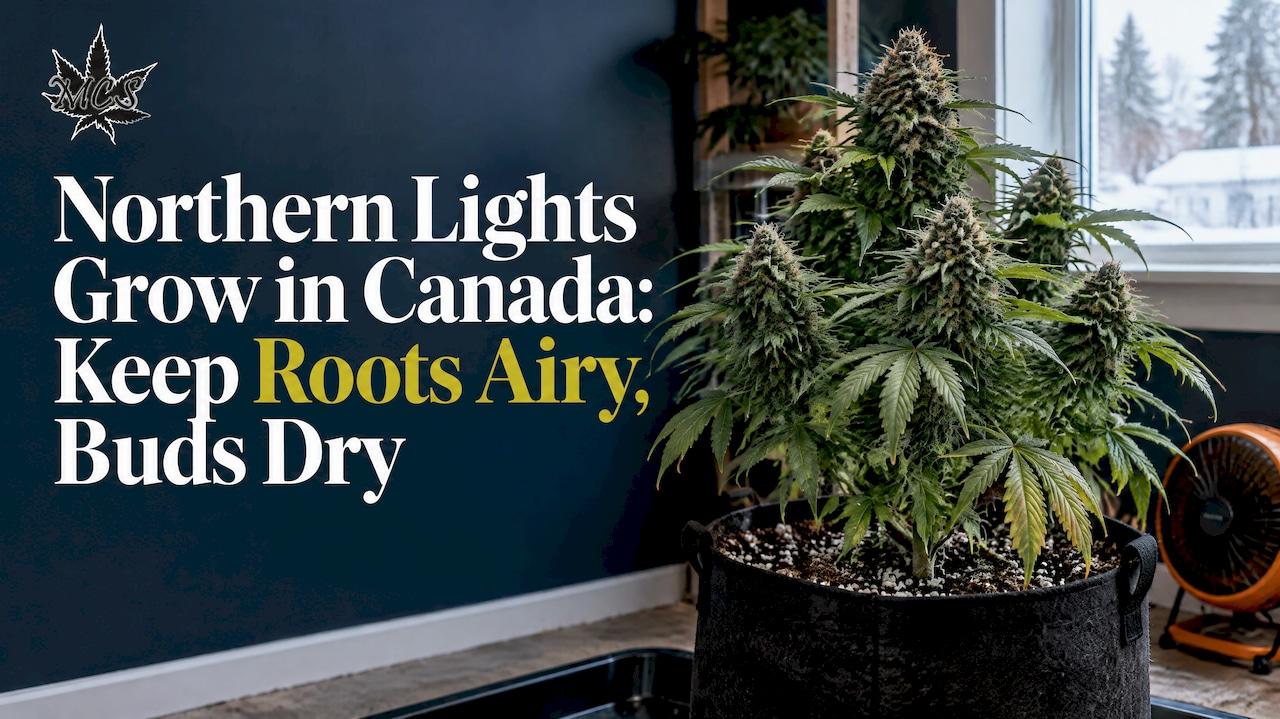
Northern Lights is a manageable strain for most home growers, provided you match the variant, autoflower or photoperiod, to your schedule and stay ahead of two risks the plant creates on its own: dense buds that trap humidity, and a root system that outgrows small containers fast. A small indoor tent with steady ventilation, or a sunny outdoor spot, works well with feminized or autoflower Northern Lights seeds. Size up containers early and plan to drop humidity hard in the final two weeks of flower.
TL;DR:
- For photoperiod plants grown for THC, use a 12 hour light and dark cycle; a 14 hour start may raise biomass but lower potency.
- During flowering, keep temperatures between 18 and 24 degrees Celsius and humidity at 40% to 50%, then below 40% for the final two weeks.
- Use a 5 to 7 gallon final pot for most indoor plants, and let the top inch of growing medium dry before watering again.
- Autoflowers need no light schedule change and usually finish in 8 to 10 weeks, but they yield less per plant than photoperiod plants.
- Canadian adults may grow up to four plants per household for nonmedical use, but some provinces prohibit home cultivation; check local rules before planting.
Table of Contents
- Northern Lights genetics and variants: autoflower, photoperiod, CBD
- Is Northern Lights easy to grow, and who does it suit?
- Choosing seeds and why genetics matter
- Vegetative and flowering light schedules that work
- Temperature, humidity, and mold prevention in late flower
- Containers, root health, and watering strategy
- Nutrients and pH basics for Northern Lights
- Training and canopy management for Northern Lights
- Troubleshooting: quick checks and prioritized fixes
- Flowering time, harvest cues, and realistic yield
- First-hand grower notes and where to get support
- A one-run checklist for Northern Lights success
- Buy Northern Lights seeds and get grow support
- FAQ
- Sources
Northern Lights genetics and variants: autoflower, photoperiod, CBD
Northern Lights built its reputation as an indica-dominant strain with a compact frame, resin-heavy colas, and a flowering period shorter than many classic indicas. That genetic consistency is part of why the strain shows up so often in beginner recommendations: plants from the same line tend to finish at similar heights and times, which makes planning your grow far more predictable.
Variant choice changes the experience more than most new growers expect. A photoperiod Northern Lights gives you control over the vegetative stage, room to train, and a flowering trigger you set yourself. An autoflower version moves faster from seed to harvest and skips light-schedule changes entirely, while fast versions split the difference with quicker photoperiod timelines. CBD Northern Lights keeps the structure and growth pattern of the original line but shifts the cannabinoid profile.
- Want speed and simplicity: choose an autoflower Northern Lights and skip light-schedule changes.
- Want control and training room: choose feminized photoperiod Northern Lights.
- Want a CBD-focused harvest: choose CBD Northern Lights with the same compact growth pattern.
For a fuller breakdown of how these lifecycle types differ, our comparison of photoperiod, autoflower and fast version strains covers the mechanics in more depth.
Is Northern Lights easy to grow, and who does it suit?
Northern Lights earns its easy reputation honestly. The phenotype stays consistent from pack to pack, the plant stays compact without heavy intervention, and the vegetative stage tolerates minor watering or temperature swings better than many sativa-leaning strains. That forgiveness, though, hides two issues that catch new growers off guard in flower.
- Starting in a final-size pot that's too small. Northern Lights pushes roots aggressively, and a cramped container stalls growth by mid-flower.
- Trusting self-watering systems without checking root moisture. Constant saturation starves roots of oxygen even when the topsoil looks dry.
- Letting humidity climb during the last two weeks. Dense colas trap moisture and invite bud rot.
- Reacting to yellow leaves with a nutrient boost. Often the real cause is a soggy or oxygen-starved root zone, not a deficiency.
Pro Tip: Before you adjust feed strength for yellowing leaves, check soil moisture at the root ball, not just the surface.
Choosing seeds and why genetics matter
A reliable product page tells you most of what you need before the seed ever touches soil. Look for a clear feminized or autoflower label, a stated flowering window, notes on phenotype expression, and some form of germination support.
- Variant label: confirms whether you're growing on a light schedule or on autopilot.
- Flowering time: sets your harvest planning from day one.
- Germination guarantee: signals the breeder stands behind viability.
- Support access: matters when a question comes up mid-grow.
Genetic consistency is what turns a strain description into a reliable plan. When a line is stable, you can predict height, flowering length, and resin development with reasonable confidence instead of guessing. Our Northern Lights Autoflower listing includes flowering time, phenotype notes, and germination backing, which gives you that baseline before you commit a growing season to it.
Vegetative and flowering light schedules that work
Most growers run Northern Lights on an 18-hour light, 6-hour dark schedule through veg, though some push to 24 hours of light to speed early growth. Either works for a compact plant like this one; the difference shows up mainly in electricity use, not final size.
Flowering conventionally starts with a hard switch to 12 hours light, 12 hours dark. A controlled photoperiod study found that starting flower with a 14-hour photoperiod increased flower biomass in tested varieties, including a Northern Lights line, but that 12L:12D produced the highest THC concentration in high-THC genetics. For THC-focused Northern Lights grows, 12/12 remains the safer default; a 14-hour early-flower trial can raise yield for growers willing to accept some variability in potency.
- Veg: 18 hours light is standard; 24 hours is an option for faster early growth.
- Flower: 12L:12D is the proven standard for THC concentration in high-THC lines.
- Autoflowers: skip the schedule change entirely; continuous long light (18 to 20 hours) is safe throughout the lifecycle.
Indoor growers aiming for strong, even canopy development generally target a daily light integral in the mid-to-upper range for flowering cannabis, adjusting fixture height and intensity as the canopy fills in.
Temperature, humidity, and mold prevention in late flower

During flowering, aim for 18 to 24 degrees Celsius and relative humidity between 40% and 50%, dropping below 40% during the final two weeks before harvest.
Dense, resin-heavy colas, the strain's signature trait, also create a microclimate risk. Moisture gets trapped inside tightly packed buds, and that trapped humidity is what feeds botrytis, or bud rot, from the inside out. A musty smell or a soft spot inside a cola is an early warning sign worth checking immediately.
- Airflow: an inline exhaust fan paired with an oscillating fan keeps air moving through the canopy, not just around it.
- Exchange rate: aim for enough exhaust capacity to fully replace tent air every few minutes during flower.
- Dehumidifier or AC mode: run one during the final two weeks to hold RH below 40%.
Pro Tip: Check the center of your densest cola with a probe thermometer-hygrometer, not just the room reading, since internal bud humidity often runs higher than ambient air.
Containers, root health, and watering strategy
Northern Lights builds a dense, vigorous root system, and that vigor becomes a liability the moment the container can't keep up. Undersized pots or an over-saturated self-watering reservoir both starve roots of oxygen, and the plant responds with yellowing leaves and stalled vertical growth that looks a lot like a nutrient problem but isn't.
- Start in a small nursery pot for the seedling stage, roughly 0.5 to 1 gallon.
- Transplant to an intermediate container around 2 to 3 gallons once roots fill the first pot.
- Finish in a 5 to 7 gallon container for most indoor runs, sized to the plant's final height.
- Water on feel and runoff, letting the top inch dry before the next watering rather than running on a fixed timer.
- Check self-watering wicks regularly and reduce their number if the media stays constantly damp.
Media with good aeration, such as a soil mix amended with perlite, gives roots the oxygen margin that a dense-rooted strain like this one needs.
Nutrients and pH basics for Northern Lights
Keep soil pH between 6.0 and 6.8, and if you're running soilless or hydro media, narrow that to 5.6 to 6.2. Outside those ranges, roots struggle to take up nutrients regardless of how much you feed.
- Vegetative stage: moderate nitrogen supports steady leaf and stem growth.
- Flowering stage: reduce nitrogen and increase phosphorus and potassium as buds form.
- Yellowing leaves: check moisture and root health before reaching for a stronger feed, since overwatered roots mimic deficiency symptoms.
If symptoms persist after confirming watering and root health, our comprehensive guide to cannabis deficiencies walks through leaf-by-leaf diagnosis with reference charts.
Training and canopy management for Northern Lights

Photoperiod Northern Lights responds well to low-stress training and light topping, both applied early in veg while the plant still has time to recover and redirect growth. A single topping cut around the fourth or fifth node, followed by gentle branch tie-downs, controls height without sacrificing much yield.
Autoflowers don't have that recovery window. Heavy topping, multi-cut defoliation, or a full SCROG setup built for a long vegetative stretch all assume time the plant doesn't have, and the stress can cost more yield than the training recovers.
- Photoperiod: light topping plus LST early in veg works well.
- Autoflower: skip aggressive cuts; minimal, gentle LST only.
- Canopy spacing: keep colas separated enough for airflow, since tight spacing raises bud-rot risk in a dense-budding strain like this one.
Troubleshooting: quick checks and prioritized fixes
- Vertical growth stalls: confirm whether you're growing an autoflower or photoperiod plant, check for a cramped pot, and review light intensity at canopy height.
- Lower leaves turn yellow: check watering habits and root zone moisture before changing your nutrient regimen.
- Buds smell musty or feel soft inside: isolate the plant, drop relative humidity immediately, remove the affected bud material, and inspect neighboring colas for the same soft, dark tissue associated with botrytis.
Each of these points back to the same two root causes covered earlier: oxygen at the root zone, and humidity around the bud. Most mid-grow problems with Northern Lights trace back to one of those two.
Flowering time, harvest cues, and realistic yield
Photoperiod Northern Lights typically finishes flowering in 7 to 9 weeks indoors, with outdoor harvest commonly landing in late September to early October in the Northern Hemisphere. Autoflower versions finish faster overall, usually around 8 to 10 weeks from seed depending on the breeder's line.
Watch trichomes rather than the calendar for your actual harvest window: a milky, mostly opaque appearance under magnification signals peak ripeness for most growers, while fading pistils confirm the plant has stopped pushing new growth.
- Indoor yield: varies by setup and technique, with reported ranges depending heavily on light intensity and training.
- Outdoor yield: per-plant output depends on pot size, sun exposure, and season length.
- Variant effect: autoflowers generally yield less per plant than full-season photoperiod plants, trading size for speed.
First-hand grower notes and where to get support
Years spent running Northern Lights through both indoor tents and outdoor containers taught us that the strain rewards attention to root zone and humidity far more than it punishes small mistakes elsewhere.
- Our Northern Lights Autoflower and CBD Northern Lights listings carry a germination guarantee on every order.
- Shipping runs fast and discreetly across the country, with product pages detailing flowering time and phenotype notes.
- Support is available to answer questions about local growing conditions and phenotype expression before or after ordering.
If you're new to strain selection generally, our roundup of beginner-friendly strains offers useful context alongside Northern Lights.
A one-run checklist for Northern Lights success
Running this strain well comes down to five decisions made early rather than fixed later. Get these right before you ever pop a seed, and most of the common problems never show up.
- Pick your variant based on timeline: autoflower for speed, photoperiod for control.
- Plan your pot progression before transplanting, not after roots are already cramped.
- Set your light schedule and commit to it rather than switching mid-cycle.
- Build a humidity plan for the final two weeks before flower even starts.
- Define your harvest cue in advance using trichome color, not a fixed date.
What we wish someone had told us earlier: root oxygen and late humidity cause more failed Northern Lights runs than nutrients ever do.
— Dino Grow Master
Buy Northern Lights seeds and get grow support
Growing a strain this forgiving still goes better with genetics bred for consistency, and that's the gap we built our catalog to close. Every Northern Lights listing we carry comes with a germination guarantee, detailed flowering and phenotype notes, and fast, discreet shipping, backed by a support team that answers real growing questions, not just order status.

Our Northern Lights Autoflower suits growers who want a fast, schedule-free run, while CBD Northern Lights fits anyone chasing a different cannabinoid balance from the same reliable structure. Browse our full autoflower and feminized categories to compare options side by side, or head to our shop to start an order today.
FAQ
Is Northern Lights hard to grow compared to other strains?
No, Northern Lights ranks among the easier strains to grow thanks to its compact size and consistent phenotype. The main challenges are root-zone management in larger containers and humidity control during dense late-flower bud development, not the plant's general vigor.
How many Northern Lights plants can I legally grow at home?
Under federal guidance, non-medical adults may grow up to four cannabis plants per household, though some provinces prohibit home cultivation entirely. Medical authorization holders may have different limits tied to their authorized daily dried-flower amount, so check your province's specific rules before planting.
How much does Northern Lights yield?
Yield depends heavily on variant, light setup, and grower technique, with indoor and outdoor ranges varying by environment and training method. Autoflower plants generally produce less per plant than full-season photoperiod plants, trading total yield for a shorter grow cycle.
What light schedule gives the best results for Northern Lights?
A standard 12-hour light, 12-hour dark schedule is the proven default for maximizing THC concentration in high-THC lines like Northern Lights, according to a controlled photoperiod study. Starting flower with a longer 14-hour photoperiod can increase biomass, but it carries a tradeoff in potency for growers prioritizing THC.
How do I stop bud rot on Northern Lights in late flower?
Dense, resinous colas trap moisture internally, so check inside the thickest buds for soft or discolored tissue rather than relying on ambient room readings alone.
Sources
- Canada
- Moving Away from 12:12; the Effect of Different Photoperiods on Biomass Yield and Cannabinoids in Medicinal Cannabis — PMC