
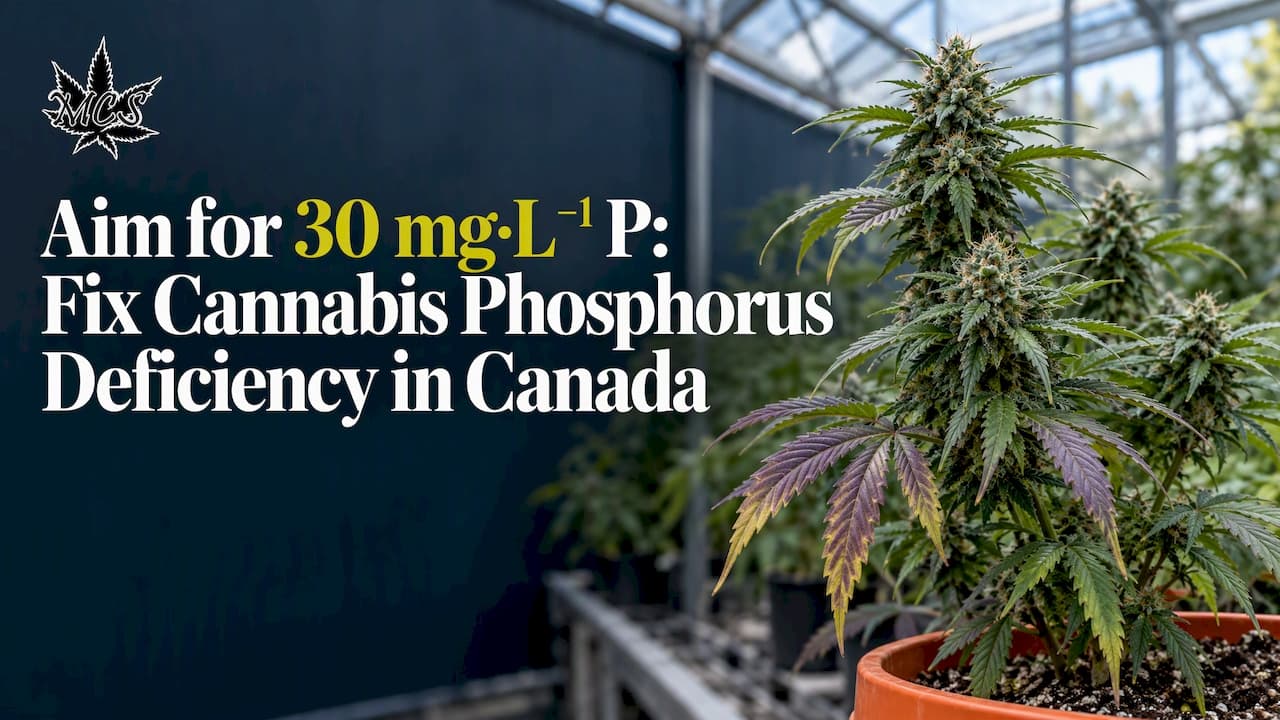
If the lower fan leaves show olive-green spotting that progress to dark, necrotic margins while growth stalls, phosphorus deficiency is the likely cause. Check your pH and runoff immediately, hold off on heavy bloom boosters until you confirm the issue, and run a conservative correction rather than a large dose. Tissue testing remains the definitive way to confirm the diagnosis when symptoms are ambiguous.
TL;DR:
- Phosphorus needs peak during root establishment and flowering, but increasing beyond approximately 30 mg·L⁻¹ rarely boosts yield due to luxury uptake.
- Early deficiency signs include subtle foliar spotting, which can progress rapidly to necrosis and reduced flowering if not corrected promptly.
- Diagnosing deficiency requires checking runoff pH, root health, and tissue analysis, with correction focusing on environment first and conservative dosing.
- Overcorrecting phosphorus can cause nutrient lockout and environmental runoff, making gradual, small adjustments safer for maximizing yield.
- Strains vary in phosphorus sensitivity, with autoflowers often reacting more severely to early deficiencies, underscoring the importance of genetic vigor.
Table of Contents
- Why phosphorus matters for cannabis growth and yield
- Symptoms and how they progress from early to advanced stages
- Diagnosing phosphorus deficiency: visual checks versus lab testing
- What causes phosphorus deficiency in cannabis crops
- How to fix phosphorus deficiency in soil, soilless, and hydro setups
- Avoiding overcorrection: nutrient interactions and trade-offs
- Do all cannabis strains respond to phosphorus deficiency the same way?
- Phosphorus deficiency in vegetative growth versus flowering
- Can you overfeed phosphorus, and what does toxicity look like?
- Preventing phosphorus deficiency over the long term
- Author perspective: choosing a phosphorus target that matches your goals
- Starting strong: how genetics reduce nutrient sensitivity
- FAQ
- Sources
Why phosphorus matters for cannabis growth and yield
Phosphorus drives the energy transfers that keep a cannabis plant running. It forms the backbone of ATP, the molecule that powers root elongation and flower development, and it contributes to DNA synthesis and the phospholipids that build every cell membrane. A plant short on phosphorus cannot move energy efficiently from roots to shoots, which shows up first as sluggish growth rather than dramatic leaf damage.
Research on Cannabis sativa in the vegetative stage used response surface analysis to identify practical nutrient targets, recommending around 30 mg·L⁻¹ phosphorus alongside 160 to 200 mg·L⁻¹ nitrogen and 60 mg·L⁻¹ potassium for optimal vegetative growth and leaf nutrient content. Separate flowering-stage trials found that 30 mg·L⁻¹ phosphorus delivered about 80% of maximum yield, with the full dose-response curve spanning 5 to 90 mg·L⁻¹.
A few points matter when translating these ranges into practice:
- Phosphorus needs peak during root establishment and again at the transition into flowering, when flower sites are forming.
- Plants readily take up phosphorus beyond their functional need, a pattern researchers call luxury uptake.
- Pushing phosphorus well above 30 mg·L⁻¹ raises tissue phosphorus but rarely raises yield by a proportional amount.
That luxury uptake pattern explains why so many growers overcorrect once they spot a deficiency: more phosphorus looks like it should help, but the plant's actual ceiling for usable phosphorus is lower than intuition suggests.
Symptoms and how they progress from early to advanced stages
Phosphorus deficiency moves through distinct phases, and catching it early makes correction far simpler. Single-element deficiency trials that withheld phosphorus from hydroponic cannabis documented this progression in detail, including a drop in foliar phosphorus to about 0.09% of dry weight in deficient plants compared with 0.43% in well-fed controls.
- Early stage: growth slows subtly, and lower, older leaves develop small olive-green to blue-green spots that are easy to mistake for shading or minor stress.
- Intermediate stage: those spots enlarge and merge into patches, leaf margins start to brown and curl downward, and leaflet tips may twist.
- Advanced stage: necrosis spreads across large sections of the leaf, affected leaves die and drop, and flowering slows as the plant redirects limited phosphorus to the youngest tissue.
Distinguishing phosphorus deficiency from similar problems saves wasted effort. Potassium deficiency tends to start with yellowing and scorched margins rather than dark spotting, and it usually appears alongside weaker stem structure. Waterlogging produces uniform wilting and often a sour smell at the root zone, not the speckled pattern typical of phosphorus loss. Cold-induced purpling, common in stems and petioles during cool nights, is a pigment response rather than tissue damage and resolves once temperatures rise. When in doubt, our comprehensive guide to cannabis deficiencies walks through the visual differences side by side.
Diagnosing phosphorus deficiency: visual checks versus lab testing
A fast, structured diagnostic sequence prevents guesswork and wasted nutrients. Start with what you can check in minutes, then escalate only if the picture stays unclear.
- Measure runoff pH and electrical conductivity (EC); phosphorus becomes far less available outside a pH window of roughly 6.0 to 7.0 in soil and 5.5 to 6.5 in hydroponic systems.
- Inspect roots for browning, a sour odor, or compacted media, since poor root health limits phosphorus uptake even when nutrient levels are adequate.
- Review your recent feeding schedule for skipped feedings, diluted mixes, or a switch to a lower-phosphorus product.
- Photograph affected leaves weekly to track whether spotting is spreading or stabilizing.
When visual signs are ambiguous or corrections aren't working, tissue analysis provides the clearest answer. Foliar nutrient analysis is considered the standard diagnostic method for nutrient disorders in cannabis, because visual symptoms can lag behind or diverge from actual tissue concentrations. Collect the most-recent mature leaf (MRML), sample at a consistent growth stage week to week for comparability, and send multiple leaves from different plants rather than a single sample.
Pro Tip: Before ordering a lab test, correct pH and root-zone temperature first. If both are already in range, a conservative phosphorus correction often resolves mild symptoms within one to two weeks without the added cost of tissue analysis.
What causes phosphorus deficiency in cannabis crops
Most phosphorus deficiencies trace back to availability problems rather than an actual shortage in the feeding reservoir. Addressing the root cause prevents the same symptoms from recurring every few weeks.
- Low root-zone temperature: cool growing media or chilly reservoir water slows phosphorus uptake even when supply is adequate, a pattern noted in vegetative-stage cultivation research.
- Waterlogged media: saturated roots lose oxygen and uptake efficiency, mimicking a nutrient shortage that no amount of extra feeding will fix.
- pH drift: phosphorus locks up into insoluble forms outside its optimal pH window, regardless of how much is in the mix.
- Nutrient antagonism: excess calcium, potassium, or magnesium can interfere with phosphorus uptake at the root surface.
- Mechanical failures: clogged drip emitters, channeling in coco coir, or exhausted amendments in living soil starve roots of phosphorus that technically exists in the system but never reaches them.
Reviewing fertilizer formulation matters here too. Our guide to choosing a fertilizer for cannabis breaks down how different formulations handle phosphorus availability, which is useful before assuming a bloom booster will solve a problem that's actually about pH or temperature.
How to fix phosphorus deficiency in soil, soilless, and hydro setups
Correcting phosphorus deficiency works best as a sequence: fix the environment first, then adjust the nutrient supply conservatively, and monitor before dosing again.
- Triage before adding anything. Confirm pH is in range, check runoff EC against your target feeding strength, and inspect roots for rot or compaction. Adding phosphorus to a plant with damaged roots or wrong pH wastes product and can push you toward toxicity.
- Correct pH first. In soil and soilless media, bring irrigation water to 6.0 to 6.5; in hydroponics, target 5.5 to 6.2. This single step resolves many apparent deficiencies without touching the feed schedule.
- Apply a conservative drench. In soil or coco, a modest phosphorus supplement mixed to label strength and applied at normal watering volume is safer than a concentrated bloom booster, which risks overshooting the plant's actual need.
- Adjust hydroponic reservoirs stepwise. Raise phosphorus by roughly 10 to 15% at a time rather than jumping straight to a high target, and hold at around 30 mg·L⁻¹, the level associated with strong yield outcomes in reproductive-stage trials. Give the plant several days to respond before increasing further.
- Use foliar feeding only as a bridge. A light foliar phosphorus spray can ease symptoms within days, but it does not fix the underlying root-zone availability problem and should not replace a proper drench or reservoir correction.
- Monitor and escalate if needed. Track new growth over seven to fourteen days. If symptoms persist despite correct pH and a reasonable phosphorus increase, that's the point to pull a tissue sample rather than keep guessing.
Pro Tip: Resist the urge to double a dose when first-week results look slow. Phosphorus correction is gradual; overshooting is far easier to cause than to undo.
For environmental variables that compound phosphorus uptake problems, particularly root-zone heat and lighting-driven canopy temperature, this lighting and heat troubleshooting guide covers the setup issues that often sit upstream of a nutrient deficiency.
Avoiding overcorrection: nutrient interactions and trade-offs
Phosphorus does not act alone. Potassium and phosphorus compete for uptake at the root surface, and excess nitrogen can mask early phosphorus symptoms by keeping foliage green even as flower development slows. Correcting one nutrient without checking the others risks trading one imbalance for another.
- Raising phosphorus without adjusting potassium can tip the N:P:K balance away from the ranges studies associate with reliable yield.
- Overcorrecting phosphorus increases tissue phosphorus levels without a matching gain in flower weight or cannabinoid content.
- Small, incremental increases (10 to 15% at a time) waste less fertilizer than a single large correction.
Elevating root-zone phosphorus substantially above target levels has been shown to increase leachate phosphorus without improving yield or quality, a pattern consistent with the luxury uptake behavior documented in controlled-environment research. That runoff represents wasted input and an avoidable environmental cost, which is one more reason conservative dosing beats aggressive correction.
Do all cannabis strains respond to phosphorus deficiency the same way?
Not entirely. Peer-reviewed dose-response work across multiple phosphorus levels found cultivar-specific differences in how much phosphorus each plant needed to reach maximum yield, meaning some cultivars plateau at lower phosphorus levels than others. In practice, this means a feeding schedule that works perfectly for one strain can leave a different strain mildly short or, conversely, oversupplied.
Fast-flowering autoflower varieties tend to be especially sensitive to early-stage phosphorus shortfalls, since their compressed vegetative window leaves little time to recover from a slow start. Photoperiod strains with longer vegetative phases generally have more room to correct a deficiency before it affects flower development.
Visual symptom severity can also vary. Some cultivars show pronounced purpling and necrosis quickly, while others display milder spotting even under similar tissue phosphorus levels, which is one reason relying on a single visual cue across every strain in a garden can be misleading. Growers managing multiple cultivars side by side benefit from tracking each one's feeding response independently rather than applying one blanket correction schedule.
Because strain-specific sensitivity is hard to predict without trial and error, starting with vigorous, well-documented genetics reduces how often this variability becomes a practical headache. Choosing strains with clear grow notes on nutrient sensitivity is a simpler path than discovering it mid-flower.
Phosphorus deficiency in vegetative growth versus flowering
Timing changes what phosphorus deficiency costs you. During the vegetative stage, phosphorus shortfalls primarily slow root development and overall structural growth; the plant is forgiving because there's usually time to correct the issue before flower sites form. Vegetative-stage research recommending around 30 mg·L⁻¹ phosphorus alongside balanced nitrogen and potassium reflects this window, where getting ratios right early sets up a stronger transition into flowering.
During flowering, the stakes rise. Phosphorus deficiency at this stage directly limits flower site formation and slows the energy transfer flowering requires, and there's far less time to reverse the damage before harvest. Reproductive-stage trials showing that 30 mg·L⁻¹ phosphorus supports roughly 80% of maximum yield highlight how sensitive this phase is to getting the dose right, since both under and overcorrection during flowering carry a real cost in final harvest weight.

A deficiency that starts in late vegetative growth and isn't caught until early flowering is the worst-case timing: the plant has already committed resources based on a nutrient budget that wasn't actually available, and correcting it mid-flower means playing catch-up during the exact window when flower development is most active. This is the practical argument for checking phosphorus status proactively at the vegetative-to-flower transition rather than waiting for visible symptoms.
Can you overfeed phosphorus, and what does toxicity look like?
Yes, and it's more common than growers expect, largely because phosphorus deficiency symptoms get people reaching for bloom boosters without checking whether more phosphorus is actually the fix. Cannabis readily absorbs phosphorus beyond what it needs, a behavior researchers describe as luxury uptake, and that excess doesn't translate into better flowers.
True phosphorus toxicity in cannabis is less visually dramatic than deficiency. Rather than causing its own distinct symptom set, excess phosphorus most often shows up indirectly by interfering with the uptake of other nutrients, particularly zinc, iron, and manganese, producing micronutrient deficiency symptoms like interveinal chlorosis even though phosphorus itself is abundant. Controlled studies elevating root-zone phosphorus well above target levels recorded sharp increases in leachate phosphorus with no corresponding gain in yield or cannabinoid concentration, which signals the plant was absorbing more than it could use.
The practical risk isn't a scorched leaf tip; it's wasted fertilizer, nutrient lockout of other elements, and phosphorus leaching into runoff. That's a strong argument for the conservative, stepwise dosing described earlier rather than a large corrective dose the moment symptoms appear. If you've already applied a heavy phosphorus correction and new growth looks fine but older leaves develop unexplained spotting, check for a secondary micronutrient deficiency before assuming the phosphorus fix didn't work.

Preventing phosphorus deficiency over the long term
The most reliable prevention strategy is keeping root-zone conditions stable so phosphorus stays available, rather than relying on corrective doses after symptoms appear. A few habits make the biggest difference over a full growing season.
Maintain consistent pH at every feeding rather than correcting it only when problems show up; drift is often gradual and easy to miss until symptoms are visible. Keep root-zone temperature above the low-60s Fahrenheit, since cool media is one of the most common and overlooked causes of reduced phosphorus uptake. Amend soil-based grows with slow-release organic phosphorus sources like bone meal or rock phosphate ahead of planting, giving the amendment time to become plant-available rather than adding it reactively mid-cycle.
Growers reusing soil or raised beds season after season benefit from rotating heavy phosphorus feeders with lighter-demand plants between cannabis cycles, which helps prevent the gradual depletion that repeated cannabis crops can cause in the same media. Refreshing or amending potting soil between cycles, rather than reusing it indefinitely, avoids the slow nutrient exhaustion that eventually mimics a feeding problem even when your schedule hasn't changed.
Finally, build a habit of tracking feeding history and symptom photos across a full grow cycle. Deficiencies are far easier to catch early, and cheaper to correct, when you have a baseline to compare against rather than reacting to a single alarming leaf.
Author perspective: choosing a phosphorus target that matches your goals
If reliable yield is the priority, targeting around 30 mg·L⁻¹ phosphorus is the most defensible middle ground the research supports. Intentionally limiting phosphorus to chase higher cannabinoid concentration per mass is a real trade-off documented in dose-response trials, but it comes at the cost of overall yield and demands tighter monitoring than most home growers can sustain. For most gardens, consistency beats chasing a theoretical quality edge.
— Dino Grow Master
Starting strong: how genetics reduce nutrient sensitivity
A plant with strong genetics and a healthy root system tolerates minor nutrient swings far better than one already under stress, which is part of why we built our seed catalog around vigorous, well-documented genetics. Choosing seeds bred for reliable germination and robust early growth gives roots the head start they need to handle the pH swings and temperature dips that trigger phosphorus problems in the first place.

A few places to start if you're planning your next grow:
- Browse our full seed collection for strains bred for consistent vigor.
- Check autoflower genetics if you want a shorter, lower-maintenance cycle.
- Read our cultivation blog for strain-specific grow notes that flag nutrient sensitivities before you plant.
Every order ships backed by a germination guarantee, so you can focus on dialing in your feeding schedule instead of wondering whether a weak seed caused the problem.
FAQ
What are the symptoms of phosphorus deficiency in plants?
Early symptoms include stunted growth and small olive or blue-green spots on lower, older leaves, which progress to enlarged necrotic patches and curling margins as the deficiency worsens. In advanced cases, affected leaves die and drop while flowering slows, consistent with the progression documented in single-element deficiency trials.
What are the early signs of potassium deficiency in cannabis leaves?
Potassium deficiency typically starts with yellowing along leaf margins that progresses to scorched, brown edges, often paired with weaker stem strength. Unlike phosphorus deficiency's dark spotting, potassium symptoms tend to begin at the leaf edge and move inward.
What is the best phosphorus fertilizer for cannabis?
There's no single best product since the right choice depends on your growing medium and current pH, but conservative, balanced formulations outperform concentrated bloom boosters for correcting deficiency without risking lockout. Our guide to fertilizer selection covers how to match formulation to your setup.
What is the best source of phosphorus for plants?
In hydroponic and soilless systems, soluble phosphate salts mixed to a target around 30 mg·L⁻¹ deliver reliable, fast-acting results. In soil, slow-release organic sources like bone meal or rock phosphate build long-term availability without the overapplication risk of soluble fertilizers.
How quickly can phosphorus deficiency be corrected?
Mild deficiency caused mainly by pH drift or low root-zone temperature often improves within one to two weeks once both are corrected and a conservative phosphorus increase is applied. Severe cases with advanced leaf necrosis take longer, since damaged tissue won't recover and the plant must grow new, healthy foliage instead.
Sources
- Mineral nutrition for Cannabis sativa in the vegetative stage using response surface analysis
- The Highs and Lows of P Supply in Medical Cannabis: Effects on Cannabinoids, the Ionome, and Morpho-Physiology
- Foliar symptomology, nutrient content, yield, and secondary metabolite variability of Cannabis grown hydroponically with different single-element nutrient deficiencies