
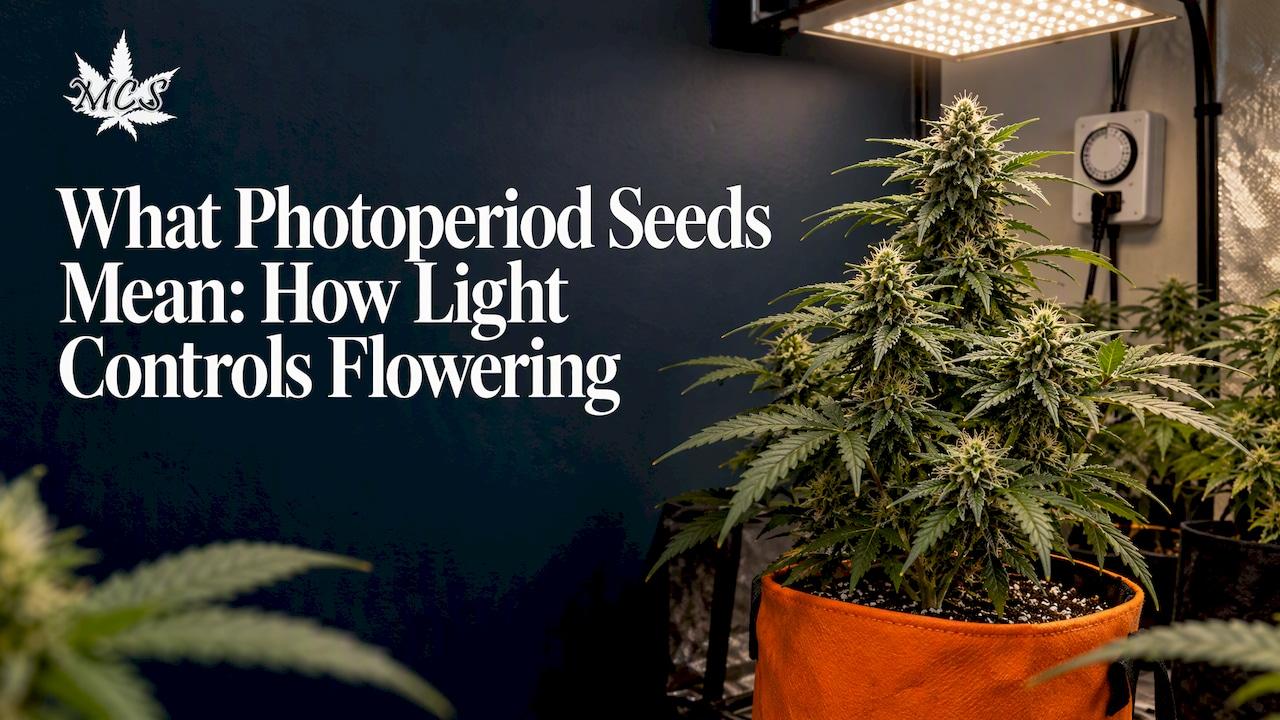
Photoperiod seeds are standard cannabis seeds whose plants begin flowering in response to the length of uninterrupted darkness they receive, not because they have reached a certain age. Under long days they keep growing leaves and branches; once nights lengthen, they switch to bud production. The word comes from Latin roots meaning "light" and "time", and Leafly's glossary describes photoperiod seeds as standard seeds that flower based on the darkness they receive. This article looks at the term itself: what it describes in the plant, how to read it on a seed listing, and what it changes for a Canadian grower.
TL;DR
- "Photoperiod" describes a plant that flowers when nights become long enough, not when it reaches a set age.
- A photoperiod plant stays in vegetative growth for as long as it gets long days, so the grower or the season decides when flowering starts.
- The trigger is the dark period, which is why a single light leak at night can disturb flowering.
- Photoperiod is a trait, not a sex: seeds can be feminized or regular and still be photoperiod.
- Home cultivation rules differ by province, and Quebec, Manitoba and Nunavut do not allow non-medical home growing.
Table of Contents
- What the term actually describes
- How a photoperiod plant senses the change
- Vegetative and flowering phases in a photoperiod plant
- Photoperiod is not the same as regular or feminized
- Reading "photoperiod" on a seed listing
- What the dark period demands in practice
- Photoperiod plants outdoors in Canada
- Photoperiod and the law: check your province first
- Our perspective: why we start people with the light schedule
- Where to start in our catalog
- Common misunderstandings
- FAQ
- Sources
What the term actually describes
A photoperiod is the number of hours of light and darkness a plant receives in each 24-hour cycle. It measures duration, not brightness. A photoperiod seed, in turn, is a seed whose plant uses that duration as a calendar. Cannabis evolved as an outdoor species, and in the wild a plant germinates in spring, grows through the long days of summer, and starts producing flowers as autumn nights lengthen. That sequence is exactly what the word "photoperiod" preserves in a seed catalog.
The practical meaning is control. Leafly's glossary entry explains that these plants rely on changes in the length of darkness, typically needing 12 or more hours of uninterrupted darkness, rather than age to start their reproductive stage. The grower therefore decides, indoors, when the plant has had enough time to build structure, and, outdoors, the sun makes that decision through the calendar.
The term is sometimes used loosely. Some sellers treat "photoperiod" as a synonym for "regular seeds", and some readers assume it means a slower or more difficult plant. Neither is accurate, and the sections below separate the three ideas: how the plant senses light, how the seed is sold, and how demanding the plant is.
How a photoperiod plant senses the change
The common shorthand is that the plant "counts hours of light". More precisely, it responds to the length of the uninterrupted night. Short-day plants of this kind detect a long enough dark period, and a sustained run of those nights pushes the plant from vegetative growth into flower development.
Research on controlled-environment production reflects the same convention. A Clemson University dissertation on cannabis horticulture notes that short-day photoperiods are required to stimulate rapid inflorescence growth, that a 12-hour photoperiod is traditionally provided for this purpose, and that there is still no consensus on the best way to set it. In other words, 12 hours of light and 12 of darkness is the customary switch, not a law of nature, and growers and researchers continue to refine it.
Two consequences follow from a dark-period trigger:
- The night matters more than the day. A plant under a 12-hour light schedule with a bright interruption in the dark phase can behave as though its night were shorter than it is.
- The plant does not flower on a timer of its own. Left under long days, it can stay in vegetative growth indefinitely, which is why photoperiod plants can be kept as mother plants or grown very large before the switch.
Vegetative and flowering phases in a photoperiod plant
A photoperiod plant lives in two clearly separated phases, and the light schedule is the divider.
| Phase | What the plant does | Light it receives | Who controls the timing |
|---|---|---|---|
| Seedling and vegetative growth | Builds roots, stems, branches and leaves | Long days (indoors, commonly 18 hours of light or more) | The grower, or the sun in late spring and summer |
| Flowering | Produces flowers (buds) and trichomes | Long nights, usually 12 hours of uninterrupted darkness indoors | The grower, or the shortening days of autumn |
The vegetative phase has no fixed length. A grower with a small space may flip the schedule after a couple of weeks to limit height, while one with more room may let the plant build a larger frame first. That flexibility is the chief reason experienced growers keep choosing photoperiod genetics, and it is also why the schedule needs attention: the plant will not move on by itself in an indoor space with long days.
A point worth knowing is that the plant usually continues to stretch for the first weeks after the change in light, so a space should leave headroom beyond the plant's height at the moment of the switch. Training techniques that manage that height are already covered on our blog, so they are not repeated here.
Photoperiod is not the same as regular or feminized
The label on a seed pack can carry three separate pieces of information, and they are easy to confuse.
- Flowering trigger: photoperiod (light-dependent) or not.
- Sex of the seed: feminized or regular.
- Cannabinoid profile: high-THC, balanced or CBD-focused.
A photoperiod seed can be feminized. Feminized seeds are bred to develop into female plants, the source of the cannabinoid-rich flowers. According to a 2024 study in Frontiers in Plant Science, they are produced by treating female plants, for example with silver thiosulfate, to induce sex reversal so that the plant produces pollen carrying only female chromosomes. A photoperiod seed can equally be a regular seed, which carries a roughly even chance of either sex and is the form nature produces. The trigger for flowering is independent of both.
That is why a catalog can list "feminized photoperiod" strains without contradiction. Our feminized seeds category is a good example: most of its genetics respond to the light cycle exactly as described here, with the feminization simply removing the need to sort out male plants. For the full comparison of feminized and regular seeds, see the existing guide on our store blog.
Reading "photoperiod" on a seed listing
Many listings never use the word at all. A strain that is not described as autoflowering is generally a photoperiod strain, and the product page will usually give a flowering time counted from the moment the light schedule changes. When a listing mentions a "flowering time" of a certain number of weeks, that number begins at the switch to 12 hours of darkness, not at germination.
A few reading rules help:
- Flowering time is counted from the flip. Add the vegetative period you plan to run to estimate the total time from seed to harvest.
- Outdoor notes refer to a calendar. A listing that gives a harvest month is describing when natural nights are long enough for that genetic to finish.
- "Fast" versions are still light-dependent. Strains marketed as fast versions are photoperiod genetics bred for a shorter flowering period, so the light schedule still applies. Our Fast Versions category lists them.
- Photoperiod strains are not a flavour or a potency class. Classic profiles such as Critical, Cheese or Northern Lights type genetics are photoperiod; the light trigger says nothing about taste or strength.
For a full side-by-side of the three flowering types, our blog already has a dedicated article, so this page stays with the meaning of the photoperiod trait itself.
What the dark period demands in practice
Because the trigger is darkness, the quality of the dark matters as much as its length. Indoors, the common problems are mundane.
Light leaks. A strip of light under a door, a standby LED on a power bar or a window facing a streetlight can interrupt the night. A plant that receives light in the middle of its dark period may stall, reveal mixed growth or delay flowering. Sealing the space and checking it with the main lights off is the first test.
Irregular schedules. A timer that fails or is set wrongly means the plant can drift between signals. Checking the timer on the day of the switch, and again a week later, costs nothing.
Opening the space at night. Brief entries in low light are usually less of a concern than a bright lamp turned on, but the safest habit is to do all maintenance during the light period.
Overall consistency. A plant in flower wants the same schedule every day until harvest. Changing it halfway can send the plant back toward vegetative growth.
The strongest advice for a first grow is to treat the light schedule as a fixed appointment, not a setting to adjust casually. Light equipment itself is covered in other guides on our blog.
Photoperiod plants outdoors in Canada
Outdoors, the sun runs the schedule, and that makes latitude and calendar important. In Canada, days are long in June and July and shorten steadily through late summer, so the natural trigger arrives later in the year than many beginners expect. A plant started late can spend most of the summer in vegetative growth and begin flowering with autumn frost approaching.
This is where genetics choice matters most. Strains bred to finish early are the sensible match for northern gardens, while long-flowering classics can fail to ripen before cold weather arrives. Our outdoor seeds category groups genetics for open-air conditions, and the store blog's guide to growing cannabis outdoors covers the practical side of the season. We also keep a seasonal page on August harvest seeds for growers thinking about timing.
A few outdoor realities follow directly from the photoperiod trait:
- Street and porch lighting can interfere. A plant near a lamp that comes on at night may flower late or unevenly.
- Size is tied to the calendar. The earlier the plant goes out, the longer it has under long days to grow, and the bigger it can become.
- Harvest dates are seasonal. You are working with the sun's schedule, and no amount of care shifts it.
Photoperiod and the law: check your province first
Seed meaning is one question; the right to grow is another. Under the federal Cannabis Act, adults of legal age may grow up to four plants per household, not per person, from legally purchased seeds or seedlings, according to Health Canada's backgrounder. That federal framework sits on top of provincial, territorial and municipal rules, including those on zoning and fire or electrical safety.
Provinces have used that room differently. The Manitoba government notes that Quebec, Nunavut and Manitoba have set the limit at zero, which effectively prohibits non-medical home cultivation. Educaloi, a Quebec legal-information organization, explains that growing at home in Quebec is not allowed except for medical reasons, and that the Supreme Court of Canada confirmed the ban is constitutional.
Two practical points follow. First, anyone growing for non-medical use should confirm the current rules in their province, territory and municipality before buying, and a tenant should also check the lease. Second, Health Canada's guidance on growing cannabis at home safely says to buy seeds or immature plants from legal sources, and that it is illegal to use seeds or grow plants known to come from illegal sources. Where there is any doubt about your own situation, a legal clinic or your provincial cannabis authority is the right place to ask.

Our perspective: why we start people with the light schedule
We curate genetics for Canadian conditions, and the questions that reach our support team about photoperiod plants are rarely about the plant itself. They are about the calendar: when to start, when to switch, and whether a strain will finish before the weather turns. The term "photoperiod" sounds technical, but it comes down to one idea, which is that you own the clock.
We think that is an advantage for most growers once it is understood. A plant that waits for your signal can be grown to the size your space allows, kept in vegetative growth while you prepare, and flipped when you are ready. The cost is attention to darkness and timing, and that is a manageable cost for a careful beginner as much as for an experienced grower.
Our advice is to choose the genetic and the schedule together. Read the listed flowering time as a count from the switch, add your planned vegetative period, and compare the total with your season or your available space. If the numbers do not fit, a faster-finishing genetic is a better answer than forcing a long-flowering one. Our germination guarantee and our support team exist so that a first photoperiod grow does not depend on guesswork.
— Dino Grow Master
Where to start in our catalog
If you are in a province where home growing is permitted and the photoperiod trait suits your plan, the simplest entry point is our feminized seeds range, which removes the need to identify and remove male plants. Growers with a shorter window can look at the Fast Versions category, and those who prefer a CBD-focused profile can browse our CBD seeds. Each product page carries detailed information, and we ship discreetly across Canada.
Common misunderstandings
"Photoperiod means regular seeds." Regular seeds are photoperiod, but not every photoperiod seed is regular. Feminized photoperiod seeds are common.
"Photoperiod plants are harder." They ask for a reliable light schedule. Many beginners find that a clear rule, 12 hours of true darkness to flower, is easier than guessing.
"More light always helps." For the trigger, the length of the night is what counts. Extra light in the dark period works against the plant.
"Flowering time on the listing is the whole grow." It is only the flowering stage, counted from the switch.
FAQ
What does photoperiod mean for seeds?
It means the plant that grows from the seed flowers in response to the length of darkness, not its age. Under long days it stays vegetative, and once nights become long enough, usually 12 hours of uninterrupted darkness indoors, it begins to flower.
Are photoperiod seeds the same as regular seeds?
No. Regular seeds describe sex: they can produce male or female plants. Photoperiod describes the flowering trigger. Regular seeds are photoperiod, but feminized seeds can be photoperiod too.
How long does a photoperiod plant stay in the vegetative stage?
As long as it receives long days, so the length is your choice indoors. Many growers decide based on the height their space allows, then switch the light schedule when the plant reaches the planned size. Outdoors, the calendar decides.
Can I grow photoperiod seeds anywhere in Canada?
The federal limit is four plants per household, but provinces can be stricter. Quebec, Manitoba and Nunavut do not allow non-medical home growing, so check your province and municipality before you buy.
Sources
- What is Photoperiod? Cannabis Glossary, Leafly
- Horticultural Strategies to Improve Yield and Efficiency for Controlled-Environment Cannabis Production, Clemson University
- Optimized guidelines for feminized seed production in high-THC Cannabis cultivars, Frontiers in Plant Science
- The Cannabis Act: The Facts, Canada.ca
- Growing cannabis at home safely, Canada.ca
- You can't grow cannabis at home in Manitoba, Government of Manitoba
- Growing Cannabis at Home in Quebec: Legal or Not?, Educaloi