
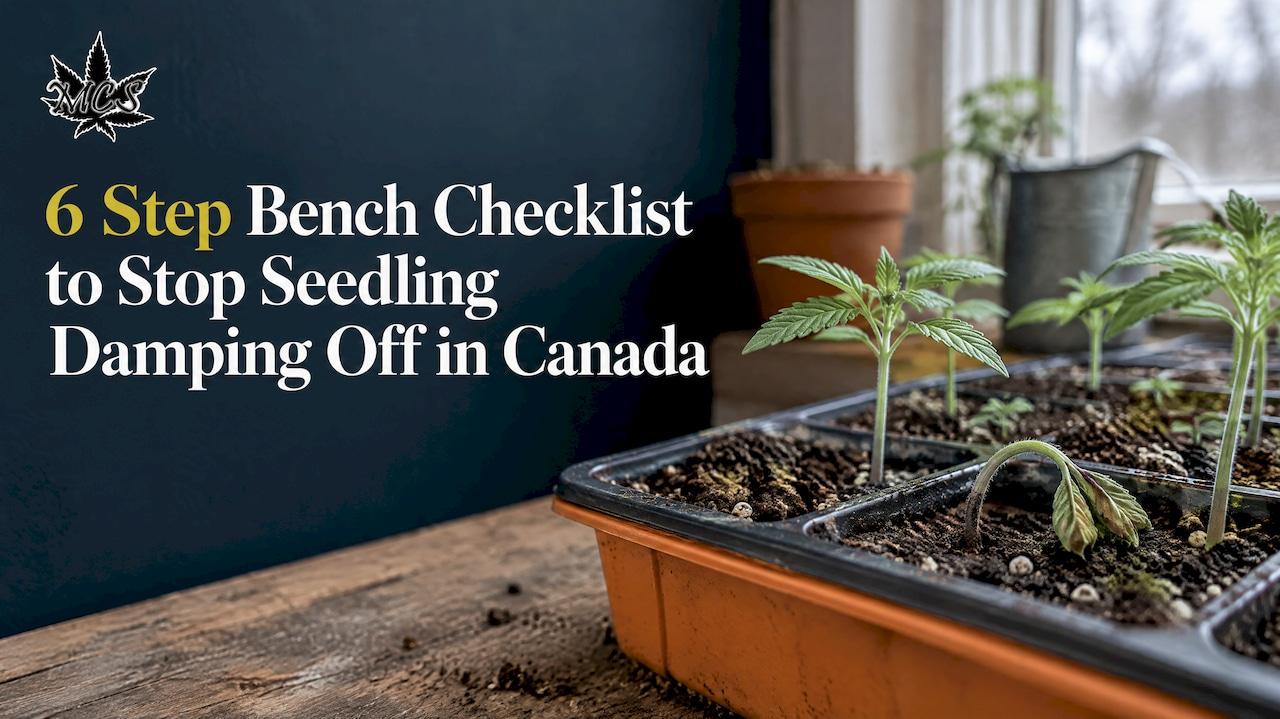
Damping-off is a seedling-killing disease caused by soil-borne fungi and water molds that thrive in cool, wet growing media. Prevention through sanitation, correct moisture levels, and warm media is the primary control, far more reliable than any treatment applied after symptoms appear. If seedlings are already collapsing, remove the affected plants immediately and cut back on watering to slow the spread.
TL;DR:
- Use sterile, soilless mix, sanitize trays and benches, and maintain media at 70 to 75°F so seeds emerge sooner and spend less time vulnerable.
- Water from below or mist gently, let the surface dry before nightfall, provide airflow and strong light, and avoid crowded trays.
- When stems develop soft, water soaked lesions at the soil line, discard affected seedlings and adjacent plugs, disinfect equipment, and separate healthy trays.
- Fungicide drenches rarely rescue symptomatic seedlings and may damage tender tissue; use biological suppressants only when their labels cover the crop.
- For recurring or large commercial outbreaks, diagnostic testing can identify the pathogen; otherwise, home gardeners can act without a precise diagnosis.
Table of Contents
- Recognizing Damping-Off: Early and Late-Stage Signs
- Which Organisms Cause Damping-Off and How They Behave
- Environmental Conditions That Raise Damping-Off Risk
- Step-by-Step Prevention Practices for Seed Starting
- Quick Diagnostic Checks and Immediate Containment Steps
- Treatment Options, Biologicals, and Realistic Expectations
- Printable Quick Checklist for the Seed-Starting Bench
- How Susceptibility Varies Across Vegetables, Flowers, and Trees
- The Lifecycle Behind Damping-Off and Why Timing Matters
- Long-Term Soil Management to Prevent Recurring Outbreaks
- What We've Learned From Years at the Seed-Starting Bench
- Starting With Reliable Seed Reduces One Layer of Risk
- FAQ
- Sources
Recognizing Damping-Off: Early and Late-Stage Signs
Damping-off shows up in two distinct phases, and knowing which one you are looking at changes what you do next. Pre-emergence damping-off happens before a seedling ever breaks the surface: seeds simply fail to sprout, and when dug up, they appear soft, discolored, or rotted. Post-emergence damping-off is more visible and more alarming, producing a water-soaked, pinched lesion at the soil line that causes the stem to buckle and the seedling to topple over, often within a day.
- Pre-emergence: missing seedlings and rotten, mushy seeds when checked below the surface.
- Post-emergence: a soft, sunken, or water-soaked stem right at the soil line, followed by collapse.
- Humid conditions: white, cottony fungal growth on the media surface and circular patches of dead seedlings spreading outward in a tray.
Catching these patterns early, especially the circular die-off pattern in a flat, gives you a window to isolate healthy cells before the problem spreads further.
Which Organisms Cause Damping-Off and How They Behave
Several soil-borne organisms cause damping-off, and they do not all behave the same way. According to UMass Extension, the main culprits include Pythium, Rhizoctonia, Fusarium, and Phytophthora, with Botrytis also implicated in humid conditions. Pythium is technically an oomycete, a water mold rather than a true fungus, which explains why it thrives in waterlogged media and spreads rapidly through standing moisture.
- Pythium: a water mold that favors saturated, poorly drained soil and spreads through water films.
- Rhizoctonia: a fungus that survives as resilient structures in soil and plant debris for long periods.
- Fusarium and Phytophthora: soil-dwelling fungi and water molds that persist in contaminated media and on dirty tools.
- Botrytis: a gray mold that takes hold in cool, humid, poorly ventilated conditions.
Most of these organisms survive between growing seasons as dormant structures in old potting mix, on bench surfaces, and inside reused trays. Mixed infections involving two or more pathogens are common, and while lab identification helps growers managing recurring commercial losses, home gardeners rarely need a precise diagnosis before taking corrective action.
Environmental Conditions That Raise Damping-Off Risk
Nearly every risk factor for damping-off traces back to moisture, temperature, or airflow, which means most of the risk is within a grower's control. Cool, wet, poorly drained media that stays damp overnight creates ideal conditions for Pythium and Rhizoctonia to establish themselves. Insufficient light produces leggy, thin-stemmed seedlings that lack the structural resilience to resist infection, a connection confirmed by the UConn IPM factsheet, which notes that weak, light-starved seedlings succumb far more readily than sturdy ones.
- Cool, saturated media with poor drainage, especially overnight.
- Low light levels that produce weak, leggy growth.
- Overcrowded trays, overhead misting, and reused contaminated containers.
- Garden soil or immature compost, both of which introduce pathogens directly into the seed-starting environment.
Crop losses attributable to damping-off can range from 20% to 85%, according to UMass Extension, a spread wide enough to show how much outcomes depend on the specific conditions in a given tray or greenhouse bench.
Step-by-Step Prevention Practices for Seed Starting
Prevention is where nearly all of your effort should go, since no reliable cure exists once a seedling is infected. The steps below follow the order extension sources recommend, starting before you ever fill a tray.
- Start with high-quality, fresh seed and a sterile, soilless potting mix rather than garden soil, which carries resident pathogens.
- Sanitize trays, benches, and tools before use; for reused trays, a 10% bleach soak works, and clean trays should never sit on a dirty bench afterward.
- Provide bottom heat of 70 to 75°F (21 to 24°C) to speed germination, since faster emergence means less time exposed to pathogens in the media, a point emphasized by both UMass Extension and the UConn factsheet.
- Water carefully using bottom-watering or gentle misting, keep the media moist but never saturated, and schedule watering so the surface dries before nightfall, as UC IPM advises against overhead misting that splashes spores onto stems.
- Space seedlings to allow airflow and avoid dense seeding, since crowded trays trap humidity near the soil line.
- Where labeled for your crop, consider a registered biological suppressant as an added layer of protection rather than a replacement for sanitation.
Pro Tip: Irrigate in the late morning rather than the evening, so foliage and media surfaces have hours of daylight to dry before the cool, humid overnight period sets in.
Quick Diagnostic Checks and Immediate Containment Steps
When you spot a suspect seedling, check the stem at the soil line first: a soft, water-soaked, or pinched lesion confirms damping-off rather than simple wilting or transplant stress. Once confirmed, act quickly, because the disease spreads through shared water and soil contact between adjacent cells.
- Remove and discard infected seedlings along with the plugs or cells immediately next to them; never add them to a compost pile.
- Disinfect the tray, tools, and bench surface before reusing them, and keep healthy flats physically separated from the affected one.
- Reduce watering frequency and increase airflow around remaining seedlings rather than adding more water to a wilting plant, since saturated, low-oxygen media is what enabled the infection in the first place, per UMN Extension.
- For large-scale losses or recurring problems in a commercial setting, contact a local extension office or plant diagnostic lab for pathogen identification.
Treatment Options, Biologicals, and Realistic Expectations
Once a seedling shows symptoms, removal and sanitation remain the primary response, since there is no cure for an already-infected plant. According to UC IPM, fungicide drenches rarely save symptomatic seedlings and can even cause phytotoxicity on tender tissue, making them a poor rescue tool.
- Fungicide drenches may offer some protection to still-healthy neighboring seedlings but should be used cautiously given the risk of leaf or stem damage.
- Biological products based on Trichoderma harzianum, including formulations such as Trianum, are registered and used in greenhouse production to suppress damping-off and root rot on specific crops when applied according to label directions, as noted in extension guidance on damping-off management.
- Chemical seed treatments and drenches appear in commercial production settings but must follow label directions and regional safety rules.
- Diagnostic testing for pathogen identification becomes worthwhile in recurring or large-scale outbreaks, since it points to the specific organism driving losses rather than leaving growers guessing, according to extension management notes.
Printable Quick Checklist for the Seed-Starting Bench
- Before seeding: use a sterile soilless mix, sanitize trays, and pre-warm the media.
- At seeding: pre-moisten the mix, avoid over-seeding each cell, and set up bottom heat and strong light.
- Daily: ventilate the growing area, check moisture levels, and remove any collapsing seedling the moment you spot it.
- If an outbreak occurs: discard infected flats, disinfect everything that touched them, and plan a biological seed treatment for the next cycle.
How Susceptibility Varies Across Vegetables, Flowers, and Trees
Not every seedling faces the same level of risk, and understanding why helps growers prioritize where to focus prevention effort. Fast-germinating vegetable crops like beans, peas, and cucurbits tend to spend less time in the vulnerable pre-emergence window, which can reduce exposure, while slower germinators such as peppers and some flowering annuals stay susceptible longer simply because they take more days to push through the media. Fine-seeded flowers, including petunias and snapdragons, are often started shallow and kept consistently moist, conditions that favor the same water molds responsible for damping-off in vegetable trays.
Tree and shrub seedlings grown in nursery flats face comparable risk, particularly conifers started in dense trays where airflow is limited and humidity builds near the base of each stem. Species with naturally slow early growth, whether a tree seedling or a slow-germinating flower, spend more days balanced between seed and established plant, and that stretched timeline is exactly when soil-borne pathogens do the most damage. The practical takeaway is not that one plant family is immune and another is doomed. It is that the same conditions, cool wet media, poor airflow, and crowded cells, create risk regardless of whether the tray holds tomatoes, marigolds, or pine seedlings. Matching your prevention routine to each crop's germination speed, rather than treating every tray identically, closes much of that gap.

The Lifecycle Behind Damping-Off and Why Timing Matters
Damping-off pathogens do not attack on a fixed schedule. They respond to the conditions a seedling creates simply by germinating. Water molds like Pythium produce swimming spores that travel through films of water in saturated media, which is why they strike hardest in the first days after watering when moisture is highest. Rhizoctonia instead survives as dormant structures in soil and organic debris, waiting for a seedling's tender stem tissue to make contact at the soil line before infecting.
This difference in lifecycle explains why the pre-emergence and post-emergence windows carry different risks. During pre-emergence, a seed sitting in cool, wet media for an extended period gives soil-borne organisms time to colonize it before it ever sprouts, which is exactly why bottom heat and a 70 to 75°F (21 to 24°C) media temperature shorten that vulnerable window, according to UMass Extension. During post-emergence, the fresh, unlignified stem tissue at the soil line remains soft and susceptible for days after sprouting, which is when water-soaked lesions typically appear.
Understanding this timing turns prevention into a scheduling problem as much as a sanitation one. Every day a seed spends ungerminated in cold, wet media is a day of added exposure, and every day a seedling's stem stays soft near the soil line is a day the pathogen can strike. Speeding both phases along through warmth, light, and correct moisture shrinks the total window during which infection can take hold.

Long-Term Soil Management to Prevent Recurring Outbreaks
A single clean seed-starting cycle does not guarantee the next one stays clean, since damping-off pathogens persist in old media, wooden flats, and even garden tools long after symptoms disappear. Replacing potting mix each season rather than reusing old bags, and never topping off a tray with leftover soil from a previous outbreak, removes one of the most common sources of recurring infection.
Reused plastic trays and cell packs deserve particular attention because their crevices are difficult to fully disinfect even with a bleach soak, which is why many growers managing repeated problems eventually switch to new trays each season rather than relying on cleaning alone. Keeping a simple log of which seed lots, mixes, and tray batches produced healthy versus failed seedlings makes it far easier to spot a pattern, whether the common thread is a particular batch of mix, a reused tray, or a watering habit that needs adjusting.
Rotating where seed-starting happens within a greenhouse or under grow lights, rather than using the same bench surface season after season without a deep clean, also limits the buildup of resident pathogens in dust and debris. None of these practices replace the core prevention steps covered earlier. They extend the same sanitation principle across years instead of just across a single tray, which is where many recurring damping-off problems actually take root.
What We've Learned From Years at the Seed-Starting Bench
Prevention beats treatment every time with damping-off, and extension guidance backs that up consistently. The real decision most growers face is where to invest: a heat mat and a bag of sterile mix cost little and solve most problems outright, while pasteurizing garden soil at home takes more effort and more oversight to get right. For a handful of trays, buying sterile mix almost always wins on time and reliability. For larger operations, the math shifts toward investing in bottom heat and biological seed treatments as a baseline. Keeping a simple record of seed lot, mix batch, and seeding date turns a mysterious recurring failure into a traceable pattern worth fixing.
— Dino Grow Master
Starting With Reliable Seed Reduces One Layer of Risk
Prevention starts before a seed ever touches soil, and seed quality is part of that equation. Seeds with strong, consistent germination rates spend less time sitting in damp media before sprouting, which shortens the exact window when pre-emergence damping-off takes hold. We back our catalog with a germination guarantee, so the seed itself is one less variable to troubleshoot when a tray underperforms.

- Our feminized seeds offer predictable sex alongside the germination support we provide.
- Our autoflower seeds suit growers who want faster cycles and simpler management from seed to harvest.
- Our mix packs give new growers a chance to compare germination performance across strains in a single order.
Browse our full seed catalog to find genetics suited to your setup, with shipping and support.
FAQ
What causes damping-off in seedlings?
Damping-off is caused by soil-borne fungi and water molds, including Pythium, Rhizoctonia, Fusarium, and Phytophthora, that thrive in cool, wet, poorly drained growing media. These organisms attack seeds before they sprout or infect tender stems right at the soil line shortly after emergence.
What do overwatered seedlings look like?
Overwatered seedlings often look wilted or droopy despite sitting in wet soil, which can be mistaken for a watering problem rather than a disease symptom. The correct response is to reduce watering and increase airflow rather than add more water, since saturated, low-oxygen media is what allows damping-off pathogens to establish, according to UMN Extension.
How damp should seedling soil be?
Seedling media should stay consistently moist but never saturated or soggy, with the surface allowed to dry somewhat before each watering. Scheduling watering for late morning rather than evening gives the surface hours to dry before the cool, humid overnight period, a practice recommended by UC IPM to limit conditions damping-off pathogens need to spread.
What is hardening off your seedlings?
Hardening off is the process of gradually exposing indoor-started seedlings to outdoor sun, wind, and temperature swings over a week or two before transplanting them permanently. It is a separate step from damping-off prevention, though sturdy, well-lit seedlings that resisted damping-off indoors typically handle hardening off more successfully than weak, leggy ones.
Can I use garden soil to start seeds indoors?
Garden soil should not be used for starting seeds indoors because it naturally carries the same pathogens responsible for damping-off. A sterile, soilless potting mix removes that risk from the start and is the standard recommendation across extension sources.
Sources
- Damping-off of Bedding Plants & Vegetables (UMass)
- Damping-off diseases in the garden (UC IPM)
- Damping-off of ornamental and vegetable seedlings (UConn IPM factsheet, 2024)
- Damping-off management notes (extension overview)