
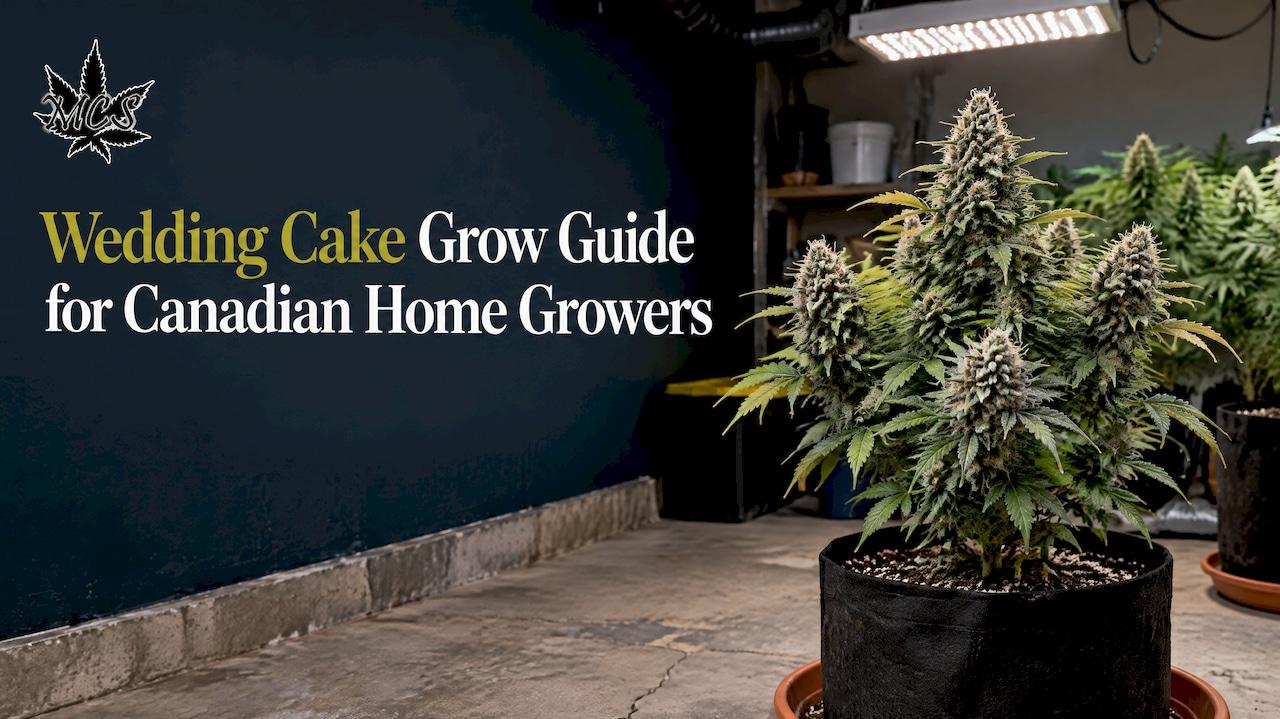
Wedding Cake is an indica-dominant hybrid prized for dense, resinous flowers and a sweet, dessert-like aroma, and it can be grown indoors or outdoors in Canada. It is not an effortless plant, however. Its compact structure rewards a grower who controls light, temperature, humidity and airflow, and it punishes one who does not. This guide explains what the name actually means when you buy seeds, how to plan the canopy, what to expect on height and timing, and which legal checks come before the first seed goes into a pot.
TL;DR
- Wedding Cake is a name, not a single genetic: parentage differs between lines, so the breeder, sex type and documented lineage matter more than the label.
- Indoors, plan for a short, bushy plant (about 70 cm is a realistic target) and manage the canopy for airflow before flowers become dense.
- Expect roughly seven to ten weeks of flowering depending on the source and line, and judge harvest by plant maturity, not the calendar alone.
- Federal law allows up to four plants per household, but provinces, territories and municipalities can restrict or prohibit home growing, and Quebec prohibits it for non-medical use.
Table of Contents
- Check the law before you buy seeds
- What "Wedding Cake" means when you buy seeds
- Why growers want it, and why it is not a beginner plant
- Planning the indoor space
- Managing the dense canopy
- Flowering time and harvest
- Growing outdoors in Canada
- How to read lab data and descriptions
- Our perspective
- Wedding Cake seeds at Montreal Cannabis Seeds
- FAQ
- Sources
Check the law before you buy seeds
The question of whether you may grow comes before the question of how. Under federal rules, Health Canada states that adults may grow up to four cannabis plants per household for personal use, and that you must follow provincial, territorial and municipal laws, including local bylaws. The same page says seeds or plants must come from legal sources and that selling what you grow is not permitted without a licence.
The federal limit is a ceiling, not a guarantee. Quebec has banned home cultivation for non-medical purposes, and the Supreme Court of Canada confirmed in 2023 that the ban is constitutional, according to Éducaloi. Growers in other provinces should still check local rules on where plants may be kept, security and odour. Medical growers operate under a separate registration with its own authorized plant limits, described on Health Canada's page on starting materials for medical production.

With only four plants per household, strain choice matters. A cultivar that demands attention has to earn its place in a small garden.
What "Wedding Cake" means when you buy seeds
The name is attached to more than one cross. The Ontario Cannabis Store (OCS) notes two commonly reported lineages: GSC × Cherry Pie, and Triangle Kush × Animal Mints. SeedFinder describes the Seed Junky version as also known as Pink Cookies and Triangle Mints #23, and estimates it at roughly 60% indica. Leafly lists it under the same aliases.
The practical consequence is simple. Two packs sold as Wedding Cake are not proof of identical genetics. Before buying, look for:
- The breeder or source of the line, not just the strain name.
- Sex type. SeedFinder notes the original Seed Junky cut was never available as feminized seed, so any feminized pack is a different breeding project, which is not a flaw but is worth knowing.
- Plant type: photoperiod or autoflower. This changes the whole schedule.
- Documented parentage and generation, where the seller publishes them.
If the photoperiod-versus-autoflower decision is still open, our detailed comparison of photoperiod, autoflower and fast version strains covers it in depth.
Why growers want it, and why it is not a beginner plant
Wedding Cake's reputation rests on flavour, resin and effect. Leafly reports that it was named its 2019 Strain of the Year, and lists caryophyllene, limonene and myrcene as its commonly reported dominant terpenes: caryophyllene is the peppery note, limonene the citrus-like one and myrcene the herbal one. Terpene ratios vary by phenotype, producer and batch, so these are tendencies, not promises. OCS also describes dense buds with substantial trichome coverage.
The same density is what makes cultivation demanding. OCS's cultivation profile stresses that the plant is sensitive to light intensity, temperature, humidity and irrigation. SeedFinder explains the mechanism: compact branching and tightly spaced nodes produce attractive flowers but reduce light penetration and air movement. A plant that photographs well can still be an unforgiving one.
For a first grow, our list of top cannabis strains for first-time growers is a more forgiving place to start. Wedding Cake suits the grower who has finished one or two cycles and wants a more rewarding second act.
Planning the indoor space
Height and canopy
A useful indoor target is a controlled, bushy canopy rather than maximum height. OCS says the plant can be kept at about 70 cm indoors and reaches about 1.5 m outdoors, while SeedFinder characterizes it as short and bushy indoors and moderate outdoors. Final size is not a fixed genetic limit. Container volume, the length of the vegetative stage, distance from the light and training all move it.
For a four-plant household, the logic is to keep each plant manageable enough that you can reach every branch. If you cannot get a hand or a leaf tuck into the centre of the plant, you cannot manage it in week five of flowering.
Light, temperature and humidity
Because the plant reacts to its environment, stability beats ambition. Aim for steady temperatures without sharp swings between lights-on and lights-off, avoid hot spots directly under the fixture, and lower humidity as flowers form, since tight buds hold moisture. We deliberately give no single set of numbers here: the right targets depend on your breeder's guidance for the specific pack and on your equipment, and a hygrometer and thermometer at canopy height will tell you more than any generic chart.
If you are assembling a space from scratch, our grow supplies starter guide lists the essential equipment.
Watering
Irrigation is the other variable OCS flags. Dense foliage slows evaporation from the container surface, so a plant can stay wetter than its size suggests. Water by container weight and plant behaviour rather than by schedule, and let the top layer of the medium dry between waterings. Persistent yellowing or drooping needs diagnosis, not more feeding; our guide to cannabis deficiencies helps separate nutrient problems from watering ones.
Managing the dense canopy
SeedFinder notes that training, pruning and defoliation are used to improve light penetration. The principle for Canadian home grows, where rooms are often small and winter air is variable, is to act early and moderately.
- Plan access before flowering. Leave room around the pots so you can inspect the lower and inner branches.
- Remove growth that will never receive light. Small, shaded lower shoots divert energy and trap humidity.
- Open the centre gradually. Several light adjustments are gentler on the plant than one heavy cut late in the cycle.
- Keep air moving. Gentle airflow through and above the canopy matters more than stronger light.
- Inspect buds regularly in late flowering. Dense flowers are where mould would start, so look inside them, not only at the surface.
Late correction is more disruptive than planned, modest maintenance. For specific training techniques, see the store blog's existing posts on topping, low-stress training and SCROG at the Montreal Cannabis Seeds blog.
Flowering time and harvest
Sources differ slightly. OCS reports an eight-to-10-week flowering phase and potential production up to 500 g/m² under its described conditions, while Leafly gives a seven-to-nine-week range. Those yield and timing figures are potential or average values, not guaranteed results. Phenotype, container size, environment and training shift them considerably.
| Source | Flowering window | Notes |
|---|---|---|
| OCS | 8 to 10 weeks | Indoor height around 70 cm; yield potential up to 500 g/m² |
| Leafly | 7 to 9 weeks | Intermediate to advanced growers |
The lesson is to use the breeder's stated finish window as a guide, then judge readiness by the plant: trichome appearance under magnification and the state of the pistils. Our store blog covers drying and curing separately, which matters as much as the harvest date for a terpene-rich cultivar.
Growing outdoors in Canada
Outdoor timing is a risk-management problem more than a strain promise. OCS reports that an outdoor harvest can arrive in early October, and Leafly's grow notes place the finish in the autumn. In much of Canada, frost, rain and humidity arrive around the same time. Dense flowers sitting in cool, wet air are exactly the setup for botrytis, so a grower in a damp region should weigh the strain's mould sensitivity against the local forecast.
Plants kept outdoors also carry local obligations. Health Canada's guidance notes that odour rules for personal non-medical grows are generally local rather than federal, so a Wedding Cake in the garden should be checked against your municipality's bylaws on visibility, fencing and smell. Our outdoor genetics are listed on the outdoor seeds page.
How to read lab data and descriptions
When comparing flower descriptions, a certificate of analysis should show cannabinoid and terpene results for a specific batch, which is a useful habit to learn even as a seed buyer: it reminds you that numbers describe batches, not strains. French-speaking readers can see how lab-tested flower is presented in this guide to CBD flower and its analyses. Remember that a strain's THC range, commonly cited at 22 to 27% on retail pages, is an outcome of genetics, environment and handling, not a figure your plant owes you.
Our perspective

We see the same pattern with dessert-style cultivars every season. Growers choose them for the photographs and the flavour, then meet the real work: a dense plant in a room where airflow was an afterthought. Our view is that the pack matters as much as the technique. A clearly described line with a known sex type and plant type removes two variables before the grower has even germinated anything, and that is the reason we publish detailed product information and stand behind germination with a guarantee.
For Canadian conditions, we encourage growers to match the plant to the space. A compact autoflower can suit a small tent or a short outdoor season, while photoperiod plants give more control over size for those with experience. Whichever route you choose, treat the legal checks as step one, because the best genetics are of no use in a province or building where growing is not permitted.
— Dino Grow Master
Wedding Cake seeds at Montreal Cannabis Seeds
For growers in places where home cultivation is permitted, we carry Wedding Cake in two feminized autoflower listings: Wedding Cake Autoflowering Feminized and Wedding Cake Autoflower Feminized. Fans of the cookie family may also like Divorce Cake or Animal Cookies. Orders ship discreetly across Canada, and you can browse the full range of feminized seeds and autoflower seeds before you decide.
FAQ
Is Wedding Cake easy to grow?
Not especially. OCS describes it as sensitive to light intensity, temperature, humidity and irrigation, and Leafly rates it for intermediate and advanced growers. A beginner can succeed with good environmental control and airflow, but a more forgiving strain is a safer first plant.
How tall should my Wedding Cake be?
Indoors, a height of about 70 cm is a sensible target according to OCS, with outdoor plants reaching around 1.5 m. Your container size, vegetative time, light distance and training will change that, so aim for a bushy, reachable plant rather than the tallest one.
What makes up Wedding Cake genetically?
It depends on the line. OCS reports GSC × Cherry Pie and Triangle Kush × Animal Mints as commonly cited parentage, and SeedFinder lists the Seed Junky version as Triangle Mints #23. Check the breeder's documentation instead of relying on the name.
Why is Wedding Cake so popular?
It pairs a sweet, dessert-like aroma and strong effects with compact, resinous flowers. Leafly named it Strain of the Year in 2019, which raised its profile further.
Can I grow Wedding Cake legally anywhere in Canada?
No. Federal law permits up to four plants per household, but provinces, territories and municipalities can add restrictions, and Quebec prohibits non-medical home growing. Check your provincial and municipal rules before buying seeds.
Sources
- Wedding Cake Strain Info, Ontario Cannabis Store
- Wedding Cake (Seed Junky Genetics), SeedFinder
- Wedding Cake, Leafly
- Growing cannabis at home safely, Health Canada
- Cannabis starting materials and interim supply, Health Canada
- Growing Cannabis at Home in Quebec: Legal or Not?, Éducaloi