
That small object in your hand is most likely a cannabis seed, a seedling past its cotyledon stage, or an unsexed young plant, and the fastest way to know which is to inspect it closely. Check the shell and colour if it looks like a seed, look for a pair of rounded first leaves if it has sprouted, and run a simple germination test if viability is the question.
TL;DR:
- Viable cannabis seeds are typically small, oval-shaped, with a glossy brown or mottled shell, while non-viable seeds often look shriveled, dull, or feel lightweight.
- Early leaf shape and size provide no reliable clues about a plant's sex, which only becomes visible when pre-flowers form weeks into vegetative growth.
- Germination failures are often caused by uneven temperatures or overwatering during the lag phase, with home tests like the paper-towel method and lab viability testing offering the most accurate assessment.
- Autoflowering plants start flowering based on age regardless of light schedule, while photoperiod plants require shortening of dark periods to trigger flowering; early traits cannot distinguish the two.
- Buying from authorized retailers with a germination guarantee, clear strain info, and lab certificates reduces risks of unverified genetics, contaminants, or mislabeling.
Table of Contents
- 1. Quick identification checklist for seeds, seedlings, and early sex cues
- 2. How and when to identify plant sex: practical options for hobbyists
- 3. Germination troubleshooting and viability testing for seeds
- 4. Telling autoflower from photoperiod traits before flowering
- 5. Legal and buying guidance for sourcing seeds safely
- 6. Author perspective: field rules worth remembering
- Montreal Cannabis Seeds: a source of guaranteed seeds and support
- Sources
- FAQ
1. Quick identification checklist for seeds, seedlings, and early sex cues
A viable cannabis seed is typically small and ovoid with a brown, tan, or mottled shell pattern. Wild or feral cannabis seeds often look different, smaller and more uniformly dark, which matters if you are working from a mixed or unlabelled lot.
Non-viable or dormant seeds tend to look shrivelled, feel unusually light, or show a pale, washed-out colour instead of a glossy sheen. Some growers float seeds in water to sort the viable from the duds, but the biology of Cannabis sativa shows that dormancy in non-domesticated or poorly processed lots can produce false negatives, so a seed that sinks slowly isn't automatically dead.
Once sprouted, a seedling passes through recognizable stages: the hypocotyl hook pushes through the medium first, followed by two rounded cotyledons, then the first set of serrated true leaves. Here's what to expect at each point:
- Cotyledon stage: two small, round leaves, no serration, usually visible within a few days of germination.
- First true leaves: single-bladed, then three-bladed, with visible serration and the characteristic cannabis shape.
- Pre-vegetative growth: stacked leaf sets, stronger stem, no reliable sex cues yet.
Early leaf shape or vigour says nothing about sex. Growers who try to guess gender from cotyledon spacing or stem thickness are usually wrong, and the same government biology reference notes that sex determination only becomes reliable once pre-flowers appear.
Pro Tip: Photograph each seedling weekly against a ruler. A simple growth log makes it far easier to compare plants later and catch a lagging or abnormal one early.

2. How and when to identify plant sex: practical options for hobbyists
Sex cannot be read from a seedling with any confidence. Pre-flowers, the first reliable visual markers, usually show up several weeks into vegetative growth, with full flowering structures appearing later as the light cycle shifts. The order of checks most hobby growers follow looks like this:
- Watch for pre-flowers at the internodes. Small growths appear where branches meet the main stem, before full flowering begins.
- Identify male pollen sacs. These are small, round, grape-like clusters with no hair, typically clustered at nodes.
- Identify female calyxes and stigmas. Females show a teardrop-shaped calyx with thin, hair-like white or pink stigmas emerging from the tip.
- Consider genetic testing if timing matters. High-resolution melt analysis and related SNP-based methods can determine sex from a small tissue sample well before pre-flowers are visible, though they require sending material to a lab and carry a cost beyond home methods.
- Cull or isolate conservatively. If you are not certain, separate the plant from your main grow rather than guess.
The biology of Cannabis sativa confirms the species is dioecious, meaning male and female flowers develop on separate plants, and that feminized seeds are produced by inducing female plants to release pollen through agents like silver thiosulfate, which is why feminized lots still occasionally throw a male. A false positive (culling a female by mistake) wastes a plant; a false negative (keeping a male too long) risks pollinating an entire room. When timing is tight, genetic testing such as the HRM sex identification method removes the guesswork, but for most hobby setups, waiting for clear pre-flowers and isolating anything ambiguous is the safer, cheaper rule.
3. Germination troubleshooting and viability testing for seeds
A slow or failed sprout doesn't always mean a dead seed. Most home germination failures happen during the metabolic lag phase, the stretch between water uptake and root emergence, where unstable temperature or overwatering does more damage than the seed's own quality.
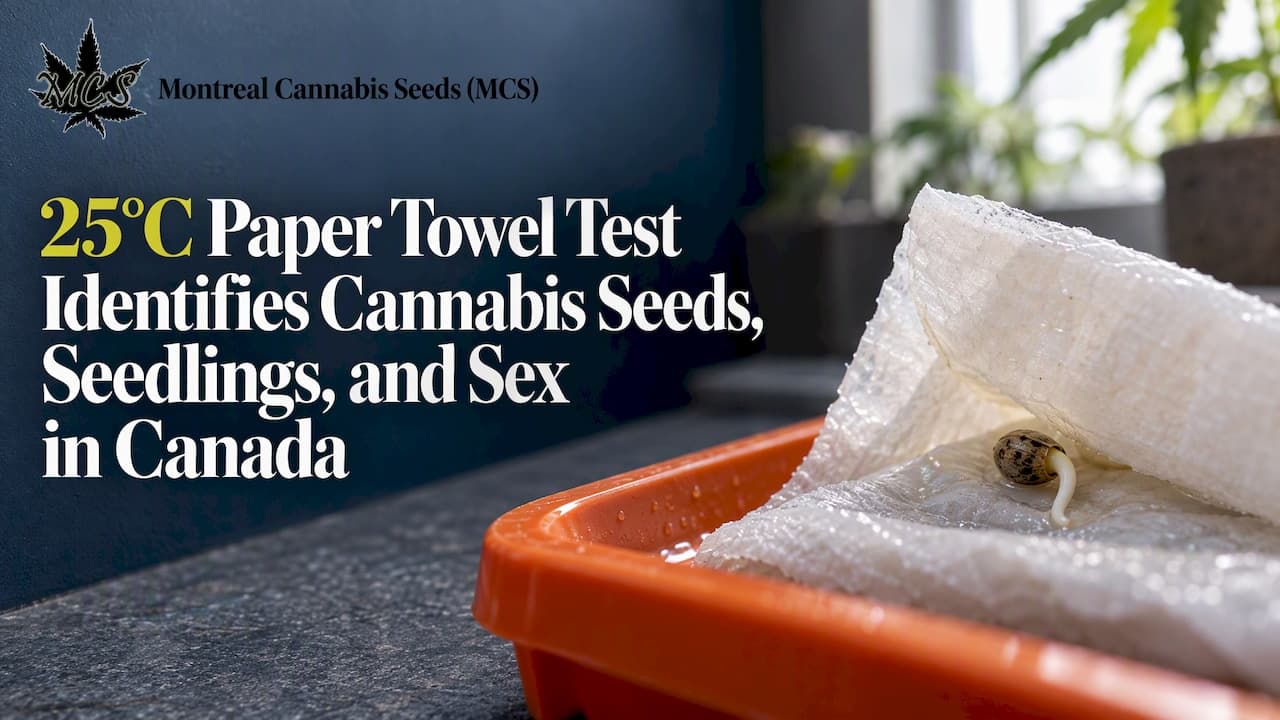
The paper-towel method remains the standard low-tech test:
- Moisten (not soak) a paper towel and fold the seed inside it.
- Keep it in a sealed container or bag near 25°C.
- Check daily; a healthy radicle typically emerges within a few days under stable warmth.
- Avoid letting the towel dry out or pooling water around the seed.
Studies comparing germination methods find that temperature near 25°C is a consistent practical optimum across paper-towel, sand, and filter-paper protocols, with results varying by method and seed quality rather than by any single trick. That's the figure worth remembering if germination has been inconsistent.
The float test, soaking seeds and watching which sink, is popular but unreliable on its own since dormant seeds can behave unpredictably in water. Pre-treatments like cold stratification or a brief hydrogen peroxide soak have shown promise in lab settings, including one protocol where a 1% hydrogen peroxide solution improved germination efficiency and reduced contamination compared with plain water. For seeds that still won't sprout after correct temperature and moisture, a formal lab test such as tetrazolium viability staining, described in the Industrial Hemp Technical Manual, gives a definitive answer. If several seeds from the same pack fail under otherwise correct conditions, the problem is very likely the lot itself, not your technique, and it may be worth asking the seed source about their germination guarantee.
4. Telling autoflower from photoperiod traits before flowering
Whether a plant flowers by age or by light cycle changes how you manage it from week one, and the distinction is invisible until you watch it behave. Photoperiod plants flower once the dark period lengthens past a threshold, meaning they stay vegetative under long light schedules and only trigger flowering when you shorten the light. Autoflowers shift into flowering automatically on a rough internal clock, regardless of light schedule.
- Autoflower timing: many complete their full cycle from seed to harvest in a compressed window measured in weeks rather than months, flowering by age.
- Photoperiod timing: vegetative growth continues indefinitely under long-light conditions and only ends when the grower changes the schedule.
- Early leaf shape is not proof of either type. Seedlings of both types can look nearly identical for the first few weeks.
- Vigour differences are unreliable indicators since nutrient status, container size, and temperature affect early growth more than genetics do.
If you're unsure which type you're growing, the safest move is to hold off on training techniques that assume a long vegetative window, and isolate the plant until its flowering behaviour under your actual light schedule confirms which category it falls into. A closer look at photoperiod, autoflower, and fast version genetics lays out the practical differences in more detail. For strain identity itself, such as which cultivar you actually have, leaf shape and early vigour won't tell you; that information comes from the seed vendor's own records or a lab chemotype test, not from visual guesswork.
5. Legal and buying guidance for sourcing seeds safely
Under the Cannabis Act backgrounder, adults may grow up to four cannabis plants per household for personal use, and seeds should come from authorised retailers rather than unregulated sellers. Illicit or unlabelled seed lots carry real risks: unknown pesticide exposure, unverified genetics, and no pedigree information, all of which make later identification harder rather than easier.
A short buying checklist helps avoid that problem before it starts:
- Confirm a germination guarantee is offered on the seeds you're buying.
- Look for clear strain information, including parentage and expected flowering type.
- Ask whether a lab certificate of analysis is available for the batch.
- Check that customer support can answer strain-specific identification questions.
6. Author perspective: field rules worth remembering
The three mistakes I see most often are guessing sex from seedling looks, trusting a float test as final proof, and blaming technique when an entire pack underperforms. Test before you cull, treat uncertain plants conservatively, and when a lot's germination is inconsistent, replace it rather than keep troubleshooting a bad batch. A guide to common cannabis deficiencies is worth reading before assuming a struggling seedling is a genetic problem.
— Dino Grow Master
Montreal Cannabis Seeds: a source of guaranteed seeds and support
Identification gets easier when you're not also second-guessing the seed itself. Montreal Cannabis Seeds (MCS) offers feminized and autoflower genetics backed by a germination guarantee that removes one layer of uncertainty before you even plant.

- A feminized and autoflower catalogue with strain-specific product pages.
- A germination guarantee on eligible seed purchases.
- Discreet shipping and customer support.
Clear product information and a guarantee mean fewer surprises at the seedling stage, since you already know what you planted and what to expect from it. Growers who want to compare traits before buying can browse all cannabis seeds or reach out to the MCS support team with strain-specific identification questions.
Sources
This article draws on the Cannabis Act backgrounder, the biology of Cannabis sativa, the germination testing comparison study, and the Industrial Hemp Technical Manual, among others. For a broader primer on matching genetics to growing goals, see this seed selection guide.
- The biology of Cannabis sativa L.
- Industrial Hemp Technical Manual — sampling, testing and processing methodology
FAQ
How can I tell if a cannabis seed is still good?
Look for a firm, unshrivelled shell with a brown, tan, or mottled colour rather than a pale or cracked one. A paper-towel germination test at around 25°C is the most reliable home check, since a float test alone can give misleading results.
At what stage can I tell if a plant is male or female?
Sex becomes visible once pre-flowers form at the internodes, well before full flowering, with males showing round pollen sacs and females showing calyxes with hair-like stigmas. The biology of Cannabis sativa confirms visual sex cues aren't reliable before that stage.
Why won't my seeds germinate even with correct care?
Uneven temperature during the lag phase, before the radicle emerges, is a common cause, and some lots simply have lower viability regardless of technique. Trying a tetrazolium or lab viability test, as outlined in the Industrial Hemp Technical Manual, can confirm whether the problem is the seed itself.
How many cannabis plants am I allowed to grow at home?
Under the Cannabis Act, adults may grow up to four plants per household for personal use, and seeds should be sourced from authorised retailers rather than unregulated sellers.
Can I tell a plant's strain just by looking at the seedling?
No, early leaf shape and vigour are not reliable indicators of strain identity. Strain information should come from the seed source's own records or, for chemotype confirmation, a lab test rather than visual comparison.