
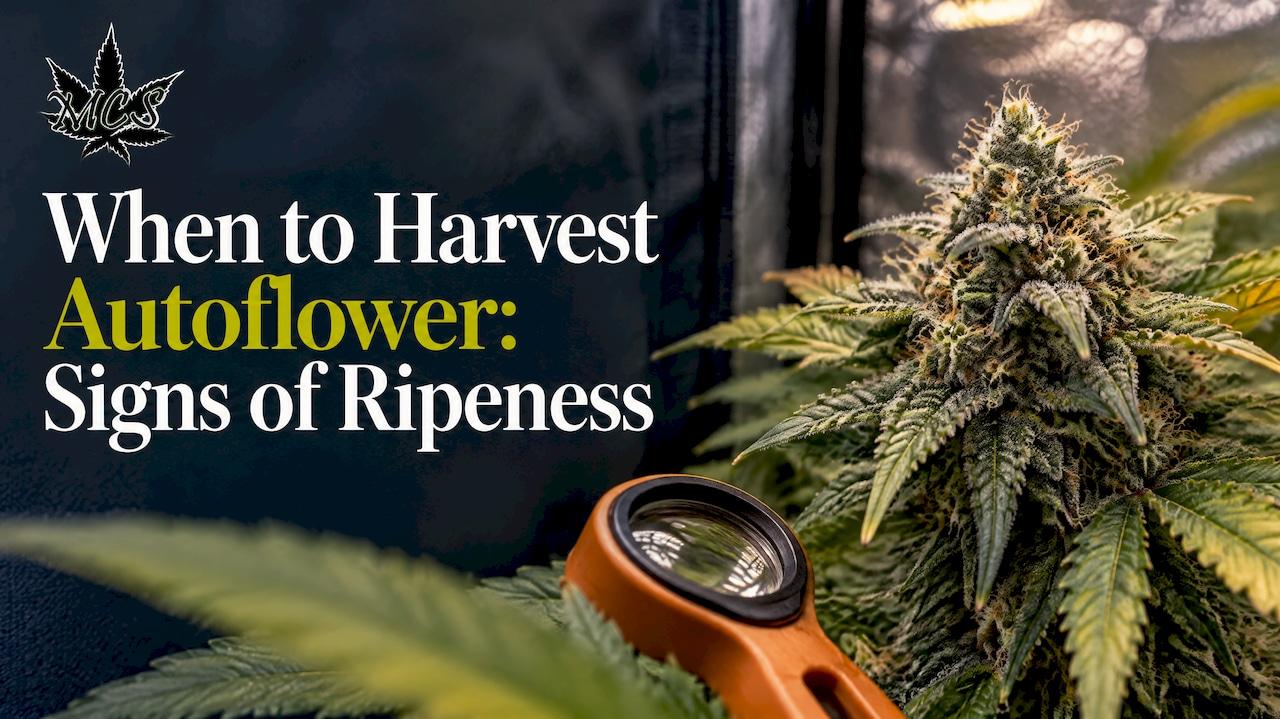
An autoflower is ready to harvest when most trichome heads have turned from clear to cloudy, with a minority of amber heads if a calmer effect is wanted, and when the pistils have darkened and the fan leaves have begun to fade. The calendar gives only a rough guide. Most autoflowering strains finish somewhere between 8 and 14 weeks from seed, but genetics, light, temperature and stress all move the date, so the plant itself is the better clock.
This guide sets out the indicators in the order they are normally checked, explains where each one misleads, and shows how Canadian conditions, from a basement tent in Montreal to a short outdoor season on the Prairies, change the decision.
TL;DR
- Judge ripeness with a magnifier of at least 16x: cloudy trichome heads mark peak maturity, while a growing share of amber heads shifts the effect toward the sedative end.
- Pistil color is a useful early warning, not a verdict. A 2025 study found that most genotypes peaked between "mostly amber" and "fully amber" stigmas, yet some peaked much earlier.
- Peak potency is a window of a few days rather than a single moment, so check several spots on the plant and compare notes over a week.
- Weeks from seed are a planning tool. Genotype, not age, drives when a given autoflower is finished.
- Outdoors, heat and wind can turn trichomes amber early, so leaf fade and bud swelling should carry more weight.
Table of Contents
- Why the calendar is only a starting point
- Trichomes: the most reliable indicator
- Pistils: an early signal, not the final word
- Leaf fade, swelling and other whole-plant cues
- Is higher potency always later?
- What happens if the harvest is early or late
- Indoors versus outdoors in Canada
- A practical pre-harvest checklist
- Our perspective: choose genetics that make the decision easier
- Picking an autoflower with a harvest plan in mind
- FAQ
- Sources
Why the calendar is only a starting point
Seed packs and strain descriptions quote a seed-to-harvest time, and it is a reasonable way to plan a season. The University of Saskatchewan's gardening program notes that deciding when to harvest rests on many factors, some objectively measurable and others a matter of personal preference. Autoflowers compress the process because flowering is triggered by age rather than by day length, which is explained in the store's article on what autoflower means. That compression makes the harvest window arrive quickly and leaves little room for error on a plant that is still maturing.
Two plants of the same strain, germinated on the same day, can finish several days apart. A cooler room slows maturation, a stressed plant may ripen early and a vigorous one may carry on. For this reason, experienced growers treat the quoted timeline as the moment to begin inspecting, not the moment to cut.
A practical rhythm works well:
- Note the strain's stated seed-to-harvest range when the seed is planted.
- Begin watching pistils and leaves roughly two weeks before the earliest date in that range.
- Begin daily trichome checks once most pistils have darkened.
- Cut within the window the trichomes define, even if it differs from the calendar.
Trichomes: the most reliable indicator
Trichomes are the tiny resin glands covering the flowers and sugar leaves. Their stalked, mushroom-shaped heads hold the cannabinoids and terpenes that give the harvest its value. For a closer look at what they are and how they relate to THC and CBD development, this explainer on trichomes is a useful companion read.
According to the University of Saskatchewan, the most dependable home method is inspecting the capitate-stalked trichome heads at 16x magnification or higher. A jeweler's loupe or a small clip-on microscope is enough. A phone camera held close can help, but the glare and autofocus often blur the very detail being judged.
The three stages
| Trichome appearance | What it indicates | Typical decision |
|---|---|---|
| Clear and glassy | Still developing; cannabinoid production is incomplete | Wait |
| Milky or cloudy | Peak maturity of THC and CBD | Harvest begins to make sense |
| Amber | Cannabinoids oxidizing; THC degrading | Harvest soon for a more sedative effect, or avoid if a bright effect is wanted |
The same University of Saskatchewan guidance observes that growers seeking an energetic, stimulating effect often cut when the heads are mostly cloudy, while those who want a more relaxing effect wait until more amber heads appear. It also describes a peak ripeness period of about five days before degradation begins and cannabinoid levels fall.
A sensible target
A common working target is mostly cloudy heads with a modest share of amber, but no single ratio is correct for every plant. The McGill University research summarized in the sources below frames the harvest as a chance to personalize the final effect by adjusting the balance of cloudy and amber heads, rather than hunting for one perfect day. A grower after a clear-headed daytime profile might cut when amber is nearly absent. A grower making evening-use flower, or a medicinal user who prefers a heavier effect, might allow a larger amber share.
Check more than one spot
Trichomes on the top colas, exposed to light and heat, mature and degrade faster than those deep in the canopy, according to the University of Saskatchewan. Looking only at the sunniest bud therefore overstates ripeness. The better habit is to examine the buds themselves, not only the sugar leaves, at the top, the middle and the shaded lower branches, and to judge the plant on the average. Sugar leaves often ripen earlier than the flower and can mislead.
Two more practical points. Magnification should be done with the plant in normal light, since a bright inspection lamp held close can distort color. And inspecting at the same time of day each time makes comparisons between days more consistent.
Pistils: an early signal, not the final word
Pistils, the hair-like stigmas on the flowers, start white and rise, then darken to orange, red or brown and curl inward as the flower matures. Many guides advise starting trichome checks once around half the pistils have darkened, and that is a sound trigger for beginning inspection.
The science supports pistils as a rough proxy with caveats. In a 2025 study of 25 cannabis genotypes, 22 reached their peak total cannabinoid concentration between the "mostly amber" and "fully amber" stigma stages: 10 at the third stage and 12 at the fourth. The traditional rule of thumb therefore holds for most plants. But one genotype peaked at the first stage and declined afterward, which shows why pistils alone cannot be trusted for an unfamiliar strain.

Pistil color is also less dependable for a few mundane reasons. Light, heat and wind can darken pistils prematurely, and a late flush of new white hairs near the tips of the colas is common in autoflowers and does not mean the plant is unfinished. Pistils indicate that harvest is approaching. Trichomes confirm it.
Leaf fade, swelling and other whole-plant cues
Autoflowers senesce in late flower, meaning the plant begins pulling resources out of the fan leaves. Bright green foliage yellows, and lower leaves may drop. A moderate fade is natural and is a supporting signal that ripening is under way. It should not be confused with a nutrient problem such as a stalled, uneven yellowing across the whole plant, which is a separate issue.
Other cues worth recording:
- Bud swelling. Calyxes stack and swell, and the flowers feel dense rather than airy.
- Aroma. Terpene smell intensifies markedly in the final weeks and is often the first sign that the plant is close.
- Slower new growth. Fresh white pistils stop appearing in large numbers and the canopy stops stretching.
The University of Saskatchewan background notes that experienced cultivators combine these indicators rather than trusting trichome color alone, partly because visual markers are proxies. They cannot confirm actual cannabinoid concentration, which only laboratory analysis of pooled samples can measure. For a home grower, a sensible conclusion is to treat the signals as a set: when pistils, trichomes and leaves agree, the decision is easy. When they disagree, trichomes at 16x or more decide.
Is higher potency always later?
A popular belief holds that THC keeps climbing until the final day. The research is less tidy. A 2021 hemp study from Oregon State University found that 59% of the cannabinoids that responded to harvest time had their highest concentration at the earliest harvest, while the rest peaked later. A McGill University thesis monitoring three cultivars through flowering reported that THC showed no statistically significant downward trend even after 63 days of flowering, which suggests that waiting somewhat longer does not necessarily cost potency in every cultivar.
These findings pull in different directions, and that is the point. Cannabinoid development depends heavily on genetics, and the differences between harvest dates can be small: the same research reports THC variation of up to 0.24% of dry weight depending on timing. The practical meaning is that over-agonizing about a single day brings little gain, while cutting far too early or leaving a plant for weeks past maturity does cost quality.
What happens if the harvest is early or late
Harvesting too early generally means a lighter yield, a grassier aroma and a flower that smokes harshly, since the trichome heads were still developing and the buds had not finished swelling. Harvesting too late, once most heads are amber, tends to give a heavier, more sedative effect and a flatter aroma as THC oxidizes and volatile terpenes are lost.
The cost of lateness is usually milder than the cost of earliness, which is why growers who are uncertain between two days often choose the later one. There is a ceiling, however. Once the trichomes are largely amber and the leaves are collapsing, nothing further is gained, and in a damp room the risk of mold in dense buds rises. Growers handling strains with tight, heavy flowers in a humid Canadian fall should watch this closely.
Indoors versus outdoors in Canada
Indoor plants ripen more predictably because light, temperature and humidity are controlled. Outdoors, the picture is less tidy. The University of Saskatchewan warns that harsh conditions such as intense heat or wind can cause resin glands to degrade and turn amber prematurely, before cannabinoid synthesis has finished. In that situation, reading trichome color alone would send the grower to the shears too early. General senescence and bud swelling become the more accurate guide.
Season length matters as well. Autoflowers are popular outdoors in Canada precisely because they can finish between a late-spring planting and the first hard frosts. A plant that is still immature when nights drop toward freezing needs protection or an earlier decision, and a cold, wet fall argues for harvesting at the early end of the window to avoid bud rot. For seeds suited to open-air conditions, the store keeps a page of outdoor cannabis seeds.
A practical pre-harvest checklist
The days around the decision go more smoothly with a short routine.
- Record the plant's age and the strain's stated range. Start inspections about two weeks before the earliest date.
- Inspect with at least 16x magnification. Look at buds from the top, middle and lower canopy and estimate the share of clear, cloudy and amber heads.
- Log the result each day or every second day. Trends matter more than a single reading, and the roughly five-day peak window becomes visible.
- Decide the target effect. Mostly cloudy for a brighter profile, more amber for a heavier one.
- Cut when the average matches the target. Do not wait for the shaded lower buds to catch up unless they are a large part of the plant.
- Prepare the drying space beforehand. Harvest day should not be the day the room is first set up.
What follows harvest, including trimming methods, is outlined in the University of Saskatchewan's guide to harvesting and trimming cannabis, which notes that growers either cut the whole plant at the base or take it apart by branch before trimming.
Our perspective: choose genetics that make the decision easier
We see harvest timing questions come from two kinds of growers: beginners who worry about cutting too soon, and experienced growers who have been burned by a strain that behaved differently from the last one. Both cases come back to the same point. The strain's genetics determine how obvious its ripeness signals are and how wide its window is.
Our approach is to curate strains for Canadian conditions and to publish detailed product information, so that the expected finishing time is known before the seed goes in the ground. A grower who knows that a given autoflower is meant to finish in a certain range can plan the room, the drying space and the calendar around it, instead of discovering the timing the hard way. That is also why we encourage keeping a simple log on a first run: the second run of the same strain is almost always easier to read.
For a first autoflower, we suggest picking a cultivar with a reputation for steady, readable finishing, keeping the environment stable, and trusting the trichomes over the calendar. Support questions about a specific plant are welcome, since local conditions often explain what looks like an odd result.
— Dino Grow Master
Picking an autoflower with a harvest plan in mind
Finishing time and flower density vary between strains, and that affects both the date and the drying risk. The store's autoflower seeds category is the place to compare genetics. A few examples from the catalog, each with its own product page, include Northern Lights Autoflower, Critical Mass Autoflower and, for a CBD-focused grow, CBD White Widow Autoflower. Each page sets out the genetics and the details that help plan the grow. Orders ship discreetly across Canada and are covered by our germination guarantee. The full range, including feminized, CBD and outdoor seeds, can be browsed from the Montreal Cannabis Seeds home page.
FAQ
How do I know when to harvest my autoflowers?
Start by watching for most pistils to darken and the fan leaves to begin fading. Then examine the trichomes at 16x magnification or higher. When most heads are cloudy, with the amber share matching the desired effect, the plant is ready. Check several areas of the plant, not only the top colas.
What happens if you wait too long to harvest an autoflower?
As trichomes turn amber, THC gradually oxidizes and the effect becomes heavier and more sedative, with a flatter aroma. Dense buds in a damp room also face a higher risk of mold. The loss is usually gradual, not sudden, so a delay of a day or two rarely ruins a harvest.
Is harvesting by the number of weeks reliable?
Only as a rough guide. Autoflowers commonly finish between 8 and 14 weeks from seed, but the range reflects different strains and growing conditions. Genotype is the strongest determinant of when peak potency arrives, so the trichomes should overrule the calendar.
Should I harvest earlier outdoors?
Often, yes, if the weather turns cold and wet, since mold becomes the main danger. Intense heat or wind can also push trichomes to amber ahead of schedule, so outdoor growers lean more on leaf fade and bud swelling than on trichome color alone.
Sources
- Harvest Timing, Gardening at USask, University of Saskatchewan
- Harvesting and Trimming Cannabis, Gardening at USask
- Determination of Optimal Harvest Time in Cannabis sativa L. Based upon Stigma Color Transition, PMC
- Monitoring of trichome morphology and THC content of 3 Cannabis sativa cultivars throughout flowering and post-harvest periods, McGill University
- Investigating the effects of harvest time and light exposure on cannabinoid potency in industrial hemp, Oregon State University