
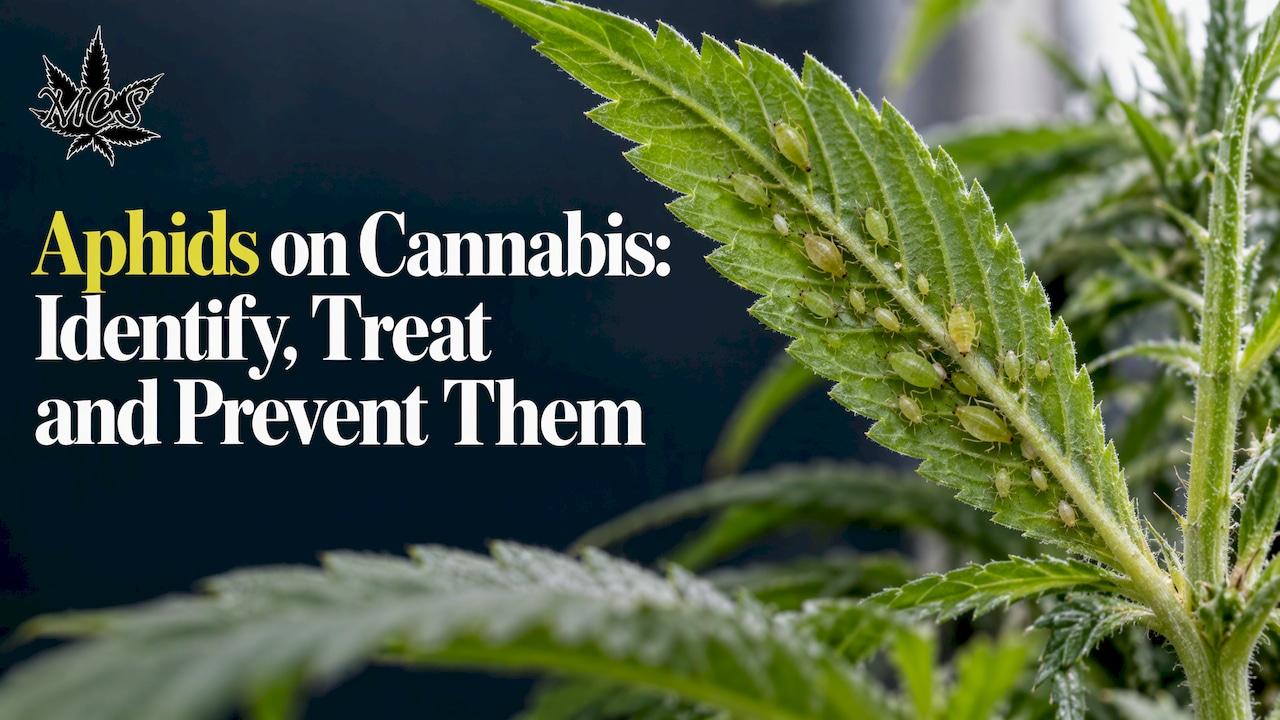
Aphids on cannabis are tiny, soft-bodied sap-feeders that show up as clusters on the undersides of leaves near new growth, or as a hidden problem at the roots. They are manageable when caught early: remove infested tissue, knock the colony back with a thorough spray on vegetative plants, and stop new insects from entering the room. Left alone, they weaken the plant, coat leaves in sticky residue and can ruin flowers. This guide explains how to tell leaf aphids from root aphids, what to do about each, and how to prevent a repeat.
TL;DR
- Leaf aphids are 1 to 4 mm, pale green, yellow, pink or brown, and leave sticky honeydew and shed skins. Root aphids live in the growing medium and look like nutrient or water stress.
- Treat early and only during vegetative growth: prune badly infested leaves, rinse the plant, and use a soap-based spray that contacts the insects directly.
- Never spray flowers. Anything applied to buds can end up in what you consume.
- Root aphids are far harder to remove, so prevention matters most: clean media, quarantine for any plant brought in, and moderate nitrogen.
- Starting from seed removes one common route of entry, since no cuttings from another room come in with the plant.
Table of Contents
- What aphids do to a cannabis plant
- How to recognize leaf aphids
- Root aphids: the hidden version
- Quick comparison: leaf aphids and root aphids
- Treating leaf aphids
- Treating root aphids
- Can a cannabis plant recover from aphids?
- Preventing aphids in a home grow
- Starting from seed and pest pressure
- Choosing seeds for a cleaner start
- FAQ
- Sources
What aphids do to a cannabis plant
Aphids pierce the plant and drink sap. According to the British Columbia integrated pest management manual for commercial cannabis, leaf-feeding aphids reduce plant vigor, can distort leaves, and produce honeydew that may lead to sooty mold. Root aphids feed on roots instead, which inhibits water and nutrient uptake, and heavy populations are associated with water-stress and nutrient-deficiency symptoms.
Two features make them a serious pest rather than a nuisance. First, they reproduce quickly: a few insects on one leaf become a colony within a short time under warm indoor conditions. Second, the damage is cumulative. Honeydew, shed skins and sooty mold are most harmful once buds form, because dense flowers hold moisture and residue that is difficult to remove.
The species also differ by where they live. The cannabis aphid (Phorodon cannabis) feeds on foliage and is specific to cannabis and hemp. The rice root aphid, studied in a 2020 paper on cannabis as a host of rice root aphid, lives in the root zone and spreads by winged adults.

How to recognize leaf aphids
A close look with a hand lens, ideally under the leaves, answers most questions. Per the BC manual, adult aphids are 1 to 4 mm long, pear-shaped and soft-bodied, with six legs, long antennae and two tail-like tubes called cornicles at the rear of the abdomen.
Color is not a reliable identifier. Utah State University Extension notes that cannabis aphids shift from cream and pale yellow to light green, pale pink or light brown depending on life stage and season.
Signs on the plant
The same extension page lists the common signals: insects clustered on the plant, shiny sticky honeydew, shed skins, yellowing leaves, slowed growth and wilting. Use this checklist during weekly inspections:
- Turn over leaves near the newest growth, where colonies usually start.
- Look for small shiny droplets on leaf surfaces. Colorado State University describes honeydew as an excellent diagnostic sign of cannabis aphid infestations.
- Check for small white, translucent skins stuck to leaf undersides or on the surface below.
- Notice curling or distorted new leaves, and lower leaves that yellow without a clear nutrient cause.
- Hang a few yellow sticky cards near the canopy. Colorado State's cannabis aphid page says yellow sticky traps can detect winged adults.
Sooty mold and what it means for buds
Honeydew is sugary, and a dark mold grows on it. The black film is sooty mold, a surface fungus that blocks light on leaves and, on flowers, is a quality and safety concern in its own right. If any dark or fuzzy growth appears on buds, a separate guide on how to spot mold on weed helps tell sooty mold, powdery mildew and bud rot apart.
Root aphids: the hidden version
Root aphids are the version most growers misdiagnose. The BC manual describes the contrast clearly: leaf aphids sit on leaf surfaces, stems and buds and leave honeydew and distortion, while root aphids feed in the soil or growing medium and typically present as poor growth and nutrient stress.
That means a plant that looks hungry, thirsty or stunted, but does not respond to feeding or watering changes, deserves a root check. Rice root aphids are dark green with red or brown coloring on the abdomen and measure 1.6 to 2.2 mm according to the same manual. Gently lift the plant from its container and inspect the outer root ball. Root aphids are often accompanied by waxy or powdery residue and ants in outdoor containers.

The 2020 paper cited above adds a useful clue: dead winged root aphids trapped on the plant hairs of upper leaf surfaces are often the first indication of an infestation. The winged adults may emerge from soil in large numbers near maturity, colonize new plants and give birth on stems and foliage.
Root aphids versus fungus gnats
Winged root aphids are easy to confuse with fungus gnats. Trade-magazine coverage in GrowerTalks points out that the aphids have stouter bodies, shorter legs and wings often folded over the body. Gnats are slimmer and longer-legged and hover near wet media. If the insects you see are on sticky cards but behave like slow, heavy-bodied flyers, consider root aphids. For gnats, our fungus gnat control plan for Canadian growers covers a full four-week approach.
Quick comparison: leaf aphids and root aphids
| Feature | Leaf aphids | Root aphids |
|---|---|---|
| Where they live | Undersides of leaves, stems, buds | Soil or growing medium, on roots |
| Typical sign | Honeydew, shed skins, curled new leaves | Stunting, wilting, apparent nutrient stress |
| First clue | Clusters at growing tips | Dead winged adults on upper leaves, or aphids on the root ball |
| Secondary problem | Sooty mold | Water and nutrient uptake reduced |
| Ease of control | Moderate if caught early | Difficult once established |
If the symptoms resemble a deficiency, compare them against our guide to cannabis deficiencies before assuming pests, and then check the roots to be sure.
Treating leaf aphids
The BC manual's approach for leaf aphids is to prune and dispose of infested tissue and then use biological controls or registered pesticides. For a home grower, that translates into a sequence.
Step 1: remove and isolate
Move the affected plant away from others. Remove heavily infested leaves, bag them tightly and take them out of the grow space so surviving aphids cannot walk back. Do not compost them in the same area.
Step 2: knock the colony back physically
A firm spray of plain water on the undersides of vegetative leaves dislodges many insects. The University of Georgia Extension guide to insecticidal soap notes that higher-pressure spray can knock small insects off in addition to any soap effect.
Step 3: use a soap-based spray correctly
A common question is whether diluted dish soap and water kills aphids. It can, with conditions. The University of Georgia source says soap only works when the spray coats the insect's body, so it must reach the undersides of leaves, and spraying leaves with no insects present does nothing. It suggests a 1 to 2 percent solution, roughly 1 to 2 teaspoons of dish soap per pint of water, and a test on a small part of the plant for a couple of days before treating the whole plant, because soap can injure foliage.
Two practical points follow from this:
- Repeat applications are usually needed, since newly hatched nymphs are not affected by earlier sprays. Re-inspect every few days.
- Apply only in the vegetative stage or very early in flowering. Soap residue on developing flowers is a quality risk and a consumption risk, so no spray belongs on buds.
A soap-based product made for plants is a safer choice than a household detergent with added fragrances, dyes or degreasers, whose effect on cannabis foliage varies.
Step 4: use biological controls where available
Beneficial insects, including parasitic wasps and predators, are the standard biological approach in commercial production. The Colorado State pages above describe cannabis aphid management with these tools. In a small home room, the practical value depends on space and temperature, so most home growers rely on sanitation, pruning and physical removal.
Hot water for cuttings
Research from the University of Guelph, a 2025 thesis on integrated pest management for cannabis aphid, found that submerging propagative cuttings in 41 °C water for 10 minutes effectively decreased cannabis aphids. It applies to cuttings brought into a room, not to flowering plants or established root balls, and it is one reason quarantine and treatment of incoming material are standard in professional operations.
Treating root aphids
Here the evidence is more cautious. The BC manual states that for root aphids the priority is preventing entry by quarantining new plants, and that no effective biological controls or registered pesticides are available for commercial indoor cannabis. In Canada, pesticide use falls under the federal Pest Control Products Act, and products must be registered for the crop. Check the label for cannabis before using anything.
Research reported in Greenhouse Canada shows why shortcuts are risky: new products tested against rice root aphids showed more than 90 percent efficacy in propagation and vegetative plants but also caused root-zone phytotoxicity. The same article notes that repeated biopesticide drenches can be effective, but concentration and frequency need careful thought to avoid negative effects on growth and yields.
For a home grower, that points to a practical order of operations:
- Confirm the diagnosis by inspecting roots.
- If the infestation is mild and the plant is young, consider discarding the plant and its media rather than risking spread to the whole room.
- Clean pots, trays and tools, and replace the media with fresh, sterile material.
- Keep new plants separate for at least a few weeks and inspect their roots at transplant.
Discarding a plant feels costly, but it is often cheaper than losing an entire grow.
Can a cannabis plant recover from aphids?
Vegetative plants often do. Once colonies are removed and growth resumes, new leaves come in normally, though damaged leaves do not repair themselves and can be removed if they are mostly dead. Sooty mold on leaves can be reduced by cleaning once the source is gone.
Recovery is less certain close to or during flowering. Honeydew and shed skins on developing buds cannot be safely washed or sprayed away, and the plant has less time to rebuild. If you find an infestation in mid or late flower, the realistic goals are to remove infested leaves by hand, improve airflow, use only physical methods, and inspect buds thoroughly at harvest. Discard any flowers with residue, mold or heavy insect contamination rather than consuming them.
Preventing aphids in a home grow
Prevention is where the evidence is strongest. The BC manual lists several measures, each of which scales down to a home setup:
- Sterilized or fresh potting media. Do not reuse soil from a previous grow that had pests.
- Quarantine incoming plants. Any clone, gifted plant or garden-center plant should stay isolated and be inspected before it enters the room.
- Screen vents and openings. Fine mesh on intakes keeps winged adults out.
- Manage nitrogen. Excess nitrogen produces lush, soft growth that attracts aphids. Feed to the plant's stage rather than overfeeding.
- Keep a weed-free buffer around the grow area and limit movement between rooms or tents.
Add a habit that makes the rest work: inspect leaf undersides weekly, and more often in warm weather. Aphids found when there are ten are a five-minute job. Aphids found when there are a thousand are a crisis.
Trouble often arrives together. Dry, warm rooms that suit aphids can also suit mites, so the same inspection should include a check for webbing and stippling. Our spider mite IPM guide for Canadian growers covers that side, and the broader cannabis pest and deficiency library helps with look-alike symptoms.
Starting from seed and pest pressure
A plant started from a seed has no history in another grower's room. Cuttings, by contrast, are a known route for aphids and mites to enter a space, which is why professional operations quarantine them. For home growers, beginning with seed is a simple, built-in form of quarantine, though it does not replace regular inspection, clean media and screened air.
We approach pests as a planning problem rather than an emergency. A grower who inspects weekly, keeps media clean and starts from seed in a controlled space gives aphids very few openings.
At Montreal Cannabis Seeds, we curate genetics for Canadian climates and back them with a germination guarantee and detailed product information, so a grow begins on a clean footing. Our support team understands local conditions, including the dry indoor air of a Canadian winter and the swings of an outdoor season. Choosing the right plant type for your space reduces how long plants stay exposed. For example, faster-finishing genetics spend fewer weeks in the room, which means fewer weeks of pest risk.
The strongest defense is not a spray. It is a routine, a clean room and a plant that grows without stress.
Dino Grow Master
Choosing seeds for a cleaner start
If you are planning your next grow, begin with a clean sheet. Our feminized seeds suit growers who want to avoid male plants, autoflower seeds finish on a compact schedule, and fast version seeds shorten the time to harvest of photoperiod genetics. Each comes with detailed product information and our germination guarantee, and shipping across Canada is fast and discreet.

Browse the full range on the Montreal Cannabis Seeds store, or compare plant types first in our photoperiod, autoflower and fast version comparison.
FAQ
How do I know if my cannabis plant has aphids?
Look under leaves near new growth for small, soft-bodied insects in cream, green, pink or brown, plus shiny sticky droplets and shed skins. Yellowing leaves, slowed growth and wilting are later signs. If nothing is visible above ground but the plant looks stressed, check the roots for root aphids.
Will dish soap and water kill aphids on cannabis?
A dilute soap solution can kill aphids that it directly coats, and repeat applications are normally needed. Extension guidance suggests about 1 to 2 teaspoons of dish soap per pint of water and a small test area first. Use it on vegetative plants only, never on flowers.
Can cannabis recover from aphids?
Yes, especially vegetative plants treated early. New growth appears normally once the colony is gone, while damaged leaves stay damaged. In flower, residue on buds is the main concern, so inspect carefully and discard contaminated flowers.
Are root aphids different from leaf aphids?
Yes. Leaf aphids feed on foliage and stems and leave honeydew. Root aphids live in the growing medium, cause stress that mimics deficiency, and have no registered treatments for commercial indoor cannabis in British Columbia's guidance, so prevention and quarantine matter most.
Can I smoke buds that had aphids?
Buds with honeydew, shed skins, sooty mold or visible insects should not be consumed. Residue is difficult to remove from dense flowers, and mold carries its own health concerns. If in doubt, discard.
Sources
- Cannabis Aphid, Utah State University Extension
- Cannabis sativa as a Host of Rice Root Aphid
- Cannabis Aphid Management Indoors, Colorado State University
- Cannabis aphid, Colorado State University Agricultural Biology
- Pesky Cannabis Pests, GrowerTalks
- Integrated Pest Management Strategies for Cannabis Aphid, University of Guelph
- Research update on cannabis and rice root aphid management, Greenhouse Canada
- Insecticidal Soap, University of Georgia Extension