
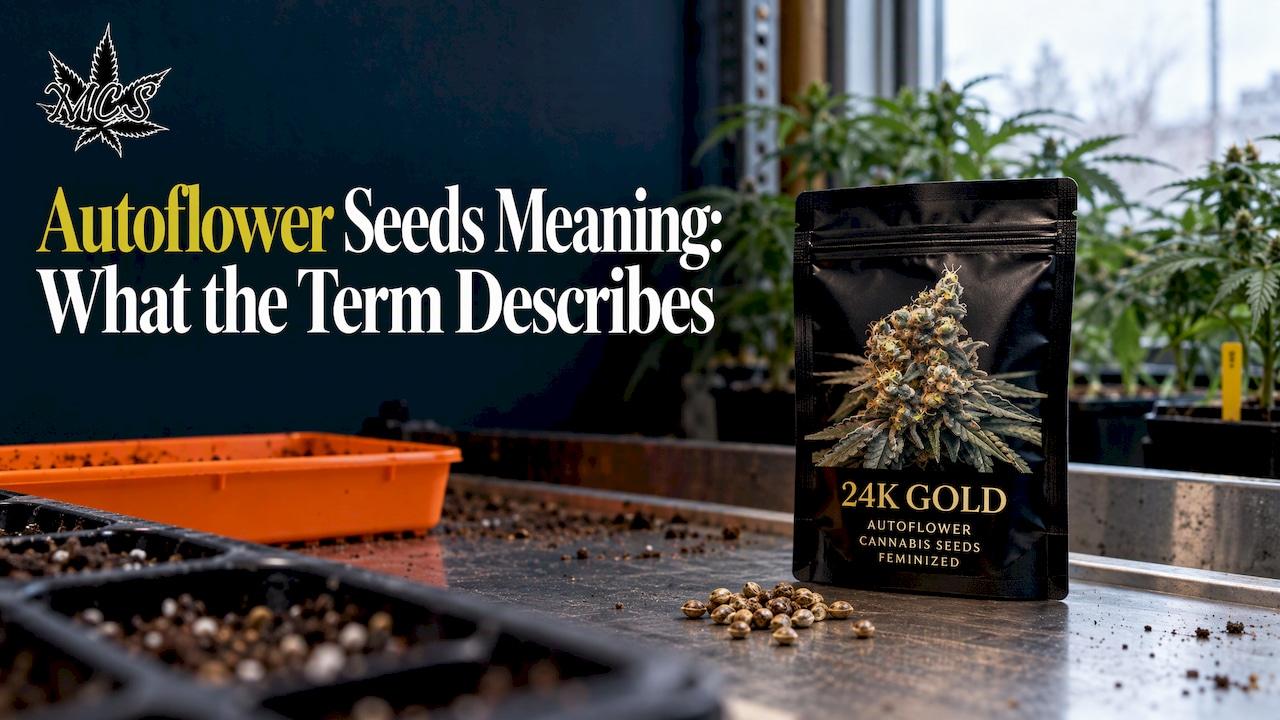
Autoflower seeds are cannabis seeds whose plants begin flowering on their own internal schedule, based on developmental stage rather than a change in the light cycle. The word "auto" describes what triggers bloom, not how the seed looks, how it was sexed or how strong the finished flower will be. Our store blog already explains what autoflowering means in general, so this article takes a narrower path: what the term means on a seed packet, where it comes from genetically, and how to read it correctly when you shop.
TL;DR
- "Autoflower" labels a flowering trigger: the plant flowers with age, roughly 4 to 5 weeks after growth begins, whatever the hours of daylight.
- The trait traces back to northern ruderalis populations and is controlled by a recessive gene locus, which is why breeders handle it deliberately.
- Autoflower describes timing, while feminized describes sex. A packet can carry both words, and the combination is the one most growers look for.
- Autoflowering plants are often ready in 70 to 90 days, which suits short Canadian seasons.
- Check your provincial rules on home cultivation before you order seeds.
Table of Contents
- What the word "auto" actually refers to
- Where the trait comes from
- How the term reads on a seed packet
- Do autoflower plants make seeds?
- What the label means for a Canadian grower
- Reading an autoflower listing well
- Our perspective
- Where to start in our catalog
- FAQ
- Sources
What the word "auto" actually refers to
Cannabis is usually classed as a short-day plant. According to a peer-reviewed study of flowering-time genetics, it flowers once night length passes a critical threshold, and some plants are photoperiod insensitive, a trait colloquially called "autoflowering." In practical terms, a conventional plant stays vegetative under long days until the nights lengthen, while an autoflowering plant does not wait for that signal.
The University of Saskatchewan's gardening program describes the contrast simply: photoperiod-type plants are triggered by 12 hours or more of uninterrupted darkness, whereas autoflowering plants begin to flower automatically after about four to five weeks of total growth, regardless of how much light the day contains.
This is the core of the meaning, and it is worth keeping the wording precise. The plant is not flowering "by itself" in a magical sense. It is flowering without needing a light-cycle cue. Researchers use the terms day-neutral and photoperiod-insensitive for the same behavior, and trade writing in Greenhouse Grower uses the same vocabulary, noting that day-neutral strains begin flowering when they are developmentally ready, regardless of photoperiod.
Why "age, not light" is a simplification
Growers often say an autoflower runs on age rather than light. That is a useful shorthand, but the underlying process still involves genetic regulation, developmental stage and internal signalling, and environment still shapes the result. A stressed autoflower will not behave like a healthy one, even though its flowering switch is not tied to the clock on your light timer. Reading the label as "flowers on a developmental schedule" is more accurate than reading it as "ignores everything."
Where the trait comes from
The meaning of autoflower is inseparable from its origin story. The University of Saskatchewan notes that the trait is thought to come from plants that evolved in harsh northern regions of Asia, where summers are short but days are long. Those plants became day-neutral so they could set viable seed before winter arrived. They tend to be very small and resin-poor, which is where the name ruderalis comes from.
Only in recent decades have breeders crossed these dwarf types with photoperiod cultivars. Leafly's overview of autoflower plants explains that modern autoflowers are usually crossbred with popular strains, which is why catalogs list names such as Northern Lights Auto or White Widow Auto: the first half of the name is the photoperiod parent's reputation, and "Auto" signals the added ruderalis timing.
If you want the longer history, our store blog covers it in Ruderalis Genetics Explained.
The genetics behind the label
The 2022 mapping study identified a locus named Autoflower1 and found the trait is recessive with respect to photoperiod insensitivity. Two details from that paper matter to anyone reading a seed description:
- Because the trait is recessive, a seed line must carry two copies of it to produce a reliably autoflowering plant. This is why a dependable autoflower line takes deliberate breeding and selection.
- In field conditions, plants carrying only one copy flowered about two weeks earlier than the comparison group, giving smaller plants with less total biomass. Timing and size are linked, which is why autoflowers are bred around compact growth.
None of this requires you to do genetics at home. It explains why "autoflower" on a product page is a statement about stable, selected seed lines rather than a casual descriptor.
How the term reads on a seed packet
A seed listing combines several labels, and each answers a different question. Confusing them is the most common misreading of the term.
| Label | Question it answers | What it does not tell you |
|---|---|---|
| Autoflower | What triggers flowering? | Sex of the plants, potency, yield |
| Photoperiod | Does flowering depend on the light cycle? | Speed, size, sex |
| Feminized | Are the plants expected to be female? | Flowering trigger |
| Regular | Will both sexes appear? | Flowering trigger |
| Fast version | Is a photoperiod plant bred to finish sooner? | Autoflowering behavior |
The University of Saskatchewan makes the key point clearly: seeds come as regular or feminized, and as photoperiod or autoflowering, with all four combinations possible. Regular seeds give roughly a 50/50 chance of either sex, while feminized seeds are intended to produce only female plants.
"Autoflower" and "feminized" together
Because the two labels cover different questions, the phrase "autoflowering cannabis seeds feminized" is not redundant. It says the plant should flower on its developmental timer and should be female. Most autoflower products in our catalog carry both, which you will see in listings such as Northern Lights Autoflower and Diesel Autoflower. Our store post on whether autoflowering seeds are always female covers that overlap in depth.
"Fast version" is a different thing
Fast version seeds are still photoperiod plants bred to finish earlier. They respond to the light cycle, so you control when they flower. Autoflowers do not. The distinction affects planning, because a photoperiod plant, even a fast one, can be held in vegetative growth as long as you like, while an autoflower cannot. Our Fast Versions category lists them separately for this reason.

Do autoflower plants make seeds?
A question that appears beside this keyword is whether an autoflower "has seeds." The answer is yes in the botanical sense. The day-neutral habit evolved precisely so that the plant could complete reproduction in a short northern season and produce viable offspring before winter. An autoflowering plant is a normal cannabis plant in this respect: a pollinated female sets seed, and an unpollinated female puts her energy into flower.
For a home grower, the practical consequence is that seed production is a separate project from growing flower. Seeds bought from a breeder are produced under controlled conditions so that the line stays stable, including the recessive autoflower trait. Saving seed at home from a mixed or unstable plant can scramble traits, which is one reason growers buy fresh, labeled stock for each run.
What the label means for a Canadian grower
The appeal of autoflowers in Canada follows from their origin. A plant bred from northern genetics suits a country with short summers. The University of Saskatchewan notes that many autoflower-type plants are ready to harvest in 70 to 90 days, which fits a late May to early June planting and a harvest in late August to early September in Saskatchewan's short but intense season.
Indoors, the same source says autoflowering plants do well under any light schedule, with 18 hours on and 6 off recommended for maximum photosynthesis. Trade coverage in Greenhouse Canada adds that autoflowers offer the predictability of a harvest within 100 days or less from planting, and that modern varieties from reputable breeders retain the terpenes and cannabinoids growers expect, with bud structure and density now on par with photoperiod types.
What you should take from this:
- Timing is built in. Count backward from your first expected frost or your preferred harvest window, and the seed's label tells you the plant will not stall in vegetative growth.
- Multiple runs become possible. A short cycle lets an indoor grower plan consecutive harvests, a point often made in grower literature on northern climates.
- Compact plants suit small spaces. The ruderalis ancestry shows up as modest stature, which is useful on a balcony, in a closet or in a small tent.
Legal context matters too. Home cultivation rules in Canada are set federally and then by each province, and they differ from one province to the next. Confirm what applies where you live with your provincial authority before you plant.
Reading an autoflower listing well
Once the label is clear, the rest of the listing does the work. A detailed product page for an autoflower should answer a short list of questions:
- Parent genetics. Which photoperiod cultivar was crossed with the autoflowering line? This tells you the likely flavor and effect profile.
- Sex. Is the seed feminized or regular?
- Expected cycle length. Seed to harvest, in days or weeks, indoors and outdoors.
- Cannabinoid profile. THC-dominant or CBD-focused. Our CBD autoflower options are one example for growers who want a CBD-led profile.
- Intended environment. Indoor, outdoor or both.
The point of reading it this way is to treat "autoflower" as one data point among several. Two autoflowers can differ as much as two photoperiod strains in aroma, structure and effect, because the label carries only timing information.
Common misreadings
- "Autoflower means weaker." The label says nothing about potency. As noted above, reputable breeders have kept cannabinoid and terpene content comparable to photoperiod lines.
- "Autoflower means no light schedule needed." The flowering trigger is independent of the schedule, but the plant still needs good light to photosynthesize. That is why a long daily light period is recommended indoors.
- "Autoflower means feminized." The two are independent traits.
- "Autoflower means wild ruderalis." Modern autoflowers are crosses. Pure ruderalis is small and resin-poor, so catalog products are selected hybrids.
Our perspective
We built our catalog around the idea that a label is only useful if the buyer can read it. "Autoflower" is a good example: it is one word describing one trait, and growers sometimes ask it to carry meaning about potency, sex or ease that it was never meant to hold.
Our position is that autoflowers are a strong fit for Canadian growers, and the reason is the genetics, not marketing. The trait comes from northern plants adapted to short seasons, and that history lines up with the conditions many of our customers grow in. We pair that with detailed product information so each listing states the parent cultivar, the sex of the seed and the intended environment, and with a germination guarantee on the seeds we sell.
We also recommend reading autoflower and feminized together. If you want plants that flower on their own timer and are expected to be female, look for both words on the packet. Our support team knows local growing conditions and can help you match a listing to your space and season.
Dino Grow Master
Where to start in our catalog
If you now know what you are looking for, the Autoflower Seeds category gathers our autoflowering genetics in one place, with feminized options, CBD-focused lines and mixed packs. Growers who like to compare can begin with a mixed autoflower pack, which puts several varieties side by side in one order. We ship quickly and discreetly across Canada.

For growers who prefer to control the flowering switch themselves, our Feminized Seeds category lists photoperiod genetics, and the same product pages explain what each seed line is designed to do.
FAQ
What are autoflower seeds in simple terms?
They are cannabis seeds that grow into plants which start flowering based on their age instead of a change in the light cycle. The University of Saskatchewan places the switch at about four to five weeks of total growth. The trait comes from northern ruderalis ancestry.
What is the difference between regular and autoflower seeds?
They describe different things. Regular describes sex: roughly half the plants can be male and half female. Autoflower describes the flowering trigger. A seed can be regular or feminized and also photoperiod or autoflowering, so all four combinations exist.
Does an autoflower plant produce seeds?
Yes. The day-neutral trait evolved so plants could finish reproduction in a short northern season. A pollinated female sets seed. Most home growers buy labeled, stable seed instead of saving their own, because traits can scramble when lines are not controlled.
Are autoflowers faster than other seeds?
Often, yes. Many autoflowering plants are ready in 70 to 90 days, and trade coverage cites harvests within 100 days or less from planting. Fast version seeds are a separate category: they are photoperiod plants bred to finish sooner.
Do autoflowers need a special light schedule?
No special trigger is needed, since flowering does not depend on the light cycle. Indoors they do well under any schedule, and the University of Saskatchewan recommends 18 hours on and 6 off for maximum photosynthesis.
Sources
- Flowering, Gardening at USask
- Cannabis, Gardening at USask
- Identification and mapping of major-effect flowering time loci in Cannabis sativa (PMC)
- Feminized Autoflowering Cannabis for Commercial Production, Greenhouse Grower
- What are autoflower weed plants? Leafly
- The case for autoflowers, Greenhouse Canada