
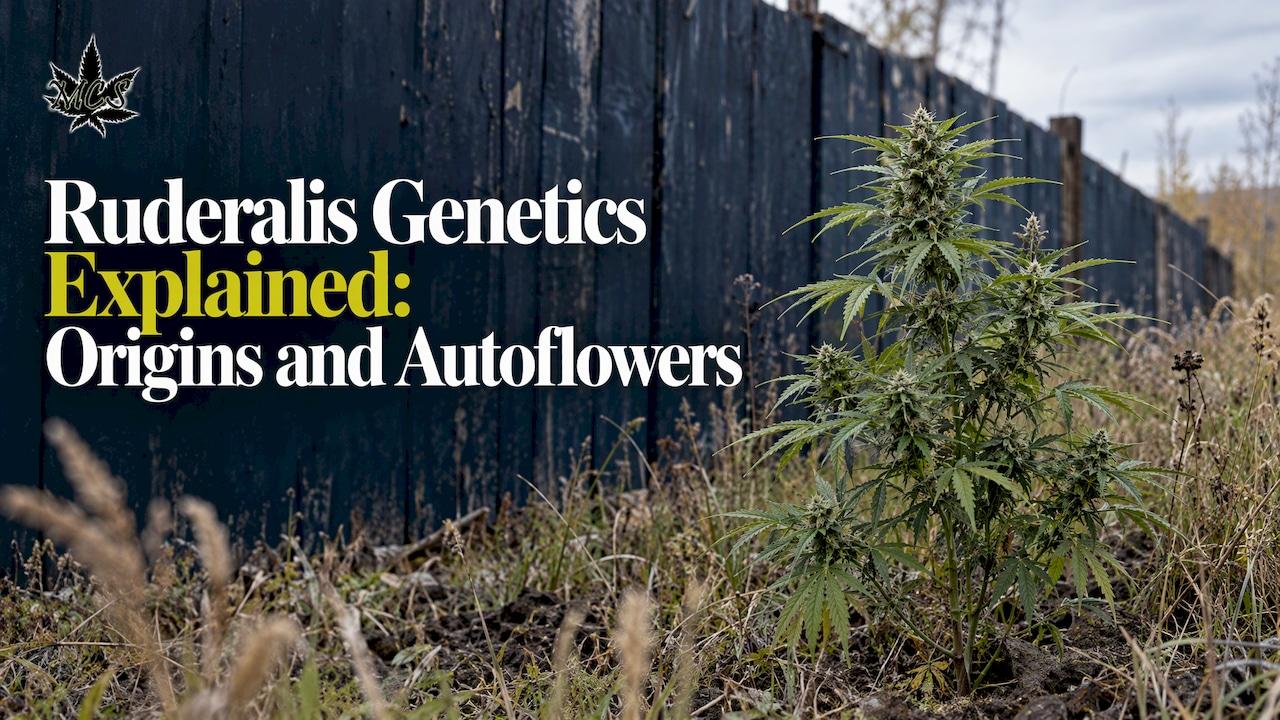
Ruderalis is a short, hardy, weedy form of cannabis that flowers according to its age instead of the length of the night. That single trait is the reason autoflowering seeds exist. Breeders crossed ruderalis with potent, flavorful drug-type plants, and the offspring kept the age-triggered flowering while taking on potency, aroma and structure from the other parent. Understanding what ruderalis contributes, and what it does not, makes it easier to read a seed description and predict how a plant will behave in a Canadian grow space.
TL;DR
- Ruderalis is a wild or weedy cannabis type from Central and Eastern Europe, Russia and Siberia. Its defining trait is flowering by age, not by light cycle.
- Botanists disagree on whether it is a species, a subspecies or simply part of Cannabis sativa. Canada's food inspection agency lists it as a synonym of C. sativa.
- Pure ruderalis is small and low in THC. Modern autoflowers are hybrids, so their potency comes mostly from the non-ruderalis parent.
- The autoflowering trait is recessive, so breeders need several generations of crossing to make it stable in a strain.
- For a Canadian grower, ruderalis genetics mean a short life cycle, compact plants and tolerance of short summers, with local rules on home cultivation still applying.
Table of Contents
- What ruderalis means in cannabis genetics
- Where ruderalis comes from
- How ruderalis flowers by age
- How breeders built modern autoflowers
- What ruderalis tells you about a seed, and what it does not
- Ruderalis genetics for the Canadian grower
- Our perspective on ruderalis genetics
- Choosing autoflower genetics at MCS
- Common misconceptions about ruderalis
- FAQ
- Sources
What ruderalis means in cannabis genetics
The name comes from botanical Latin. A ruderal plant is one of the first to colonize land after a disturbance, and the word is commonly glossed as "weedy" or "growing among waste", as a 2023 genomics paper on cannabis classification explains. That description fits the plant well: it grows on roadsides, field edges and abandoned ground, with no one tending it.
In practical cannabis vocabulary, "ruderalis" has become shorthand for a bundle of traits: a small stature, an open growth habit, early maturity, and above all day-neutral flowering. Botanist John McPartland has pointed out that the label is often applied loosely to any cannabis showing wild-type form, day-neutral flowering or particular CBD to THC ratios, which departs from the formal taxonomic description. In other words, a seed catalog that says "ruderalis genetics" is usually describing the autoflowering inheritance in a plant, not certifying a botanical identity.
How it differs from indica and sativa
Indica and sativa are the two labels most growers know. They describe broad differences in plant structure and, loosely, in the experience of the finished flower. Ruderalis sits apart because it is defined by its life cycle rather than by its effects. A comparison of cannabis types in a peer-reviewed table lists ruderalis as very short, at roughly 0.6 to 1.0 meters, bushy and very early maturing, in about 1.5 to 2 months, and as autoflowering.
| Trait | Typical ruderalis | Typical photoperiod hybrid |
|---|---|---|
| Height | Roughly 0.6 to 1.0 m | Often much taller indoors and out |
| Flowering trigger | Plant age | Longer nights |
| Maturity | About 1.5 to 2 months | Months, depending on the cultivar |
| Branching | Sparse, open habit | Varies, often dense with training |
| THC | Low | Can be high |
The height and timing figures come from the research table cited above. The comparison column is a general description of drug-type photoperiod plants and varies enormously by cultivar.
Where ruderalis comes from
Ruderalis is commonly associated with Central and Eastern Europe and Russia, and the type was first described from plants collected in southern Siberia. It tends to turn up in regions where hemp was once cultivated, which fits the idea that it is a feral or escaped descendant of cultivated material rather than an untouched wild ancestor.
That last point matters, because the true ancestry of cannabis is hard to pin down. A 2022 review notes that scientific consensus on the plant's precise origin is difficult to reach because thousands of years of human cultivation have reshaped it, and because fossil cannabis pollen cannot be told apart from pollen of hops. The same review reports that chloroplast genome comparisons show very high similarity (99.99%) between hemp and marijuana, which supports treating them as one species.

Species, subspecies or one plant?
The Canadian Food Inspection Agency's biology document takes the conservative view. It lists Cannabis ruderalis Janisch. as a synonym of C. sativa, and notes that most botanical treatments consider the genus monospecific, although some taxonomists recognize several species. The agency attributes the wide geographic, structural and chemical variation to selection and domestication for different uses, and states that all forms are diploid and sexually compatible.
Sexual compatibility is the practical key. Because ruderalis can cross freely with any other cannabis, a breeder can move its flowering behavior into any lineage, which is exactly what happened.
How ruderalis flowers by age
Most cannabis is a short-day plant. It stays in vegetative growth under long days and starts flowering as nights lengthen in late summer. This is a sensible strategy in temperate regions with long growing seasons. In the far north, however, summers are brief and a plant waiting for long nights might not finish before frost.
Ruderalis adapted to that problem. As the University of Saskatchewan's gardening extension explains, autoflowering plants begin to flower based on age rather than darkness, an adaptation to harsh northern Asian regions with short seasons. The plant simply counts its own development instead of watching the sky.
The gene behind the behavior
Genetics research has started to identify the mechanism. Studies of the autoflowering locus point to PRR37, a gene belonging to the plant's circadian clock machinery, as having a causal effect on photoperiod sensitivity. A mutation in this gene is the leading explanation for why ruderalis-type plants ignore day length. The work is recent and still developing, so it is best read as a strong working model, not a closed case.
The trait is recessive. A plant needs two copies of the autoflowering version to display it, which has a direct consequence for breeding: a first-generation cross between ruderalis and a photoperiod plant will not flower automatically. The trait only reappears in later generations, and stabilizing it takes patient selection.
How breeders built modern autoflowers
Pure ruderalis is not an appealing crop for most growers. It is small, thinly branched and low in THC. Leafly notes that its natural THC concentrations are low, and that breeders value its genes for the autoflowering habit while the potency and flavor come from the partner plant.
The approach is straightforward in outline:
- Cross a ruderalis plant with a drug-type indica, sativa or hybrid.
- Grow the offspring and cross siblings or backcross to the desirable parent.
- Select plants that flower on their own while keeping the structure, aroma and potency of the photoperiod parent.
- Repeat until the autoflowering trait is fixed and consistent in the seed.
A Canadian chapter belongs in this story. Cannabis Culture's history of the plant reports that the first documented experiments crossing drug-type varieties with ruderalis were carried out by Ernest Small of Agriculture Canada in Ontario during the 1970s. Commercial breeders later picked up the idea to combine early flowering with potency and flavor, producing hybrids that flower regardless of photoperiod.
What ruderalis tells you about a seed, and what it does not
A seed that carries ruderalis in its background can be expected to share certain tendencies. It will probably finish quickly, stay compact, and tolerate cooler or shorter seasons better than many photoperiod types. The practical consequences for a grower follow.
What you can reasonably infer
- Life cycle. The plant moves into flower on a schedule set by age, so the whole run from seed to harvest is short. Harvest timing, however, still depends on trichome ripeness, not the calendar; the store's guide to signs of ripeness in autoflowers covers that step.
- Size. Autoflowers are generally smaller than their photoperiod counterparts, which suits closets, small tents and balconies.
- Light flexibility. Because flowering is not triggered by darkness, the plant does not need a strict 12/12 flip. The store has a separate piece on choosing an autoflower light schedule.
- Hardiness. Ruderalis crosses can yield autoflowering plants with high THC content, improved hardiness and reduced height, as summarized in a general reference on the plant.
What you cannot infer
- Potency. Ruderalis percentage on a label does not predict THC. The potency of an autoflower depends on the other parent and on the breeder's selection work.
- Effects and flavor. These come from the terpene and cannabinoid profile of the specific cultivar, not from the presence of ruderalis.
- Exact ruderalis content. Many autoflower lines have been backcrossed so many times that the ruderalis share is small. The trait is what remains, not a fixed percentage of wild ancestry.
- Taxonomic identity. As McPartland's work cautions, the word is used loosely in the trade, so it should not be treated as a precise scientific classification.
Ruderalis genetics for the Canadian grower
Canada is, in a sense, a natural home for this trait. Short summers, early frosts and unpredictable shoulder seasons are the conditions ruderalis evolved around. A plant that finishes in a couple of months, without needing the nights to lengthen, can fit a window that a long-flowering photoperiod plant outdoors might not.
Three practical points follow from that:
- Timing outdoors. Autoflowers can be started after the last spring frost and still reach maturity within the season. Because they do not wait for autumn nights, planting date is more flexible.
- Space indoors. Compact plants suit the limited footprint most home growers have, which matters given household plant limits.
- Plant counts and local rules. Under federal law, adults can grow a maximum of 4 cannabis plants per household, subject to provincial, territorial and municipal restrictions. Home cultivation rules differ by province, so confirm what applies where you live before you buy seeds. Medical growers have separate registration requirements set out by Health Canada.
With only four plants to work with, the choice between a photoperiod and an autoflower matters more than usual. The store's comparison of autoflower and feminized costs for Canadian growers works through that trade-off in numbers.
Our perspective on ruderalis genetics
We think the most useful way to understand ruderalis is as a tool, not a type of weed to chase. Pure ruderalis rarely belongs in a home grow. What matters is the autoflowering trait it carries, and how well a breeder has built that trait into a plant with real potency, a pleasant profile and a manageable structure.
That is why our catalog is organized around dependable results for Canadian conditions. When we describe an autoflowering strain, our aim is to give the details a grower needs: the cross, the expected plant size, the flowering behavior and the cannabinoid focus. Our germination guarantee and our support team exist so that a first-time grower does not have to decode genetics alone.
For growers working with short seasons or small spaces, our autoflower range is designed to make the most of what ruderalis contributed: speed, compact growth and resilience. For those who want more height and a longer run, feminized photoperiod seeds remain the alternative we also stock.
Dino Grow Master
Choosing autoflower genetics at MCS
Our autoflower seeds are feminized, which removes the need to sort out male plants in a small grow. Growers who want a heavier-yielding profile often start with Critical Mass Autoflower, while those who prefer a cannabidiol focus can look at CBD Cheese Autoflowering. Anyone unsure which direction to take can browse the full catalog and contact our support team for help matching a strain to a space and a season.

Our shipping is discreet and covers all of Canada, and our product pages describe each strain in detail so the genetics are never a mystery.
Common misconceptions about ruderalis
A few ideas circulate widely and deserve correction.
"Ruderalis is a weak, inferior plant." Pure ruderalis is low in THC, but that says nothing about autoflowers made with it. The same trait that makes wild ruderalis small is bred into much stronger lines through crossing and selection.
"Ruderalis is a descendant of indica." Some popular guides state this, but the evidence is not settled. Given how unclear the ancestry of cannabis is, as the 2022 review explains, confident claims about lineage should be treated with caution.
"Autoflowers are just ruderalis." They are hybrids. The ruderalis contribution is the flowering trigger and some hardiness; the rest is inherited from the other parents.
"A higher ruderalis percentage means a better autoflower." There is no reliable relationship. A stable, well-selected line matters far more than the proportion of any ancestor.
FAQ
What is ruderalis?
Ruderalis is a short, early-maturing, weedy cannabis type native to Central and Eastern Europe, Russia and Siberia. It flowers according to plant age rather than day length, and its natural THC content is low. Botanists differ on whether it is a separate species, a subspecies or part of C. sativa.
Is ruderalis a separate species?
That depends on which taxonomist is asked. The Canadian Food Inspection Agency lists it as a synonym of Cannabis sativa and notes that most treatments regard the genus as a single species. Some researchers prefer to recognize several species, so the question is still debated.
Why do autoflowers need ruderalis genetics?
The ability to flower without a change in light comes from the ruderalis lineage. Breeders crossed it into drug-type plants and selected offspring that kept the trait. Because the trait is recessive, it takes several generations to make it reliable in a seed line.
Does ruderalis make an autoflower less potent?
Not by itself. Potency depends mainly on the non-ruderalis parents and the breeder's selection. A well-bred autoflower can reach high THC levels, while a poorly selected one may fall short, regardless of how much ruderalis is in its background.
Sources
- Genomics-based taxonomy to clarify cannabis classification
- Cannabis Systematics at the Levels of Family, Genus, and Species
- Understanding Cannabis sativa L.: Current Status of Cannabis Origins and Taxonomy
- The Biology of Cannabis sativa L., Canadian Food Inspection Agency
- Cannabis types comparison table, PMC
- Cannabis, Gardening at USask
- Autoflowering locus genotype and PRR37, ResearchGate
- What Is Cannabis Ruderalis? Leafly
- The return of Ruderalis, Cannabis Culture
- Cannabis ruderalis, Wikipedia
- Growing cannabis at home safely, Health Canada