
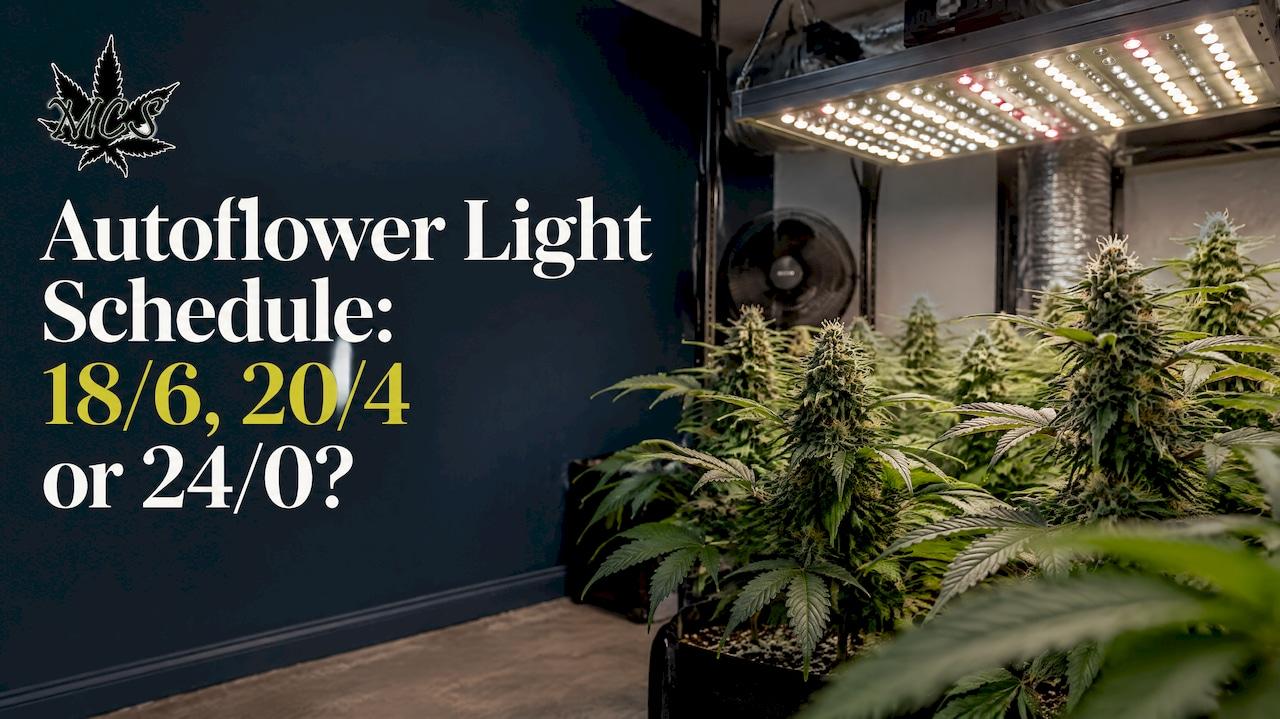
Most autoflowers do well on 18 hours of light and 6 hours of darkness from sprout to harvest, and 20/4 or 24/0 are legitimate variations rather than corrections. Autoflowering plants begin to flower with age, not with the length of the night, so the schedule is a tool for delivering light, not a switch for flowering. What matters is the total light the canopy receives each day, which depends on hours and intensity together.
TL;DR
- 18/6 is the dependable default for the whole life cycle: it suits seedlings, vegetative growth and flower, and leaves a daily rest for the lights and the grower's power bill.
- 20/4 and 24/0 raise daily light, but the same gain can be made by raising intensity, so hours alone are not a yield shortcut.
- Seedlings need at least 14 hours of light according to the University of Saskatchewan, with 18 hours commonly used, and the fixture distance changes what those hours deliver.
- Daily light integral (DLI) is the number that ties it together: PPFD × hours × 0.0036.
- Do not switch an autoflower to 12/12. It gains nothing from the change and receives less light.
Table of Contents
- Why autoflowers follow a different rule
- The main schedules compared
- Hours and intensity trade against each other
- The seedling stage
- Can an autoflower be flowered on 12/12?
- What the dark period does
- Reading the plant instead of the clock
- Spectrum and schedule
- Our perspective
- Choosing seeds that suit the schedule
- FAQ
- Sources
Why autoflowers follow a different rule
A photoperiod plant reads the length of the dark period and flowers when nights lengthen. An autoflower carries a genetic trait that starts flowering after a set number of weeks, whatever the light cycle. Our explanation of how light controls flowering in photoperiod seeds covers the mechanism in detail, and it is the reason the autoflower grower has a freedom the photoperiod grower lacks: the light can stay long for the entire cycle.
That freedom has a practical consequence. Because the plant will flower on its own clock, the grower is not managing a trigger. The question becomes how much light to supply, at what intensity, and at what cost in electricity and heat. Every common schedule is an answer to that question.
A caution on research: much of the published work on photoperiod cannabis concerns photoperiod-sensitive cultivars. A 2023 life-cycle study, for example, kept plants on 16 hours of light until they naturally transitioned and then moved them to 12/12, which documents a research protocol for photoperiod plants and not a prescription for autoflowers. The findings below are used for the principles they establish about light dose, not as autoflower-specific rules.
The main schedules compared
Four schedules cover nearly every autoflower grow. The differences are in dose, cost and margin for error.
| Schedule | Light / dark | Daily light at 400 µmol m⁻² s⁻¹ (DLI) | Best suited to |
|---|---|---|---|
| 16/8 | 16 h / 8 h | 23.0 mol m⁻² d⁻¹ | Tight heat or power limits, small tents in warm rooms |
| 18/6 | 18 h / 6 h | 25.9 mol m⁻² d⁻¹ | The all-round default for beginners and experienced growers alike |
| 20/4 | 20 h / 4 h | 28.8 mol m⁻² d⁻¹ | Growers who want more light without buying a stronger fixture |
| 24/0 | 24 h / 0 h | 34.6 mol m⁻² d⁻¹ | Growers who accept the highest power cost for the largest dose |
The DLI column uses the formula given in a University of Guelph thesis on photoperiod and fertigation: PPFD multiplied by hours of light multiplied by 0.0036. The 400 µmol figure is only an illustration, and the values are our own arithmetic from that formula.
18/6: the reliable baseline
Eighteen hours is the schedule most growers and most published cannabis experiments use for the non-flowering stage. A peer-reviewed experiment on light spectrum, for instance, used 18/6 for vegetative growth before moving to 12/12. A University of Guelph flowering study likewise grew plants vegetatively under about 425 µmol m⁻² s⁻¹ and 18/6 before flowering them on 12/12.
For an autoflower, 18/6 has three practical advantages. The plant gets a long day, the fixture has six hours to cool, and any timer fault or short power cut leaves a comfortable margin. Nothing about the schedule is a compromise.
20/4: more light, modest extra cost
Moving from 18 to 20 hours raises daily light by about 11 percent at constant intensity, and the electricity bill rises by the same proportion. Growers who run 20/4 usually do so because they want more total light without raising the fixture's output, or because the room is cool and the extra heat from the lamp is welcome. It is a sensible middle choice, and the four dark hours still provide a clear daily rhythm.
24/0: maximum dose, maximum cost
Continuous light delivers the largest daily dose at any given intensity and removes the question of timers. It also carries the highest power use, the most heat in a closed tent and no rest for the equipment. Many growers also prefer to keep a dark period because they believe it supports plant health and resin, though that claim is more often asserted by growers than demonstrated, so it is better treated as a preference than as established fact.
Hours and intensity trade against each other
The most useful idea in this topic is that hours of light are not an independent variable. Longer photoperiods inherently provide higher daily light integrals, and the same total can be reached by raising intensity instead. The Guelph thesis makes the point that DLI can be increased by either route, and that photoperiod, intensity and spectrum interact, so changing hours without considering PPFD changes both the dose and the environmental demand on the plant.
A worked example makes this concrete. A fixture delivering 400 µmol m⁻² s⁻¹ at canopy level on 18/6 gives 25.9 mol m⁻² d⁻¹. Dropping to 16/8 at 450 µmol gives 25.9 as well. The plant receives the same daily dose from fewer hours, and the lamp rests two hours longer. The reverse also holds: a dim fixture on 24/0 may still deliver less than a strong one on 18/6.

There is a ceiling, naturally. In a University of Guelph flowering experiment, dry flower yield increased linearly with canopy PPFD up to 1,800 µmol m⁻² s⁻¹ under 12/12, which shows that intensity can be a stronger lever than hours when the plant has enough water, nutrients and CO₂ to use it. Most home tents never approach that intensity, and heat, not light, is usually the first limit.
A practical consequence: the schedule should be chosen after the fixture is known. A modest LED may justify 20/4 or 24/0 to reach a worthwhile dose, while a powerful one may do better on 16/8 or 18/6 with the dimmer lowered. University of New Hampshire Extension adds that accurate DLI estimates require measuring light output at crop level, so a quantum meter, or at least the manufacturer's PPFD map at a stated distance, is worth consulting before adjusting the timer.
The seedling stage
The University of Saskatchewan recommends at least 14 hours of light for cannabis seedlings and notes that 18 hours is commonly used. Weak light, it warns, produces long, weak, spindly stems. For an autoflower, whose life cycle is short, a stretched and fragile start is a real cost, since there is little time to recover.
The same page gives starting distances: fluorescent fixtures generally work at 10 to 15 cm from the canopy, LEDs can start at approximately 30 cm and HID fixtures at approximately 90 cm, with adjustment according to heat and the plant's response. Our own guide to seedling light distance explains why a single figure is only a starting point.
The University of New Hampshire material explains why duration and distance cannot be chosen separately. One fixture may need eight hours at 8 inches but 16 hours at 20 inches to provide comparable DLI. A seedling under a weak lamp placed far away gains little from a longer photoperiod, while one placed close with a strong lamp may need fewer hours.
A sensible seedling routine
- Start on 18/6, with the fixture at the manufacturer's recommended seedling height or the distances above.
- Check the seedling daily for the first week. Compact, sturdy stems and leaves held level indicate adequate light.
- If stems elongate quickly, bring the lamp closer or raise its output before adding hours. The UNH guidance lists moving the fixture closer, increasing intensity, adding fixtures or increasing daily runtime as possible corrections for stretching.
- Raise intensity gradually as leaves expand, and keep the same timer settings so that the plant's day does not change abruptly.
Germination and early handling are covered in our store blog, and feeding at this stage follows its own logic, set out in the autoflower feeding schedule.
Can an autoflower be flowered on 12/12?
An autoflower will flower regardless, so 12/12 is unnecessary, and it halves the benefit of a long day. The week-by-week development is driven by genetics, and the fewer hours of light mean a smaller daily dose and, usually, a smaller plant. Growers who see their plant begin to show pistils after three to four weeks should read the pattern as normal development, not as a light fault. Our article on flowering too soon separates the genuine triggers from the ordinary autoflower timeline.
The research on photoperiod plants nevertheless shows how flexible the 12-hour figure is. A University of Guelph-led 2023 study tested 12, 12.5, 13, 13.5, 14 and 15 hours of light on ten drug-type cultivars and found that flowering began in every cultivar through 14 hours, with a delay at 14 versus 12 hours ranging from none to about four days. Some cultivars initiated at 15 hours, but floral tissue did not develop beyond initiation, and several metrics were best between 12 and 13 hours. A separate 2024 study of two high-THC cultivars found that extending flowering light from 12 to 13 hours substantially increased yield and quality, though the authors frame the result as dependent on cultivar and conditions.
The lesson for autoflower growers is indirect. Even in plants that read the night, a long day with a short dark period is workable, and more light within reasonable limits improves results. In a plant that does not read the night at all, there is even less reason to shorten the day.

What the dark period does
The question of whether autoflowers need darkness has a plain answer: they do not need it to flower, and many growers run 24/0 successfully. They also do not need to be denied it. A dark period lowers power use and heat load, gives growers a window for tent maintenance and gives the equipment a rest. Whether it improves resin or aroma is a belief held by many growers and not something this article can state as established.
What darkness does require is real darkness. A small light leak or a stray indicator LED matters little on an autoflower, unlike on a photoperiod plant, but a steady dark period is easiest to keep when the tent is sealed and the timer is reliable.
Reading the plant instead of the clock
The schedule is a starting point and the plant gives the corrections. The signs below are general observations, and the causes overlap, so change one variable at a time.
- Stretching with wide gaps between nodes: the plant is reaching for light. The UNH guidance associates elongation with insufficient light in seedlings. Move the lamp closer or increase intensity before adding hours.
- Compact, dense growth, pale or bleached leaf tops: too much intensity or too little distance. Raise the lamp or dim it. Adding dark hours does not fix an intensity problem.
- Leaves curling upward or edges crisping near the lamp: heat, not photoperiod, is the likely cause. Check canopy temperature before touching the timer.
- Slow growth with healthy colour: the dose may simply be low. Compare the fixture's PPFD at canopy height to the DLI calculation above.
Intensity also shapes structure. A University of Guelph thesis by Melissa Moher reports that vegetative morphology can be manipulated with light intensity, with 500 to 600 µmol m⁻² s⁻¹ producing taller plants and 900 to 1,000 µmol m⁻² s⁻¹ producing shorter ones in the studied conditions. That is useful for a short-ceilinged tent, where a stronger, closer light can keep an autoflower compact.
Spectrum and schedule
Hours are one part of the dose, and colour is another. In an experiment that changed the light source while keeping the schedule fixed, spectrum-dependent differences in morphology and cannabinoid profile appeared, though total cannabinoid yield did not differ between the tested sources. A broader discussion of light spectrum in indoor cultivation shows how growers think about matching spectrum to stage. For an autoflower, a full-spectrum fixture run for 18 hours is a safe configuration at every stage.
Our perspective
We see the same pattern in the questions that reach our support team: growers worry about the number on the timer and overlook the distance of the lamp. Our view is that 18/6 should be the default for nearly every autoflower in a Canadian home tent, because it is forgiving, economical and well supported by the way cannabis is grown in research settings. The cases for 20/4 and 24/0 are real, but they belong to growers who have measured their light and know their heat limits.
Canadian conditions add a second consideration. Basements and garages in winter run cool, so a longer day can double as a source of warmth, while a sealed closet in summer may need the lamp running at night, when the air is cooler. Choosing the dark hours to fall in the warmest part of the day is a small adjustment that costs nothing.
We also hold that the genetics should be chosen with the space in mind. A compact autoflower suits a low tent and a modest fixture, which is why we describe plant height and flowering time on each product page. Home cultivation rules are set by each province and territory, and Health Canada's review of the Cannabis Act notes that provinces and territories may add home-growing controls, so growers should confirm their local rules before germinating anything.
— Dino Grow Master
Choosing seeds that suit the schedule
Once the light plan is set, the genetics decide how much of it the plant uses. Compact varieties such as Mandarin Light autoflower suit lower tents, while growers who want a CBD-focused plant can look at CBD White Widow autoflower. Our full range of autoflower seeds is selected for Canadian growing conditions and backed by a germination guarantee, with fast and discreet shipping across Canada.

Growers still deciding between plant types can compare the cost per square foot in our guide to autoflower versus feminized plants.
FAQ
Is 18/6 or 20/4 better for autoflowers?
Neither is categorically better. Twenty hours gives about 11 percent more light than 18 at the same intensity, which can help under a modest fixture. Eighteen hours is easier on heat and electricity, and the same dose can often be reached by raising intensity instead.
Can autoflowers get 24 hours of light?
Yes, autoflowers will grow and flower under continuous light, because flowering is age-driven. The costs are higher electricity use, more heat and no rest for the fixture. Many growers prefer to keep a few dark hours for these practical reasons.
What light schedule should seedlings follow?
The University of Saskatchewan recommends at least 14 hours of light for cannabis seedlings and says 18 hours is commonly used. Keep the lamp at a suitable distance, since weak light leads to stretched stems.
Should an autoflower be switched to 12/12 to flower?
No. The plant flowers by age, so the change brings no benefit and cuts the daily light dose. Keep the same schedule from sprout to harvest.
How is daily light integral calculated?
Multiply PPFD in µmol m⁻² s⁻¹ by the hours of light and by 0.0036 to get mol m⁻² d⁻¹. A reading at canopy level is needed for an accurate figure.
Sources
- Is Twelve Hours Really the Optimum Photoperiod for Cannabis? (PMC, 2023)
- Morphological Characterization of Cannabis sativa L. (PMC, 2023)
- Seedlings, Gardening at USask
- Growing Seedlings Under Lights, UNH Extension
- Photoperiod and Fertigation Strategies for Controlled Environment Cannabis, University of Guelph
- Lighting Strategies for the Flowering Stage of Indoor Cannabis, University of Guelph
- The Effect of Light Spectrum on the Morphology and Cannabinoid Content of Cannabis sativa L.
- Longer Photoperiod Substantially Increases Indoor-Grown Cannabis Yield and Quality
- Moher thesis on light intensity and vegetative morphology, University of Guelph
- Legislative Review of the Cannabis Act, Health Canada
- Light spectrum in indoor cultivation