
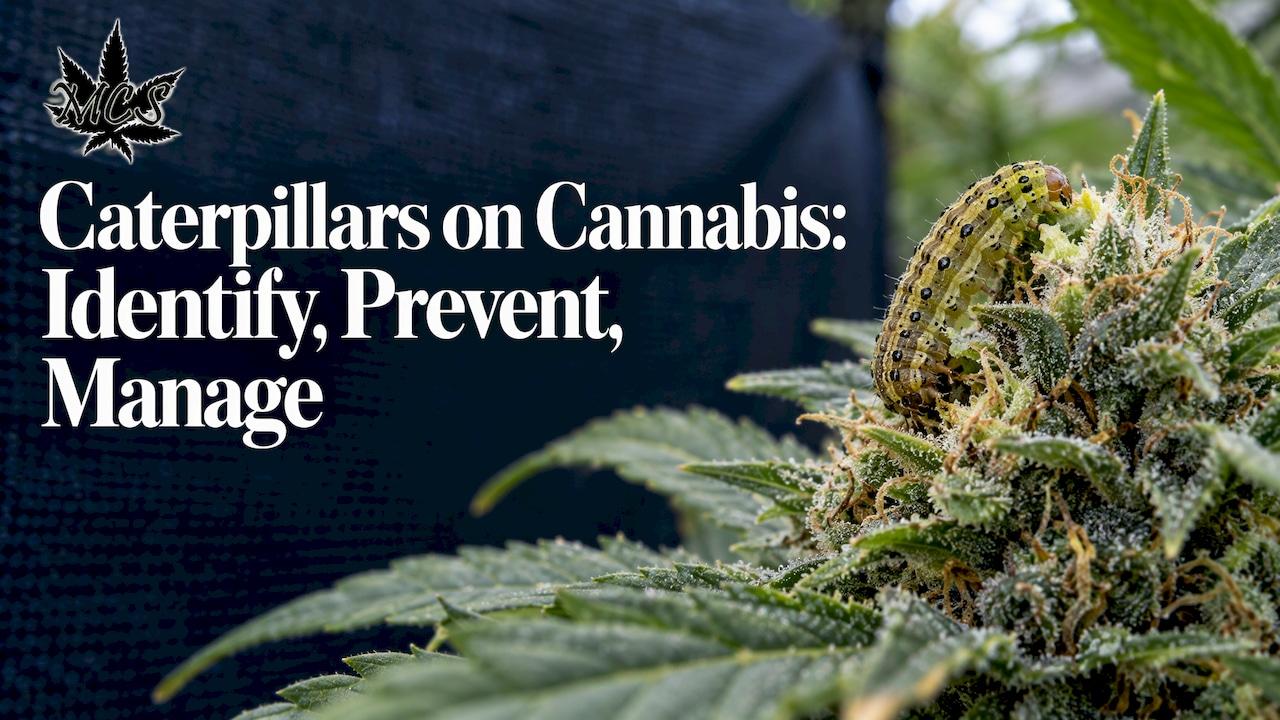
Caterpillars are the larvae of moths and butterflies, and several species will feed on cannabis, chewing leaves and, more seriously, tunnelling into flowers. For Canadian home growers the practical answer is early identification, physical removal and prevention, because Health Canada currently lists no registered domestic pesticides for homegrown cannabis. This guide explains how to recognize the pest, what damage matters, which controls are realistic under Canadian rules, and what to do with buds that have already been touched.
TL;DR
- Caterpillars have a distinct head capsule, three pairs of true legs and up to five pairs of fleshy prolegs; black-brown frass, chewed leaves and webbing are the usual signs.
- The real danger is inside flowers: feeding wounds and wet frass invite bud rot, so inspection matters most from the start of flowering.
- Canadian home growers have no registered pesticide for cannabis and rely on non-chemical methods: hand removal, barriers, sanitation and regular scouting.
- Buds with brown, mushy sections or frass inside should be cut back or discarded; drying does not fix the problem.
- Seed choice and timing can shorten the period in which flowers are exposed outdoors.
Table of Contents
- How to recognize caterpillars on cannabis plants
- What damage caterpillars cause, and when it becomes serious
- Prevention for Canadian home growers
- What control methods are legal and appropriate
- What to do with caterpillar-damaged buds
- Choosing seeds for a shorter, cleaner season
- FAQ
- Sources
How to recognize caterpillars on cannabis plants
Many caterpillar species feed on cannabis, and they vary widely in colour and size. The British Columbia Ministry of Environment's commercial cannabis pest management manual gives the features that separate them from look-alikes: a distinct head capsule, three sets of true legs on the thorax just behind the head, and up to five pairs of prolegs on the abdomen. The number of prolegs is a key identification feature. Loopers, for example, are a type of caterpillar with fewer prolegs and a characteristic arching walk.
The same manual lists the signs that usually show up before the larva itself is found:
- Chewed leaves, with irregular holes and ragged edges.
- Leaves that are rolled or tied together with webbing.
- Frass, the black-brown droppings, on leaves, stems and inside flowers.
- Boring into stems in some cases.
- Adult moths near the plants, or caught on sticky traps.
Confirm the pest before acting
Not every larva on a cannabis plant is a caterpillar. The BC manual points out that sawfly larvae can look similar but do not respond to the controls used for caterpillars, while syrphid (hover fly) larvae are beneficial and need no action. Checking the legs and prolegs under a hand lens takes a minute and prevents needless removal of helpful insects.

Which species matter in Canada
The species list depends on region and on whether plants are grown indoors, in a greenhouse or outdoors. A University of Guelph survey of the insect complex associated with cannabis documents the arthropods found on Canadian crops and the limited pesticide options available. Among the caterpillars of concern in hemp and cannabis flower, corn earworm is the most cited. The University of California hemp program notes that it occurs across North America except Alaska and northern Canada, which covers most of the country's growing regions.
What damage caterpillars cause, and when it becomes serious
Leaf damage is visible and alarming, but it is rarely the main problem. The BC manual describes caterpillars as typically an occasional pest in greenhouse cannabis, yet notes that feeding can reduce plant growth and the yield and quality of the final product. The Pacific Northwest Pest Management Handbooks add a useful distinction for hemp: damage to mature plants from most caterpillars is usually minor and generally does not require control, with the exception of corn earworm. That is regional hemp guidance, not a Canadian threshold, but it explains why the flowering stage deserves the closest attention.
Corn earworm feeds mainly on flower buds. According to the same handbook, larvae can hide inside buds, causing extensive tunnelling and wounds that let pathogens in and contribute to bud rot.
Why a small hole can ruin a cola
The sequence is straightforward. A larva enters a dense flower, feeds from the inside and leaves frass behind. British Columbia's factsheet on cannabis diseases explains that injuries to buds can enable rot, and that Botrytis infections commonly begin inside buds, where humidity is highest and air movement is lowest, before progressing outward. The first visible sign may be a single leaf that browns or a section of the flower that turns soft, long after the damage started.

The BC manual also warns that frass can contaminate the harvest. Contamination and rot, rather than missing leaf tissue, are what turn a minor infestation into a lost cola.
Timing
Vegetative plants can tolerate a surprising amount of chewing. Risk rises once flowers form and thicken, usually in late summer and early autumn for outdoor plants. Plants moved outdoors for summer and brought inside to finish can carry larvae or eggs with them, so a thorough inspection at the doorway is worth the effort.
Prevention for Canadian home growers
Prevention carries more weight than treatment because, once larvae are inside buds, nothing that can legally be applied at home will reach them. The BC guidance for homegrown cannabis frames integrated pest management around sterilizing tools and pots, using sterilized potting mix and monitoring plants so that pests are not introduced in the first place. The commercial manual adds measures that scale down well to a small grow:
- Exclude the moths. Greenhouse growers screen vents to keep adults out. At home, fine mesh over windows, vents and outdoor frames serves the same purpose, and a fine insect netting over outdoor plants works as a physical barrier during flowering.
- Monitor for adults. Pheromone-baited and light traps attract adult moths, according to the manual. A moth trapped in late summer is an early warning that eggs are likely on nearby plants.
- Practice sanitation. Remove plant debris, fallen leaves and weeds around the plants, and clean tools and pots between uses.
- Keep plants healthy. Vigorous plants tolerate feeding better. The cannabis deficiency guide helps separate nutrient problems from pest damage when leaves look off.
- Scout on a schedule. Look under leaves, along stems and inside the denser flowers at least every few days once buds form, checking for frass first.
Reduce the exposure window
The longer flowers stand outdoors, the more chances a moth has to lay eggs in them. Choosing genetics that finish sooner is one lever growers can use. The comparison of photoperiod, autoflower and fast version strains explains how the types differ in timing. Other pests need their own routines too, and the store's guides on spider mites and fungus gnats follow the same integrated approach. For a wider view of how pest pressure fits into a full crop cycle, the hemp cultivation process guide is a helpful companion.
What control methods are legal and appropriate
This is the area where Canadian growers most often go wrong, because garden-centre products are labelled for roses and vegetables, not cannabis. Under the Cannabis Act and Cannabis Regulations, licence holders may use only pest control products approved for cannabis under the Pest Control Products Act. Health Canada's page on pest control products for use on cannabis states that commercial growers must follow label instructions for products registered for cannabis by the Pest Management Regulatory Agency, and that currently there are no registered domestic pesticides for homegrown cannabis. Home growers must therefore rely exclusively on non-chemical methods.
British Columbia's guidance on homegrown cannabis explains the reasoning: residues may remain on the plant, may become more concentrated in extracts and can add health risks when burned. It also cautions that a product considered safe for house or garden plants should not be assumed safe for cannabis, since cannabis is inhaled or ingested.
Methods that remain open to home growers
- Hand removal. Pick off larvae by hand during daily or every-other-day checks, and dispose of them away from the plants. This is the most reliable response to a few visible caterpillars.
- Trimming damaged foliage. Remove rolled or webbed leaves that shelter larvae, and clear frass.
- Physical barriers. Fine netting prevents egg-laying, and works best when fitted before flowers form.
- Airflow and humidity control. Keeping flowers dry and ventilated lowers the chance that any wound becomes rot, in line with the BC disease factsheet.
What licensed producers use
For context, the BC manual identifies Bacillus thuringiensis subspecies kurstaki as a registered active ingredient for caterpillars on commercially grown cannabis in Canada, most effective on young larvae and quick to break down under UV light. The Guelph survey lists three insecticides registered for cannabis grown outdoors in Canada: Helicovex, Purespray FX and Bioprotec Plus. Those registrations apply to licensed production, and the same survey observes that the few registered products do not give reliable control of arthropod outbreaks, which is why prevention and monitoring come first. A home grower should not treat those registrations as permission to apply similar products on a domestic crop.
What to do with caterpillar-damaged buds
Most damage that growers regret was found late. Once a larva has bored into a cola, a spray, even where one is allowed, cannot reach it. The practical response is surgical.
- Open the suspect flower. Look for frass, a tunnel, or a brown, soft or slimy section. Gently separate the bud rather than squeezing it.
- Cut back to clean tissue. If part of a cola has turned brown or mushy, remove it with a margin of healthy tissue below the affected area, so the rot does not continue.
- Check the neighbours. Rot spreads outward from the inside, so inspect adjacent buds on the same branch.
- Discard what is compromised. Frass and rot remain inside a bud after it is dried, so drying does not solve the problem. Bagged and binned material is safer than anything with visible mould or droppings.
- Wash hands and tools after handling affected flowers.
The BC disease factsheet recommends removing diseased tissue, together with good airflow, humidity control and sanitation. For the stages that follow harvest, the store's coverage of drying and curing sits in the growing cannabis in Canada blog, and the pest and deficiency hub collects the other common problems in one place.
Perspective: Grow it clean from the start
We see caterpillars as a planning problem more than a pest problem. A grower who learns the signs, scouts through flowering and starts from dependable genetics seldom has to make the hard choice between losing a cola and using something that was never meant for cannabis.
Because Canadian home growers have no registered domestic pesticide to fall back on, strong starting material matters. We curate our catalog for Canadian climates, publish detailed product information so growers can match plant type to their season and space, and back our seeds with a germination guarantee. Faster-finishing options, such as our fast versions and autoflowers, are there for growers who want a shorter stretch in which flowers are exposed.
Our support team understands local growing conditions and can help match a strain to a setup, whether it is a balcony, a tent or a backyard bed.
Dino Grow Master
Choosing seeds for a shorter, cleaner season
For growers planning next year's garden, genetics are the first decision in a pest strategy. Our feminized seeds remove the need to cull males, autoflower seeds are bred for compact, fast-flowering plants, and fast version seeds offer quicker photoperiod harvests. Browse the full range on the Montreal Cannabis Seeds store, where each listing carries the product details to compare before ordering.

Our fast and discreet shipping across Canada and the germination guarantee are meant to make the first step of the season the easy one. Beginners can start with the top strains for first-time growers.
FAQ
Can you use Bt or other insecticides on homegrown cannabis in Canada?
No product is currently registered for homegrown cannabis in Canada, according to Health Canada, so home growers are directed to non-chemical methods. Bt (Bacillus thuringiensis subspecies kurstaki) is registered for commercial production, with label conditions that apply to licensed producers. Hand removal, netting and sanitation are the options left for a domestic grow.
Can you smoke buds that had caterpillars in them?
The careful answer is to cut away or discard any flower with tunnels, frass or brown, mushy tissue. Frass can contaminate a harvest, and BC guidance links bud wounds to rot that begins inside the flower. Drying does not remove either the droppings or the rot, so affected material should not be kept for use.
How can you tell a caterpillar from other larvae on cannabis?
Count the legs. Caterpillars have a distinct head capsule, three pairs of true legs on the thorax and up to five pairs of prolegs on the abdomen. Sawfly larvae look similar but do not respond to caterpillar controls, and syrphid larvae are beneficial, according to the BC manual.
Do caterpillars only matter outdoors?
Outdoor plants face the most exposure, but the BC manual treats caterpillars as an occasional pest even in greenhouses, and moths can enter through vents. Indoor growers who move plants outside for part of the season, or who bring in cut branches and soil, should inspect everything before it goes back into the grow space.
Sources
- Pest control products for use on cannabis, Health Canada
- A Survey of the Insect Complex Associated with Cannabis, University of Guelph
- Hemp Caterpillars, Pacific Northwest Pest Management Handbooks
- Corn Earworm Management in Hemp, UC Davis
- Hemp Cultivation Process: A Complete Grower's Guide