
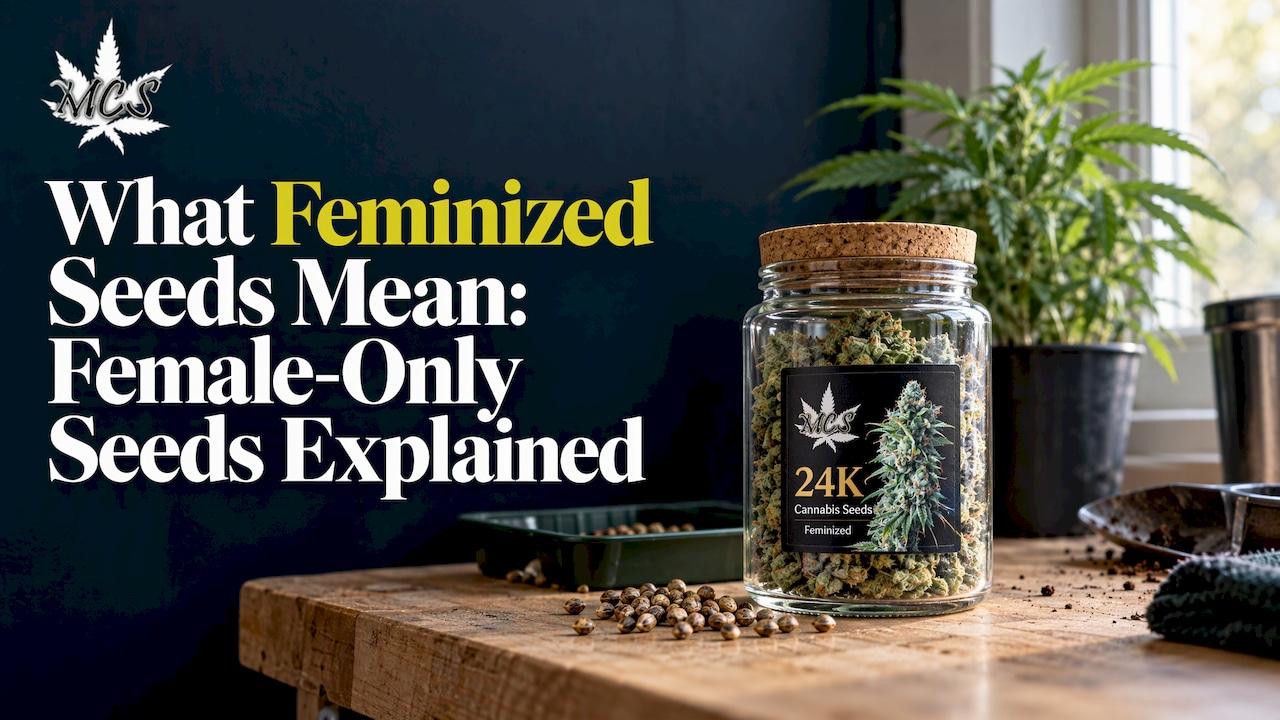
Feminized seeds are cannabis seeds bred so that the plants they grow are female, the sex that produces the resinous flowers growers harvest. According to the University of Saskatchewan's cannabis gardening guide, they are made by chemically inducing a female plant to produce male flowers and pollen. Because that pollen carries only female sex chromosomes, pollinating another female produces a population that is female, with rare exceptions. For Canadian home growers working within a small plant count, that is the practical reason feminized genetics are the usual starting point.
TL;DR
- Feminized seeds are bred to grow female plants almost exclusively; regular seeds give roughly a 50/50 split between male and female.
- They are made by treating a female plant so it produces pollen, then using that all-female pollen on another female. The result can be over 99% female.
- You cannot tell a feminized seed from any other seed by its look; sex shows only as the plant matures.
- Under a four-plant household limit, every plant slot counts, so avoiding males matters.
- Feminized is a breeding category; autoflower describes flowering behavior, and a seed can be both.
Table of Contents
- What feminized seeds mean in plain terms
- How cannabis seeds get feminized
- What regular seeds are, and what they produce
- Why the meaning matters under Canada's plant limit
- Can you tell a feminized seed by looking at it?
- When the plant shows its sex
- What the plants from feminized seeds can produce
- Feminized versus autoflower: two different questions
- How to read a feminized seed listing
- Where to start with feminized seeds from MCS
- Our perspective on feminized seeds
- FAQ
- Sources
What feminized seeds mean in plain terms
Cannabis is naturally dioecious, a botanical term meaning that male and female flowers grow on separate plants. Only the female plant develops the dense, resin-covered flowers that are harvested. The male plant produces pollen sacs, and if it releases pollen near a female, the female puts energy into making seeds instead of resin.
A feminized seed is one whose parentage has been arranged so that this problem mostly disappears. Both parents are female, so every seed inherits an X chromosome from each (XX, the female pattern) and there is no Y chromosome in the mix. The word is also spelled "feminised" in British and Commonwealth usage, and it means exactly the same thing.
Two points are worth keeping straight:
- Feminized does not mean genetically modified in the laboratory sense. The plants are not altered at the gene level. A parent plant is triggered to make pollen, and the pollen is used in ordinary pollination.
- Feminized describes sex, not strength, flavor or flowering speed. Potency, aroma and size come from the strain's genetics, which is a separate question from whether a seed will grow a female plant.
How cannabis seeds get feminized
The process rests on one piece of plant biology. According to a 2024 peer-reviewed review in PMC, ethylene, a plant hormone, normally promotes female flowers. When a female plant is treated with an ethylene inhibitor, such as silver thiosulfate or colloidal silver, it undergoes sex reversal: it becomes monoecious, meaning it carries both flower types, and can fertilize itself or another female. The seeds that result carry only the XX female chromosomes of the female parent.
The same review found silver thiosulfate to be the most effective of the inhibitors it assessed for high-THC cannabis, applied as a single foliar spray during the vegetative stage and followed by a shorter light cycle. That is a description of how breeders work with parent plants, and it is a step that takes controlled conditions and careful record-keeping, which is why seed production is best left to dedicated breeders.
Utah State University Extension describes the same method: treating female plants with chemicals such as silver thiosulfate so they develop male flowers with genetically female pollen, which then pollinates a female flower. Seeds produced this way can be over 99% female.
The seeds you plant carry no trace of the treatment. The silver compound is applied to the parent plant before the seeds develop, which is why feminized seed is a standard product category in the market rather than an experimental one.
What regular seeds are, and what they produce
Regular seeds come from the ordinary pairing of a male and a female plant. The University of Saskatchewan notes that each seed has about a 50/50 chance of growing into a male or a female, and that regular seeds were the only type available until feminized seeds became widely available in the 1990s. Oregon State University Extension, writing about hemp, puts open-pollinated seed at about 30% to 50% male plants.
Regular seeds remain the tool for breeders. Anyone who wants to cross two plants, keep a line going or create new genetics needs a male. For a home grower whose goal is a harvest of flower, though, the male is a plant to identify and remove early, and the time spent growing it is time not spent on a plant that will yield.
The store's guide to feminized versus regular seeds compares the two in more depth, so this article stays on the meaning of the term.
Why the meaning matters under Canada's plant limit
Federal law allows adults to grow up to four cannabis plants per household for personal use, and the University of Saskatchewan's horticultural team treats the limit as the main reason feminized seed suits Canadian home growers: a male grown from regular seed wastes one of those slots and has to be composted and replaced, so choosing feminized seed can save a lot of time and resources. Provincial and territorial rules differ on home cultivation, so confirm what applies where you live before you order or plant anything.
Here is a worked example. A grower in a province that permits home cultivation plants four regular seeds. With a 50/50 split, the most likely outcome is two females and two males, which leaves half the allowed plants as non-producers, and a run of bad luck could give no females at all. One Canadian beginners' guide notes that four regular seeds could yield four males and no harvest. Four feminized seeds, by contrast, are expected to yield four female plants.

The Halton Region Master Gardeners in Ontario make the same point from the quality side. A male never produces resin-rich flowers, and a female that is pollinated puts energy into seed production, which lowers THC and CBD. Seeded buds are of poorer quality. Their advice to home growers is to buy feminized seed and remove any male immediately.
Can you tell a feminized seed by looking at it?
No. Herb.co's identification guide states there is no reliable visual method to tell male from female cannabis seeds: size, stripe pattern, color and shape do not predict sex, and the genetics involved are invisible to the naked eye. A dark, striped, plump seed is not more likely to be female than a pale one.
What the seed's origin tells you is the thing to rely on, and that comes from the seller. A product listed as feminized has been produced from the all-female breeding process above. The seed's appearance only tells you about maturity and handling. Utah State University Extension notes that, in the United States, there is no certification program for feminized seed, so the supplier's breeding standards and clear product information carry the weight. The same applies when you choose a seed source in Canada: look for detailed strain information and a stated guarantee.
When the plant shows its sex
Sex becomes visible only as the plant grows. Per Herb.co, females show teardrop-shaped calyxes with white hairs (pistils) at about 4 to 6 weeks of vegetative growth, or 2 to 3 weeks after switching to a 12/12 light cycle, while males show round clusters of pollen sacs without hairs. Master Gardeners of Ontario give a similar timeline for seedlings: gender becomes evident at about 6 weeks old.
Even with feminized seed, it is good practice to inspect your plants at the nodes, the points where branches meet the stem, as flowering approaches. Rare exceptions occur, and a plant that shows pollen sacs should be removed before it can pollinate the others. Our guide to how to sex cannabis plants shows what to look for at the nodes first and when a lab test is worth considering.
What the plants from feminized seeds can produce
A grower sometimes asks whether plants from feminized seed will give feminized seeds in turn. If a female is pollinated, it makes seeds, and according to Master Gardeners of Ontario about half of those seeds will be female and half male. Saving seed for next year's crop needs one male and one female kept in a separate area. That is why a grower who wants a seedless harvest keeps males away from females entirely, and why growers who want a new, reliably female crop each season start from a new pack of feminized seed.
Feminized versus autoflower: two different questions
This is the most common point of confusion for first-time growers. The two words answer different questions.
| Term | What it tells you | What it does not tell you |
|---|---|---|
| Feminized | The seed is bred to grow a female plant | How the plant decides when to flower |
| Autoflower | The plant flowers with age, not with a change in the light cycle | Whether the seed is male or female |
| Regular | The seed may grow a male or a female | Anything about flowering speed |
A seed can therefore be both feminized and autoflowering, and most autoflower seeds sold for home growing are. A standard feminized photoperiod seed, by contrast, needs the light cycle changed to flower. The store's guide to feminized, regular and autoflowering seeds lays out the comparison, and the autoflower seeds and fast version seeds categories show the options within each flowering style.
How to read a feminized seed listing
Once you know the meaning, the useful part is reading a product page. These are the details worth checking before you add a pack to the cart:
- Sex: the page should state feminized, not leave it implied.
- Flowering type: photoperiod, fast version or autoflower, since this sets your light schedule.
- Cannabinoid profile: THC-dominant or CBD-focused, which matters most to medicinal growers. The CBD seeds category lists feminized and autoflower options.
- Climate fit: a strain chosen for Canadian growing conditions, indoors or out, is a better foundation than one chosen only for its name.
- Guarantee and support: a stated germination guarantee and a team that can answer questions about local growing conditions.
For a first grow, a feminized strain with a clear description is a sensible starting point. Examples in our catalog include Critical Magic feminized and Critical Kush feminized, and for CBD-focused growing, CBD Northern Lights feminized.
Where to start with feminized seeds from MCS
Montreal Cannabis Seeds is a Canadian online seed bank, and our feminized range is built around genetics curated for Canadian climates, with detailed product information for each strain and a germination guarantee. We ship quickly and discreetly across Canada, and our support team understands local growing conditions, which helps when a first-time grower has a question about a strain or a flowering type.
Browse the full feminized seeds collection to compare strains by flowering style and cannabinoid profile.

Prefer to start from our home page? It also leads to our Quebec line, mix packs and outdoor genetics: Montreal Cannabis Seeds.
Our perspective on feminized seeds
For most Canadian home growers, feminized seed is the right place to begin, and the reasoning is simple arithmetic. A household has a small number of plants to work with, and each one should be able to repeat the work you put in with a harvest. Feminized genetics remove the sorting step that regular seed demands and let a grower focus on light, feeding and timing.
We built our catalog around that idea. Feminized photoperiod, fast version and autoflower seeds sit alongside CBD-focused options, so a medicinal grower and a recreational grower can each find genetics that match their purpose. Every strain page carries detailed information, because a seed is only a good choice when you know what it will do in your space.
The germination guarantee and the support team exist for the same reason: growing is easier when the starting point is dependable and someone who knows Canadian conditions can answer your questions.
Dino Grow Master
FAQ
What does feminized seeds mean?
It means the seeds are bred to grow female cannabis plants, which are the ones that produce harvestable flowers. They come from a female plant treated to make pollen, then used to pollinate another female. The result is seed that can be over 99% female.
What are regular cannabis seeds?
Regular seeds are produced by a normal male and female pairing, so each seed has about a 50/50 chance of becoming male or female. They are the original seed type, and breeders use them to make crosses and new lines. Home growers who want flower choose feminized seed so that males do not take up plant slots.
How can you tell if a seed is feminized?
You cannot tell by looking. Seed size, color and stripes do not indicate sex. The product listing and the seed bank's breeding information are what identify a seed as feminized, and the plant's sex shows at the nodes once it matures.
What is the difference between feminized and autoflowering seeds?
Feminized refers to the plant's sex, while autoflowering refers to how it flowers: with age rather than with a change in the light schedule. A seed can be both. Check the listing for each of the two terms separately.
Is feminised the same as feminized?
Yes. "Feminised" is the British and Commonwealth spelling, and "feminized" is the spelling used in North America. Both describe seeds bred to grow female plants.
Sources
- Cannabis, University of Saskatchewan Gardening guide
- Ten Frequently Asked Questions About Growing Cannabis, USU Extension
- Ten Frequently Asked Questions About Growing Cannabis, USU Extension (PDF)
- Optimized guidelines for feminized seed production in cannabis, PMC
- Hemp sex-ed, OSU Extension Service
- Cannabis, Halton Region Master Gardeners
- How To Identify Female Weed Seeds, Herb.co
- Cannabis fact sheet, Master Gardeners of Ontario
- Cannabis Seed Types for Beginners, Weedth