
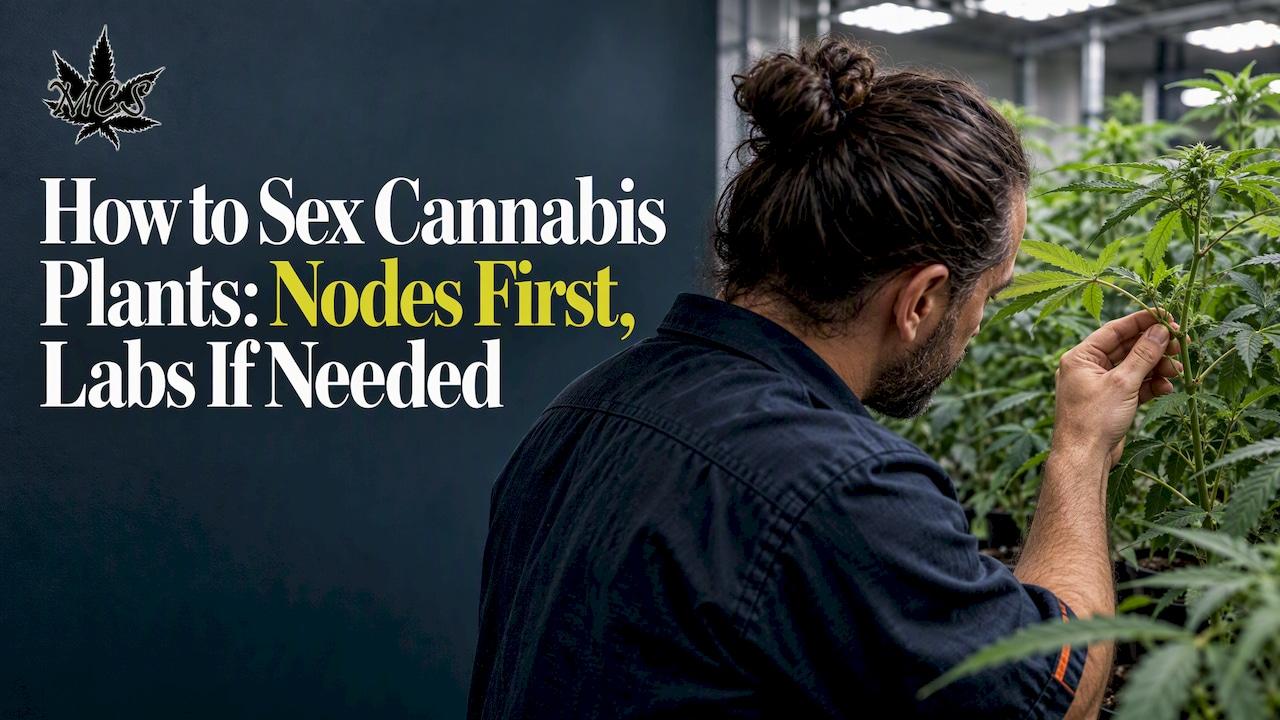
Sex cannabis plants by checking the nodes for small pollen sacs on males or white pistils on females, and pull any suspected male the moment you see sacs forming. A single male can produce on average 350,000 pollen grains, enough to seed an entire room. Start inspecting the node junctions today.
TL;DR:
- Begin checking once plants have several nodes; photoperiod plants often show early sex signs during vegetative growth, while autoflowers follow their genetic schedule.
- Move any plant with an unclear node to a separate space immediately, then inspect it again in two days, including shaded upper branches.
- Feminized seeds reduce male hunting, but inspect plants weekly for pollen sacs or yellow anthers, especially after heat, light leaks, or heavy feeding.
- The CsPDS5 test matched later plant sex in all validation samples, but that result covers tested cultivars only; home growers usually rely on visual checks.
Table of Contents
- When should you check your plants for sex?
- What do male and female pre-flowers look like at the nodes?
- How do you identify sex once plants are flowering?
- How do you recognize hermaphrodite plants and what triggers them?
- What are the molecular and lab sexing options?
- What is a step-by-step sexing routine you can follow every week?
- How do you handle and sex feminized and autoflower seeds?
- How can photos help you tell male, female and hermaphrodite plants apart?
- What mistakes do growers make most often when sexing plants?
- Why feminized seeds can take sexing off your to-do list
- FAQ
- Sources
When should you check your plants for sex?
Sex becomes visible when a plant starts producing pre-flowers, tiny structures that form at the nodes, where a leaf stem meets the main stalk. In regular seed populations, males and females appear in a nearly equal ratio, so male and female seedlings are expected in roughly equal numbers. Males usually reveal themselves earlier than females, which means your first inspections matter most.
For photoperiod plants, pre-flowers typically show up during the vegetative stage, often a few weeks after germination, well before you flip the light cycle. Autoflowers follow their own internal clock, so their pre-flowers appear on a schedule set by genetics rather than by light hours. Check each plant regularly once nodes start to develop.
Several variables can shift the timing.
- Genetics: some strains pre-flower early, others hold out until late in veg.
- Light cycle: shorter days push photoperiod plants toward flowering and bring sex signs sooner.
- Plant stress: heat, root problems or light leaks can accelerate or confuse early signs.
- Plant age and size: a seedling with only two or three nodes rarely has anything to show yet.
- Training and pruning: heavy defoliation can hide the nodes you need to inspect.
What do male and female pre-flowers look like at the nodes?
Learning to read the nodes is the core skill. Male pre-flowers appear as small, ball-like pods, and the early ball-like pre-flowers at the nodes are your signal to isolate that plant. Female pre-flowers look different: a small, teardrop-shaped calyx with one or two thin white hairs, called pistils, poking out.
Use this checklist at each inspection:
- Males: round, green sacs without hairs, often forming in small grape-like clusters on a short stem.
- Females: a pointed, teardrop calyx with white pistils emerging from the tip.
- Unclear: a node with a tiny bump and no hairs or sacs yet. Check again in two days.
- Position: look at the junctions on the upper third of the plant first, where new growth is most active.
- Tools: a 30x to 60x hand lens or a phone with a macro lens makes the difference between guessing and knowing.
The most reliable spot is the node where a branch meets the main stem. Check the shaded side of the plant too, since pre-flowers sometimes hide under fan leaves.
Pro Tip: Photograph the same node regularly. A side-by-side comparison shows the difference between a developing sac and a harmless swelling far better than memory does.
How do you identify sex once plants are flowering?
If you missed the pre-flowers, full flowers remove all doubt. Male flowers mature into clusters of pollen sacs that eventually split open into small, banana-shaped anthers. Once they open, pollen is released quickly and drifts on even gentle air movement, so you have a very short window between "I think that's a male" and "my room is pollinated."

Female plants develop clusters of calyxes stacked along the branches, each topped with a pair of pistils. As long as those pistils stay pollinated, the buds keep swelling with resin instead of seed, which is what growers call sinsemilla, Spanish for "without seeds."
When you confirm a male, you have three clear options:
- Remove it promptly: cut the plant at the base and carry it out of the grow space before shaking it.
- Isolate it for breeding: move it to a separate, sealed room or tent with its own airflow if you want its genetics.
- Dispose of it: bag it first, then discard it away from your garden.
If you keep a male for breeding, treat that room like a pollen lab. Our guide to male cannabis seeds and their role in breeding covers why some growers preserve males on purpose.
How do you recognize hermaphrodite plants and what triggers them?
A hermaphrodite carries both pistils and pollen-producing parts on the same plant. Look for small yellow-green "nanners" (the banana-shaped anthers) tucked among the buds, or for round pollen sacs forming on a plant that was clearly female a week earlier. Even a handful of sacs can release enough pollen to set seed across your crop.
Stress is the usual culprit, and several triggers come up again and again:
- Light leaks: a stray light during the dark period confuses the plant's flowering cues.
- Temperature swings: extreme heat or sudden cold can push a female to produce male parts.
- Nutrient or chemical stress: heavy feeding, root damage or harsh sprays add pressure.
- Late harvests: plants left far past maturity sometimes produce late male flowers.
- Genetics: some lines are simply more prone to intersex expression than others.
Chemical induction exists too. Breeders sometimes deliberately trigger male flowers on female plants with silver compounds to produce feminized seed, but that is breeding context, not something a home grower should do to a crop meant for flower.
For practical handling, isolate any plant showing pollen parts, inspect it daily, and remove it if it starts shedding. Plants with only a few sacs can sometimes be saved by picking them off with tweezers, but any pollen-bearing plant stays a risk until harvest.
What are the molecular and lab sexing options?
Cannabis uses an XY sex-determination system, so researchers have built DNA tests that tell males from females long before any flower shows. Marker-based PCR methods look for male-associated markers such as MADC2. High-throughput genotyping studies show that these markers can be detected reliably by qPCR and by newer isothermal or high-resolution melting (HRM) methods, with high reported accuracy across large sample sets.
A newer approach targets the conserved CsPDS5 gene. The CsPDS5-CAPS PCR method separates XX from XY genotypes and was tested across multiple cultivars. HRM and microsatellite approaches, as described in a PeerJ germplasm study, offer a relatively low-cost way to match DNA results to what plants later show.
- Best for: breeders and nurseries screening hundreds of seedlings early.
- Needs: lab equipment, a small leaf sample and a basic understanding of primers and controls.
- Caveat: marker presence or absence can vary by cultivar, so a validated test for one line may not transfer cleanly to another.
- Home growers: usually better served by visual checks or by skipping the problem with feminized seed.
The CsPDS5-CAPS method reported 100% concordance in the authors' validation set, which shows how precise lab sexing can get, though that result applies to the cultivars those researchers tested.
What is a step-by-step sexing routine you can follow every week?
A simple routine beats a clever one. Run the same checks on the same days and write down what you see.
- Label every plant with a number and keep a notebook or spreadsheet, one line per plant.
- Start inspecting once plants have several nodes, then check them regularly.
- Look at the upper nodes on each plant with a hand lens or macro camera, including shaded branches.
- Mark any plant with a suspected sac or unclear bump and move it to a separate space right away.
- Watch the isolated plant and check for developing sacs or pistils. Sacs that swell and cluster mean male. Pistils that appear mean female.
- Remove confirmed males before sacs open, carrying them out in a bag.
- Move through flowering with a weekly walk-through, scanning for yellow anthers or late sacs that signal a hermaphrodite.
- Pull any pollen-bearing plant, or at minimum isolate it, and clean tools and hands before touching other plants.
- Decide for the next run: if sexing consumed too much time, use lab testing for a breeding project or switch to feminized seed.
The point of isolation is that you never have to guess. A suspect plant in a separate space costs you nothing, while a male left in the room can cost you the crop.
Pro Tip: Wash your hands and wipe your scissors after handling any suspected male. Pollen clings to skin, sleeves and tools, and it travels with you.
How do you handle and sex feminized and autoflower seeds?
Feminized seeds are bred to produce almost entirely female plants, so you are not hunting for males. You still need to inspect them. Stress can trigger hermaphroditism in feminized plants, and a single intersex plant can ruin a crop just like a missed male. Treat feminized plants as females, but keep your weekly check for sacs and anthers, especially during heat waves, light-leak accidents or heavy feeding.
Autoflowers add a timing twist. They flower on age rather than on light hours, so there is no clear veg-to-flower switch to anchor your inspections. Start looking early and keep checking regularly through the whole life cycle. Pre-flowers on an autoflower appear on the plant's own schedule, so a consistent routine matters more than a calendar date. Many autoflowers are sold feminized, which removes most of the sexing work.
Photoperiod plants, by contrast, show sex as day length shortens or as they reach maturity, so your inspection window follows the light cycle you set. That is why photoperiod regulars require the most attention and why feminized lines reduce the effort most for growers short on time.

If you grow from regular seed on purpose, plan for a nearly equal mix of male and female seedlings. For a clean, step-by-step view of seedling stages, our paper towel test walk-through helps you spot problems early.
How can photos help you tell male, female and hermaphrodite plants apart?
Pictures speed up learning, and you do not need a professional camera to build your own reference set. Take close-ups of the same node every two days, from a consistent angle, and keep them in one folder. Over a single grow you will collect a personal field guide.
A good reference set has three sections:
- Male traits: tight clusters of round green sacs on short stems, later opening into pale, banana-like anthers. No white hairs anywhere.
- Female traits: pointed teardrop calyxes with paired white pistils, later turning into dense resinous buds.
- Hermaphrodite traits: pistils and pollen sacs or yellow anthers on the same plant, often hiding deep inside bud sites.
When you shoot, use steady light, fill the frame with the node and avoid shadows from your phone. A cheap clip-on macro lens turns almost any phone into a reliable inspection tool. Compare your shots against each other rather than against a single online image, because lighting and strain genetics change how pre-flowers look.
When two nodes look alike, trust the pattern over the frame: sacs mean male, hairs mean female, both on one plant means isolate now. Photos also help you see that a "male" bump in one image became a female calyx two days later.
What mistakes do growers make most often when sexing plants?
The most common mistake we see is waiting. Growers see a suspicious bump, tell themselves they will look again next week, and by then the sacs have opened. The habit that prevents it is simple: any unclear node gets its plant moved away from the rest the same day, then rechecked in two days. Isolation is cheap, and pollination is not.
Reliable genetics cut the number of decisions you have to make. Starting from feminized or autoflower seed from a source with a germination guarantee means fewer males to catch and fewer wasted weeks on seedlings that never sprout. Even then, keep looking at nodes through the entire flowering stretch.
One last tip: tie your inspection schedule to your watering schedule. Every time you water, look at the top nodes. That single pairing protects your yield better than any gadget.
— Dino Grow Master
Why feminized seeds can take sexing off your to-do list
Feminized seeds are bred so nearly every seedling grows into a female, which means no male hunting and far less culling. If you would rather spend your time on feeding and training than on node inspections, start with our Feminized Seeds selection, then look at our Autoflower Seeds.

We also carry Mix Packs for growers who want to try several strains in one order, and our germination guarantee backs the seeds we ship. Browse the full range at Montrealcannabis-seeds and pick the lines that suit your space.
FAQ
How do you tell when a cannabis plant is male?
Look at the nodes for small, round, ball-like pods without white hairs. Males typically show these pre-flowers earlier than females, so frequent node checks catch them first. Once you see pods, isolate the plant before they open.
What are early signs of a male cannabis plant?
The earliest sign is a cluster of tiny, round green sacs at a node, often on the upper part of the plant. They look like small grapes and have no pistils. A hand lens or phone macro photo makes them easy to confirm.
How do you determine the sex of a plant with a lab test?
Labs use PCR-based tests that detect male-associated markers such as MADC2, or the CsPDS5 gene, in a small leaf sample. High-throughput genotyping work reports high accuracy on large sample sets, though results can vary by cultivar. Most home growers rely on visual checks instead.
Do feminized seeds still need to be checked for males or hermaphrodites?
Yes, a quick weekly check is still worthwhile. Feminized plants rarely turn out male, but stress from heat, light leaks or heavy feeding can trigger pollen sacs. Catching them early protects the rest of your crop from seeds.