
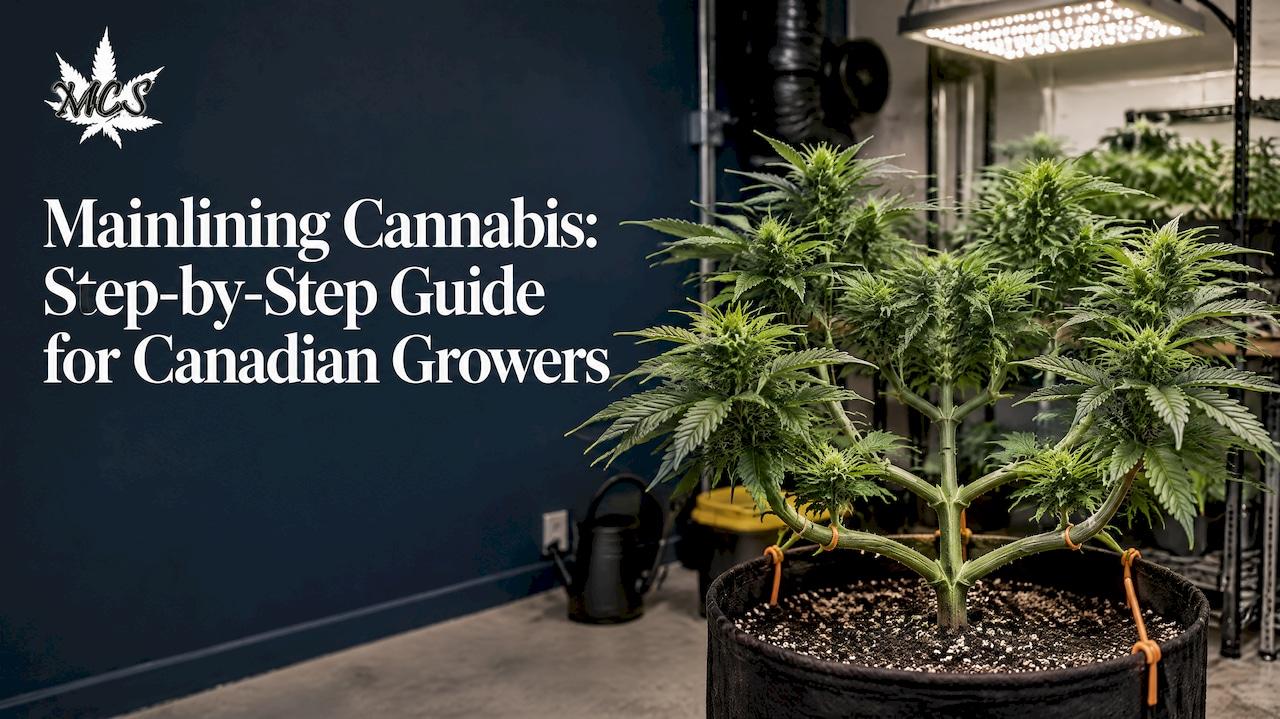
Mainlining cannabis is a high-stress training method that turns one main stem into a symmetrical "manifold" of 4, 8 or more evenly sized colas by topping the plant in stages and spreading the branches flat. The aim is a level canopy in which every bud site receives similar light and similar resources. The cost is time: each cut needs a recovery period, so the plant spends longer in vegetative growth. This guide covers how the technique works, a stage-by-stage schedule, the trade-offs, which seeds suit it, and the Canadian rules that decide whether a home grower can use it at all.
TL;DR
- Mainlining builds a manifold: a short, centralized stem that splits into two, then four, then eight evenly sized branches through repeated topping and tying down.
- It is a photoperiod technique. Autoflowers have a fixed life cycle and little time to recover from high-stress cuts, so it is generally discouraged for them.
- Expect a longer vegetative phase. Evidence that mainlining out-yields other methods is mostly observational, so it is best chosen for canopy control and uniformity, not as a guaranteed yield boost.
- Home cultivation is lawful under federal rules up to four plants per household, but provinces set their own limits, and Quebec prohibits it outside medical cases.
Table of Contents
- What mainlining actually is
- When mainlining makes sense
- Step-by-step mainlining schedule
- What mainlining gives, and what it costs
- Choosing seeds for a mainline
- Canadian rules that come before the technique
- Our perspective
- Seeds suited to a trained plant
- Common mistakes to avoid
- FAQ
- Sources
What mainlining actually is
The term describes a pruning and training pattern, not a single cut. A grower tops the young plant above a chosen node, removes everything growing below that point, and leaves a short stump. The two shoots that emerge become the first "mains." These are topped again, and the process repeats until the plant carries a symmetrical structure with a small number of strong branches growing from a central hub.
The logic is about distribution. A plant left untouched sends most of its energy to the dominant apical tip, while lower branches stay small and shaded. By removing the lower "shrapnel" growth early and forcing the plant to divide evenly, a mainlined plant directs its resources into a handful of equal branches. Each one is meant to finish as a large, uniform cola instead of a mix of one tall top and many weak lower sites.
A 2025 review in the Journal of Cannabis Research classifies the technique, which it discusses under the name manifolding, as an advanced form of topping that combines topping, lollipopping and tie-downs. The same review cautions that scientific literature on the mechanisms behind it is limited and that standardized protocols across cannabis types are lacking. That is a useful framing: mainlining rests on grower experience far more than on controlled trials.

Mainlining versus manifolding
The two words are often used as if they were the same, and in the review above they are treated together. Among growers, a distinction has developed. Mainlining usually refers to the slow, binary progression: one stem becomes two, two become four, four become eight, with a pause between each doubling. Manifolding in its traditional, faster form uses two aggressive cuts early on to split the plant into four branches at once, then moves quickly to training. Both end in a manifold. Mainlining trades speed for control, since each stage is small enough that the plant recovers predictably.
How it differs from topping, LST and SCROG
Single topping removes one growth tip so that two main branches develop; it is the simplest high-stress step, and the store has covered it in depth in topping versus untopped plants. Mainlining is topping repeated on a plan, combined with removal of lower growth and low-stress training to spread branches outward.
SCROG uses a screen to hold the canopy level. Mainlining shapes the plant so the canopy is level by structure, and the two work well together. The SCROG versus sea of green comparison explains the screen side of that pairing. The Journal of Cannabis Research review goes further and describes a screen as mandatory to achieve the finished result, which matches the common practice of tying branches down to a frame or net.
When mainlining makes sense
The technique rewards a particular kind of grower and garden. It fits best when:
- the plants are photoperiod, so vegetative time is adjustable;
- the space is a tent or room with a fixed light, where a flat canopy matters;
- the grower has only one to four plants, so each plant should justify its footprint;
- the grower is willing to wait for recovery between cuts instead of rushing the schedule.
It makes less sense for a first grow in a crowded space, for a grower who needs a fast turnaround, or for anyone growing autoflowers. Beginners can still mainline, but a first run is easier with a forgiving variety. The store's list of top strains for first-time growers is a sensible starting point for choosing one.
Why photoperiod plants are the right fit
Photoperiod plants stay vegetative as long as the light cycle is kept long, so a grower can wait for each recovery without losing flowering time. Autoflowers begin flowering on an internal schedule, and a high-stress cut early in their short life can consume a large share of the vegetative window. Guidance from growing educators is consistent on this point: reserve high-stress training for stable photoperiod plants, and use gentle low-stress methods on autos. The store's comparison of photoperiod, autoflower and fast version strains lays out how those life cycles differ.
Fast versions sit between the two. They are photoperiod genetics bred to finish sooner, which makes them an interesting choice for a grower who wants a shaped canopy but cannot give a plant a long vegetative run. A small mainline of two or four tops suits them better than a full eight.
Step-by-step mainlining schedule
Timing is described in nodes, the points on the stem where leaves and branches emerge, not in calendar days, because growth rate varies with genetics, light and temperature. The schedule below reflects the widely used grower approach: top at the third node, build a stump, and top the new growth after it recovers.

Stage 0: Start with a healthy, established seedling
Wait until the plant has roughly five or six nodes and is clearly growing vigorously. A seedling that has just been transplanted or is showing deficiency symptoms will recover slowly from cuts. If leaves are yellowing or spotting, sort that out first; the store's guide to cannabis deficiencies helps identify the cause.
Stage 1: Create the first manifold
- Choose the third node as the point to work from.
- Remove the growth tip above that node.
- Remove the branches and leaves growing below the third node, so that only the two shoots at that node remain.
- Leave a short stump of stem between the cut and the nodes. This is not decoration: the stump gives the new shoots a thick, stable base, and leaving it helps prevent the stem from splitting as it develops over time.
After this, the plant looks stark and a little alarming. That is normal. Energy that would have gone to the lower sites now goes into the two remaining shoots.
Stage 2: Train the two mains apart
When the two shoots have grown several nodes, use soft ties to bend them gently outward and downward, in opposite directions, and anchor the ties to the pot rim or a frame. The goal is to make both shoots equal in height and angle. If one is stronger, tie it slightly lower to let the weaker one catch up. Check ties every few days, and loosen any that bite into the stem.
Stage 3: Top the mains to make four
After a recovery period, top each of the two mains at the second or third node of the new growth. Grower accounts usually give about 10 to 15 days between rounds, but the plant sets the pace: resume when growth is visibly vigorous again, not when a date arrives. Four tops now grow from the manifold. Continue to spread them horizontally.
Stage 4: Go to eight, or stop
A third round turns four tops into eight. Indoors, three rounds is the typical stopping point, and most growers do not go beyond eight. Sixteen or more colas require substantial extra vegetative time, and the additional yield often fails to justify the delay. A plant with eight well-lit colas in a tent is already a full canopy for most home spaces.
Stage 5: Flip to flower
Once the manifold has filled its allotted space and the branches are level, switch the light cycle to flowering. Expect stretch in the first weeks, so keep the canopy a safe distance below the light and keep tying down anything that outgrows its neighbours. A modest, conservative tidy of lower growth can help, but heavy leaf stripping, particularly outdoors, can create damp pockets or stress the plant. Remove only what blocks light or airflow.
What mainlining gives, and what it costs
| Factor | Effect of mainlining |
|---|---|
| Canopy uniformity | Branches finish at similar height, so light reaches buds evenly |
| Bud size | More consistent colas, with fewer small lower sites |
| Airflow | A deliberately open centre can ventilate better than a dense, bushy plant |
| Vegetative time | Commonly reported to add several weeks, and each cut needs recovery |
| Skill and attention | Regular tying, checking and adjusting through veg |
| Risk | Poorly executed high-stress training can permanently harm a plant |
The last row deserves honesty. The review cited above notes that high-stress training done incorrectly could cause permanent harm, and the same review is clear that the evidence base is thin. Controlled, head-to-head trials comparing mainlining with other training styles under identical conditions are scarce, so claims of yield superiority are best read as grower observations, not universal laws. The more reliable claim is about structure: a mainlined plant is easier to keep level, easier to light and easier to manage.
There is also a fair argument against it. Time spent in vegetative growth is time not spent flowering, and many experienced growers conclude that for a small home garden, a single topping combined with low-stress training delivers most of the benefit in less time. Mainlining is a choice for growers who value control and are prepared to give the plant that time.
Mainlining and outdoor plants
It is possible outdoors, but the logic changes. Sun angle shifts through the day, wind loads the branches, and the need for a perfectly flat canopy is lower. A manifold also needs support, since eight heavy colas on a short stump can strain in wind and rain. Outdoor growers in Canada have a short season to consider as well; a plant that spends extra weeks recovering from cuts in spring may be racing the first frosts in autumn. For these reasons, a lighter approach to training generally suits the garden better. The store covers the broader subject in its outdoor material, and the Outdoors line on the main shop page lists seeds chosen for northern conditions.
Choosing seeds for a mainline
Pick genetics that tolerate pruning and are stable in structure. In practice that means:
- Feminized photoperiod seeds. They remove the risk of spending weeks shaping a male plant. Browse the feminized seeds category for the options we carry.
- Moderate stretch. Hybrids with balanced growth are easier to hold level than very tall, lanky plants.
- Vigorous recovery. Healthy, well-fed seedlings from reliable seed bounce back faster from each cut.
- Realistic flowering time. Fast versions finish earlier, which helps when the vegetative phase has been extended; see the fast version seeds page.
Training begins with a successful start. If germination is still a weak point, the store's paper towel test guide explains how to read seeds and seedlings, and for equipment such as ties, pots and a small frame, the starter equipment guide covers what is worth buying.
Canadian rules that come before the technique
Training a plant matters little if growing it is not allowed where you live. Under the federal framework introduced with the Cannabis Act, eligible adults may grow up to four plants per household for personal use, subject to provincial or territorial restrictions, using licensed seeds or seedlings. Health Canada also states that home growers must follow provincial, territorial and municipal requirements such as zoning, fire safety and electrical standards, and must not use dangerous organic solvents for home production.
Provincial differences are real. In Quebec, home cultivation is banned except for medical reasons, and the Supreme Court of Canada confirmed the province's right to impose that ban. Readers in Quebec who hold medical authorization, or who live in a province that permits home growing, should check their own provincial rules and municipal bylaws before starting. Four plants is a ceiling for the household, not for each person, which is one more reason mainlining appeals to the grower with a single tent: a few well-shaped plants are easier to manage than a crowded garden.
Our perspective
We see mainlining as a precision tool, not a rite of passage. Most of the questions we receive from Canadian growers are about getting a dependable result from a small space, and a symmetrical plant is a good answer to that problem when the grower has the vegetative time to build it. We also see the opposite case often: a first-time grower with a tent, a few weeks of patience and a fast-finishing photoperiod seed, who would be better served by one topping and gentle tie-downs.
Our advice follows from how the technique behaves. Start from healthy, vigorous seedlings, because recovery is the whole game. Keep a mainline to four or eight tops. Do not attempt it on autoflowers. And treat claims of enormous yield gains with caution, since the research on this method is still sparse. A level canopy, even bud size and good airflow are real, dependable advantages; a guaranteed jump in grams is not.
— Dino Grow Master
Seeds suited to a trained plant
If a shaped, controlled canopy is the goal, start with seed that is reliable. Montreal Cannabis Seeds carries feminized photoperiod genetics, fast versions and mix packs selected for Canadian growing conditions, backed by a germination guarantee and discreet shipping across Canada. Browse the feminized collection or the full range on our home page, and check your provincial rules before you order.

Common mistakes to avoid
- Topping too early. A seedling with only two or three nodes has little to recover with. Wait for the plant to establish.
- Skipping the stump. Cutting flush to the nodes can leave a weak joint that splits later.
- Rushing the schedule. Cutting again before growth resumes compounds stress and extends total time anyway.
- Over-tying. Ties that are too tight restrict the stem. Use soft material and check regularly.
- Heavy defoliation. Remove only what shades or crowds; stripping too much, especially outdoors, can invite damp pockets and environmental stress.
- Applying it to autoflowers. The fixed life cycle leaves little margin; choose low-stress training instead.
FAQ
Is mainlining worth it for a beginner?
It can be, if the beginner has a photoperiod plant and the patience to wait between cuts. The learning curve is mostly about timing and tying, not difficulty. A simpler route is a single topping with low-stress training, which delivers much of the canopy benefit with less time.
How many times should you top a plant when mainlining?
Indoors, three rounds is the usual stopping point, producing eight colas. Each round is followed by a recovery period of roughly one to two weeks, depending on how quickly the plant resumes growth. Going past eight needs substantial extra vegetative time, which rarely pays off in a home tent.
Can you mainline autoflowers?
It is generally discouraged. Autoflowers have a fixed life cycle, and recovering from high-stress cuts can consume a large part of it. Low-stress training is a safer way to shape them.
Can mainlining be combined with SCROG?
Yes, and the two are often paired. The mainline provides the even structure and a screen holds the branches level. The Journal of Cannabis Research review treats a screen as part of achieving the finished form.
Is mainlining legal everywhere in Canada?
The technique is only a way of growing, so the question is whether home cultivation is allowed where you live. Federal rules allow up to four plants per household, but provinces can restrict that, and Quebec prohibits home growing outside medical cases. Check provincial and municipal rules first.
Sources
- The curious origins of a high-stress training technique, Journal of Cannabis Research (2025)
- The Cannabis Act: The Facts, Health Canada
- Growing cannabis at home safely, Health Canada
- Growing Cannabis at Home in Quebec: Legal or Not?, Éducaloi