
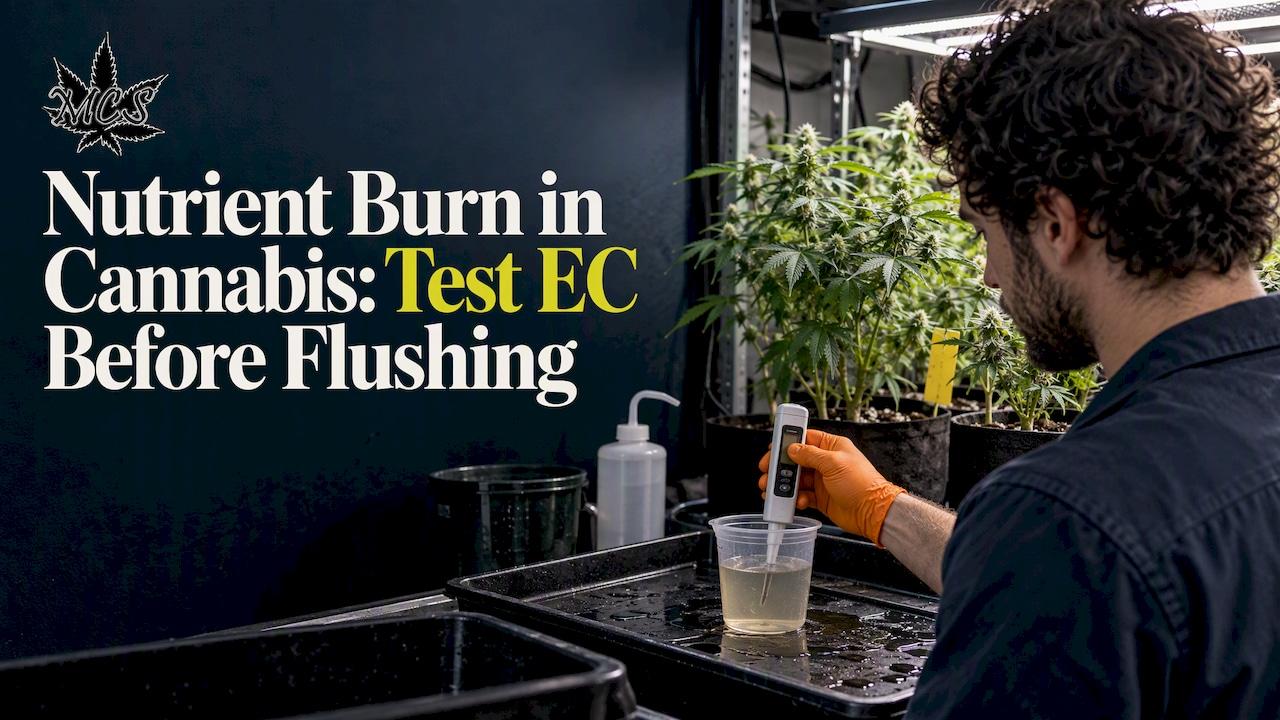
Nutrient burn is marginal leaf necrosis caused by excess salts or nutrients building up in the root zone, and the first move is always the same: stop feeding and measure the root zone before you do anything else. Test the runoff or substrate EC and pH with a PourThru or saturated media extract, and check your water source for high salinity. Where the damage appears, lower leaves or new growth, tells you whether you are looking at salt toxicity or an immobile-element deficiency.
TL;DR:
- Salt damage starts at leaf tips and edges, usually on older leaves; calcium deficiency affects new growth, while light burn targets upper leaves.
- Use a PourThru test or saturated media extract to collect leachate, then measure EC and pH; tank readings alone cannot show root conditions.
- If leachate EC is very high, leach with clear water while monitoring pH; for moderate elevations, dilute feed over successive waterings to avoid shock.
- Studies found that excess root zone nutrients can raise leachate levels without improving yield or quality, so routine flushing is not warranted.
Table of Contents
- What Nutrient Burn Looks Like on Cannabis
- Main Causes of Nutrient Burn in Cannabis
- How to Diagnose Nutrient Burn: EC, pH, and Tissue Testing
- How to Fix Nutrient Burn: Triage and Recovery
- Preventing Nutrient Burn Before It Starts
- What Research Says About Flushing and Excess Fertilizer
- A Grower's Take on Skipping the Reflexive Flush
- Growing With Fewer Surprises
- FAQ
- Sources
What Nutrient Burn Looks Like on Cannabis
Nutrient burn shows up as marginal necrosis: brown, crispy edges and tips, often separated from healthy green tissue by a thin yellow halo. This pattern reflects how salts accumulate in the leaf margins, where water moves last and salts concentrate most, and it generally begins at the very tip of the leaf before creeping along the edges and finally working inward toward the midrib, a progression documented in extension research on salt burn.

The speed of onset depends on how far EC has climbed above the plant's tolerance, but a useful pattern clue is location. Salt-driven nutrient burn tends to surface first on lower or older leaves, since those leaves have been transpiring the longest and have had more time to accumulate excess ions. Deficiencies in immobile elements like calcium, by contrast, show up on new growth first because the plant cannot relocate those nutrients from older tissue. Practitioners also note that high nitrogen inputs can produce unusually dark green foliage alongside marginal burn, a combination that is easy to mistake for simple overfeeding without a deeper look.
Several other problems mimic nutrient burn closely enough to cause confusion:
- Light burn bleaches or crisps the uppermost canopy closest to the light source rather than the margins of random leaves across the plant.
- Drought stress droops and curls leaves uniformly before any browning starts, while nutrient burn leaves usually stay firm until the necrotic tissue appears.
- Potassium deficiency also starts at the margins but spreads more slowly and often includes interveinal yellowing rather than a clean brown edge.
- Pest damage leaves stippling, webbing, or irregular bite marks instead of the smooth marginal pattern salts produce.
Our pest and deficiency comparison chart and our guide to light-burned seedlings both walk through these lookalikes in more visual detail.
Main Causes of Nutrient Burn in Cannabis
Nutrient burn almost always traces back to salt accumulation in the growing medium, and overfeeding without adequate leaching is the most common driver. Every feeding adds dissolved mineral salts to the substrate. When a grower waters with just enough solution to saturate the root zone but never enough to flush a portion out the bottom, those salts stay put and concentrate with each subsequent feed, pushing substrate EC steadily upward until roots can no longer manage the osmotic load.
Excess nitrogen is often blamed first, and it does play a role, but it is more accurate to think of nitrogen as one contributor to a broader salt problem rather than the sole cause. A tank mixed too strong raises total EC across every nutrient in the formula, not just nitrogen, which is why EC is the more useful number to track than any single element's concentration.
Water quality compounds the issue. Source water with high sodium content or high alkalinity adds its own dissolved salts before any fertilizer is mixed in, meaning two growers running identical feed schedules can end up with very different root-zone EC depending on what comes out of the tap. Poor drainage or a dense, compacted medium makes it worse still, since water cannot move freely through the substrate to carry excess salts to the drainage holes during normal watering.
A less obvious complication is nutrient antagonism: when one element is present in excess, it can interfere with the plant's uptake of another, producing visual symptoms that look like a deficiency even though the real problem is an oversupply elsewhere in the mix. This is part of why visual inspection alone often misleads growers into treating the wrong input, and why root-zone testing matters more than guessing from leaf color.

How to Diagnose Nutrient Burn: EC, pH, and Tissue Testing
A reliable diagnosis depends on testing the root zone directly rather than relying on how the feed solution looks going in. The following sequence, grounded in practices described by Cannabis Business Times, gives a reproducible path from symptom to confirmed cause.
- Sample the root zone. Use the PourThru method or a saturated media extract to pull a leachate sample, since testing only the nutrient tank tells you what you added, not what the roots are actually sitting in.
- Measure EC and pH of the leachate. Compare the reading against recommended interpretive ranges for the media type, since EC is the most direct indicator of accumulated soluble salts and correlates closely with burn risk.
- Map the symptom location. Burn concentrated on lower or older leaves points toward salt accumulation, while symptoms starting on new growth point toward an immobile-element deficiency such as calcium, a distinction confirmed by cultivation research.
- Send tissue for lab analysis if results stay ambiguous. Collect the most recent fully mature leaves, since documented sampling protocols show this tissue gives the clearest picture of current nutrient status for confirming a specific excess or deficiency.
Calibrate your EC and pH meters against known reference solutions before each testing session, and always rinse probes between samples to avoid cross-contaminating readings from different plants or containers.
Pro Tip: Keep a small log of leachate EC readings over time. A gradual upward trend warns you of salt buildup days before any visible burn appears.
How to Fix Nutrient Burn: Triage and Recovery
The correction depends on how far EC has climbed, so start with triage before committing to any aggressive fix.
- Stop feeding immediately. Switch to plain water or a very dilute solution for the next watering while you gather test data.
- Measure leachate EC and pH. This single reading tells you whether the situation calls for a full leach or a gentler dilution approach.
- Decide on leaching only if EC is very high. Guidance from Cannabis Business Times recommends irrigating with clear water until leachate EC drops into an acceptable range, while watching pH throughout since salt buildup can shift substrate pH unpredictably during the process.
- Prefer gradual dilution when EC is only moderately elevated. Reducing feed strength across several consecutive waterings lets the root zone re-equilibrate without the osmotic shock that a full flush can cause, an approach many experienced growers favor over reflexive flushing.
- Restart feeding at reduced concentration. Once EC trends back down, resume with a weaker mix than before and build back up gradually while tracking EC at every feeding.
- Remove only fully necrotic leaf tissue. Partially damaged leaves can still contribute some photosynthesis, so trim conservatively rather than stripping foliage preemptively.
Watch pH closely during any leaching step. Heavy salt accumulation can mask or distort pH readings, and flushing too fast with water at the wrong pH can introduce a second stress on top of the first.
Damaged leaf tissue itself will not revert to green, so judge recovery by what grows next rather than by what the burned leaves do. New growth may start showing normal color and shape after the root zone is corrected, with more severe cases taking longer. If new leaves keep emerging with burn, the root-zone EC likely has not actually come down enough, and it is worth retesting rather than guessing.
Preventing Nutrient Burn Before It Starts
Prevention comes down to feeding conservatively and watching the numbers rather than the leaves.
- Start low and adjust by response. Our autoflower feeding schedule outlines starting with a diluted feed and increasing only as the plant shows it can handle more, a principle that applies to photoperiod strains as well.
- Check EC and pH on a fixed schedule. Testing the tank before every feeding and the substrate leachate periodically catches a rising trend before it becomes visible damage.
- Leach on purpose, not by accident. Running a controlled, deliberate leach every several feedings clears accumulated salts in a predictable way, rather than discovering the need for one after symptoms appear.
- Avoid frequent, shallow waterings. Light, frequent irrigation that never produces runoff concentrates salts near the surface instead of carrying them through the medium.
- Test your water source before mixing nutrients. High sodium or alkalinity in tap water changes how much fertilizer you can safely add, so knowing your baseline matters as much as the nutrient label does.
- Log every feeding strength and every EC/pH reading. A simple record reveals a slow upward drift long before leaf tips start to brown.
Media choice matters here too. Our guide to organic soil basics and pH covers how drainage and buffering capacity affect how forgiving a medium is when feeding runs slightly strong, and our fertilizer selection guide explains why a balanced, well-formulated product reduces the antagonism issues that complicate diagnosis in the first place.
What Research Says About Flushing and Excess Fertilizer
Controlled research backs up what careful growers already suspect: more is not better. The Frontiers study on elevated root-zone phosphorus found that pushing nutrient concentrations higher raises leachate phosphorus without improving yield or quality. A Frontiers study on root-zone nutrient levels found that exceeding optimal EC rarely improves yield or cannabinoid concentration while raising the risk of salt burn. Flushing, in this light, is a corrective tool for acute salt toxicity rather than a routine practice, and overusing it can reduce yield. The more reliable approach is measured: confirm root-zone EC with a PourThru test, then correct only as much as the number tells you to.
A Grower's Take on Skipping the Reflexive Flush
The instinct to flush the moment leaf tips brown is understandable, but it skips the one step that actually tells you what is happening underground. Measuring root-zone EC first, before reaching for gallons of plain water, saves plants from unnecessary shock. When EC is only moderately elevated, cutting feed strength over successive waterings and watching the trend is the lower-risk move.
— Dino Grow Master
Growing With Fewer Surprises
Nutrient burn is frustrating precisely because it often shows up after weeks of what felt like good care, one feeding too strong, one missed leach, and the margins start to brown. Starting with genetics bred for consistency takes some of that guesswork out of the equation from the first watering. Our Quebec Line is curated with Canadian growing conditions in mind, and product details for each strain can help you focus on dialing in feed strength.
Whether you are working with feminized seeds for a controlled indoor run or autoflower seeds for a faster cycle, our support team understands the local growing challenges that shape feeding decisions and can point you toward strains suited to your setup. Browse our full catalog at Montreal Cannabis Seeds and find the genetics that fit your next grow.
FAQ
What is the first sign of nutrient burn on cannabis?
The earliest visible sign is a thin brown line right at the leaf tip, which then spreads along the margins as salt accumulation worsens. A faint yellow halo often separates the dying tissue from the still-healthy green leaf, a pattern described in research on salt-induced marginal necrosis.
Can nutrient-burned leaves recover their green color?
No, leaf tissue that has already turned brown and necrotic will not revert to green or healthy function. Recovery shows up in new growth instead, which may appear normal after the root-zone EC is corrected.
Should I always flush my cannabis plants if I see leaf burn?
Not necessarily. Flushing is most useful when leachate EC testing confirms very high salt accumulation, and research indicates that flushing used too aggressively can reduce yield without improving quality, so a measured dilution over several waterings is often the better first step.
How is nutrient burn different from a nutrient deficiency?
Nutrient burn from excess salts tends to appear first on lower or older leaves as marginal browning, while deficiencies in immobile nutrients like calcium show up first on new growth. Testing root-zone EC and pH, as outlined in troubleshooting guidance from Cannabis Business Times, is the most reliable way to tell the two apart.
Sources
- Feel the (Cannabis Leaf Margin) Burn | Cannabis Business Times
- NUTRIENT
- How to Troubleshoot Cannabis Nutrient Disorders | Cannabis Business Times
- Frontiers | Sustainable Cannabis Nutrition: Elevated root-zone phosphorus significantly increases leachate P and does not improve yield or quality