
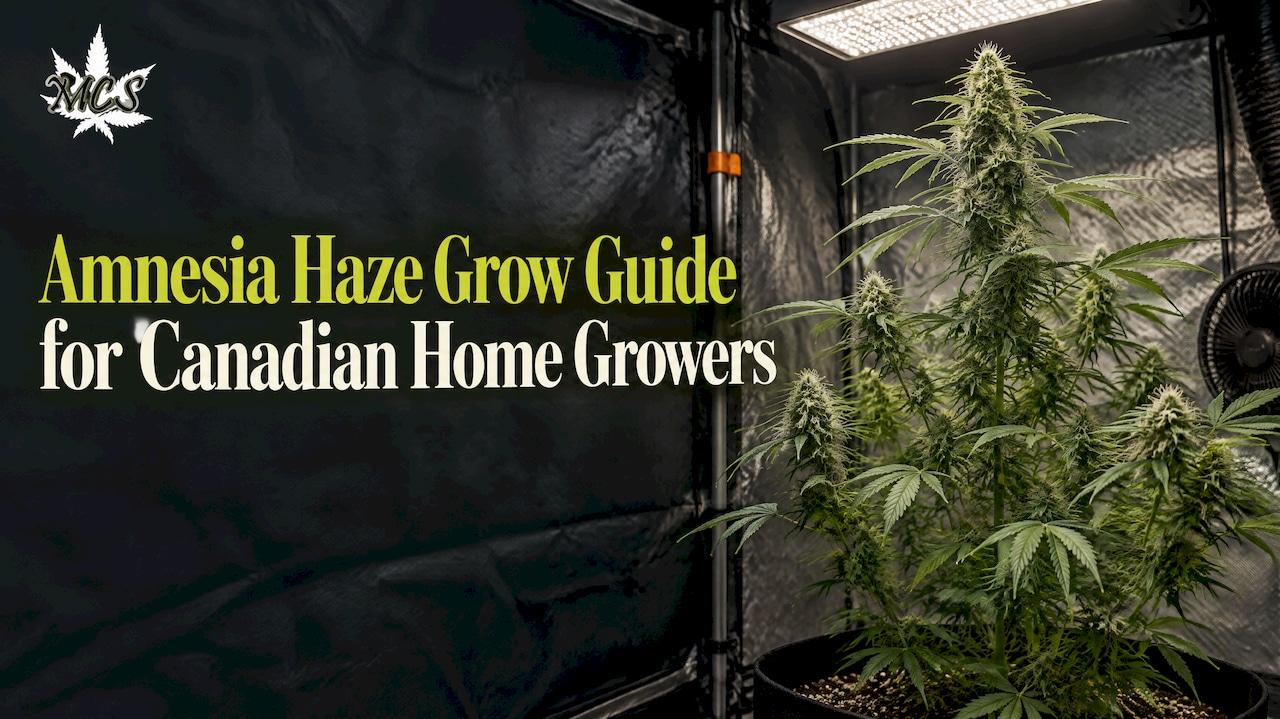
Amnesia Haze is a rewarding but demanding sativa-dominant plant. It stretches tall, flowers for roughly ten to eleven weeks, and needs steady warmth and dry air to finish well. In Canada, that makes it a strain best suited to a controlled indoor space, with outdoor growing realistic only in the warmest regions or with an autoflowering version. This guide covers setup, training, climate, feeding, harvest timing and the problems that most often ruin a Haze crop, along with the legal limits that apply to home growers.
TL;DR
- Amnesia Haze is a long-flowering, tall-stretching sativa. Leafly rates it moderate in difficulty, so it suits growers who have already finished one or two grows.
- Plan for height from day one: train early, and leave generous vertical room in the tent or room, because the plant keeps stretching after the switch to flowering.
- Keep temperatures warm but stable and humidity low during the long flowering phase. Mildew and bud rot are the main threats to dense Haze flowers.
- Outdoors, most of Canada is too cold and short-seasoned for a photoperiod Haze. An autoflower is the more dependable outdoor option.
- Adults may grow up to 4 plants per residence, subject to provincial and municipal rules.
Table of Contents
- What makes Amnesia Haze different to grow
- Know the legal limits before you plant
- Choosing between photoperiod and autoflower
- Indoor setup for a tall sativa
- Training to keep a Haze in check
- Feeding without overdoing it
- Pests, mildew and bud rot
- Growing Amnesia Haze outdoors in Canada
- When to harvest
- Our perspective on growing Amnesia Haze
- Find seeds suited to your grow
- FAQ
- Sources
What makes Amnesia Haze different to grow
Amnesia Haze belongs to the Haze family, a line of sativa genetics known for tall frames, airy branching and long flowering periods. Those traits explain nearly every instruction in a grow guide for it. A plant bred from tropical-leaning sativa ancestry has more vertical growth to give, takes longer to ripen its flowers, and tolerates humidity less comfortably than a compact indica-leaning plant.
The practical consequences are straightforward:
- Space. The plant needs more headroom than most beginner strains.
- Time. Leafly lists a flowering time of 10 to 11 weeks, counted from the switch to a 12-hour light cycle, on top of the vegetative period. Individual phenotypes and growing conditions can push that later.
- Yield. The same source describes the yield as high, but that result depends on controlling height and keeping the canopy healthy for the whole cycle.
- Patience. Hurrying a Haze rarely pays. Harvesting early gives a lighter, less developed flower.
Growers who are new to the hobby will usually have an easier first season with a compact, quicker plant. Our guide to top cannabis strains for first-time growers explains which genetics forgive mistakes, and Amnesia Haze makes more sense as a second or third project.
Know the legal limits before you plant
Growing at home in Canada is legal for adults, within limits. Health Canada states that adults can grow up to 4 cannabis plants per household, subject to provincial, territorial and municipal restrictions, including zoning, fire safety and electrical safety. That limit applies to the residence, not to each adult in it. The federal government also notes that plants must be grown from legal seeds or seedlings, with local oversight such as registration or a permit in some places.
Provinces set their own details. Ontario, for example, requires cultivators to be 19 or older, and the cannabis must be for personal use and grown from seeds or plants bought from authorized legal sources. Rules in other provinces differ, and Quebec has its own approach to home cultivation, so check your provincial government's current page before setting up.
A four-plant limit changes how a Haze grower thinks. A tall, long-flowering plant occupies its space for months, so every seed counts. Starting with feminized seeds avoids spending a slot on a male plant, which is why most home growers working within the limit choose feminized seeds.
Choosing between photoperiod and autoflower
A photoperiod plant only flowers when the light cycle shortens, which gives the grower control over how long it stays in vegetative growth and how large it becomes. That control matters for a Haze, because it lets you flip the lights to flower before the plant is too tall for the room. An autoflower begins flowering on its own timeline, usually within a few weeks of sprouting, regardless of light hours.
| Factor | Photoperiod Haze | Autoflower Haze-type |
|---|---|---|
| Flowering trigger | 12 hours of light, set by the grower | Automatic, based on age |
| Height control | Choose when to flip the lights | Limited, set by genetics |
| Total time | Long, with a flexible veg phase | Shorter overall |
| Outdoor in Canada | Difficult in most regions | Much more realistic |
| Best for | Indoor growers with vertical room | Short-season outdoor or small spaces |
If you are still weighing the formats, our detailed comparison of photoperiod, autoflower and fast version strains sets out the differences in full. Our autoflower selection and fast version photoperiod seeds are the practical alternatives when a pure long-flowering sativa is too slow for your climate.
Indoor setup for a tall sativa
Space and height
Indoors is where Amnesia Haze performs most reliably in Canada, because you control light, temperature and humidity. The main planning problem is stretch. Sativa-dominant plants commonly gain a large share of their final height in the first weeks after flowering begins, so a plant that looks manageable when you switch the lights can end up far taller by harvest. A good rule is to flip to 12 hours of light when the plant is well under half the height of your available space, then check the canopy weekly.
If you are building or upgrading a space, our Canada grow supplies starter equipment guide lists what a first indoor setup needs, from tents to ventilation.
Temperature and humidity
Leafly suggests keeping the plant between 70 and 85 degrees Fahrenheit, which is roughly 21 to 29°C. In practice, aim for the middle of that band and avoid sharp swings between lights-on and lights-off. Large temperature drops at night encourage condensation, and condensation on dense flowers is how bud rot starts.
Humidity deserves as much attention as temperature. A Canadian winter grow often begins with air that is too dry in vegetative growth and ends with a damp tent when the plants are large. Use a hygrometer inside the canopy, not on the wall of the room, and lower the humidity gradually as the buds fill in during the final weeks.
Container and medium
Use a large pot, ideally in the range of several gallons per plant, filled with a light, well-aerated mix. Roots that can spread freely support the vigorous growth of a Haze. A medium that drains well also reduces the chance of overwatering, a frequent beginner error. Whatever you choose, water only when the top layer is dry and the pot feels light.
Training to keep a Haze in check
Training is not optional with this strain. The goal is a flat, even canopy so that every bud site receives light and air, rather than a tall central cola with weak side branches.
- Top early. Cutting the main growing tip during vegetative growth encourages side branches and slows the vertical race.
- Bend and tie. Low-stress training spreads the branches sideways and lowers the plant's profile.
- Use a net. A screen holds branches level and supports heavy flowers late in the cycle. Our guide to SCROG versus sea of green explains how each method uses space, and for a stretchy sativa the screen approach is the more natural fit.
- Defoliate with care. Remove leaves that block airflow around bud sites, but never strip the plant heavily. A stressed Haze slows down, and it has little time to spare.
Because only a few plants are permitted per residence, many growers run a single large, well-trained plant per tent rather than crowding several.
Feeding without overdoing it
Haze plants are generally described as sensitive feeders, meaning they react quickly to excess. Start at a fraction of the manufacturer's recommended dose, then increase only when the leaves show a clear need. Leafly's advice for this plant includes foliar-spraying with compost tea to help it resist infection and pests, with direct liquid feeding to build vigor. Keep any foliar application to the vegetative stage, since moisture on developing flowers raises the risk of rot.
Two problems are common. Over-feeding produces scorched leaf tips and a salt buildup in the pot. Our post on nutrient burn and testing EC before flushing shows how to diagnose it before making the situation worse. Under-feeding, on the other hand, appears as pale or yellowing leaves, and our guide to cannabis deficiencies helps you tell the two apart. Excess nitrogen also matters beyond leaf color: provincial plant-health guidance links it to higher disease risk, as the next section explains.

Pests, mildew and bud rot
The long flowering period gives problems time to arrive. The British Columbia government's factsheet on diseases of cannabis singles out powdery mildew and Botrytis bud rot, and links disease risk to high humidity, condensation, poor airflow, damaged tissue and excessive nitrogen. It recommends sanitation, good air circulation and humidity control, regular scouting, and removing diseased tissue promptly. It also advises using only registered products and following the label.
For a Haze grower, that translates into a short routine:
- Check the underside of leaves and the inside of the densest buds every few days.
- Run an oscillating fan below and within the canopy, and keep an exhaust fan working continuously.
- Cut away and dispose of any bud with gray, brown or collapsing tissue, taking a margin of healthy material with it.
- Keep tools and the grow area clean between plants and between cycles.
- Do not mist flowers.
Leafly adds that the plant is prone to infection and pest issues and should be kept supported and well ventilated, which agrees with the guidance above. Because the flowering phase is so long, regular monitoring of the environment matters more than any single product.
Growing Amnesia Haze outdoors in Canada
Outdoor growing is where this strain meets the hardest limit. Leafly cautions against attempting this long-flowering sativa unless the region stays warm through the fall. Most Canadian growing regions do not offer that. The University of Saskatchewan's gardening guidance notes that natural flowering there starts around early to mid-September, and that photoperiod cannabis needs at least eight weeks to mature, which is why it calls outdoor growing challenging and suggests autoflowers for the short season.
A ten-week-plus sativa flowering from September collides with frost and cold, wet autumn weather, exactly the conditions that favor bud rot. If you still want to try:
- Choose a full-sun, south-facing site with fertile, well-drained soil, or use containers with potting soil that can be moved as the weather changes, as the same university advice suggests.
- Use large pots so you can shelter the plants during cold spells.
- Prune steadily to keep the size manageable and the airflow high.
- Be ready to move plants under cover as the nights cool.
A more dependable route is to choose genetics built for the season. Our outdoor cannabis seeds are selected for open-air conditions, and our autoflower range finishes well before the fall weather turns.
When to harvest
Harvest timing is judged on the flowers, not the calendar. Because the strain's total flowering window can stretch past the typical estimate, look at the trichomes, the small resin glands that cover the buds, under a magnifier. Mostly cloudy trichomes with a few amber ones indicate a mature flower for most growers, while mostly clear trichomes mean it is too early. Pistil color alone is a poor guide.

Cut the plant when the flowers are ready, and handle drying and curing carefully, since dense buds hold moisture. Our store blog covers the drying and curing process in detail, and the same rule applies to Haze as to any strain: slow and cool beats fast and warm.
Our perspective on growing Amnesia Haze
We see the same pattern each season among Canadian customers: growers are drawn to the name of a famous sativa, then discover that the climate and the space they actually have make the plant harder than the photo suggested. Our catalog is curated for Canadian conditions for this reason. A strain that needs a long, warm autumn will disappoint most outdoor growers, while a well-chosen feminized or autoflower plant can deliver a clean, reliable harvest.
If you do commit to a Haze-style grow, we recommend treating it as an indoor project, building your height plan before germination, and watching humidity as closely as you watch feeding. If you would rather start with something forgiving, our beginner cannabis seeds page is the place to begin, and our support team can help you match genetics to your province and your space.
— Dino Grow Master
Find seeds suited to your grow
Montreal Cannabis Seeds ships discreetly across Canada and backs its seeds with a germination guarantee. If you want long-flowering character with less risk, browse our feminized seeds for controlled indoor grows, or start from the Montreal Cannabis Seeds catalog to compare every category in one place.
FAQ
How long does Amnesia Haze take to flower?
Leafly gives a flowering time of 10 to 11 weeks once the plant is on a 12-hour light cycle. Add the vegetative period before that, and expect a total grow of several months. Phenotypes and conditions vary, so judge ripeness by the trichomes.
Is Amnesia Haze good for beginners?
It is usually not the best first plant. Leafly rates its difficulty as moderate, and its height, long flowering time and sensitivity to humidity leave little room for error. Beginners generally do better with compact or autoflowering genetics.
Can I grow Amnesia Haze outdoors in Canada?
Only in a few warm regions, and even then with risk. The plant needs a warm fall to finish, while Saskatchewan's natural flowering already begins in early to mid-September. An autoflower is the safer outdoor choice.
How many cannabis plants can I grow at home in Canada?
The federal rule allows up to 4 plants per household, subject to provincial, territorial and municipal rules. Check your own province before you plant, since some set tighter limits or other conditions.
Sources
- Tips for growing Amnesia Haze cannabis, Leafly
- Cannabis, Gardening at USask
- Diseases of Cannabis in British Columbia
- Growing cannabis at home safely, Canada.ca
- Legalizing and strictly regulating cannabis, Canada.ca
- Cannabis laws, Ontario.ca