
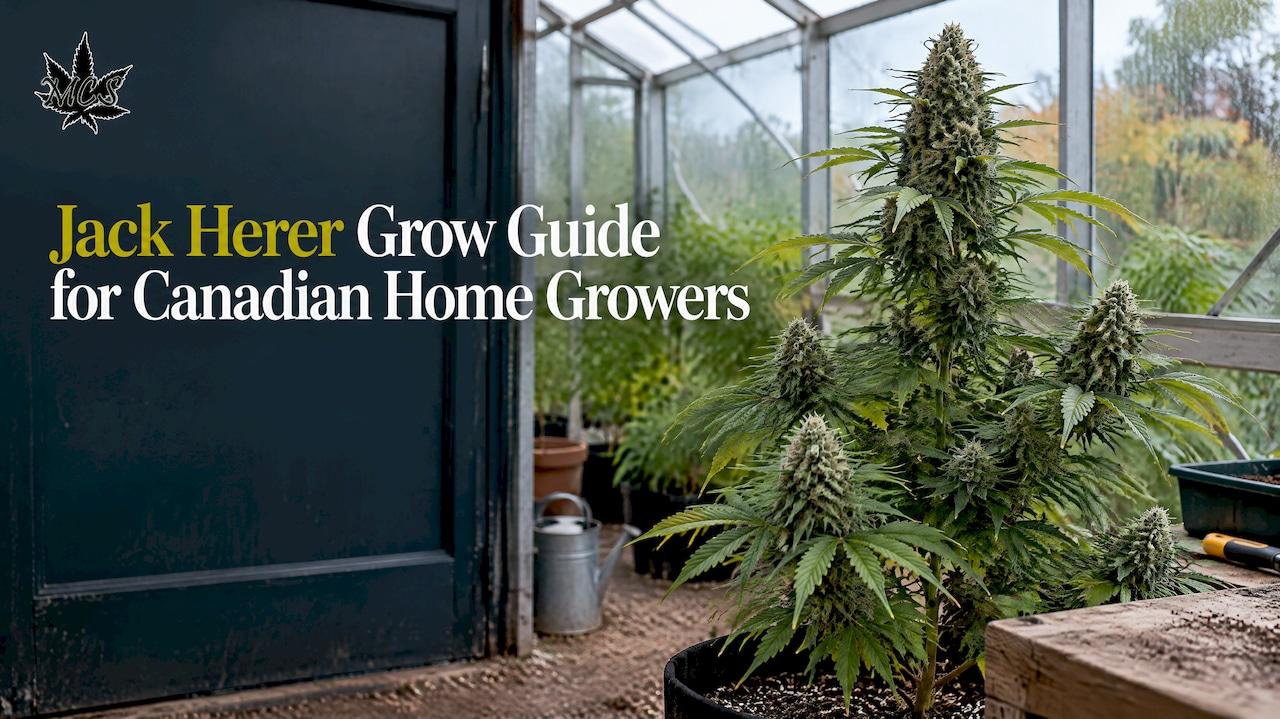
Jack Herer is a sativa-dominant hybrid that rewards patient, well-spaced growing: it stretches during flowering, prefers steady warmth and moderate feeding, and needs a longer window than most indica-leaning cultivars. In Canada, the first question is legal rather than horticultural, because home cultivation rules differ by province, and Quebec prohibits it. This guide covers the rules first, then the plant's habits, indoor and outdoor strategy, timing, yield factors, problems and harvest signs.
TL;DR
- Federally, adults may grow up to four plants per household from legally sourced seeds, but provinces set their own limits, and Quebec bans home cultivation.
- Jack Herer is a tall, stretchy, sativa-leaning plant, so height control and spacing matter more than heavy feeding.
- Its flowering period is longer than that of many popular indicas, which makes the autoflower and fast-flowering versions attractive for short Canadian seasons.
- Outdoors, the main risk in Canada is autumn cold and damp arriving before the buds finish, so site choice and timing decide the harvest.
- Most problems (stretch, nutrient burn, bud rot) come from crowding, overfeeding and humidity, and all can be prevented with planning.
Table of Contents
- Check the rules before planting
- What Jack Herer is, and why it behaves the way it does
- Choosing the right Jack Herer version
- Growing Jack Herer indoors
- Growing Jack Herer outdoors in Canada
- Flowering time and harvest timing
- What affects yield
- Common problems and how to prevent them
- Our perspective
- Find your Jack Herer genetics
- FAQ
- Sources
Check the rules before planting
Health Canada states that, under the federal Cannabis Act, adults of legal age may grow up to four cannabis plants per household for personal use. The limit applies to the household, not to each person living in it, so two adults sharing a home still share four plants in total. The same page advises that seeds and plants must come from legal sources, and warns that illegally sourced material can carry pesticides not approved for use on cannabis in Canada.
Provinces and territories add their own layers. Two cases deserve particular attention:
- Quebec. The Supreme Court of Canada upheld the province's ban on personal cultivation in its April 2023 decision in Murray-Hall v. Quebec, and the court's summary notes fines of $250 to $750 under the provincial law. Anyone living in Quebec should treat the rest of this guide as general horticultural knowledge and not as a plan to grow at home.
- Manitoba. The province lifted its ban effective May 1, 2025, and, as CBC News reported, adults 19 and older may now grow up to four plants indoors, kept out of reach of young people.
Other provinces, landlords, condo corporations and municipal bylaws can restrict where and how plants are grown, for example indoors only. Confirm the current provincial rule and the terms of a lease or condo agreement before buying seeds. For a broader view of sourcing, our guide to buying cannabis seeds in Canada explains what to look for in a seed supplier, and the essential tips for growing cannabis at home are a useful complement on choosing legally sourced seeds and seedlings.
What Jack Herer is, and why it behaves the way it does
Jack Herer is generally described as a sativa-dominant hybrid with Haze in its background, bred in the Netherlands in the 1990s and named after the cannabis activist. Its reputation among growers rests on a few traits that follow from that sativa heritage:
- Vertical growth. Plants add noticeable height once the light cycle flips to flowering, and branches lengthen with wide spacing between nodes.
- A steady, moderate appetite. Sativa-leaning plants usually tolerate lighter feeding better than heavy doses.
- A longer finish. Buds ripen gradually, and the final weeks decide whether the harvest is rich in resin or merely large.
- Modest scent in the plant stage. Many grow reports describe a plant that smells pleasant but not overpowering while growing, with aroma intensifying during drying and curing.
These traits explain most of the cultivation advice below. A grower who plans for height, patience and airflow is working with the plant rather than against it.
Choosing the right Jack Herer version
The version chosen shapes everything else, and in Canada the climate often makes the choice for the grower.
Feminized photoperiod seeds
Feminized seeds remove the guesswork of sexing plants, which matters when the law caps the household at four plants. A photoperiod plant stays in vegetative growth until the light period is shortened, so the grower controls the plant's size by deciding when to start flowering. This is the classic route for indoor tents and for sheltered outdoor spaces. Browse the feminized seed range for current genetics.
Autoflower and fast versions
Autoflowering plants begin flowering with age rather than with light changes, and fast versions shorten the photoperiod cycle. Both suit northern growers because the plant finishes before the worst of the cold. We stock a Jack Herer autoflower in feminized form, and the fast version category groups other photoperiod genetics bred for quicker harvests. Autoflowers are usually smaller and more compact than their photoperiod parents, so they trade a measure of height and size for speed and simplicity.
Growing Jack Herer indoors
Indoor growing gives the most control, and it suits a tall plant provided the space is planned in advance.
Space and height planning
The most common mistake with a sativa-leaning plant is underestimating stretch. Growers who flip to flowering at a tall vegetative height often watch the plant climb well beyond what they expected and press against the light. A practical rule is to begin flowering when the plant is roughly half of the height that the tent can accommodate. Leave clear distance between canopy and light so that the tips do not bleach or burn.
If the tent is short, use the training methods already covered in our blog, such as the techniques in our Wedding Cake grow guide, which apply to any bushy hybrid, and keep the plant count within the legal limit rather than crowding a small space.

Environment targets
Seedlings and young plants do well with warm, humid air, and humidity should fall steadily as the plant matures. A workable pattern for most grow rooms:
| Stage | Temperature (day) | Relative humidity | Light cycle |
|---|---|---|---|
| Seedling | 22 to 26°C | 65 to 70% | 18 hours on |
| Vegetative | 22 to 28°C | 50 to 65% | 18 hours on |
| Early flowering | 20 to 26°C | 45 to 55% | 12 hours on |
| Late flowering | 18 to 24°C | 40 to 45% | 12 hours on |
These are general grower conventions, not guarantees, and each room differs. A thermometer-hygrometer at canopy height is more useful than one placed on the wall. Keep a gentle fan moving air through and under the canopy, since stagnant, humid air is where most mold problems begin.
Feeding and watering
Start with light feeding and raise it only when the plant asks for more. Pale new growth suggests a shortage, while dark, glossy, clawing leaves and burnt tips suggest too much. Sativa-leaning plants often show these signs early, so it pays to feed below the bottle's recommended strength and increase gradually. Water thoroughly, then allow the top of the medium to dry before the next watering, because constantly wet roots slow growth. Our blog's general overview of nutrient deficiencies covers the diagnosis in detail, and the grow supplies starter guide lists the basic equipment, including meters for pH and moisture.
Flowering and the stretch
When the light cycle changes to 12 hours of light and 12 of darkness, expect a stretch lasting a few weeks, after which growth slows and buds start to form. During this period:
- Tuck or tie down branches that rise above the rest, so the canopy stays level.
- Remove lower growth that receives little light, to direct energy upward and improve airflow.
- Hold humidity in the lower range to protect developing flowers.
- Avoid major changes in nutrients, temperature or light timing, which can stress the plant.
Light leaks during the dark period are worth checking, since a plant under interrupted darkness may delay or disrupt flowering.
Growing Jack Herer outdoors in Canada
A plant that relishes long, warm seasons faces a challenge in most Canadian regions, where autumn cold, early frost and rain can arrive before late-ripening buds finish. Outdoor success is therefore a matter of timing and microclimate, not just genetics.
Site and timing
- Choose the sunniest, most sheltered spot. A south-facing wall or fence stores heat and breaks the wind. Aim for as many hours of direct sun as the property allows.
- Start plants after the last frost. Seedlings that have been hardened off outdoors for several days cope better with the move.
- Use large containers. Pots can be moved to shelter during a cold snap or a storm, which is a major advantage for a plant that finishes late in the year.
- Respect privacy and access rules. Plants must be kept out of reach of young people and, depending on the province, may need to stay out of public view.
For general outdoor practice, see our guide to growing cannabis outdoors and the outdoor seed selection. Because the standard photoperiod version needs a long season, many Canadian growers choose the autoflower or a fast version for outdoor beds, and keep the classic photoperiod plant for greenhouses and tents.
Protecting late buds
The risk in October is moisture rather than cold alone. Dense, resinous buds that stay damp are vulnerable to bud rot, which spreads from the inside and can ruin a flower in days. A simple rain cover, spacing that lets wind pass through the canopy, and thinning of inner leaves reduce the risk. After a wet spell, check the interior of larger buds, and remove any that are brown, grey or mushy, with a wide margin around the affected tissue.

Flowering time and harvest timing
Grow guides commonly describe the flowering period for the photoperiod version as longer than average, in the range of roughly eight to ten weeks from the light change, although phenotype, environment and feeding all move the number. Autoflower versions complete their whole life cycle faster, and fast versions shorten the flowering window. The calendar is only a guide; the plant gives better signals.
Reading the plant
- Pistils. White, hair-like pistils darken and curl inward as the flowers ripen. A majority of darkened pistils suggests the plant is approaching harvest.
- Trichomes. Using a jeweler's loupe or a small magnifier, look at the resin heads. Clear heads are immature, cloudy or milky heads indicate peak potency, and amber heads show the plant moving past it. Many growers harvest when most heads are cloudy with a small share turning amber, which usually produces a more energetic, uplifting profile, while a higher share of amber produces a heavier effect.
- Fan leaves. Gradual yellowing in the last two weeks is normal as the plant uses its reserves. Dramatic yellowing much earlier points to a feeding or root problem.
A flushing period with plain water in the last week or two is a common practice. Whatever the approach, harvest decisions should rest on the trichomes rather than on the date. Once cut, the flowers need careful drying and curing, which our blog covers separately.
What affects yield
Sativa-leaning plants have a reputation for good yields when conditions suit them, but no figure can be promised, because the result depends on several variables the grower controls:
- Light intensity and coverage. A canopy that is level and evenly lit yields more than one with a few towering tops.
- Plant count and spacing. With four plants per household as the ceiling, each plant can be given room to fill out, which suits a bushy plant.
- Container size and medium. Roots with room to expand support larger plants.
- Training. Early training, such as the methods in our blog's low-stress training and topping posts, spreads the canopy and exposes more bud sites to light.
- Stability. Steady temperature, humidity and feeding avoid the stalls that cost days in a long flowering cycle.
- Season length outdoors. A plant harvested before it is ready, or a crop lost to mold, cannot be recovered by any other measure.
The seed itself is part of the equation. Reliable germination and consistent genetics reduce the risk that a slot among four plants is wasted, which is why a germination guarantee and clear product information carry real weight for a limited-plant household.
Common problems and how to prevent them
| Problem | Typical cause | Prevention or fix |
|---|---|---|
| Excess stretch | Flipping to flowering too late, weak light | Flip earlier, train branches, increase light intensity |
| Nutrient burn | Overfeeding, salt build-up | Feed at partial strength, flush with plain water, monitor pH |
| Light bleaching | Lamp too close to tops | Raise the light, dim it, check canopy distance |
| Bud rot | Humidity, dense canopy, rain | Lower humidity, thin foliage, add airflow, cover outdoors |
| Overwatering | Constantly wet medium | Water when the top layer dries, use pots with good drainage |
| Slow flowering | Late-season cold, light leaks | Fix darkness, choose a faster version for short seasons |
Spider mites and powdery mildew are also common in warm, dry or stagnant rooms. Inspect the undersides of leaves weekly, keep air moving and avoid wet foliage late in flowering. Remove any problem leaves promptly, and use only products labelled for use on plants meant for consumption.
Our perspective
Jack Herer is a strain that teaches discipline. It does not reward crowding, overfeeding or impatience, and it rewards growers who plan height, airflow and timing before the first seed is planted.
At Montreal Cannabis Seeds, we built our catalog around the inconsistencies Canadian cultivators face: short seasons, cool nights, limited space and a legal limit of four plants for households that are allowed to grow. For that reason we describe our autoflower and fast-flowering genetics in detail, so that growers can match a plant to their tent, balcony or garden before ordering.
Our germination guarantee and our support team, who understand local growing conditions, exist because every seed counts when a household is limited to four plants. We encourage growers to learn the rules in their province first, then choose genetics that fit their space and season.
Dino Grow Master
Find your Jack Herer genetics
Growers who want the classic profile in a version suited to a shorter season can start with our Jack Herer autoflower, feminized. Those who prefer a photoperiod plant can compare the feminized range, and every order ships discreetly and quickly across Canada, backed by our germination guarantee.

For the full catalog, including mix packs and outdoor genetics, visit Montreal Cannabis Seeds.
FAQ
Can I grow Jack Herer at home in Quebec?
No. Quebec prohibits personal cultivation, and the Supreme Court of Canada upheld that ban in 2023. The rules in other provinces differ, so check the provincial law where you live before buying seeds.
How many Jack Herer plants can I grow in Canada?
Federal law allows up to four cannabis plants per household for personal use, from legally sourced seeds or seedlings. A province, landlord or condo corporation may set stricter conditions, such as indoor-only growing.
Is Jack Herer a good choice for beginners?
It can be, provided the grower plans for height and keeps feeding light. The autoflower version is more compact and finishes faster, which makes it more forgiving for a first grow in a small tent or a short outdoor season.
Can Jack Herer finish outdoors in a Canadian climate?
It depends on the region and the version. The classic photoperiod plant needs a long, warm season and protection from autumn rain, while the autoflower and fast versions are better matched to shorter seasons. Large containers that can be moved under cover improve the odds.
Sources
- Growing cannabis at home safely, Health Canada
- Murray-Hall v. Quebec (Attorney General), Supreme Court of Canada
- Changes on homegrown pot rules don't go far enough, CBC News