
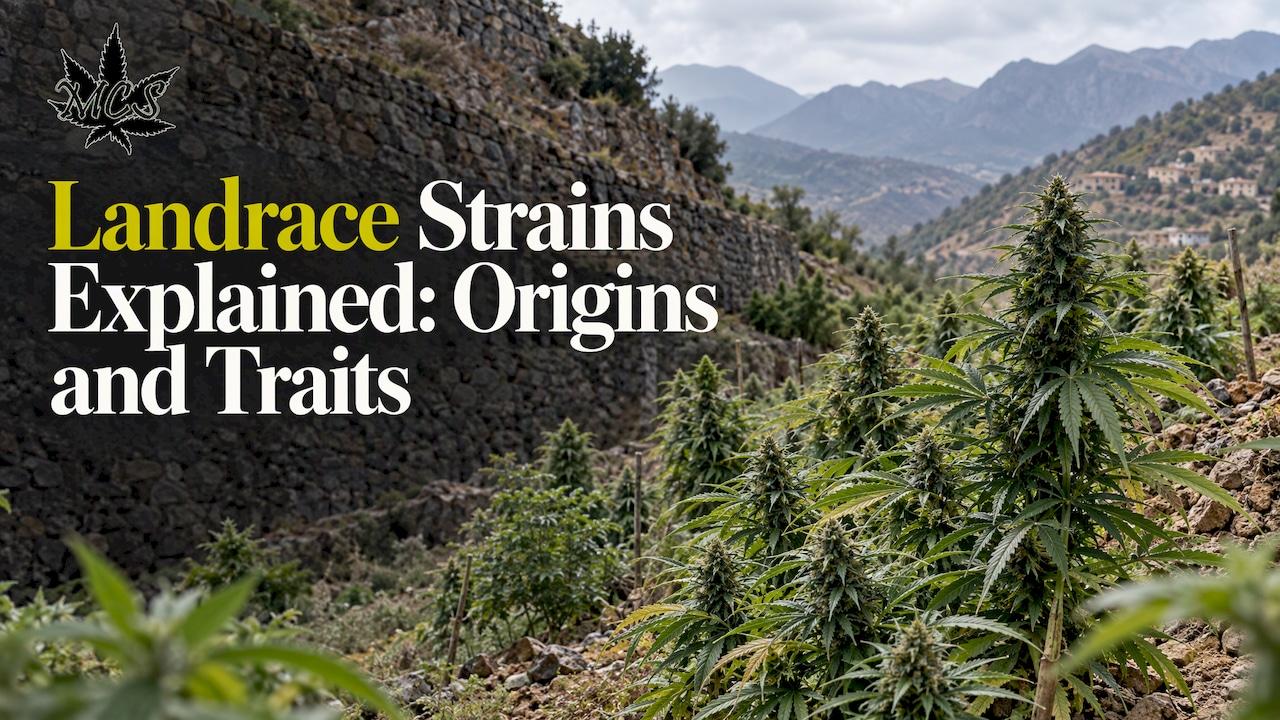
A landrace is a cannabis population that has adapted over many generations to one region and to the farmers who grew it there. Afghani, Thai, Durban Poison and Acapulco Gold are the names most often given as examples. For a Canadian grower, the useful point is that nearly every modern seed, from a feminized photoperiod to an autoflower, descends from crosses that began with these regional plants. Knowing what a landrace is, and what it is not, makes strain descriptions easier to read and seed choices easier to make. At Montreal Cannabis Seeds, we build our catalog around genetics suited to Canadian climates, backed by a germination guarantee.
TL;DR
- A landrace is a regionally adapted, human-cultivated population, not an untouched wild plant. The word comes from agriculture and describes crops and animals as well.
- The classic cannabis landraces come from Central Asia, South Asia, Africa and the Americas. Their climate shaped plant height, branching, resin and flowering time.
- Heirlooms are landrace genetics kept going outside their home region. Hybrids are deliberate crosses, and a landrace parent does not make a hybrid a landrace.
- Canada has no cannabis landrace of its own, so Canadian growers work with breeder-developed genetics selected for short seasons and variable weather.
- A strain name alone does not prove origin. Seed descriptions that state parentage and growing traits are the better guide.
Table of Contents
- What a landrace actually is
- How geography shapes the plant
- Well-known landrace names and where they come from
- Landrace, heirloom and hybrid: three different things
- What landrace traits mean for a grower
- Canada and the landrace question
- Why landrace diversity matters
- Reading a seed listing with landrace knowledge
- Perspective
- Choosing seeds with this in mind
- FAQ
- Sources
What a landrace actually is
The Cambridge Dictionary defines a landrace as a variety of crop or breed of animal that has developed over time to suit the conditions of a particular local area. Cannabis simply borrows that agricultural term. A peer-reviewed paper on terroir in drug cannabis, written by geographer Pierre-Arnaud Chouvy, describes a landrace as a domesticated variety that has adapted to its natural and cultural environments through isolation.
Two parts of that definition matter.
Adaptation to place. Climate, altitude, rainfall, soil and day length act as a filter. Plants that finish flowering before the cold or the rains set seed, and those seeds become the next crop.
Human involvement. Landraces are not wild. Farmers saved seed, favored certain plants, moved seed between villages and used the harvest in a local way, whether for smoking or for hashish. The popular image of a landrace as a pristine plant that nobody ever touched is a misapplication of the word. It describes a cultivated population shaped by both environment and culture.
Because a landrace is a population and not a single fixed genotype, individual plants within it differ. Two seed lots from the same valley can look and smell different. That variability is normal and is part of what the word means.
How geography shapes the plant
The plain version of the story is that place builds plant. The research supports it, with detail.
In a 2020 classification paper, botanists McPartland and Small explain that plants from Central Asia and South Asia occupied separate ecological niches for at least 32,600 years, according to fossil pollen evidence. The Central Asian plants developed brittle, densely branched structures with compact flower clusters. Those traits suit a drier climate but cope poorly with monsoon rain, because the branches snap and the dense flowers are vulnerable to fungus. South Asian plants, by contrast, developed flexible branches and looser flowers that tolerate humidity better.
Climate is measurable too. A 2024 study in BMC Plant Biology looked at wild hemp in northern Pakistan and found that average annual temperature explained more of the variation in plant traits than geographic variables. Populations in the humid, cooler Lesser Himalayas and on the Potohar Plateau converged on similar traits because they faced similar conditions, not because they sat close together.
Culture steers selection as well. Chouvy's case study of Morocco's Rif region shows that early local plants were large and branched and grown for smoking. Once large-scale hashish production took off in the 1960s, selection moved toward the narrow-leafed, fast-flowering plant that dominates the region today. That same paper describes the Rif plant as open-pollinated, low in input needs, stable in yield and ready to harvest by mid-July, before the autumn rains. The plant fits the calendar of the place.
Broad patterns by region
Growers and breeders often sort landraces into three broad groups. These are generalizations, and individual populations vary.
| Origin | Typical structure | Typical character |
|---|---|---|
| Central Asia and the Hindu Kush (Afghanistan, Pakistan) | Short, bushy, broad leaves | Thick resin, quick flowering, dense flowers |
| Tropical regions (Thailand, Colombia, Mexico, Jamaica) | Tall, airy, narrow leaves | Long flowering time, lighter flower structure |
| Africa (South Africa, Malawi) | Medium height, sturdy stems | Widely spaced flowers, often sweet or citrus aromas |
The logic is easy to follow. A short plant with dense resin copes with cold, dry mountain conditions and a short season. A tall, open plant with a long flowering window suits a warm equatorial climate with a long season.
Well-known landrace names and where they come from
The names most often cited as landraces, with their regions of origin:
- Hindu Kush and Afghani: the mountain ranges of Afghanistan and Pakistan. Both are cornerstones of the compact, resinous type behind many kush lines.
- Thai: Thailand, a tall tropical plant with a long flowering time.
- Durban Poison: the Durban area of South Africa.
- Acapulco Gold: Guerrero, Mexico.
- Colombian Gold: the Santa Marta mountains of Colombia.
- Lamb's Bread: Jamaica.
- Malawi: the African country of the same name.
Two cautions apply. First, these names now appear on many seed packs, and a name on a label is not a certificate of origin. Cannabis naming is not regulated the way wine regions are. Second, many of the famous source regions have since been exposed to modern hybrid seed through travel and trade, so plants grown in a home valley today may not match what was grown there in the 1970s.
The classic story is told in more depth in the store's own history of cannabis from ancient Asia to Canada's Act, which is the place to start for the wider timeline.
Landrace, heirloom and hybrid: three different things
These three terms are often mixed up, and the difference helps when reading a seed description.
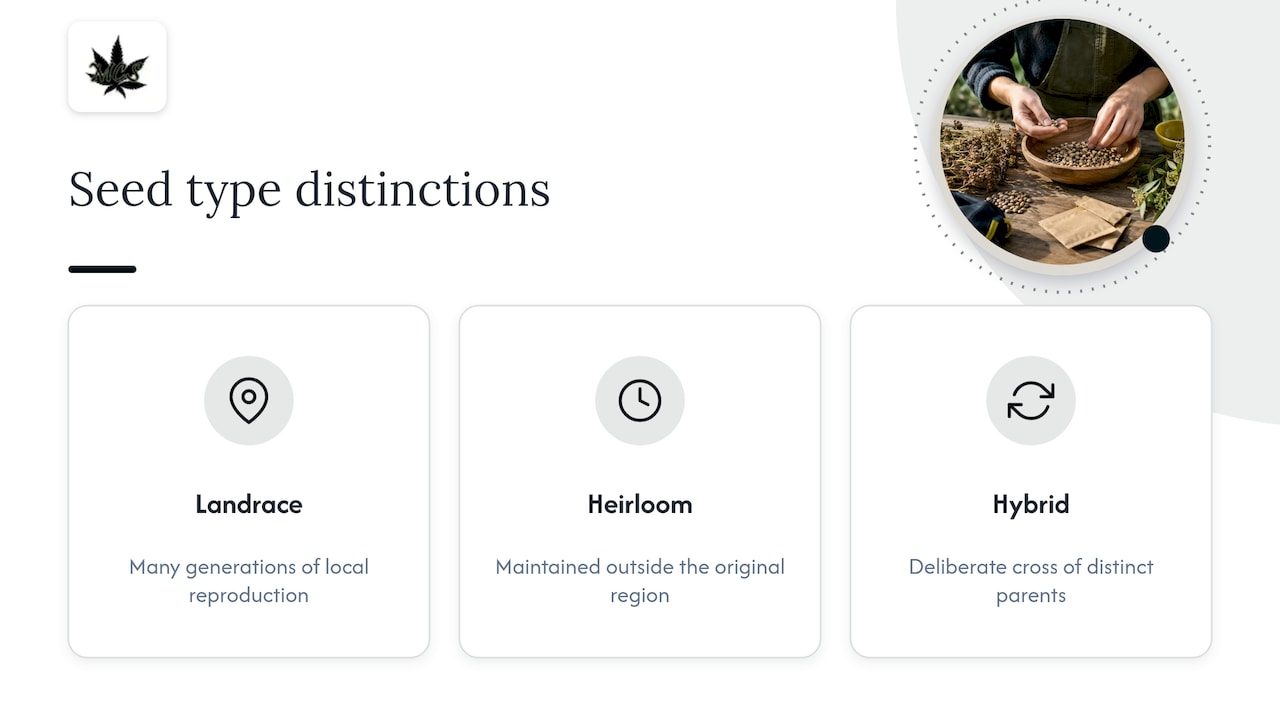
Landrace. A population that developed inside a regional cultivation system, over many generations of local reproduction.
Heirloom. Landrace genetics that have been kept stable and maintained over a long period, usually outside the original region. A common working definition is genetics cultivated for at least 50 years away from the original environment. The heirloom emphasizes preservation over time, while the landrace emphasizes local adaptation.
Hybrid. The offspring of two deliberately combined, genetically distinct parents. Landrace status does not pass to descendants. A cross between a landrace and a modern hybrid is a hybrid, and a plant selected from a landrace and propagated as a clone is a regional selection, not a landrace.
The history of modern hybrids is short and well documented. Chouvy's 2019 paper describes Skunk #1 as the first modern cannabis hybrid, a cross of Afghan, Colombian and Mexican landraces. Breeding began in 1969, and after ten growing seasons it produced a relatively true-breeding seed cultivar that was sold from the late 1970s or early 1980s. Most of what fills seed catalogs today follows that pattern: take regional parents, select for the traits wanted, and stabilize the result over several generations. The store guide to cannabis breeding and strain development covers how that work is done.
What landrace traits mean for a grower
The regional traits above explain much of how modern plants behave:
- Structure. Compact, broad-leafed ancestry tends to appear in plants that stay manageable and suit smaller spaces. Tall, narrow-leafed ancestry tends to appear in plants that stretch and need more headroom.
- Flowering time. Landraces from short-season mountain regions finish quickly. Tropical lines take much longer, which matters a great deal when frost arrives in October.
- Humidity tolerance. Dense flowers from dry regions collect moisture and invite mold in damp weather. Open structures shed it more easily.
- Aroma. Earthy, peppery and pine notes are typical of Central Asian ancestry, while sweeter and citrus notes are more often associated with African and tropical lines.
A landrace is not automatically stronger than a modern strain either. Selective breeding for potency has been a priority of the modern market, so potency is better read from a seed description's stated THC and CBD ranges than assumed from heritage. The store's guide on checking THC and CBD first goes into that, and the labels themselves are worth understanding: the question of how indica and sativa labels work shows why chemistry on a lab report says more about a flower than a name does. For the botanical background, see our overview of sativa, indica and hybrid cannabis.
Outside its home range, a landrace behaves differently too. Seed from a Hindu Kush-type population grown in a different climate can produce plants with similar genetics but different traits, because the environment now does part of the selecting. That is the practical reason why a plant described by its place of origin is a weaker guide to home-grown results than its tested performance in a comparable climate.
Canada and the landrace question
Cannabis arrived in Canada through human cultivation, not as a native species, and its time here has been short compared with the thousands of years behind the classic landraces. For that reason, Canadian strains with a long local reputation are better described as heirlooms or regional breeding projects than as true landraces. Quebec has its own well-known lines and local growing culture, but they come from deliberate breeding.
That matters for a grower because Canada's conditions are demanding. Seasons are short, nights turn cold early, and autumn humidity can arrive before flowers finish. The genetics that handle these conditions best tend to combine what landraces gave to breeding, such as speed, resin, compact structure and resilience, with the stability that only generations of selection can produce.
Why landrace diversity matters
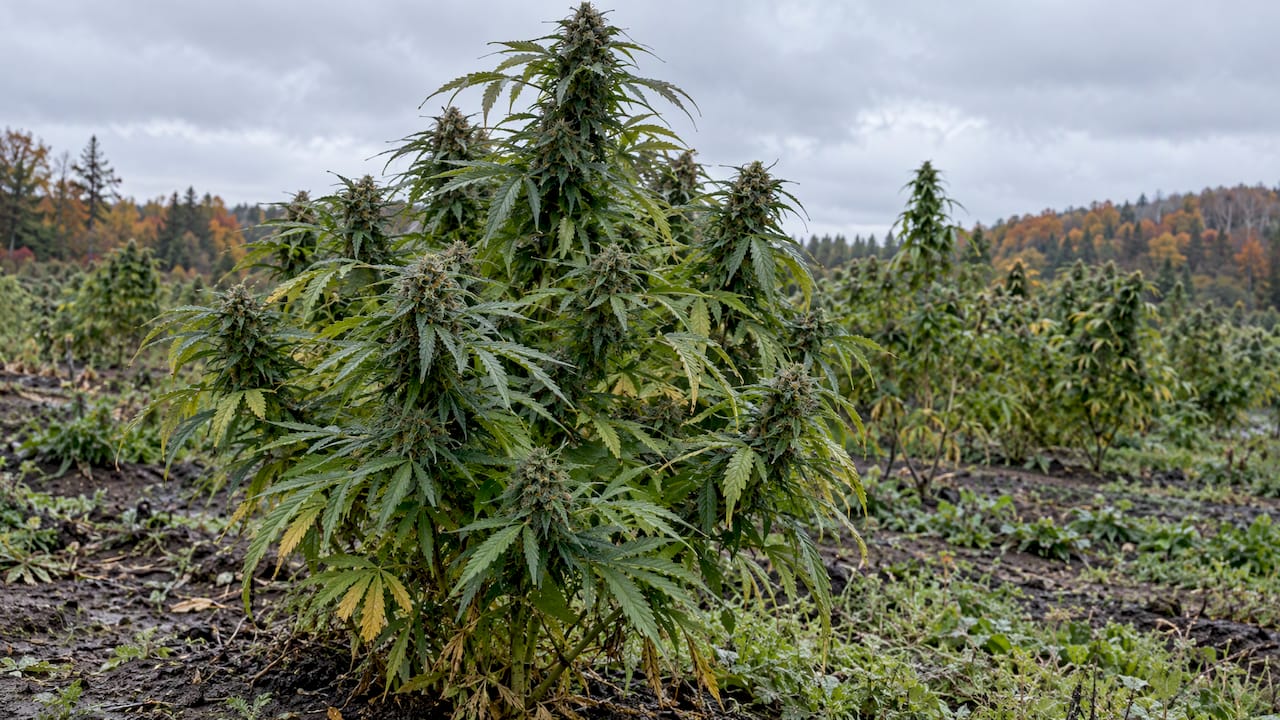
Chouvy argues that landrace and terroir should be studied together, because both result from interaction between physical environment and human practice. He also warns that the commercial expansion after legalization threatens the genetic and cultural diversity tied to small-scale historical cultivation. The reasoning is simple: when a few high-yielding hybrids replace regional populations, the genetic material that breeders draw on narrows. Every trait mentioned in this article, from fast finishing to mold tolerance, was first tested by the climate of a particular place.
Reading a seed listing with landrace knowledge
A grower choosing seed does not need to find a landrace. The better approach is to use the vocabulary to read what a listing says:
- Check the parentage. A description that names its parent lines, such as an Afghan or Hindu Kush side, tells more about structure and flowering time than the marketing name.
- Match flowering time to the season. Compact, mountain-type ancestry generally finishes earlier, which suits Canadian outdoor and short-season setups.
- Look at the type of seed. Feminized seed removes the need to sort plants by sex, and autoflowers do not depend on day length. The store's feminized seeds and autoflower seeds pages show the range.
- Look for stated trait ranges. Height, flowering weeks and cannabinoid ranges are more useful than a legendary name.
Kush lines make a good example, since they carry the compact, resinous character of the Hindu Kush type. Critical Kush feminized seeds and Crush Kush feminized seeds are both listed in the catalog. Growers who want a shorter wait can look at the fast version photoperiod range.
Perspective
Landrace talk can sound like nostalgia, but for a Canadian grower it is a practical lesson. Every plant in a garden is the product of selection by a climate, and the question that matters is whether that climate resembles yours.
This is the reasoning behind how we build our catalog. We curate genetics for Canadian growing conditions, we describe each line in detail so that parentage and traits are clear before purchase, and we back germination with a guarantee. Our team understands local conditions, so a first-time grower and an experienced one both get information that reflects the short seasons and variable weather here.
The old landraces showed what adaptation looks like. Seed that is selected, stabilized and described honestly is how that adaptation reaches a home grower in Canada.
Dino Grow Master
Choosing seeds with this in mind
Our catalog groups genetics by the way growers actually work: feminized seeds, autoflowers, fast versions, CBD lines, regular seeds, mix packs and outdoor selections, along with our Quebec line. Each product page carries detailed information so the traits discussed above can be checked against what is listed. Orders ship quickly and discreetly across Canada, and the germination guarantee applies to our seeds. Browse the full range at Montreal Cannabis Seeds, or start with the mix packs if you want to compare several types side by side.

FAQ
What are landrace strains?
Landrace strains are cannabis populations that adapted over many generations to a specific region and to the farming practices of the people growing them. They are cultivated plants, not wild ones. Afghani, Thai, Durban Poison and Acapulco Gold are commonly cited examples.
What does landrace mean in simple terms?
It describes a plant or animal variety shaped over time by one local area. The Cambridge Dictionary uses the same idea for crops and livestock. In cannabis, it means a regional population with its own structure, flowering time and aroma.
Are landrace strains stronger than modern strains?
Not necessarily. Modern breeding has focused heavily on potency, so many hybrids carry higher THC than classic landraces. Read the stated THC and CBD ranges on a seed listing instead of assuming from heritage.
Are there landrace strains in Canada?
No cannabis population in Canada has had the thousands of years of local adaptation behind the classic landraces. Long-established Canadian lines are better understood as heirlooms or breeding projects, selected for traits that suit Canadian seasons.
Is a hybrid made from a landrace still a landrace?
No. Landrace status does not pass to offspring. Once a landrace is deliberately crossed with another line, the result is a hybrid, even if the landrace parent is clearly visible in its traits.
Sources
- Landrace, English meaning, Cambridge Dictionary
- Why the concept of terroir matters for drug cannabis, Chouvy, 2022
- A classification of endangered high-THC cannabis, McPartland and Small, 2020
- Geo-climatic factors co-drive the phenotypic diversity of wild hemp, BMC Plant Biology, 2024
- Moroccan hashish as an example of a cannabis terroir product, Chouvy, 2022
- Cannabis cultivation in the world: heritages, trends and challenges, Chouvy, 2019