
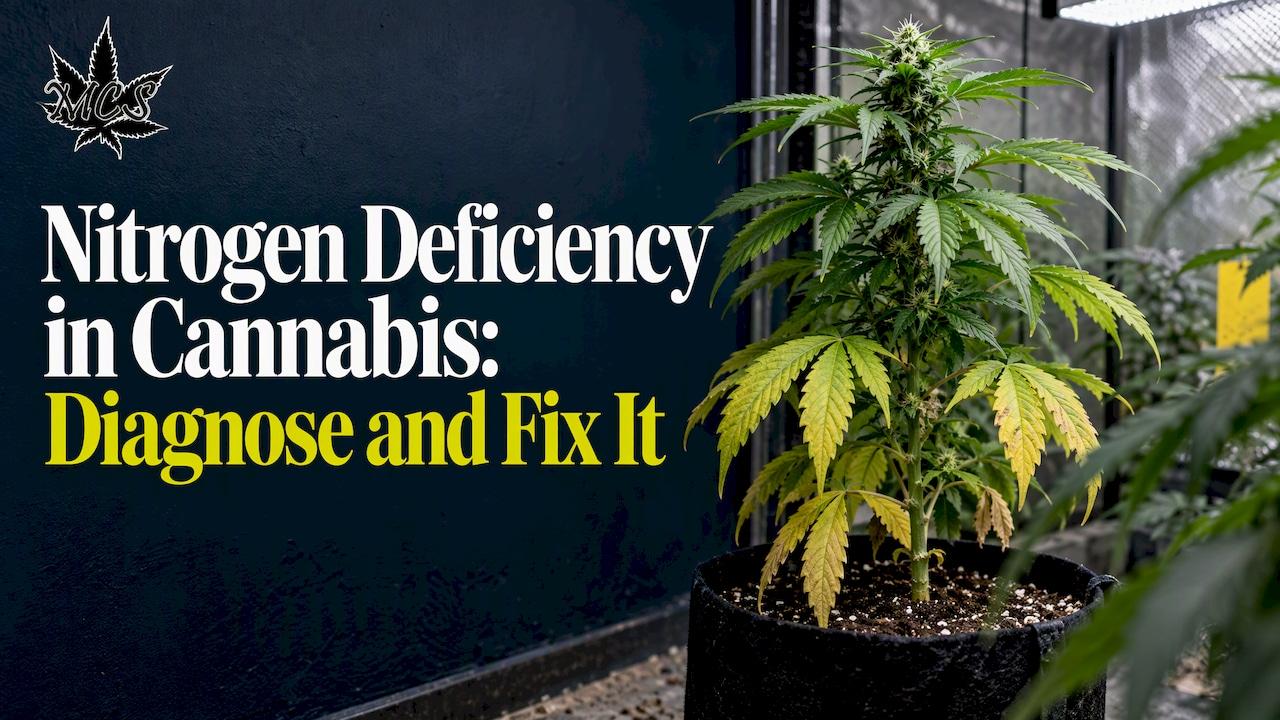
Nitrogen deficiency in cannabis shows first as pale, yellowing leaves at the base of the plant, while the newest growth at the top stays comparatively green. The plant moves nitrogen out of its oldest leaves to feed new tissue, so the damage climbs upward over time. The cause is almost always a feeding or root-zone problem, not a bad seed, and in most cases it can be corrected if it is caught early. This guide covers how to recognize the problem, how to separate it from look-alikes such as sulfur deficiency and overfeeding, how to correct it, and why the form of nitrogen matters as much as the amount.
TL;DR
- Nitrogen is mobile in the plant, so deficiency begins as yellowing in the oldest, lowest leaves and moves up. Yellowing that starts at the top points to something else, often sulfur.
- Yellow leaves are a late signal. Research on nitrogen-starved plants found vegetative fresh weight cut by 73% and flower yield by 33% to 72%.
- Correct gradually with a balanced, nitrate-based feed, and confirm the root zone is healthy before adding more nitrogen.
- Late-flower yellowing is partly normal. Treat it as a deficiency only if it appears early, spreads fast or is paired with stunted growth.
Table of Contents
- How nitrogen works inside a cannabis plant
- Recognizing the symptoms
- Is it really nitrogen? Look-alikes to rule out
- Common causes
- The form of nitrogen matters
- How to correct a nitrogen deficiency
- Nitrogen in flowering: when yellowing is normal
- Preventing nitrogen problems before the first yellow leaf
- Our perspective on nitrogen deficiency
- Choosing genetics that suit your feeding style
- FAQ
- Sources
How nitrogen works inside a cannabis plant
Nitrogen is a building block of chlorophyll, amino acids and proteins, which is why vegetative cannabis consumes it in larger quantities than almost any other element. A plant short of nitrogen makes less chlorophyll, photosynthesizes more slowly and grows less. Controlled-environment work on medical cannabis put the best vegetative supply at roughly 160 mg/L of nitrogen, with supplies as low as 30 to 80 mg/L producing reduced chlorophyll, slower photosynthesis and visible symptoms. Supplying well beyond the optimum added no benefit and could induce toxicity.
Those figures come from hydroponic research under controlled conditions, so they are a reference point, not a recipe for a soil grow in a Canadian basement. What transfers is the principle: there is a window, and both sides of it cost yield.
The second principle is mobility. Because nitrogen is mobile, a hungry plant strips it from older leaves and sends it to growing tips. That is why the first symptom appears at the bottom, and why diagnosing by position on the plant is more reliable than diagnosing by color alone.

Recognizing the symptoms
A typical progression looks like this:
- Pale green lower leaves. The oldest fan leaves lose depth of color, often evenly across the blade.
- Yellowing. Chlorosis spreads across the leaf, including between the veins, and the whole leaf turns light yellow. The Ontario Ministry of Agriculture's hemp deficiency guide is a useful Canadian photo reference for comparing nutrients side by side.
- Leaf drop. Badly affected leaves wither and fall, and the yellowing moves to the next tier of leaves.
- Slowed growth. Internodes stay short, new growth is small and the plant stalls even if it looks otherwise healthy.
- Weak flowering. In bloom, a nitrogen-starved plant produces fewer and lighter buds.
The research summary above is blunt about the stakes: vegetative fresh weight fell by 73% and floral yield by 33% to 72% in nitrogen-deficient treatments compared with fully fed controls. Those numbers describe plants grown hydroponically with nitrogen withheld entirely, an extreme case, but they show how much is at stake in a mild case that goes unnoticed for weeks.
Why yellow leaves arrive late
Visible chlorosis is a lagging indicator. By the time a leaf has changed color, the plant has usually been short of chlorophyll-building material for some time. Researchers working on non-invasive detection of nitrogen deficiency in Cannabis sativa have tested hand-held Raman spectroscopy precisely because the eye notices the problem after it has begun. Home growers do not need laboratory equipment, but the lesson applies: watch growth rate, node spacing and the color of the newest leaves as well as the oldest, and treat a slowdown as a prompt to check, not a mystery.
Is it really nitrogen? Look-alikes to rule out
Several problems yellow a cannabis leaf. Matching the pattern to the position on the plant narrows the list quickly.
| Problem | Where it starts | What it looks like | Key clue |
|---|---|---|---|
| Nitrogen deficiency | Oldest, lowest leaves | Even pale green to yellow, leaves drop | Moves upward over time |
| Sulfur deficiency | Youngest, upper leaves | Pale green or yellow new growth | Sulfur is immobile, so new tissue suffers first |
| Phosphorus deficiency | Lower leaves, often darker | Dull, dark or bluish-green with spotting | Color is darker, not paler |
| Nutrient burn | Leaf tips | Burnt, yellow or brown tips, dark green leaves | Tips damaged before the blade |
| Natural late-flower fade | Lower leaves | Gradual yellowing as buds ripen | Happens in the final weeks |
Nitrogen versus sulfur
This is the confusion that fills grower forums. Sulfur deficiency produces pale green or yellow leaves too, but the Ontario guide explains that sulfur is immobile in the plant, so chlorosis shows first on younger, upper leaves, while nitrogen deficiency starts low. Sulfur-deficient stems may also look woody with shortened internodes. If the top of the plant is the pale part, adding nitrogen will not help and may push the plant toward toxicity.
Nitrogen versus phosphorus
Phosphorus shortage also begins on older leaves, but the tone differs: darker, duller foliage instead of a clean fade to yellow. The store's guide to fixing cannabis phosphorus deficiency in Canada covers that case in detail, and the broader pest and nutrient deficiency chart helps with side-by-side comparison.
Nitrogen versus too much nitrogen
Excess nitrogen produces very dark green, sometimes clawing leaves, with burnt tips. Beyond the optimum, extra nitrogen offers no benefit and can reduce cannabinoid concentrations. A plant that already looks overfed needs the opposite treatment, and the store's article on nutrient burn and testing EC before flushing explains how to confirm it first.
Common causes
A deficiency symptom means the plant is not getting enough usable nitrogen. That is not always the same as the feed containing too little. The usual causes are:
- Underfeeding. Small pots, a slow-release soil that has run out, or a feed schedule built for a different strain size.
- Root-zone trouble. Overwatering, compacted media or cold roots reduce uptake even when nitrogen is present. A plant that is sitting wet can look starved.
- Pot-bound plants. Roots with nowhere to go limit what the plant can absorb. Fast-growing plants often outgrow their container before the schedule says they should.
- Heavy feeding by a large plant. Vigorous vegetative growth drains soil nutrients quickly, and the demand is highest just before flowering.
- Wrong nitrogen form. Covered below, this is the cause most growers overlook.
- Late-flower senescence. Not a fault at all, if it happens at the right time.
Autoflowering plants deserve a special note. Their life cycle is short and they react badly to aggressive corrections, so the practical approach is to start light and follow the plant. The store's autoflower feeding schedule begins at one-eighth strength and adjusts to plant cues, which is a sound pattern for any nitrogen correction in autos.
The form of nitrogen matters
Most deficiency advice treats nitrogen as a single number. A 2022 study on medical cannabis showed why that is incomplete. Nitrogen reaches the plant as nitrate (NO3-) or ammonium (NH4+), and the study found that a high ammonium-to-nitrate ratio reduced cannabinoids, terpenoids and yield. In the research summary reviewed for this article, ammonium above roughly 30% of total nitrogen was linked to toxicity-like symptoms in late maturation even when total nitrogen looked adequate.
The practical consequences for a home grower are straightforward:
- Choose a nutrient line where nitrate is the main nitrogen source, and read the guaranteed analysis on the label for the split between nitrate, ammonium and urea nitrogen.
- Do not respond to every yellow leaf by raising total nitrogen. If the plant already receives plenty and still struggles, the form or the root zone is the likelier culprit.
- Be cautious with ammonium-heavy products in the second half of flowering.
This finding comes from controlled, mostly soilless production. In living soil, microbes convert much of the nitrogen to nitrate on their own, so the ratio matters most for bottled-nutrient and hydroponic growers.
How to correct a nitrogen deficiency
Step 1: Confirm the diagnosis
Check position first: are lower leaves going pale while the top stays green? Then check the growing conditions. Is the medium waterlogged, is the pot too small, and has the feed been consistent? Measure the runoff pH and EC if possible. Skipping this step is how a root problem gets treated with more fertilizer.
Step 2: Fix the root zone
Let an overwatered pot dry back, repot a root-bound plant, and bring the root-zone temperature into a comfortable range. The store's guidance on transplanting lives in its main blog if a move is needed. Nutrients cannot be absorbed by roots that are struggling.
Step 3: Feed in measured increments
Raise nitrogen modestly, not dramatically. Because the plant can take only so much, a correction in two or three smaller steps is safer than one large one. Observe new growth over several days: improved color in the upper foliage is the first sign the correction is working. Leaves that have already turned yellow rarely turn fully green again, so judge success by the new leaves, and consider removing leaves that are fully dead.
Step 4: Prefer nitrate-dominant inputs
If the nutrient line is ammonium-heavy, switch to a nitrate-dominant option, particularly heading into mid and late flower. For organic soil growers, top-dressing or a compost tea is gentler than a mineral jump, though it works more slowly.
Step 5: Keep notes
Record feed strength, runoff readings and the date symptoms appeared. In the next run, the plant's own history becomes the best diagnostic tool, and the problem can be prevented instead of corrected.
Nitrogen in flowering: when yellowing is normal
The common advice to cut nitrogen in bloom is sound in principle, since flowering plants need relatively more phosphorus and potassium and relatively less nitrogen than they did in veg. Still, the line between normal and a deficiency is fine.
- Normal: gradual yellowing of the lowest leaves in the last two to three weeks as the plant remobilizes nutrients into buds.
- Problem: yellowing that begins in the first weeks of flower, spreads rapidly up the plant, or comes with small, airy buds.
A 2023 study with the playful title Cannabis Hunger Games examined deliberate nutrient stress in flowering. Plants under controlled stress made less flower mass but could compensate with higher CBD concentrations, which suggests that mild hunger late in the cycle is not the catastrophe it looks like. That is a research finding on indoor medicinal plants, not a license to starve a home crop from week one.
The flushing myth
Many growers cut feed or flush with plain water in the final weeks to improve flavor. A university thesis on controlled-environment nutrient management reports that flushing can lower nitrogen in vegetative leaves and possibly reduce yield, but does not reliably lower it in the flower tissue or improve the sensory qualities of the dried product. In practice, a plant that yellows early because of a flush may simply be giving up weight. A moderate, planned taper is more defensible than an abrupt cut.
Preventing nitrogen problems before the first yellow leaf
Prevention rests on a few repeatable habits:
- Start with a feed schedule that matches the plant type. Photoperiod plants are usually fed more heavily and for longer than autoflowers.
- Match pot size to the plant's expected final size. Fewer transplants and less root disturbance reduce stalls.
- Track growth, not only appearance. A plant that stops adding nodes or new leaf size for a week is signaling a limit.
- Test the runoff. Runoff readings reveal salt buildup and pH drift that cause lockout.
- Consider diagnostic tools. SPAD chlorophyll meters give a numerical read on leaf greenness, so growers who want to catch a decline before it is visible can use one on a few reference leaves each week. Experienced medical growers lean on tissue tests for the same reason.
Genetics play a part too. Vigorous, fast-growing varieties draw nitrogen harder, while compact, slower plants tolerate leaner feeding. Reading a strain's description before germination helps set a realistic feed from day one.
Our perspective on nitrogen deficiency
We see the same pattern again and again with Canadian growers: a plant is blamed for a problem that began in the pot. Cool basements, dense soil mixes that stay wet and a long winter indoor season all push roots into poor condition, and the leaves then report it as hunger. Before reaching for a stronger feed, we ask growers to check watering rhythm, container size and runoff readings.

The second pattern is impatience. A single yellow lower leaf is not an emergency, and a heavy correction does more harm than the original shortfall. Small adjustments, a week of observation and a note in the grow log resolve most cases. This is especially true with autoflowers, which have no time to recover from a swing from deficiency into burn.
Seed choice sits upstream of all this. We curate genetics with Canadian conditions in mind and describe each variety's vigor and feeding appetite, so growers can match plant to setup instead of fighting it. Our support team is available when a diagnosis is unclear.
— Dino Grow Master
Choosing genetics that suit your feeding style
Growers who prefer a lighter touch often do well with compact plants that finish quickly. Our autoflower seeds suit shorter indoor seasons and modest feeding, while feminized seeds give photoperiod growers more control over vegetative time and nutrient planning. Each product page carries detailed information on the variety, and every order is covered by our germination guarantee. For a wider look, the full seed collection is available, with fast and discreet shipping across Canada.
FAQ
How can nitrogen deficiency be fixed naturally?
Slow, biologically active sources such as well-finished compost, worm castings or a diluted compost tea can lift nitrogen gently in soil. They act over days to weeks, so they suit mild cases better than an advanced one. Address watering and pot size at the same time, since poor roots limit uptake of any input.
What does nitrogen toxicity look like in cannabis?
Leaves turn very dark green, tips yellow or brown and burn, and leaf edges may curl. Growth can be lush but soft, and in flower the plant may produce lower cannabinoid concentrations. The nutrient burn guide explains how to confirm it with an EC reading.
When should nitrogen be reduced during flowering?
Most growers lower nitrogen as the plant transitions into bloom and taper further toward the final weeks, since flowers draw heavily on phosphorus and potassium. Gradual yellowing of the lowest leaves in the last two to three weeks is expected. Avoid an abrupt cut early in flower, which can cost weight.
Can sulfur deficiency be mistaken for nitrogen deficiency?
Yes, because both produce pale leaves. Position separates them: nitrogen deficiency begins on older, lower leaves, while sulfur deficiency, as the Ontario guide explains, shows first on younger, upper leaves because sulfur does not move within the plant.
Will yellow leaves turn green again after treatment?
Usually not. Fully yellowed leaves rarely recover, even after the correction works. The reliable sign of success is healthy color in the new growth above them.
Sources
- Foliar symptomology, nutrient content and yield of cannabis with single-element deficiencies (PMC)
- Response of medical cannabis to nitrogen supply under long photoperiod (PMC)
- Nutrient Deficiency ID Guide for Hemp, Ontario Ministry of Agriculture, Food and Rural Affairs
- Nitrogen source matters: high NH4/NO3 ratio reduces cannabinoids, terpenoids and yield (PMC)
- Non-invasive detection of nitrogen deficiency in Cannabis sativa using hand-held Raman spectroscopy (MDPI)
- Cannabis Hunger Games: nutrient stress induction in flowering stage (PMC)
- Nutrient Management of Cannabis in Controlled Environments (Utah State University)