
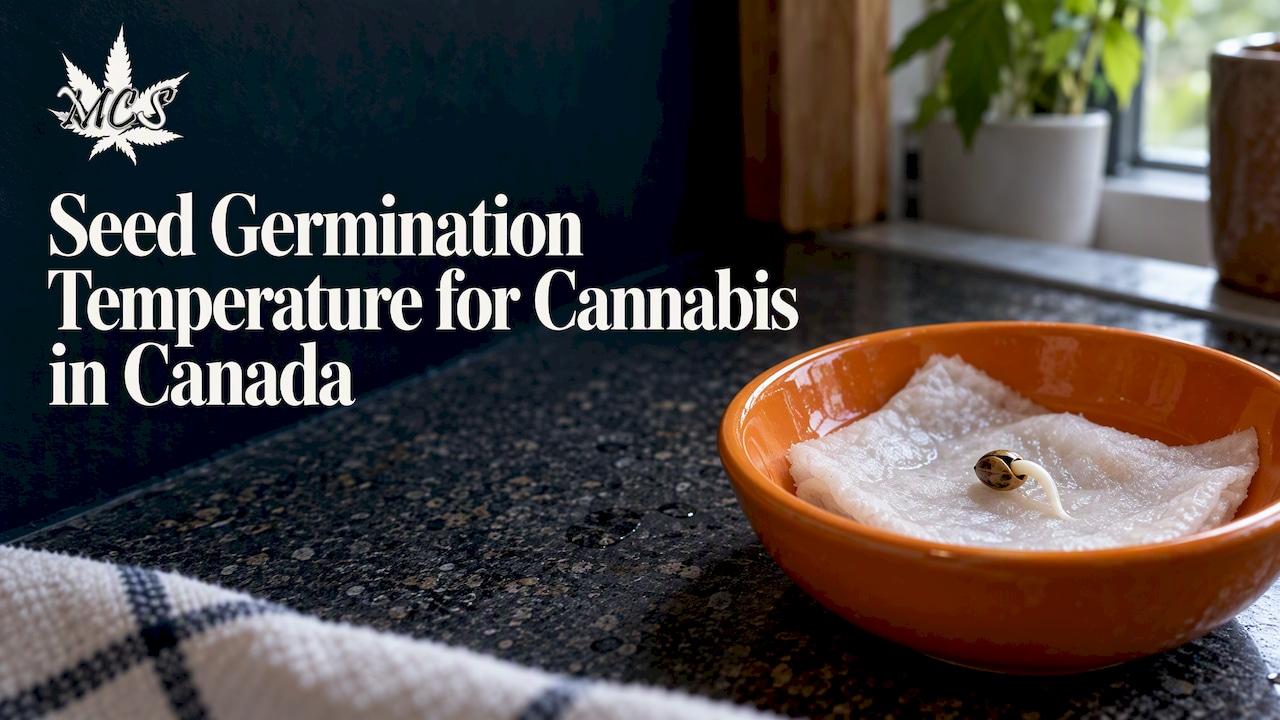
Cannabis seeds germinate most reliably at a steady 23°C to 27°C (73°F to 81°F). Below that range they still sprout, but more slowly and with more failures, and above it the embryo risks drying out or rotting. This guide explains why that window exists, what happens on either side of it, and how Canadian growers, whose homes are often cooler than the seed prefers from October to April, can keep conditions stable without special equipment.
The article deals with temperature only. For the full step-by-step process, the store already publishes a guide to germinating cannabis seeds: methods and timing, and this page is meant to sit beside it.
TL;DR
- The working target is 23°C to 27°C, according to University of Saskatchewan gardening guidance, which also notes that most healthy seeds germinate within two to seven days.
- Stability matters more than hitting one exact figure: a seed that swings between 15°C and 30°C each day is under more stress than one held at 23°C.
- Air temperature in a Canadian living room is a poor guide. The temperature at the seed, inside the medium or paper towel, is the number that counts.
- Cold slows germination rather than simply stopping it, and genetics play a role: northern hemp lines tolerate cold far better than most drug-type cultivars.
Table of Contents
- Why temperature governs germination
- The ideal range, in numbers
- What the cold-tolerance research shows
- The Canadian problem: cool homes from October to April
- Measuring the temperature that matters
- Ways to hold 23°C to 27°C at home
- Temperature by method
- Does a cold seed fail, or just run late?
- Storage affects how seeds respond to temperature
- Hydrogen peroxide: not a substitute for warmth
- Our perspective: control the environment before judging the seed
- Choosing seeds for a first, cooler start
- A simple temperature checklist
- FAQ
- Sources
Why temperature governs germination
A dry seed is a dormant embryo with a small food reserve. Germination begins when the seed absorbs water, and from that moment its enzymes start converting stored fats and proteins into energy for the root, called the radicle or taproot, to push through the shell. Enzymes work within temperature limits: too cool and the reactions crawl, too hot and they falter or the seed loses moisture faster than it can take it up.
This is why growers speak of a window rather than a single value. Inside it, the seed receives water, oxygen and warmth in balance, and the taproot typically appears within a few days. Outside it, the same seed may need a week or more, and a weakened seed may never finish.
Temperature also interacts with moisture and oxygen. A warm, soaking-wet medium holds little air, so the embryo can suffocate even at the ideal temperature. A cool, wet medium is worse still, since slow germination leaves the seed sitting in damp conditions where fungi thrive. Temperature, then, is best treated as the first of three linked variables.

The ideal range, in numbers
The University of Saskatchewan's cannabis gardening pages state that cannabis seeds germinate best between 23°C and 27°C, with high soil moisture maintained so that the new seedling is not stressed. A commonly used Fahrenheit equivalent is 73°F to 81°F.
The table below converts the working range into practical terms. The first row reflects the source above; the remaining rows are general horticultural reasoning rather than measured thresholds, so they describe tendencies, not guarantees.
| Temperature at the seed | What to expect |
|---|---|
| 23°C to 27°C (73°F to 81°F) | Target range. Taproot commonly appears within two to seven days. |
| 18°C to 22°C (64°F to 72°F) | Germination usually still occurs, but slower and less uniform. Typical of a cool Canadian room in winter. |
| Below about 15°C (59°F) | Very slow. Longer exposure to damp conditions raises the risk of rot. |
| Above about 30°C (86°F) | Moisture is lost quickly and the seed may cook or dry out, especially near a heat source. |
The lesson of the table is that the lower rows are not a cliff. A seed at 20°C is not doomed. It is simply running slower and giving moisture problems more time to develop.
What the cold-tolerance research shows
Most of the formal research on cannabis germination temperature comes from industrial hemp, the same species grown for fibre and grain. It is not a perfect proxy for drug-type cultivars, but it shows how much temperature response depends on where a line originates.
University of Kentucky researchers measuring temperature limits for germination in industrial hemp reported base germination temperatures as low as 3.4°C for some cultivars. A separate paper in MDPI's journal on the same subject found that northern European and Canadian hemp lines germinated well at 10°C, whereas southern European lines were better adapted to warmth.
Two practical conclusions follow:
- Genetics shape cold tolerance. Lines bred for short northern seasons tend to be more forgiving of a cool start than lines from warmer latitudes.
- Being able to germinate in the cold is not the same as germinating well. Even cold-tolerant hemp has an optimum well above its minimum. For a home grower, the objective is a fast, even start, not survival at the limit.
The store's own approach follows the same logic. Seeds suited to Canadian conditions are chosen partly because a short, unpredictable season rewards a strong early start.
The Canadian problem: cool homes from October to April
A typical heated Canadian home sits somewhere between 18°C and 22°C during the day and often drops at night, particularly in basements, near windows or where thermostats are set back. Seeds started on a windowsill in a Montreal or Winnipeg January also face cold glass and drafts that the thermometer on the wall will not show.
The common failure pattern is not dramatic. It is a paper towel left on a kitchen counter near an exterior wall, cooling overnight to 16°C or 17°C, where a seed that might have sprouted in two days takes a week and develops a mouldy shell in the meantime. Growers who then blame the seed are often reacting to a thermal problem.
Seasonal timing matters too. Outdoor growers starting seeds indoors in spring face the same cool-room issue in April, and those starting in October for indoor tents face it as heating systems cycle. If germination was already failing, the store's article on seeds not germinating and safe peroxide priming works through a diagnosis in order, with temperature as one of the first checks.
Measuring the temperature that matters
Room temperature and seed temperature differ more often than most growers expect. A paper towel on a plate loses heat by evaporation, and a pot of damp medium on a cold floor sits several degrees below the air above it.
A reliable routine:
- Use a digital probe thermometer, or a thermometer with a remote sensor, and place the probe in the medium or between the plates beside the seeds.
- Read it at the start and end of the day, and once during the night the first time, to learn the size of the swing.
- Keep the setup away from exterior walls, window glass and cold floors. A shelf at chest height, inside a cupboard or on top of an appliance that runs warm, tends to be steadier than a counter.
- Record readings for the first two days. If the numbers wander by more than a few degrees, change the location before changing anything else.
Watch moisture alongside the thermometer. Cooling by evaporation means a medium that dries out also drops in temperature, so keeping it consistently damp, not wet, helps hold warmth.
Ways to hold 23°C to 27°C at home
Several approaches work, and none requires a full grow room.
A propagation heat mat with a thermostat
A seedling heat mat warms the medium from below, which is where the seed is. The decisive feature is an external thermostat or controller with a probe, because an unregulated mat can overshoot 30°C, especially under a plastic dome. Set the probe in the medium, not on the mat surface, and aim for the middle of the range.
Warm appliance tops and cupboards
The top of a refrigerator, a cabinet above it, or an insulated cupboard can hold a steady few degrees above room temperature. The temperature varies by appliance, so measure before trusting it. Avoid anything that gets truly hot, such as the top of a stove or a radiator, and avoid heating pads that lack a thermostat.
An insulated box
A small cooler or insulated container with a modest heat source, a probe thermometer and a lid slightly ajar can create a stable pocket. It suits growers starting only a few seeds who want a cheap and controllable option.
A propagator dome or plastic cover
A dome traps warmth and humidity, but it also amplifies swings. In a sunny window it can overheat within an hour, and at night it cools quickly. It works best combined with a thermostat-controlled mat and vents.
Warm water, with care
Some growers soak seeds briefly in water at room temperature or slightly warmer before moving them to the germination medium. Water that is hot can damage the embryo, so treat anything much above comfortable lukewarm as too much. A soak is also a short step, not a germination environment: seeds left submerged for long periods can drown.
Temperature by method
The method used to germinate changes how heat reaches the seed.
| Method | Temperature behaviour | Practical note |
|---|---|---|
| Paper towel between plates | Loses heat quickly through evaporation and the plate surfaces | Place the plates on a warm, insulated surface and check the towel stays damp |
| Direct sowing in a starter plug or small pot | Soil buffers swings, so temperature stays steadier | Warm the medium before sowing, not after |
| Soaking in water | Water temperature changes fast | Use only as a short preliminary step |
The store's guidance on germinating seeds in soil covers the soil method in detail, and the paper towel test post describes the towel approach and its warm target. Both fit with the temperature advice here.
Does a cold seed fail, or just run late?
This is the question most growers need answered before they discard a batch. In general, a viable seed held cool tends to take longer rather than fail outright, provided it is not waterlogged. The University of Saskatchewan page quotes a normal window of two to seven days for healthy seeds, so a seed that is 8 or 9 days old but shows no sign of rot may still be worth a few more days of steady warmth.
Signs that a seed has probably failed rather than slowed:
- Fuzzy mould on the shell or medium that does not wipe off.
- A soft, dark or foul-smelling seed.
- A cracked shell with a taproot that has turned brown and stopped growing.
- No change after about two weeks in verified warm conditions.
Signs that it is only slow: an intact, firm seed, a clean medium and a thermometer that confirms the cool reading. In that case, correct the temperature before replacing the seed.
Storage affects how seeds respond to temperature
Temperature during germination is only half of the picture. A seed that has been stored warm or damp for months enters germination weakened, and the same conditions that suit a fresh seed may then produce poor results.
Researchers at Wiley's Agrosystems, Geosciences and Environment examined hemp seed and found that germination rates in some lots had dropped by 50% after only one year of storage. The study investigated the effects of seed moisture and storage temperature, and its conclusions reinforce a simple principle: keep seeds cool, dry and dark between purchase and sowing. The store's guide to storing cannabis seeds and keeping them fresh explains the practical steps.
This matters in Canada because seeds shipped in winter can pass through cold vehicles and mailboxes. Letting a package come to room temperature before opening avoids condensation on the seeds.
Hydrogen peroxide: not a substitute for warmth
Peroxide is frequently suggested as a germination booster. A published protocol in the National Library of Medicine's PMC archive describes a rapid germination method for Cannabis sativa using a hydrogen peroxide solution as the liquid medium, and it is a laboratory sterile technique, not a home shortcut. Its existence does not mean that peroxide compensates for a cold room. Whatever the liquid, the seed still needs the right thermal conditions, adequate oxygen and moderate moisture. For home use, clean water and a stable temperature remain the foundation, and peroxide, if used at all, belongs in the troubleshooting stage described in the store's article on stubborn seeds.
Our perspective: control the environment before judging the seed
At Montreal Cannabis Seeds, we hear the same pattern from growers across the country: a batch fails to sprout in winter, and the conclusion is that the seeds were bad. In our experience, the first thing worth examining is the temperature where the seed actually sat, because a cool room and a weak seed look identical on day five.

Our catalog is curated with Canadian growing conditions in mind, and we back our seeds with a germination guarantee. That commitment is only meaningful when paired with clear guidance, which is why we favour a plain routine: warm the medium to the target range, confirm it with a probe, keep moisture even, and give the seed several days before drawing conclusions. Growers who follow that sequence rarely need to use the guarantee, and those who do can tell our support team exactly what conditions the seeds experienced, which makes a diagnosis faster.
One point deserves emphasis. A single steady reading in the middle of the range is better than a high number reached by an unregulated heater. Overheating is as avoidable as chilling, and neither is fixed by a more expensive seed.
— Dino Grow Master
Choosing seeds for a first, cooler start
Seed type does not change the germination temperature range, but it changes how much an early setback costs. A fast-flowering autoflower that loses a week at the start has less season left in which to recover than a photoperiod plant, which can stay in vegetative growth until the light schedule is changed. Growers starting during cooler months, or with unreliable heat, may prefer to practise on varieties that give them margin.
The store lists feminized seeds, autoflower seeds and fast version seeds, each with detailed product information, and ships discreetly across Canada. Our Quebec line and the rest of the catalog start from the same germination guarantee, so the temperature routine above can be tested with confidence in the seed.
A simple temperature checklist
- Choose a location away from windows, exterior walls and cold floors.
- Bring the seed package to room temperature if it travelled in winter.
- Warm the medium, with a thermostat-controlled mat if the room is below about 22°C.
- Place a probe at seed level and confirm 23°C to 27°C before sowing.
- Keep the medium damp but not saturated, and vent any dome daily.
- Check twice a day for the first three days and note any drift.
- Allow up to a week before judging, and move a sprouted seed to its pot carefully once the taproot is visible.
FAQ
What is the best temperature to germinate cannabis seeds?
The range recommended by the University of Saskatchewan is 23°C to 27°C. Within it, steadiness matters more than the exact figure, so a constant 24°C or 25°C is a sound target for a home setup.
Can cannabis seeds germinate at room temperature?
Often yes, although a cool room of 18°C to 20°C will usually slow the process and leave more room for rot. Placing the seeds on a thermostat-controlled heat mat or in an insulated, warm spot brings them closer to the preferred range and shortens the wait.
How long does germination take at the right temperature?
The University of Saskatchewan notes that healthy, viable seeds usually germinate in two to seven days. Colder conditions can stretch that window, and it is worth verifying the temperature before assuming a seed has failed.
Is it too hot for seeds above 30°C?
Temperatures well above the recommended range risk drying out or damaging the embryo, particularly near a lamp, radiator or unregulated heat pad. A thermostat and a probe at seed level prevent overshooting, and a slightly cooler setting is safer than a hotter one.
Sources
- Germination, Gardening at USask, University of Saskatchewan
- Temperature Limits for Seed Germination in Industrial Hemp, University of Kentucky
- Temperature Limits for Seed Germination in Industrial Hemp, MDPI
- Impact of seed moisture and temperature on hemp seed germination, Agrosystems, Geosciences & Environment
- Development and Standardization of Rapid and Efficient Seed Germination Protocol for Cannabis sativa, PMC