
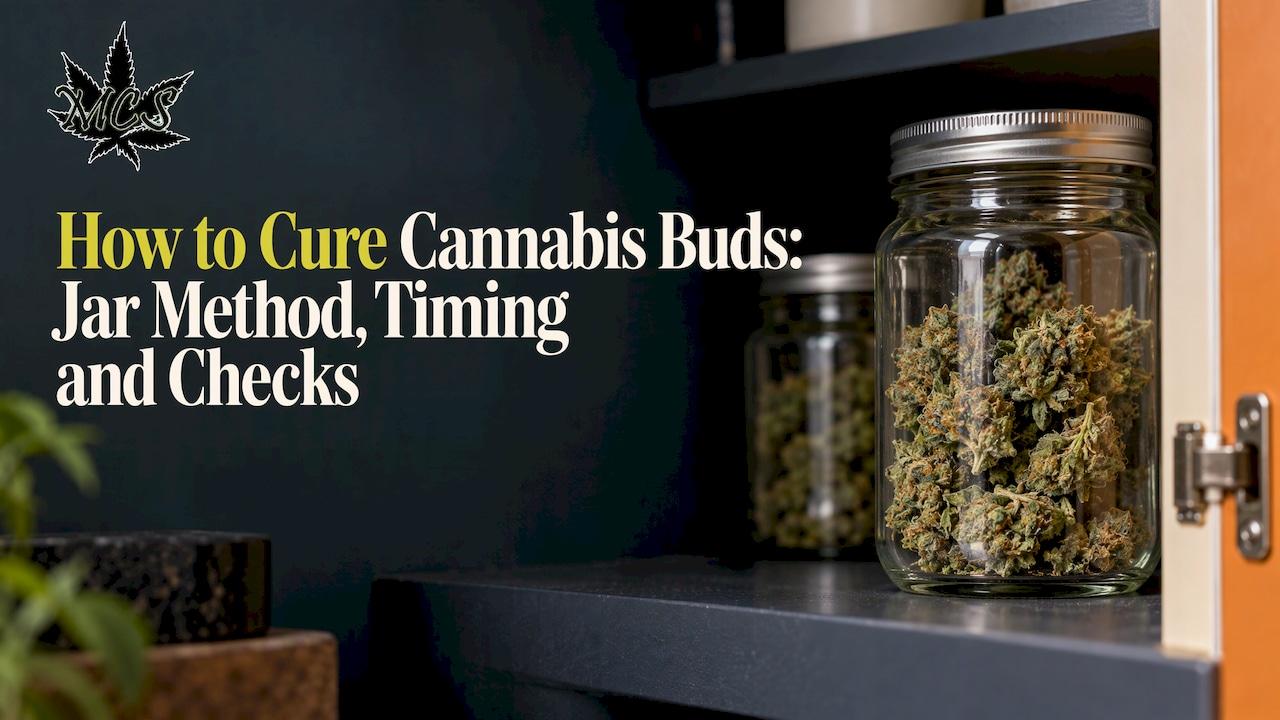
Curing cannabis buds means sealing properly dried flower in airtight glass jars and opening them on a schedule, so the moisture left inside evens out and the harsh, grassy compounds fade. A cure of two to four weeks at roughly 55–65% relative humidity inside the jar is the standard range, and a finished cure shows in the smell, the feel and the way the jar stops fogging. Everything below covers the jar stage in detail: the setup, the schedule, the checks and the repairs. The drying stage that comes first is covered on our blog in Drying Cannabis Humidity: Ideal Ranges and Control.
TL;DR
- Cure only after the buds are dry enough that a small stem snaps cleanly instead of bending. Buds that are still wet go moldy in a jar.
- Fill wide-mouth glass jars about two-thirds to three-quarters full, keep them cool and dark, and hold the air inside at about 55–65% relative humidity.
- Open the jars once or twice a day for the first week ("burping"), then every few days. Plan on two to four weeks, longer if the strain rewards it.
- A finished cure smells like the strain rather than hay, the jar no longer fogs, and the bud feels dry outside without crumbling.
- Any ammonia smell or visible fuzz means the batch is damp and must be dealt with at once, not cured further.
Table of Contents
- What curing actually changes
- Before the jars: the buds must be ready
- The jar method, step by step
- How long a cure takes
- Humidity: the number that decides the cure
- How to tell the cure is finished
- Fixing problems in the jar
- Storing cured flower
- Where curing begins: with the plant
- Seeds suited to a first full cycle
- Our view on curing
- FAQ
- Sources
What curing actually changes
Drying removes most of the water. Curing is the slower stage that follows, and it does two separate jobs.
The first is chemical. According to a peer-reviewed review of cannabis postharvest operations, enzymes and aerobic bacteria keep breaking down residual sugars and starches after the plant is cut, and smoking flower that has skipped this step can burn the throat. The same review notes that curing can raise THC and CBN levels by completing decarboxylation (the conversion of the raw acid form of THC into the active form) and that it extends storability by limiting fungal growth. Ed Rosenthal takes a more cautious view of potency: a good cure does not add potency but preserves and refines what is already there.
The second job is physical. Even well-dried flowers hold unevenly distributed moisture, and curing spreads it out for smoother smoke, more even burning and a better grind. The harsh "green" taste comes from chlorophyll-related compounds that keep breaking down during the cure, which lets terpenes, the aromatic molecules that give a strain its smell, come forward.
The Ontario Cannabis Store describes the method in the same plain terms: dried buds stored in an airtight, controlled environment, with the containers opened regularly.
Is curing always needed?
The University of Saskatchewan's gardening guide treats curing as strain-dependent: some flower is at its best soon after drying because of its volatile aroma compounds, while other strains need extended time for their flavours to develop, much like wine. A short cure suits delicate, fruity or citrus-forward profiles, and a longer one tends to suit heavy, earthy ones. Seed descriptions that list a strain's aroma profile help in planning how long to leave each batch.
Before the jars: the buds must be ready
Most curing failures begin with a drying mistake. Fresh cannabis is roughly 90% water, and properly dried flower is down to 10–13%, according to the University of Saskatchewan. That guide puts the drying stage at 10–14 days for most average-sized wet-trimmed plants, in the dark at 16–23°C (61–73°F) and 50–60% relative humidity, with most of the water leaving in the first four to five days.

The practical readiness test is the stem snap. Bend a small stem: if it snaps cleanly, the bud is ready for jars; if it only bends, it needs more time. Buds should not be bone dry either. Leafly Canada cautions that flower should not be completely dry going into the cure, because the jar stage depends on a little moisture in the centre of each bud moving outward.
Harvest timing matters here too. Plants cut at the right ripeness dry and cure more evenly, and autoflowering plants ripen on their own schedule, so the guide to when to harvest autoflower is worth reading before the knife comes out.
A note on flushing
Growers often ask about flushing, which means giving plants plain water only before harvest to clear out nutrients. Leafly's harvest guide recommends doing it about a week before harvest. Plants grown in organic soil with a light feeding schedule often need little adjustment, and the timing is best matched to the strain's flowering window.
The jar method, step by step
- Trim the buds. Cut the dried buds from the branches and remove remaining sugar leaves with scissors. Work on a clean surface with clean hands.
- Choose the right jars. Wide-mouth glass jars with tight-fitting lids work best. Glass does not absorb aromas and does not leak moisture the way many plastics do.
- Fill them loosely. Aim for about two-thirds to three-quarters full. The empty air space holds the moisture that the buds release, and packing too tightly crushes trichomes and traps damp pockets.
- Measure the humidity. A small digital hygrometer inside a jar shows what is happening. Leafly points to a range of 55–65% inside curing containers and notes that a digital hygrometer costs about $20.
- Store the jars cool and dark. Light and heat degrade terpenes and cannabinoids. A closet or cupboard away from windows and appliances is enough.
- Burp on schedule. Open each jar for a short time, then reseal. The University of Saskatchewan recommends opening jars two to three times daily in the first week, then once or twice weekly for the following two to four weeks.
- Check the surface on day one or two. According to Leafly Canada, moisture from the centre of the bud should soften the outer surface in the first day or two, and if that does not happen, the flower may have been over-dried.
A few growers opt for different burping frequencies: GreenState describes daily burping in week one and every few days afterwards. The two schedules differ only slightly. The consistent rule is that frequent opening early on releases excess moisture, and the interval widens as the jar stabilizes.
How long a cure takes
There is no single answer, and sources give overlapping ranges:
| Source | Cure length |
|---|---|
| Leafly | Two weeks to a month as usual; four to eight weeks preferred by some; six months or more for certain strains |
| GreenState | 10 to 30 days in ideal conditions |
| University of Saskatchewan | Intensive burping for the first week, then two to four more weeks of less frequent opening |
| Postharvest review (PMC) | Citing a trial that found 18°C (64°F) at 60% relative humidity for two weeks to be the best condition, with the lid opened after six hours |
For a first batch, two weeks is the minimum that makes a noticeable difference, and four weeks is a sensible target. Growers who like to wait longer simply keep the jars sealed, opening them rarely, and sample from one jar at a time.
Humidity: the number that decides the cure
The target inside the jar is a relative humidity of roughly 58–65%, and one figure from research stands out. A 2025 master's thesis from McGill University, by Daniel Santander, recommended curing at 62% relative humidity: lower humidity was linked to harsher smoke, while higher humidity raised the risk of microbial contamination.
The flower's own moisture content tells the same story. SQDC notes that compliant flower generally has 10–15% moisture content, that overly dry flower turns brittle and loses aroma, and that excess moisture can encourage mould. GreenState describes buds entering the cure at 11–12% moisture and finishing at 8–11%.
| Reading in the jar | What it means | What to do |
|---|---|---|
| Above about 65% | Buds still hold too much water | Leave the lid off for longer periods, spread buds on a rack for several hours, then re-jar |
| 58–65% | The working range | Keep burping on schedule |
| Below about 55% | Buds are drying out | Seal the jar and burp less often; add a humidity pack if needed |
An ambient humidity reading in the room matters too, since each burp swaps jar air for room air. In dry Canadian winters, the University of Saskatchewan points out that outside air dries bud out quickly, so burping should be brief.
How to tell the cure is finished
No single test settles it. These signs together do:
- The smell. A hay-like, grassy smell fades and the strain's real aroma, whether fruity, earthy or gassy, takes over. Ed Rosenthal's test, as relayed by GreenState, is that all hay-like odours should be gone and terpenes prominent.
- The jar. Condensation stops forming on the glass, and burping produces little change in the humidity reading.
- The feel. Buds are dry on the outside, but not brittle. A bud that crumbles to dust was dried too far.
- The burn and smoke. A well-cured bud burns evenly and the smoke is smooth rather than scratchy.
A note on stickiness: it is tied to trichomes, not to water. Leafly Canada explains that sticky buds are not necessarily wet, so a tacky bud is not a reason for alarm by itself.
Fixing problems in the jar
Buds that smell like hay after a week
This is normal in the first days and usually clears as burping continues. A persistent hay smell after two weeks usually points to buds that went in too wet or a jar that was burped too rarely.
Buds that feel too dry
If buds have dried past the useful point, a humidity pack can rehydrate them, as noted by Leafly Canada. Add it to the jar, reseal and check the reading after a day. Rehydrating does not restore lost aroma, so prevention by checking the stem snap is better.
Buds that feel damp or smell of ammonia
This is the one problem that cannot be waited out. GreenState identifies an ammonia smell as an early sign of mold. Remove the buds from the jar, spread them out in a cool, dark, airy spot to dry, and check each bud for fuzz, grey patches or a musty smell. Flower with visible mold should be thrown out, never smoked or vaped, because mold and its by-products can harm the lungs. People with asthma, a weakened immune system or other respiratory conditions face particular risk and should speak to a doctor about any exposure.
Storing cured flower
Once the cure is done, the jar becomes storage. The University of Saskatchewan notes that oxygen slowly converts THC to cannabinol (CBN), so the main container should be opened as little as possible. A common routine is to keep a small jar with a few days' worth of flower and refill it from the main one. According to Leafly, well-cured flower kept airtight in a cool, dark place can last up to two years without significant loss of potency.
The same principle of cool, dark and sealed applies to seeds, which is covered in our guide to storing cannabis seeds.
Where curing begins: with the plant
A smooth cure rests on decisions made months earlier. Genetics set the terpene profile that a cure reveals, and the grow environment sets how evenly the flower ripens. Those new to the process can start with the step-by-step beginner garden guide, and seedlings that get off to a good start, covered in when to transplant cannabis seedlings, finish in better shape for the jar stage. Home cultivation rules differ across Canada, so growers should confirm the rules that apply in their own province before planting.
Seeds suited to a first full cycle
Montreal Cannabis Seeds is a Canadian online seed bank with a catalog of feminized, autoflower, CBD and photoperiod seeds, curated for Canadian climates and backed by a germination guarantee. Growers who want a compact plant that finishes quickly can start with autoflower seeds, and those who prefer plants that are all female can browse the feminized range. Shipping across Canada is fast and discreet, and our support team understands local growing conditions.

Each product page carries detailed strain information, which helps in choosing seeds whose aroma profile suits the length of cure planned.
Our view on curing
We treat the cure as the last step of a single process that begins with the seed. A strain chosen for the climate it will grow in, ripened evenly and harvested at the right time, gives the jar something worth preserving.
That is why our catalog is curated for Canadian conditions and why every product page carries detailed information on the strain. Knowing how a plant behaves helps a grower plan the harvest, the drying room and the cure around it.
Our germination guarantee and our support team exist for the same reason: a grower who starts with reliable genetics and clear guidance has fewer surprises at harvest, and the cure becomes a matter of patience rather than rescue.
Dino Grow Master
FAQ
How do you cure cannabis buds at home?
Dry the branches until a small stem snaps cleanly, trim the buds and fill wide-mouth glass jars about two-thirds to three-quarters full. Store the jars somewhere cool and dark and open them once or twice a day for the first week. After that, open them every few days for two to four weeks in total.
Should buds still feel sticky after drying?
Yes, in the sense of tackiness from resin. Stickiness comes from trichomes, not from water, so a sticky bud is not necessarily wet. Buds should be dry to the touch on the outside with a stem that snaps, but not crumbling.
How can dried cannabis be revived?
If buds have become too dry, a humidity pack placed in the sealed jar can bring them back toward the 55–65% range. Check the reading after a day. Buds with a musty or ammonia smell are not dry but damp, and should be inspected for mold instead.
How long should buds cure before use?
The flower is usually enjoyable after two weeks and tends to improve up to four to eight weeks, with some strains rewarding longer. The University of Saskatchewan notes that some strains are best used soon after drying, so sampling a little at each stage is a reasonable way to find the point a given plant prefers.
Sources
- Postharvest Operations of Cannabis and Their Effect on Cannabinoid Content (PMC)
- How to Trim, Dry & Cure Cannabis Plants (Ontario Cannabis Store)
- Cannabis Drying and Curing: How to Preserve Terpenes and Potency (Ed Rosenthal)
- Cannabis Post-Harvest Control (Ed Rosenthal)
- Cannabis, Gardening at USask
- Drying and Curing Bud (Leafly Canada)
- When & How to Harvest Marijuana (Leafly Canada)
- Optimizing post-harvest processing of cannabis for smokable flower (McGill)
- How to cure cannabis (GreenState)
- Demystifying Cannabis Moisture Levels (SQDC)