
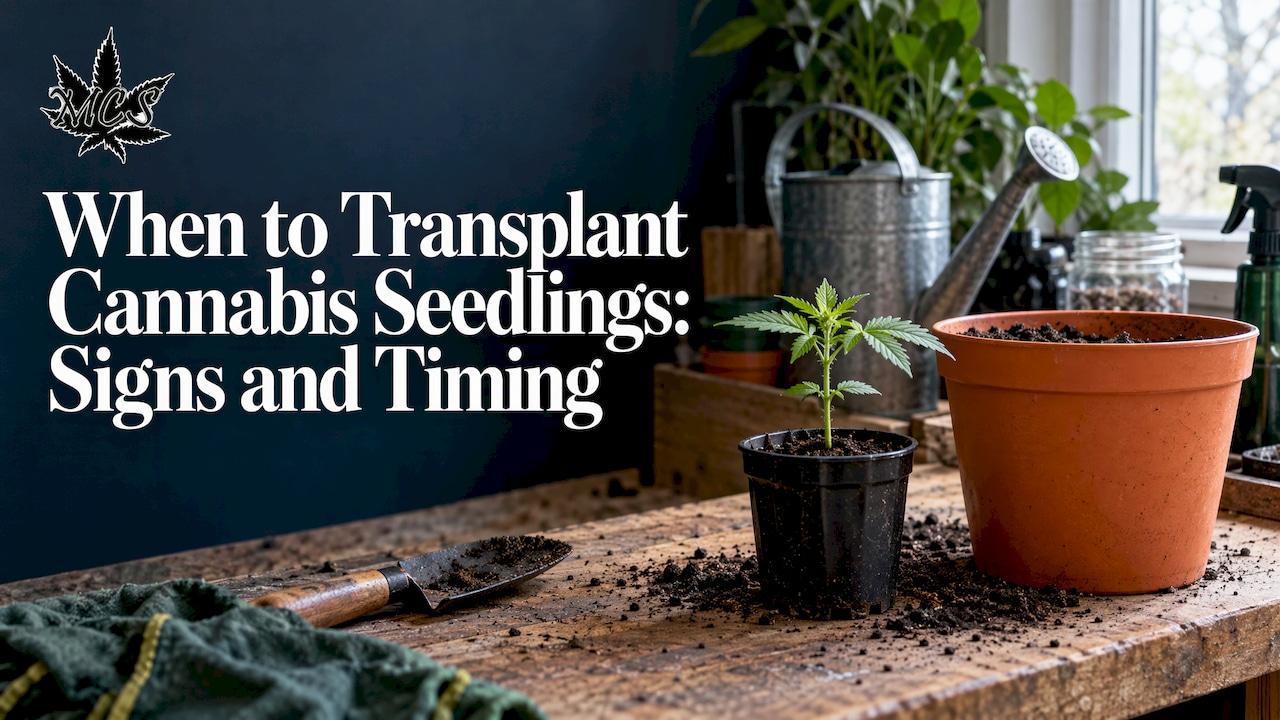
Cannabis seedlings are ready to transplant when their roots have filled the starter container and the plant has developed its first true leaves, which for most seedlings falls at about three weeks of age. The calendar gives a rough window, but the roots set the real deadline: a seedling moved too late stalls in a cramped cup, and one moved too early can lose the root ball it has not yet built. This article concentrates on the decision itself, how to read the signs, how Canadian conditions shift the timing, and how to avoid the shock that follows a poorly timed move. For the mechanics of germination and early care, the store blog already has a Canadian guide to cannabis seedling care, and autoflowering plants have their own tighter schedule, covered in the post on transplanting autoflowers.
TL;DR
- The seedling stage usually lasts about three weeks, and plants of that age are generally the ones to move on promptly.
- A first pair of true leaves is the minimum size for potting a seedling individually; roots reaching the edge of the container are the more reliable trigger.
- Moving into a modestly larger pot works better than jumping to a very large one, which holds excess moisture around a small root system.
- Water the medium lightly beforehand, handle the root ball gently, and give the plant indirect light for a day or two afterwards.
- Outdoors in Canada, frost, not the calendar, decides when seedlings leave the protected space.
Table of Contents
- What "ready" actually means
- Signs the container has become too small
- A timeline from germination to the first move
- Choosing the next container
- Timing outdoors in Canada
- How to transplant without causing shock
- Our perspective on timing
- Starting the season with the right seeds
- FAQ
- Sources
What "ready" actually means
Two things have to be true at once. The plant must be large enough to handle being moved, and the root system must be large enough to hold its medium together when it comes out of the container. A seedling can satisfy the first condition and fail the second, which is why a calendar date alone misleads.
On size, Canadian horticultural guidance is simple: according to the Halton Region Master Gardeners, seedlings can be potted on individually once they have at least one pair of true leaves. True leaves are the serrated, finger-shaped leaves that appear after the two rounded seed leaves (cotyledons) that emerge first. The cotyledons are only a temporary food store; the true leaves signal that the plant has begun its own photosynthesis in earnest.

On age, the University of Saskatchewan notes that the seedling stage usually lasts about three weeks, and its example treats roughly three-week-old plants as mature seedlings that should be transplanted as soon as possible. That figure is a useful anchor, though growth rate varies with temperature, light, genetics and container size. A plant kept at the cool end of its range develops more slowly than one kept warm, and a seedling in a small cup fills it faster than one in a larger pot.
Signs the container has become too small
Growers who track the roots rather than the date tend to avoid both extremes. The common signs are these:
- Roots at the drainage holes. White root tips appearing at the bottom of the container mean the root system has reached the limit of the space. This is the most widely used trigger among home growers, and it is easy to check without disturbing the plant.
- Roots visible at the sides. In a clear or semi-transparent cup, a network of white roots pressed against the wall shows the same thing from the side.
- A tightly bound root ball. When the plant is eased out gently, the medium holds together as a single cylinder threaded with roots. A root ball that crumbles apart means the plant needs more time.
- Water running straight through. A medium that has become mostly root dries quickly and drains faster than it did in the first week.
- Slowing growth with crowded foliage. When the plant looks large for its container, with new leaves tightly packed and the pot appearing small beneath it, the roots are usually already limiting it.
No single sign is a verdict. The combination of true leaves, an age near three weeks and visible roots at the container's edge is what makes the decision straightforward.
Why early is safer than late
A seedling that is slightly early has a modest root ball but an easy time recovering, because the roots are still growing outward into fresh medium. A seedling left too long becomes root-bound: roots circle the inside of the container and the plant stops expanding while it waits. Growers commonly accept transplanting a little early over a little late for this reason. The caution on the early side is real, though: a root ball that falls apart when the cup is inverted has not yet earned its move, and the plant is better left for several more days.
A timeline from germination to the first move
The following pattern is typical for a photoperiod plant grown indoors at a comfortable temperature. Treat the day counts as a guide, not a rule.
| Stage | Approximate timing | What the grower sees |
|---|---|---|
| Germination | Day 0 to 3 | Taproot emerges, seed is planted taproot-down |
| Cotyledons open | Day 3 to 7 | Two rounded seed leaves unfold |
| First true leaves | Around week 1 to 2 | Serrated leaves appear, usually a single blade first |
| More true leaf sets | Week 2 to 3 | Leaves with three to five blades, visible root growth |
| Transplant window | About week 3 | Roots reach the container's edge or drainage holes |
The temperature of the germination stage affects the schedule, which is why a seed started in a cool room runs behind one started at a steady warmth. The store blog's pieces on seed germination temperature and how to germinate cannabis seeds explain how the first days shape everything that follows.
Autoflowers run on a shorter clock
Autoflowering plants begin flowering on a timer set by their genetics rather than by the light schedule, so a delay in transplanting costs them a larger share of their vegetative period. For that reason the window is shorter and the plants are commonly moved earlier. The store's post on transplanting autoflowers within 8 to 15 days covers that timing in full. Many growers avoid the issue by planting autoflowers directly into their final container, which removes the transplant altogether.
Choosing the next container
The size of the next pot matters as much as the moment of the move. Halifax Seed advises that a pot that is too large can lead to poor growth and root rot, whereas a modest step up gives the roots room without leaving a wide band of unused, wet medium around them. The reasoning is mechanical: a small root system cannot take up water from a large volume of medium, so the unused portion stays wet for longer, which lowers the oxygen available to the roots and encourages the conditions in which rot and fungus gnats thrive.
A practical progression for an indoor grower looks like this:
- Starter container (a small cup or plug) for the first two to three weeks.
- A middle container of roughly one to three litres, once the roots have filled the starter.
- The final container, sized to the space and the plant's expected final height, once the plant has again filled the middle pot.
This staged approach is slower in paperwork but gentler on the plant, and it keeps the medium's moisture matched to the root zone at each stage. Growers who prefer a single move from starter to final pot generally do so with a lightly watered, well-aerated medium and a patient watering routine. Whichever route is chosen, drainage is non-negotiable: every container needs holes, and standing water at the bottom undoes the benefit of any other technique.
The store's Canada grow supplies guide lists the starter equipment that most home growers need for these stages.
Timing outdoors in Canada
Indoors, the transplant date is set by roots and the grower's schedule. Outdoors, the climate sets a second condition. The Canadian Food Inspection Agency's biology document states that cannabis grows best at 14 to 27°C and may tolerate light frost to about −6°C, but that heavy frost or extended near-freezing conditions kill the plant. The same document observes that Canada's short growing season can prevent seed maturation, which is why seedlings meant for the garden are usually started under protection and moved outside only when the weather has settled.
For a Canadian outdoor grower, this produces a few working rules:
- Start seedlings indoors or in a sheltered space, and let them reach the three-week, true-leaf stage there.
- Move them outside only after the last frost risk in the local area has passed. That date varies widely between, for example, southern Ontario, the Quebec regions and the Prairies, so local frost dates from a provincial or municipal source are the reference.
- Harden seedlings off over several days, beginning with an hour or two of sheltered outdoor light and increasing exposure gradually. Plants raised indoors have not met wind or direct sun and can scorch quickly.
- Pick a stage that suits the final location: a seedling that has already been potted once usually handles the final planting better than one moved directly from a tiny cup.
A note on legality: the number of plants a household may grow is set by federal and provincial rules, and licensed medical growers work to limits set by Health Canada. Health Canada's calculator explains that registered medical growers' plant limits depend on the authorized daily amount, expected yield and growth cycles. Growers should confirm the rules in their own province before deciding how many seedlings to start and move.
Those planning an outdoor season will find genetics suited to open-air conditions in the store's outdoor cannabis seeds range, and a broader walkthrough in Mastering the Art of Growing Cannabis Outdoors.
How to transplant without causing shock
Transplant shock is the pause in growth that follows root disturbance. It shows as drooping, slowed growth or pale leaves, and it is largely preventable with careful handling. The steps below combine the guidance of Canadian horticultural sources with common grower practice.
- Prepare the new container first. Fill it with the same type of medium the seedling has been in, so the roots do not face an abrupt change in texture. Make a hole in the centre roughly the size of the root ball.
- Water lightly beforehand. The medium in the old container should be evenly moist, not wet and not dry. Halifax Seed recommends evenly moist medium because it holds together around the roots without becoming heavy mud. Watering a day or so ahead is a common routine.
- Loosen the container, not the plant. Squeeze the sides of a flexible cup, or run a thin tool around the inside edge, then tip the container and let the root ball slide into the hand. Never pull on the stem.
- Handle the root ball, not the stem. Support the base with the fingers and keep the medium intact. The stem and leaves of a seedling are fragile, and damage there does not recover.
- Set the plant at the same depth. Place it so the stem meets the medium at the same height as before, or slightly deeper, then firm the medium lightly around it. Avoid pressing hard enough to compact it.
- Water gently. A small amount around the base settles the medium without flooding the new pot.
- Give it a quiet day or two. Halifax Seed suggests placing freshly transplanted seedlings in indirect light for a day or two before returning them to full intensity. Indoors, that can mean raising the light slightly or dimming it for the first period.
Common mistakes
- Waiting for a calendar date. Roots, not the day count, give the signal.
- Moving to a far larger pot. The excess medium stays wet, and the small roots cannot use it.
- Transplanting a dry or soaked medium. Dry medium falls away from the roots; soaked medium collapses under its own weight.
- Disturbing the plant repeatedly. Each transplant sets growth back slightly, so one or two planned moves are better than several improvised ones.
- Reading deficiency symptoms as disease. Pale lower leaves after a move often reflect a temporary slowdown rather than a nutrient problem. The store's guide to cannabis deficiencies helps tell the two apart when symptoms persist.
Our perspective on timing
Most transplant problems we hear about begin before the transplant: with a seed that germinated slowly, a seedling raised in a cool room, or genetics that were never suited to the grower's climate. A plant that grows steadily reaches the three-week mark with a healthy root system, and the move becomes routine.
That is the reasoning behind how we build our catalogue. We curate seeds for Canadian growing conditions, publish detailed product information so growers know what each strain needs, and back our seeds with a germination guarantee. A grower who starts with reliable genetics spends the seedling weeks watching roots, not worrying about whether the plant will come up at all.
For first-time growers, we suggest choosing feminized seeds or autoflowers for a simple first season, planning the container sequence before the seeds are planted, and keeping the roots, rather than the calendar, as the guide. Our support team understands local growing conditions and is there for questions about timing.
Dino Grow Master
Starting the season with the right seeds
A clean transplant depends on a seedling with a strong start. Montreal Cannabis Seeds offers feminized seeds for growers who want plants that produce flowers, and autoflower seeds for a compact plant with a shorter, fixed life cycle. Each is supported by detailed product information and a germination guarantee, with fast and discreet shipping across Canada.

The full catalogue, including the Quebec line, mix packs and outdoor genetics, is on the Montreal Cannabis Seeds home page.
FAQ
How big should cannabis seedlings be before transplanting?
A seedling needs at least one pair of true leaves before it is potted on individually, according to Canadian master gardener guidance. In practice most growers wait until the plant has several leaf sets and roots that reach the container's edge, which commonly happens around three weeks after germination.
How long should seedlings grow before transplanting?
The seedling stage usually lasts about three weeks, and plants of that age are generally the ones to transplant. Autoflowers are moved earlier, often within the first two weeks, while photoperiod plants in cooler conditions may take a few days longer. The root ball is the better judge than the date.
Do roots showing through the bottom of the container mean it is time?
Roots emerging from the drainage holes are one of the most common signs that a container is full, and growers usually treat them as a cue to move the plant within a day or two. Confirm by checking that the medium holds together as a root ball when the plant is gently lifted out.
Is it better to transplant too early or too late?
Slightly early is generally the safer error, because a young root system recovers quickly in fresh medium, whereas a root-bound plant stops growing while it waits. The limit is a root ball that falls apart on removal, which means the plant needs a few more days.
Can seedlings go straight outdoors from the starter cup?
Only once frost risk has passed and the plant has been hardened off over several days. Because the Canadian Food Inspection Agency notes that heavy frost kills cannabis, local last-frost dates decide the timing outdoors, not the plant's age alone.
Sources
- Seedlings, Gardening at USask
- Cannabis, Halton Region Master Gardeners
- How To Transplant Seedlings, Halifax Seed Company
- The Biology of Cannabis sativa L., Canadian Food Inspection Agency
- Calculator for the production of a limited amount of cannabis for medical purposes, Health Canada