
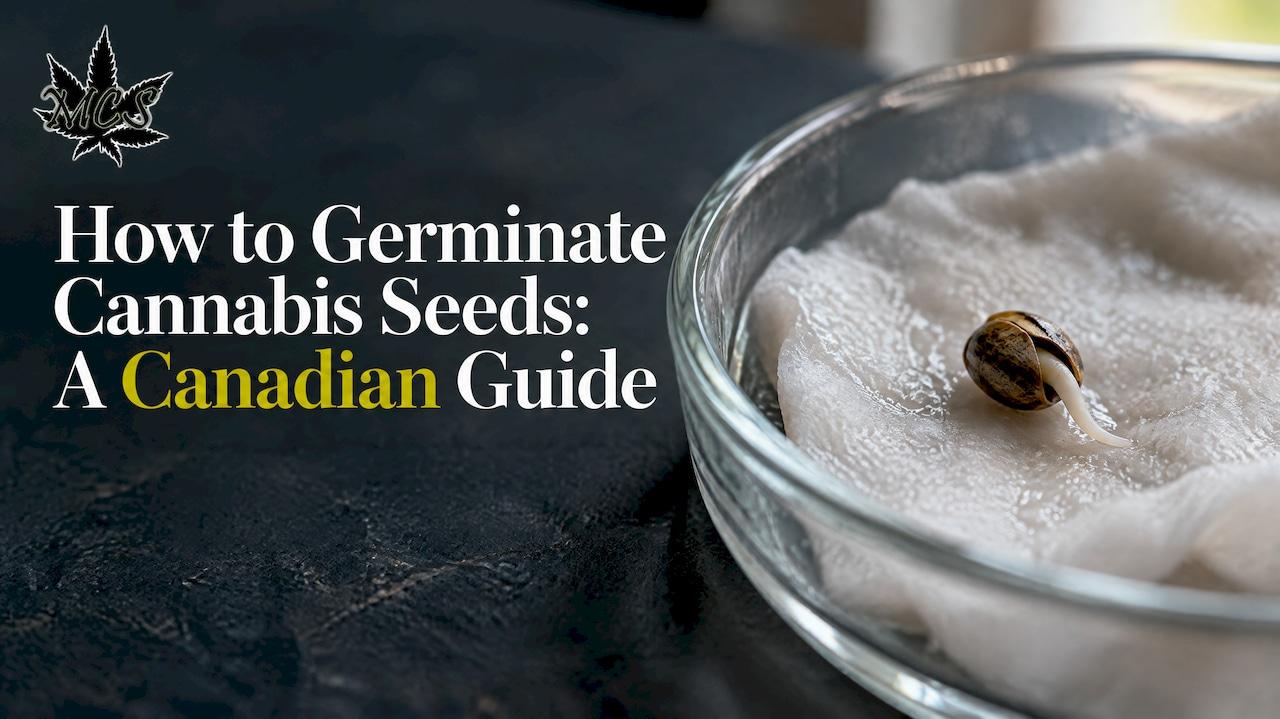
Cannabis seeds germinate when they take up water, stay warm (roughly 23°C to 27°C) and are kept moist but never soaked, in darkness or gentle light. Most healthy seeds crack within one to three days, and some need up to seven. The method matters less than keeping those conditions steady. This guide compares the three common methods, shows when each one makes sense and covers what to do when a seed stalls. It also covers the home-grow rules that apply before a seed goes into a cup, because those differ by province.
Our store blog already explains the basics of germinating seeds in soil and the details of germination temperature. This article takes a different angle: how to choose a method, how to run it without losing seeds, and how to read the signs when something goes wrong.
TL;DR
- Aim for 23°C to 27°C, a medium that feels like a damp sponge, and a seed that never dries out once it has started.
- Three methods work: sowing directly in the medium, soaking for 12 to 16 hours first, or the paper towel method. Pick one and repeat it consistently.
- Expect a taproot in one to three days, and allow up to seven in cooler rooms.
- Plant the sprouted seed about 1 cm deep with the taproot pointing down, and hold off on nutrients for the first weeks.
- Seeds must come from a legal source, and home cultivation is restricted or prohibited depending on the province.
Table of Contents
- What happens inside a seed during germination
- Before you start: what to prepare
- Temperature, moisture and light
- Three germination methods compared
- How long germination takes
- When seeds do not sprout: a troubleshooting checklist
- After germination: the first two weeks
- The legal side of germinating in Canada
- Start with seeds suited to Canadian growers
- FAQ
- Sources
What happens inside a seed during germination
A cannabis seed is a dormant package of stored energy. Water starts the process: according to the University of Saskatchewan's cannabis growing resource, hormones and enzymes in the seed need to absorb water before they become active and start growth. The same source adds that once this has begun, the seed must not be allowed to dry out.
The first visible sign is the radicle, the white taproot that pushes out of the shell. Then the seed leaves (cotyledons) rise above the surface. Everything a grower does at this stage serves three needs: water, warmth and oxygen. Too much water displaces oxygen, which is why "damp, not dripping" is the rule in almost every reliable guide.
Before you start: what to prepare
A short checklist saves most failed batches:
- Clean hands and tools. Wash your hands, and clean any container, tweezers or tray you will use.
- Water. Room-temperature water is fine. The University of Saskatchewan notes that if your tap water has high total dissolved solids (TDS) or high electroconductivity (EC), distilled or reverse osmosis water may be a better choice.
- A light starter medium. A basic seedling mix or a lightly amended coco and perlite blend suits a young seedling better than a rich, heavily fertilized soil, because the seed carries enough stored energy to get going. A small container of around 100 to 250 ml, such as a solo cup, is a common starting size, as described by Cannabis Plant Care.
- A warm, steady spot. A shelf above a router or appliance that cycles on and off can swing in temperature. A heat mat with a thermostat, or a stable cabinet, is more predictable.
- A thermometer. A cheap probe thermometer removes guesswork.
For a full list of starter equipment, see our Canada grow supplies guide.
Temperature, moisture and light
Temperature
The University of Saskatchewan states that cannabis seeds germinate best between 23°C and 27°C. Another guide gives a slightly wider working range of 20°C to 25°C, with seeds usually cracking within 24 to 72 hours and some taking up to seven days. The practical reading for a Canadian home: a cool basement or a window ledge in November is below that band, so use a heat mat or a warmer room and expect slower results if you cannot.

Moisture
The target is a medium that feels like a damp sponge: moist, but if you squeeze it, no water should run out. Overwatering is the most common beginner error, and it is the reason direct sowing needs a light hand with the watering can.
Light
Seeds do not need light to crack, so a dark spot works for paper towels and soaking. Once a seedling pushes through the medium, it needs light straight away. The University of Saskatchewan advises moderate intensity light for seeds planted directly in the medium. A gentle light is enough: too strong a light close to a young seedling dries the surface and stresses the plant.
Three germination methods compared
No method wins in every situation. Athena Ag's grower guide says the right choice depends on your system, experience and comfort handling delicate seedlings, and recommends prioritizing a consistent, clean process over switching techniques. The table summarizes the trade-offs.
| Method | How it works | Strength | Watch out for |
|---|---|---|---|
| Direct in the medium | Seed placed about 1 cm deep in pre-moistened medium | Least handling, no transplant shock | You cannot see progress |
| Soak, then plant | Seed soaked 12 to 16 hours, then planted about 1 cm deep | Quick water uptake, simple | Soaking beyond 24 hours can damage the seedling |
| Paper towel | Seeds between damp towels in a closed container | You see the taproot emerge | Fragile taproot at transplant |
The soak times and planting depth come from the University of Saskatchewan guidance.
Method 1: sow directly in the medium
This is the lowest-handling route. A germination guide from Cannabivo makes the point that every extra step between water uptake and emergence is another chance to damage the radicle, which is why many growers plant straight into the final starter pot.
- Fill a small container with pre-moistened, light medium.
- Make a hole about 1 cm deep and drop in the seed.
- Cover lightly and water conservatively. The medium should stay consistently moist, never soaked.
- Place under moderate light and keep the moisture level steady until the seedling emerges.
The trade-off is feedback. If nothing appears after a week, you cannot tell whether the seed is slow, too cold or dead.
Method 2: soak first, then plant
Soaking speeds up the water uptake that starts germination.
- Place seeds in a glass of room-temperature water for 12 to 16 hours. Do not exceed 24 hours, as longer soaking can damage the seedling.
- Plant the seeds about 1 cm deep. If a taproot has already emerged, handle the seed with extra care and point the root downward.
- Cover, place under moderate light and keep the medium near the seed moist until the seedling emerges.
Setting a phone timer prevents the classic overnight-into-next-day mistake.
Method 3: the paper towel method
This method is popular for a simple reason: you can watch the seed. Cannabivo points out that germination biology does not depend on the paper towel itself, it is simply the visibility that appeals. The steps, as described by the University of Saskatchewan:
- Soak the seeds as above.
- Place them between folded paper towels that are moistened but not soaked.
- Put the towels in an enclosed container or a zip-style bag, in a warm, dark place.
- Check often so the towel stays damp but not wet.
- After a day or two, seeds should crack and show a taproot.
- Lift each seed carefully, ideally with tweezers, and plant about 1 cm deep with the taproot pointing down.
Transfer the seed as soon as the taproot is a short, visible tip. A long root tangles in the towel and snaps easily. For more on identifying viable seeds with a simple paper towel test, read our post on the 25°C paper towel test. For another walk-through of the step-by-step germination methods, including how to handle the sprouted seed, it is worth comparing notes.
Which one should you pick?
- First-time grower who wants reassurance: the paper towel method, with tweezers and patience.
- Grower who prefers fewer steps: direct sowing in the final starter pot.
- Grower with older or hard-shelled seeds: a 12 to 16 hour soak, then plant.
- Autoflower grower: autoflowers dislike root disturbance and a lost week hurts their short life cycle, so direct sowing or a gentle soak suits them well. If you are choosing between plant types, our comparison of photoperiod, autoflower and fast version strains explains the differences.
How long germination takes
Under good conditions, a radicle from the paper towel or plug method can appear in as little as one to three days, though some seeds take up to seven days, particularly at lower temperatures. Seeds sown directly in a medium will take a little longer to show above the surface, since the sprout must travel through the soil. A reasonable timeline to plan around:
| Stage | Typical timing |
|---|---|
| Taproot emerges | 1 to 3 days, up to 7 in cool conditions |
| Seedling breaks the surface (direct sowing) | Several days after the taproot forms |
| Seed leaves open | Shortly after emergence |
If you grow outdoors, remember that direct sowing into a prepared bed can match transplanting when soil conditions are good, with typical stand rates of roughly 60 to 80 percent according to the same Cannigma article, so plan extra seeds rather than counting on every one.
When seeds do not sprout: a troubleshooting checklist
A stalled seed is almost always a conditions problem. Work through these in order before giving up.
- Check the temperature. A medium at 18°C will germinate slowly or not at all. Move the seeds into the 23°C to 27°C band and give them several more days.
- Check the moisture. A towel or medium that has dried out interrupts the process, and the University of Saskatchewan warns that seeds must not dry out once germination has begun. A waterlogged medium, on the other hand, starves the seed of oxygen. Aim for a damp sponge.
- Review the soak. Anything beyond 24 hours risks damaging the seedling.
- Look at planting depth. About 1 cm is the recommended depth. Deeper planting delays emergence, and a seed placed on the surface can dry out.
- Check root direction. A sprouted seed planted with the taproot pointing up wastes energy turning around, so always orient the root downward.
- Wait a full week. Some seeds simply take longer, especially when it is cool.
- Rule out the seed itself. If a seed shows no change after a week in correct conditions, it may not be viable. Our germination guarantee exists for this scenario, so contact our support team with your order details and a short description of how you germinated the seeds.
For the weeks after sprouting, our cannabis seedling care guide covers light distance, watering rhythm and early problems.
After germination: the first two weeks
Two habits protect a new seedling. First, keep humidity high. Verdiario recommends 65 to 75 percent relative humidity for the first two weeks after emergence. Second, hold back on feeding. The same guide notes that most soils already contain enough food for the first two to three weeks, and that coco should be kept at a very low EC of 0.4 to 0.6 mS/cm. Water a little at a time around the stem rather than flooding the pot.
If leaves later turn yellow, spotted or pale, our guide to cannabis deficiencies helps you tell hunger from overfeeding.

The legal side of germinating in Canada
Germination is the first act of cultivation, so the home-grow rules apply from the moment a seed is placed in water. They differ by province.
- Federal baseline. Since October 2018, adults of legal age can grow a maximum of four cannabis plants per household, not per person, subject to provincial, territorial and municipal restrictions, according to Health Canada.
- Legal seed sources. Health Canada states that it is illegal to use seeds or grow plants you know came from illegal sources, and seeds must be bought from a legal source such as an authorized retailer in your province or territory.
- British Columbia. Adults 19 or older can grow up to four plants, seeds must come from a provincially licensed private store or a B.C. Cannabis Store, and plants must not be visible from any public place, per the Province of British Columbia. The province also recommends contacting your insurance broker, since growing can affect a home insurance policy.
- Manitoba. As of May 1, 2025, people 19 and older can grow up to four plants per household, indoors, in a room, container or enclosure that is not accessible to people under 19.
- Quebec. The province bars people from growing their own cannabis, and the ban was upheld in a 2023 Supreme Court ruling. Our page on growing cannabis in Quebec sets out the law, medical permits and timing in detail.
Rules change, so check your own province's official cannabis page and your municipality's bylaws before you start.
Our perspective on germination
Across the questions we receive from Canadian growers, one pattern stands out: germination rarely fails because of the method. It fails because conditions drift. A room that is warm at noon and cold at midnight, a towel that dries out, a soak that runs overnight into the next afternoon. That is why we recommend choosing one method and repeating it exactly.
Our catalog is curated for Canadian climates, and we publish detailed product information so that you know what you are planting before the seed ever touches water. Beginners usually do best with feminized or autoflower genetics, since there is no sexing to manage and the plant's schedule is predictable.
We also stand behind our seeds with a germination guarantee, and our support team understands local growing conditions, from basement tents in the Prairies to a sunny balcony in the Maritimes. If a seed does not sprout despite good conditions, we want to hear about it.
Dino Grow Master
Start with seeds suited to Canadian growers
Good technique helps most when the genetics are reliable. Our feminized seeds remove the guesswork of identifying males, and our autoflower seeds suit growers who want a compact plant with a short cycle. Every order ships quickly and discreetly across Canada and is covered by our germination guarantee.

Not sure where to begin? Our guide to top strains for first-time growers helps you match a strain to your space, or browse the full range on the Montreal Cannabis Seeds home page.
FAQ
How long should I let cannabis seeds germinate?
Most healthy seeds show a taproot within one to three days, and some take up to seven, especially in cool rooms. If nothing has happened after a week in the right temperature and moisture range, the seed may not be viable. Contact our support team at that point.
Is it better to germinate in soil or with paper towels?
Neither is universally better. Paper towels let you see the taproot but require careful transplanting, while direct sowing means less handling but less feedback. Pick the one you can repeat consistently.
What is the best potting mix for cannabis seeds?
A light, slightly amended mix works best, such as a basic seedling mix or a lightly amended coco and perlite blend. Avoid heavy clay soils and mixes loaded with slow-release fertilizer, since stored energy in the seed covers the first stage.
Can I germinate seeds in Quebec?
Quebec prohibits growing cannabis at home, so the rules there are different from the rest of the country. Read our Quebec page for the current legal position and the medical permit pathway before buying seeds.
Sources
- Germination, Gardening at USask
- How to Germinate Cannabis Seeds Step by Step, Verdiario
- How to Germinate Cannabis Seeds: Sprouting, Transplanting, and Direct Sowing, The Cannigma
- How to Germinate Cannabis Seeds: Step-by-Step Grower Guide, Athena Ag
- Cannabis Germination Guide, Cannabivo
- How to Plant Cannabis Seeds, Cannabis Plant Care
- Growing cannabis at home safely, Canada.ca
- Cannabis Home Grow, Liquor, Gaming and Cannabis Authority of Manitoba
- Changes on homegrown pot rules don't go far enough, CBC News