
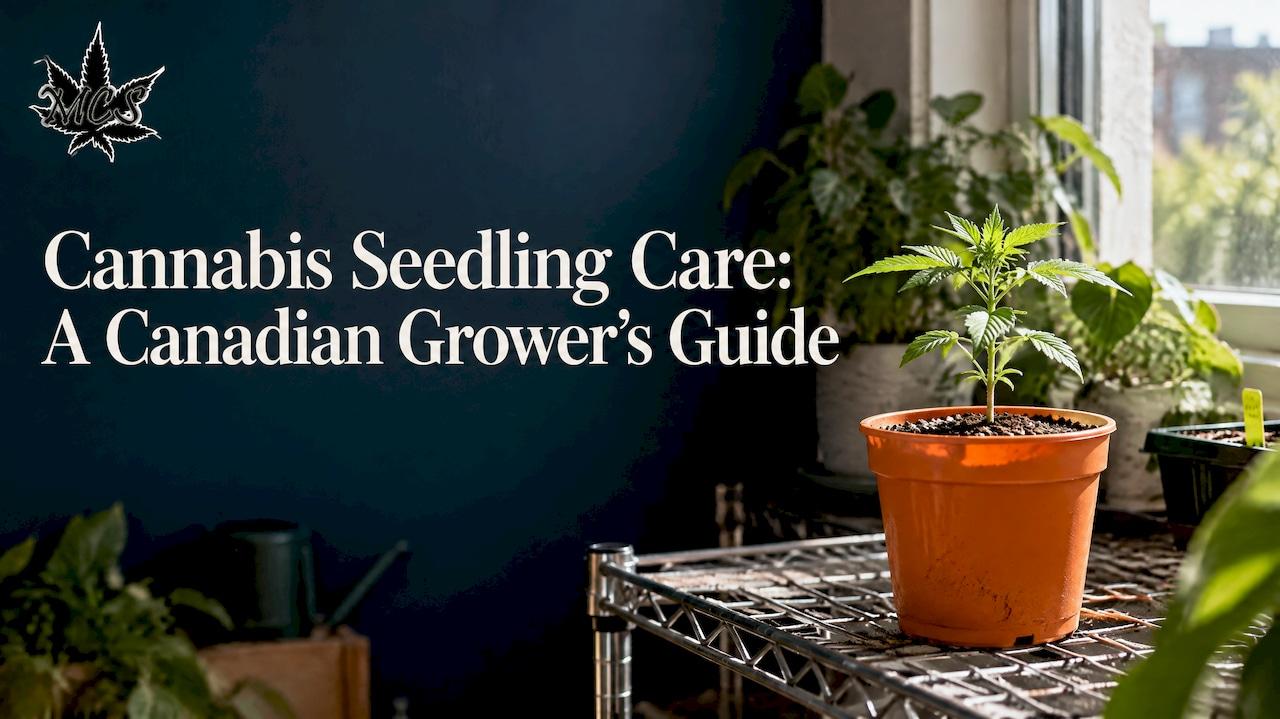
Cannabis seedling care comes down to five controls: strong light at the right distance, a medium kept like a damp sponge, mild temperatures and humidity, little or no fertilizer in the first one to two weeks, and airflow that keeps stems dry at the soil line. Most early losses, from leggy stems to sudden collapse, trace back to one of those five being slightly off. This guide covers what each looks like in practice, how to read the warning signs, and how Canadian home growers can move seedlings on safely.
Germination, light-distance charts and humidity targets already have their own detailed posts on our blog, so this article focuses on the days after the seed has opened: what a seedling needs, what goes wrong, and how to respond.
TL;DR
- Give seedlings at least 14 hours of light a day (18 is common), a temperature of 21°C to 27°C and a medium that feels like a damp sponge, never dripping.
- Stretching almost always means the light is too weak or too far away. Move it closer in small steps rather than in one jump.
- Hold off on fertilizer for the first week or two, then begin at half or quarter strength.
- Damping off cannot be reversed once a stem collapses, so prevention (airflow, clean containers, restrained watering) is the whole strategy.
- In Canada, home growing is limited to four plants per household under federal rules, and provinces can be stricter, so check local rules before planting.
Table of Contents
- What a seedling actually needs in the first three weeks
- Watering seedlings without drowning them
- Light: the cause of most leggy seedlings
- Feeding: when and how much
- Damping off: the quiet seedling killer
- Reading other signs of stress
- Moving seedlings on
- Rules to check before seedlings go in
- Perspective
- Start with seeds suited to Canadian growers
- FAQ
- Sources
What a seedling actually needs in the first three weeks
A seedling is at its most vulnerable and its most forgiving at once. It carries stored energy in its first round cotyledon leaves, so it needs very little from the grower, but its roots are tiny and its stem is soft. The goal is a short, thick stem, deep green leaves and steady, unhurried growth.
The University of Saskatchewan's cannabis seedling guide sets out the baseline: at least 14 hours of light, with 18 hours commonly used, temperatures of 21°C to 27°C, relative humidity of 60 to 70 percent, and a consistently moist but never saturated medium. Those numbers are a useful target for a grow tent, a basement shelf or a spare room.
| Factor | Seedling target | Common mistake |
|---|---|---|
| Light period | 14 to 18 hours | Light left off too long, or lamp too weak |
| Temperature | 21°C to 27°C | Cold window sills in a Canadian winter |
| Humidity | 60 to 70% | Dry heated air in a closed house |
| Water | Damp sponge feel, small amounts, often | Soaking a tiny root ball in a large pot |
| Feeding | None for 1 to 2 weeks, then 1/4 to 1/2 strength | Full-strength nutrients too early |
For humidity in particular, our post on seedling humidity levels for cannabis goes into ranges and control methods in detail.
Watering seedlings without drowning them
Overwatering is the most common beginner error, and it is easy to see why: a seedling looks small and thirsty, and a generous watering feels kind. In reality the roots need air as much as water. Waterlogged medium starves them of oxygen, slows growth and invites fungal problems.
The University of Saskatchewan recommends a light but consistent supply, using small amounts of water more often rather than a large amount at once. The medium should feel like a damp sponge: wet to the touch, but not dripping or oversaturated.
How to tell when it is time
Two simple checks work well. The first is the finger test: push a fingertip about a centimetre into the medium and water only when it feels barely damp. The second is the lift test: a freshly watered pot is noticeably heavier than a dry one, and learning that difference by hand is more reliable than any calendar. Leafly's watering guide describes both methods and lists a seedling-stage watering interval of roughly every three to seven days, a range that shows how much it depends on pot size, medium and room conditions.
Where to water
Water in a small ring around the stem, not on it, and not in the centre of a large pot where the roots have not yet reached. Starting seedlings in small containers helps, because a small pot dries at a pace matched to a small root system. A large pot holds far more moisture than a seedling can use, which is the usual starting point of root problems.
Light: the cause of most leggy seedlings
Searching for answers on leggy or stretching seedlings usually leads to one root cause: not enough light intensity reaching the plant. When light is weak, the seedling elongates in search of more. The result is a long, pale, thin stem with wide gaps between leaf sets.
The University of Saskatchewan notes that seedlings without sufficiently strong light grow long, weak, spindly stems that are hard to manage and often fall over. Its advice is direct: if seedlings are getting too tall and leggy, move the light closer to prevent more elongation. The same guide gives starting distances by lamp type: 10 to 15 cm for fluorescents, around 30 cm for LEDs and 90 cm for HID lamps.

Reading the numbers
Manufacturers publish different figures, and that is fine, because LED fixtures vary widely in output. BioFloral suggests a seedling intensity of 100 to 300 µmol/m²/s and recommends adjusting in 2-inch increments until stretching stops. Gorilla Grow Tent explains that too little light triggers etiolation, producing thin stems that can collapse at transplant, and suggests raising a dimmer by 20 percent or lowering the fixture by 4 inches as a correction.
The practical lesson is to change one thing at a time and watch for two or three days. Our post on seedling light distance explains why a fixed distance is only a starting point.
The opposite problem
Pushing the light too close has its own cost. Seedling cotyledons lack the protective waxy coating of mature leaves, so excessive intensity can bleach them. If leaves look pale or white-spotted on the side facing the lamp, see our photo guide to light burned seedlings before changing anything else.
Can a stretched seedling be rescued?
Once the light is corrected, new growth generally comes in shorter and thicker. The existing long stem will not shrink, but it can be supported with a small stake or, at transplant, the seedling can be set slightly deeper so more of the stem is buried and braced. Avoid heavy handling of a weak stem. Fan airflow, gentle enough to make leaves flutter, also helps stems thicken over time.

Feeding: when and how much
Seedlings carry their first meal with them. The University of Saskatchewan advises that fertilizer is generally unnecessary until after the first week or two, and that when feeding begins it should start at half or quarter strength. A pre-fertilized potting mix often supplies enough for the earliest weeks on its own.
Some growers go further. GrowGuide's nutrient schedule recommends only plain, pH-adjusted water in weeks one and two, with a very low electrical conductivity, and begins nitrogen-forward feeding at 50 percent of label strength in weeks three and four. The two sources agree on the principle: start late, start light.
Signs of too much, too early
- Leaf tips that look scorched or crispy while the rest of the leaf is dark green.
- Leaves that curl downward in a claw shape.
- Growth that stalls despite good light and moisture.
If these appear, water with plain pH-adjusted water and skip the next feeding. Seedlings that are simply pale and slow at the three-week mark, with decent light and moisture, can usually take a first quarter-strength feed. For autoflowers, whose short life cycle makes timing more sensitive, our autoflower feeding schedule starts at one-eighth strength and follows the plant's cues.
Damping off: the quiet seedling killer
Damping off is the sudden collapse of a seemingly healthy seedling at the soil line. The stem becomes thin, dark and watery at the base, and the plant falls over. It is caused by soil-borne fungal and mould-like organisms such as Pythium, Rhizoctonia and Fusarium, according to Elm Dirt's guide to damping off, which also states that a seedling showing a collapsed stem cannot be saved. That is why prevention matters more than treatment.
Prevention that works
- Start clean. Use fresh seed-starting or potting mix and containers washed with a dilute soap solution and rinsed well.
- Water lightly. Constantly wet medium at the surface is the condition these organisms favour. Let the top centimetre dry slightly between waterings.
- Move air. A small oscillating fan on low keeps the surface and stem base from staying damp.
- Keep temperatures stable. Cool, wet medium is a classic setup for damping off, so avoid placing pots on cold floors or sills.
- Give light early. Stocky, well-lit seedlings with thicker stems resist disease better than stretched ones, a point the same guide makes about tall, skinny starts.
- Avoid crowding. Space pots so that leaves are not touching and humid air is not trapped between them.
If it appears
Remove the collapsed seedling and the medium immediately around it, improve airflow, and let the surface of neighbouring pots dry a little more before the next watering. Do not reuse that medium. Home growers should also note that Health Canada states there are no pesticides registered specifically for cannabis grown at home, so a spray-based rescue is not a safe option. Hygiene and moisture control are the tools.
Reading other signs of stress
Not every odd colour is a crisis. A short guide to common seedling signals:
| What you see | Likely cause | Response |
|---|---|---|
| Tall, pale, thin stem | Weak or distant light | Bring light closer in small steps |
| Bleached or white cotyledons | Light too close or too intense | Raise the fixture slightly |
| Drooping, wet medium | Overwatering | Let the pot dry back, water less per session |
| Drooping, light pot | Underwatering | Water in a ring around the stem |
| Dark green, clawed leaf tips | Too much nutrient | Plain water, skip next feed |
| Purple stems | Often genetics or cool air | Check temperature before assuming a problem |
| Collapsed at the soil line | Damping off | Remove, improve airflow, restart clean |
A useful habit is to photograph seedlings at the same time each day. Slow changes are hard to notice in person but obvious in a week of pictures.
Moving seedlings on
For indoor grows, a seedling is generally ready for a larger container once roots show at the drainage holes and it has several sets of true leaves. Our post on your first cannabis garden walks beginners through the full sequence.
Hardening off for outdoor plants
In Canada, outdoor timing is dictated by frost. BudTrainer recommends waiting until nighttime lows stay consistently above 10°C (50°F) and using a 10-day hardening period: two hours in shade on the first two days, then four, then six hours with some direct sun, and finally full days outdoors. The reasoning is that a seedling raised under an LED has no defence against midday sun and can sunburn within hours. The University of Saskatchewan likewise advises starting plants indoors in small pots and hardening them off, much like tomato or pepper transplants.
Seeds bred for open-air conditions suit this routine well; see our outdoor cannabis seeds.
Rules to check before seedlings go in
Federal rules allow adults to grow up to four cannabis plants per household, not per person, and require seeds to come from legal sources, according to Health Canada's home-growing guidance. Provincial, territorial and municipal laws, including bylaws on zoning and electrical and fire safety, also apply. Provinces can go further: CBC reported that from 1 May 2025 Manitobans aged 19 and over can grow up to four plants indoors, out of reach of anyone under 19, ending the province's earlier ban. Because the rules differ by province, check yours, including any restriction on outdoor plants, before planting. The federal government's overview of home cultivation limits also notes that making cannabis-containing products at home with dangerous solvents is prohibited.
With only four plants allowed, each seedling matters, which is one more reason to keep early care simple and consistent. An overview of caring for young cannabis seedlings offers a complementary general summary.
Perspective
We hear the same story from Canadian home growers every year: the seed was fine, the seedling died in week two. When the household limit is four plants, losing one is a quarter of the garden, so early care deserves more attention than it usually gets.
Our view is that seedling success begins before the seed is planted. Genetics chosen for Canadian conditions, a clear product description and a germination guarantee remove some of the uncertainty, which lets a grower focus on the few variables that matter: light, water, air and patience. That is why we curate our catalogue around Canadian climates and describe each strain in detail, and why our support team answers questions about local growing conditions.
Beginners often ask which seeds are easiest to start. Feminized seeds remove the guesswork about plant sex, and autoflowers keep the schedule short, but the habits in this guide apply to every type we carry. A careful first three weeks is worth more than any product.
Dino Grow Master
Start with seeds suited to Canadian growers
Careful seedling care works best when the genetics are reliable. Our catalogue includes feminized seeds, autoflower seeds and CBD seeds, each with detailed product information and backed by a germination guarantee, with fast and discreet shipping across Canada.

Browse the full range on the Montreal Cannabis Seeds store, or read our guide to germinating seeds in soil if the seeds are still in their packets.
FAQ
How often should cannabis seedlings be watered?
There is no fixed calendar. Small amounts, given more often, suit seedlings better than one large soak, and the medium should stay like a damp sponge. Leafly lists a range of about three to seven days at this stage, but the finger test and the weight of the pot are better guides.
Why are my cannabis seedlings stretching?
The usual cause is light that is too weak or too far away, so the stem elongates to reach it. Move the light closer in small steps and check again after a few days. Warm temperatures and crowded plants can add to the effect.
When should I start feeding cannabis seedlings?
Generally after the first week or two, because the cotyledons supply early food. Begin at quarter or half strength and watch the leaves for a few days before increasing. Plain pH-adjusted water is enough until then.
Can a seedling with damping off be saved?
Once the stem has collapsed at the soil line, it cannot be saved. Remove it, discard the medium around it, and improve airflow and drying between waterings for the remaining pots. Clean containers and fresh medium are the best protection for the next batch.
How many cannabis plants can I grow at home in Canada?
Federal rules allow up to four plants per household for adults growing for non-medical purposes, using seeds from a legal source. Provinces, territories and municipalities can set stricter rules, so confirm what applies where you live.
Sources
- Seedlings, Gardening at USask (University of Saskatchewan)
- How to Water & Flush Marijuana Plants, Leafly
- LED Grow Light Distance Chart, BioFloral
- PPFD for Seedlings, Gorilla Grow Tent
- Nutrient Schedule for Cannabis, GrowGuide
- Damping Off Disease: Prevention & Treatment for Seedlings, Elm Dirt
- Growing cannabis at home safely, Health Canada
- How to Plant Cannabis Indoors & Outdoors, BudTrainer
- Changes on homegrown pot rules, CBC News
- Legalizing and strictly regulating cannabis, Government of Canada