
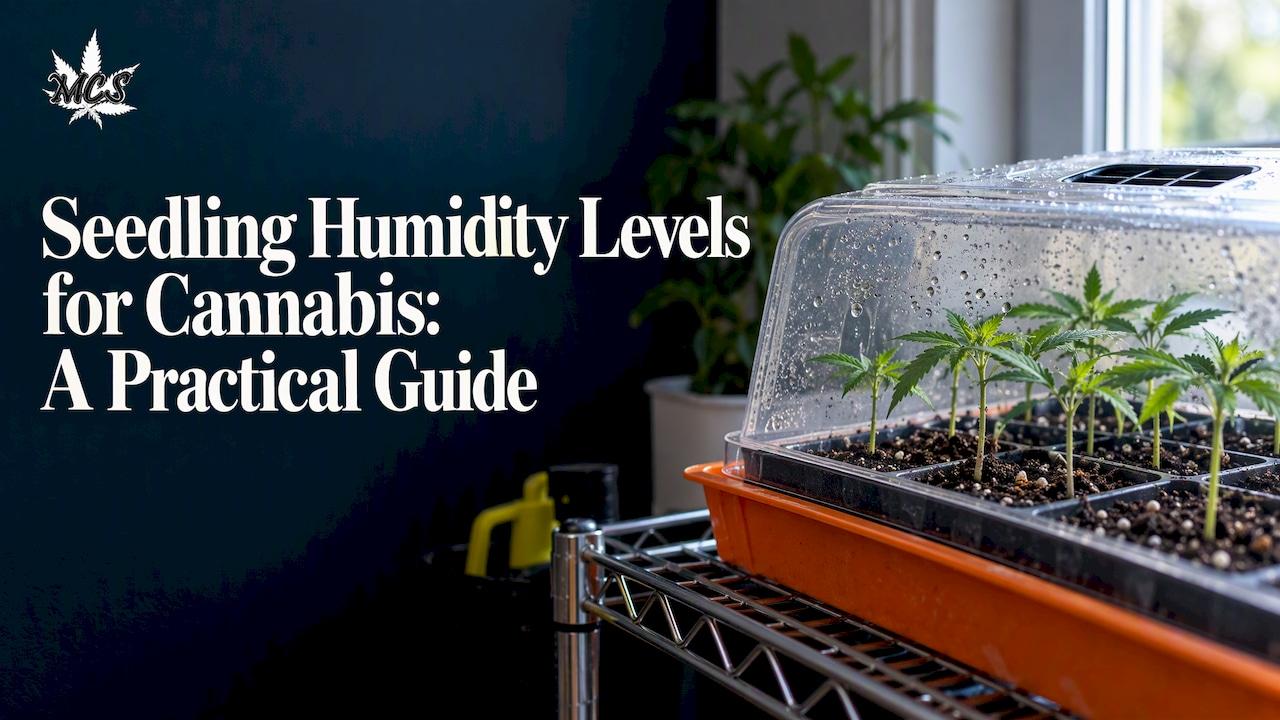
Cannabis seedlings do best in humid air, roughly 65 to 75% relative humidity (RH) once they have sprouted, stepping down gradually as true leaves develop. Published ranges run higher, and one review of cannabis disease management cites 90% and above for germination and the earliest seedling stage. In a Canadian home, where a dome, a heated room and a cold February outside can all interact, the practical goal is not a single number. It is a humidity that falls on a schedule, paired with enough airflow to keep the surface of the soil and the stem base from staying wet.
This guide covers the first two to three weeks after emergence. It does not repeat the basics of cracking seeds, which the store blog treats in its guide to germinating seeds in soil and in its note on seed germination temperature.
TL;DR
- Target about 65 to 75% RH for newly emerged seedlings, then lower it step by step toward the 40 to 60% range that flowering plants need.
- A humidity dome is a tool for the first days only. Vent it progressively and remove it once the seedling has several sets of true leaves and sturdy stems.
- Relative humidity shifts with temperature, so vapor pressure deficit (VPD) gives a more reliable picture of how hard a seedling is working to hold water.
- Humidity without airflow invites damping off and mould, and in a Canadian house the moisture can end up in walls and windows, not only in the tent.
Table of Contents
- Why seedlings want humid air
- Humidity targets by stage
- Using a humidity dome properly
- Why VPD is a better yardstick than RH
- Reading the seedling instead of the meter
- Airflow: the other half of the equation
- Humidity and the Canadian home
- Common questions about the setup
- Perspective: what we see from Canadian growers
- Choosing seeds that suit your setup
- A simple weekly routine
- FAQ
- Sources
Why seedlings want humid air
A seedling has a tiny root system and thin, soft leaves. Its roots cannot yet move large amounts of water, while its leaves lose moisture to dry air through transpiration. When the surrounding air is humid, the plant loses less water, the leaves stay turgid (firm and full of water), and the young plant can put its energy into roots and new growth instead of coping with stress.
That is the logic behind the dome and the advice to keep seedlings in a moist microclimate. The same logic explains why the target drops over time. As roots expand and the plant grows a thicker cuticle and more leaf area, it can handle drier air, and it needs that drier air to pull water and nutrients upward steadily.
Humidity targets by stage
Published figures differ because they describe different moments. The PMC review on integrated disease management gives 90% and above for germination and the initial seedling stage, 65 to 75% for vegetative growth and cloning, and 40 to 60% for flowering. The same review notes that seedlings benefit from roughly 65 to 90% to maintain turgidity. Reading these together, a sensible home schedule looks like this:
| Stage | Approximate age | Target RH | Notes |
|---|---|---|---|
| Seed in medium under a dome | Day 0 to emergence | 80 to 90%+ | Warm, moist, not waterlogged |
| Fresh seedling, cotyledons open | Days 1 to 7 | 70 to 80% | Dome with small vents |
| First true leaves | Weeks 1 to 2 | 65 to 75% | Dome propped open or removed for part of the day |
| Several true leaf sets | Weeks 2 to 3 | 60 to 70% | Dome off, gentle fan in the room |
| Early vegetative growth | Week 3 onward | 55 to 65% | Continue easing down toward flowering ranges |
These are working ranges for a typical indoor space, not laws of nature. A strong, fast-growing seedling in a well-ventilated room can come out from under a dome earlier than a slow one. Watching the plant matters as much as watching the meter.
Temperature travels with humidity
RH and temperature cannot be separated. Warm air holds more water vapor, so the same amount of moisture in the room reads as lower RH when the heat goes up. Research on cannabis germination puts the optimum near 25°C, with temperatures well above 30°C inhibiting germination and values above 40°C causing critical cell damage. A dome sitting under a light or on a heat mat can easily overshoot, which brings us to the real reason a thermometer-hygrometer belongs in the dome itself.
Using a humidity dome properly
A dome is a clear plastic lid that traps the moisture rising from the medium and the plants. It works well for a short window, and it causes most of its trouble when left on too long.
Setting it up
- Fill the pots with pre-moistened medium that is damp but not dripping. Squeezed in the hand, it should release only a drop or two.
- Place the dome over the tray once seeds are planted or seedlings have emerged.
- Put a small digital hygrometer inside the dome, at plant height, not on the tent wall or the room shelf.
- Open the vents partly from the start if the dome has them. If it does not, lift one edge for a few minutes each day.
Reducing humidity in steps
The usual progression is simple. Once the seedling is up and the cotyledons are open, keep the vents about half open. When the first true leaves expand, open them fully or prop the lid for several hours a day. After a few days of that, take the lid off for longer periods and then remove it entirely, usually within the first two weeks. A seedling that droops after the lid comes off is telling the grower that the step was too large. Replace the lid briefly and try again the next day with a smaller step.

What to avoid
Heavy, frequent misting is a common reflex. Extension guidance on propagation, written for cuttings but relevant to any tender young tissue, warns that propagators most often provide too much moisture, and describes frequent heavy misting as a habit that can leave plants waterlogged. For seedlings, a light mist of the inside of the dome or the soil surface is enough. Soaking the stem and leaves repeatedly is not.
Two other mistakes show up often:
- A sealed dome under strong light. Heat builds quickly, humidity swings and condensation drips onto the stems.
- A dome left on for weeks. Seedlings grown in constant saturated air tend to stay soft and stretch, and they are slower to adapt when the cover finally comes off.
Why VPD is a better yardstick than RH
Experienced growers often shift from RH to vapor pressure deficit. Michigan State University Extension explains that VPD is independent of temperature and predicts transpiration and water loss more accurately than relative humidity. Its guidance for propagation is a low VPD, around 0.3 kPa, which minimizes transpiration stress, while finishing plants need a higher VPD, above 0.5 kPa, to support nutrient uptake and reduce disease pressure.
In practice this means a seedling at 26°C and a seedling at 21°C can both read 70% RH and still be under very different stress. At the warmer temperature, the air has a greater capacity to pull water out of the leaf. Many hygrometer apps and online charts convert temperature and RH into VPD automatically. A beginner does not need to chart it daily, but it explains why a room that "looks fine" on the RH reading can still produce limp, crispy-edged seedlings once the heat creeps up.
Reading the seedling instead of the meter
Instruments approximate the plant's experience. The plant itself reports more directly.
- Too dry: leaf edges curl upward or look dry and crisp, cotyledons wither early, and the medium dries out within a day.
- Too wet and humid: stems look pale and thin, the soil surface stays dark for days, algae or fuzzy white growth appears on the medium, or the stem base pinches and the seedling falls over, the classic sign of damping off.
- About right: cotyledons stay flat and green, new leaves unfold steadily, and the stem thickens.
If the leaves are showing colour changes instead, that is generally a feeding or pH question and not a humidity one. The store's guide to cannabis deficiencies helps separate the two.
Airflow: the other half of the equation
Humidity on its own is not the villain. Humidity with still air is. A gentle fan in the room, aimed so it moves air around the seedlings and not directly at them, prevents stagnant pockets of damp air that fungi favour. A 2025 study of bud rot in greenhouse cannabis found that improved air circulation was among the most effective non-chemical measures, reducing disease incidence by as much as 66 to 92%, with airflow of 0.5 to 1.0 m/s cited as effective. That research concerns flowering plants in greenhouses, so it should not be read as a seedling prescription. A seedling needs much less than a stiff breeze. The principle carries over, though: moving air breaks up the damp layer around plant tissue.

Bud rot itself is a flowering-stage disease, but the habits that prevent it start early. BudTrainer's overview of Botrytis notes that conditions inside a dense flower can run about 15% more humid and 2.5°C warmer than the room reading. Seedlings do not have flowers, but the takeaway is general: a sensor on the wall does not describe the microclimate right at the plant, so place it where the plant is.
Humidity and the Canadian home
Canadian conditions add a wrinkle. In winter, outdoor air is cold and dry, and heated indoor air is drier still, so a room used for seedlings can swing from 25% RH to 80% when a dome or humidifier goes on. In spring and early summer, a basement can do the opposite and sit damp all day.
There is also the house itself. Under the federal Cannabis Act, adults may grow up to four plants per household, a limit that the National Collaborating Centre for Environmental Health fact sheet summarizes alongside its health warnings. Provincial rules vary: Quebec, for instance, has restricted home cultivation separately, so growers in each province should check their own rules before planting. The same fact sheet points out that the moisture from growing can degrade indoor air quality and contribute to mould in the home, and it recommends scaling the grow to the home's ventilation capacity and monitoring humidity with a hygrometer.
Two practical consequences follow:
- A seedling area should have its own measured conditions, ideally in an enclosure or a room where excess moisture can be exhausted outdoors or dispersed.
- A dome is the better choice than humidifying an entire room, because it confines the extra moisture to a small volume and keeps it away from walls, windows and insulation.
Anyone with asthma, allergies or a mould-sensitive household member should be especially cautious about humid grow spaces and may want to ask a family doctor or a local public health unit about indoor air concerns.
Common questions about the setup
Dome, tray or cling film?
A purpose-made dome with adjustable vents gives the most control. A clear plastic tote turned over a tray works for a small number of pots, though it needs to be lifted more often. Cling film resting directly on the plants is the weakest option, since it traps heat and touches the leaves. The store's starter equipment guide for Canadian growers lists basic tools including hygrometers and small fans.
Does the plant type change the schedule?
Somewhat. Autoflowers move through life quickly and do not benefit from being babied under a dome beyond the first week or so, while photoperiod plants have a longer vegetative phase to adapt. Either way, the humidity plan simply steps down from the early range toward the 40 to 60% expected in flower. For the difference between the plant types, the store has a detailed comparison of photoperiod, autoflower and fast version strains.
What happens later?
Humidity management never ends, it only changes direction. Vegetative plants tolerate around 65 to 75%, flowering plants need much less, and even after harvest, moisture control remains essential. The store explains the post-harvest side in its piece on humidity while drying cannabis. High humidity can also affect the plant's output: a 2025 study in Cannabis sativa reports that elevated relative humidity decreased cannabinoid concentrations and delayed flowering development.
Perspective: what we see from Canadian growers
At Montreal Cannabis Seeds, we build our catalog around the conditions Canadian cultivators actually face: short seasons, heated indoor spaces and wide swings in indoor humidity. The pattern we find most useful to share is that seedling losses rarely come from the number on the hygrometer alone. They come from a combination of a dome left sealed, a warm spot under a light and no air movement, which together push a tray into the zone where damping off becomes likely.
Our advice is to measure inside the dome, ease the cover off over days, and keep a gentle fan running nearby from the start. Good genetics help too, since a vigorous seedling recovers from small mistakes where a weak one does not. That is why we publish detailed product information for each strain and back our seeds with a germination guarantee, so that a first-time grower can concentrate on conditions instead of wondering about the seed.
— Dino Grow Master
Choosing seeds that suit your setup
Humidity control is easier when the plant is forgiving and the grow plan is clear. Beginners who want predictable plants can start with feminized seeds, while those who prefer a compact, quick cycle often look at autoflower seeds. Both categories ship discreetly across Canada, and our support team can talk through the conditions in your space. The full range is on the Montreal Cannabis Seeds store.
A simple weekly routine
For a small home grow, the following routine keeps humidity manageable without constant fiddling:
- Day 0 to emergence: dome on, vents half open, hygrometer inside, medium damp.
- Days 3 to 7: check morning and evening. Wipe heavy condensation from the lid. Aim for 70 to 80% RH.
- Week 2: vents fully open or lid propped for several hours a day. Fan on low in the room, 65 to 75% target.
- Week 3: dome off. Water at the base of the plant, let the top of the medium dry slightly between waterings, and aim for 60 to 70%.
- Every week after: reduce a few points at a time toward the flowering range, and log the readings so patterns become visible.
FAQ
What is the ideal humidity for cannabis seedlings?
About 65 to 75% RH works well for seedlings after they emerge, and higher levels around 80% or more suit the first days under a dome. Reviews of cannabis disease management cite figures as high as 90% for the earliest stage. The target should decline as true leaves develop.
How long should a humidity dome stay on?
Usually for the first one to two weeks, vented progressively. Remove it once the seedling has several sets of true leaves and a sturdy stem. If the plants droop after the cover comes off, put it back for a few hours and reduce the time in smaller steps.
Can seedlings be damaged by too much humidity?
Yes. Constant saturated air with little airflow encourages damping off, algae on the medium and soft, weak growth. It also adds moisture to the house, and Canadian public health guidance warns that grow moisture can contribute to indoor mould.
Do I need a humidifier or just a dome?
For a handful of seedlings a dome is usually sufficient and keeps the extra moisture contained. A humidifier makes sense only in a dry, enclosed space, and it should be paired with a hygrometer and a fan so that the room does not overshoot.
Sources
- Integrated Management of Pathogens and Microbes in Cannabis sativa L. under Greenhouse Conditions (PMC)
- Influence of extrinsic factors and salt stress on in vitro germination of Moroccan Cannabis sativa L.
- Moisture management during vegetative cutting propagation, MSU Extension
- Why should greenhouse growers pay attention to vapor-pressure deficit, MSU Extension
- The epidemiology and management of Botrytis cinerea on greenhouse cannabis
- Cannabis Bud Rot: How to Identify, Stop, and Prevent Botrytis, BudTrainer
- Environmental Health Risks of Personal Cannabis Cultivation, NCCEH
- Elevated relative humidity decreases cannabinoid concentrations in Cannabis sativa L. (PMC)