
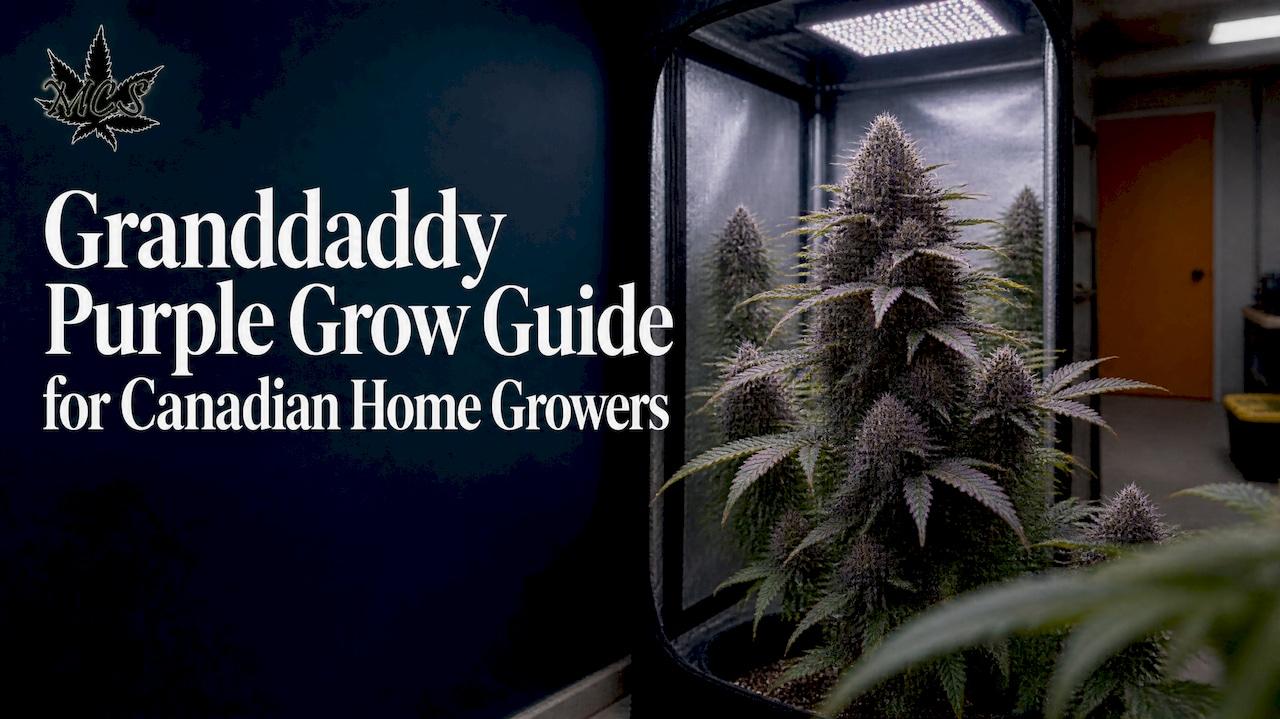
Granddaddy Purple, usually shortened to GDP, is an indica-dominant strain that suits a first indoor grow in Canada: it is compact enough for a small tent, its flowering period is short for a photoperiod plant, and its deep violet buds are the reward most growers are after. Growing it well depends on three things: starting from a genetically stable feminized seed, managing humidity and airflow in the last weeks of flower, and staying inside the home-grow rules of the province in question. This guide covers each in turn, without repeating the general technique articles already on the Montreal Cannabis Seeds blog.
TL;DR
- GDP is an indica strain popularized in 2003 by breeder Ken Estes, and Leafly lists an indoor flowering time of about 60 days. Real runs vary with phenotype and environment.
- Dense, resinous flowers make late-flower airflow and humidity control the main risk to manage. Health Canada also notes that no pesticides are registered for home-grown cannabis.
- THC figures for the name range widely between lab tests, so a published percentage describes a batch, not every plant.
- Federal law allows four plants per household, but provinces and territories set their own home-grow rules. Confirm the local rules before ordering seeds.
- Granddaddy Purple feminized seeds remove the guesswork of sexing plants in a small, plant-limited grow.
Table of Contents
- What Granddaddy Purple is, and why growers choose it
- Choosing seeds for a plant-limited grow
- Timeline: from seed to harvest
- Setting up for GDP
- Pests and mold: prevention comes first
- Colour, THC and what the label cannot tell a grower
- Know the rules before germinating
- Our perspective
- Where to start
- FAQ
- Sources
What Granddaddy Purple is, and why growers choose it
GDP is commonly described as a cross of Mendo Purps, Skunk and Afghanistan, although some accounts give Big Bud and Purple Urkle as the parents. Leafly's strain page places its release in 2003 under Ken Estes and describes grape, berry and violet flavours, myrcene, pinene and caryophyllene as the dominant terpenes (the aromatic compounds that shape smell and part of the experience), and deep purple flowers dusted with white resin. A Leafly Strain Madness write-up adds that the strain is valued for large, chunky flowers and relaxing effects.
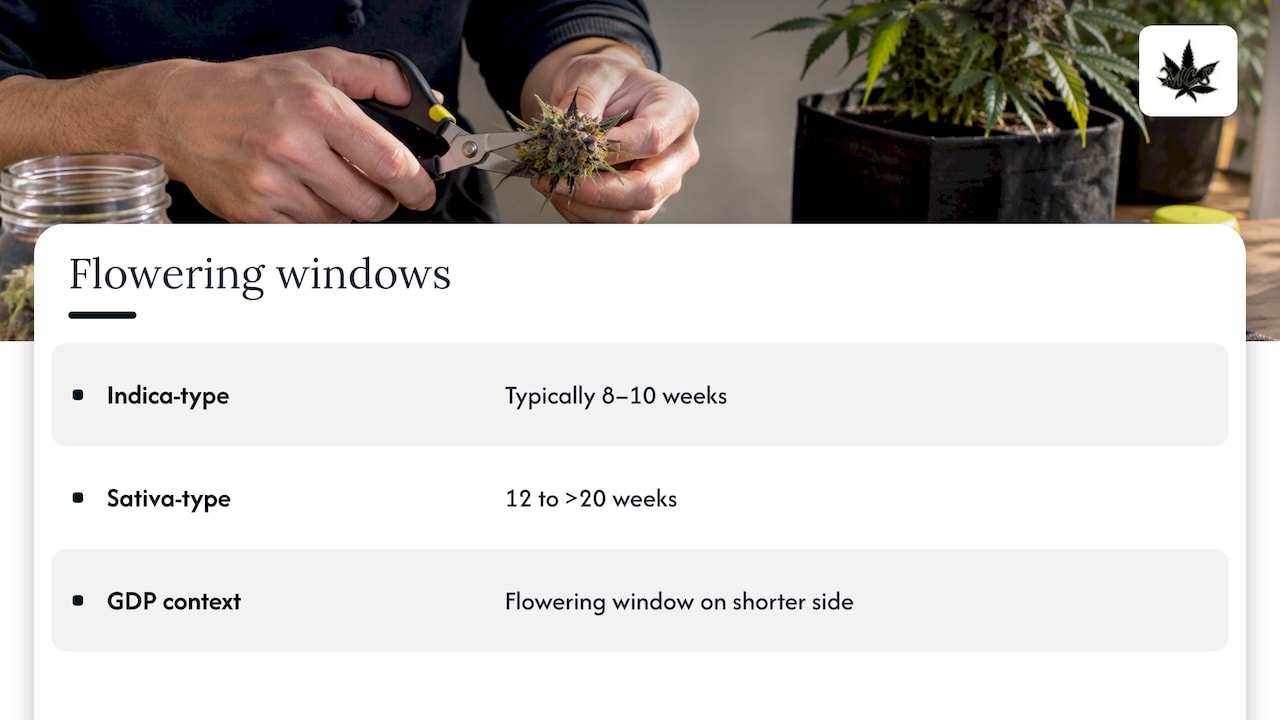
For a home grower the appeal is practical. Indica-leaning plants tend to stay shorter and bushier than sativa-leaning ones, which matters in a grow tent with a fixed ceiling. The flowering window is also on the short side. The University of Saskatchewan notes that indica-type plants typically mature in 8 to 10 weeks, against 12 to more than 20 weeks for sativa types.
The colour is the other draw. Purple in cannabis comes from pigments that some phenotypes express more strongly than others, and it is influenced by how the plant is grown as well as by genetics. A GDP that finishes green is not a failed grow; it is a reminder that appearance is only one indicator of quality.
Choosing seeds for a plant-limited grow
With a household limit of four plants, every plant counts. Health Canada's guidance on growing at home sets the federal maximum at four plants per household, not per person, and advises buying seeds or immature plants from legal sources.
That limit is the strongest argument for feminized seeds. A regular seed pack produces males and females in roughly equal proportion, and a male discovered in flower costs a slot and a few weeks. Feminized genetics are bred to produce female plants, the ones that grow the flowers. The Montreal Cannabis Seeds catalog lists Granddaddy Purple feminized seeds alongside a wider range of feminized seeds, and the store offers a germination guarantee on its seeds. The full comparison of seed types is covered in the store's guide to photoperiod, autoflower and fast version strains.
GDP is a photoperiod plant, meaning it begins flowering when the light cycle is shortened, typically to 12 hours of light and 12 of darkness. That gives the grower control over plant size: vegetative growth continues under long light hours until the plant is ready to be flipped. Those who prefer a shorter overall timeline can look at the fast version or autoflower categories instead.
Timeline: from seed to harvest
A realistic GDP schedule has four stages. Durations are approximate because they depend on phenotype, light intensity and how long the plant is kept in vegetative growth.
| Stage | What happens | What to watch |
|---|---|---|
| Seedling | Roots establish, first true leaves open | Overwatering and damp surface soil |
| Vegetative | Rapid stem and leaf growth under long light hours | Final plant height, branch spacing, airflow |
| Flowering | Light cycle shortened, buds form and swell | Humidity, bud density, resin development |
| Harvest and drying | Flowers cut once ready, then dried and cured | Slow drying, mold prevention |
On flowering length, growers' accounts and published profiles cluster near the 60-day mark indoors that Leafly cites, with some reporting runs a little longer. Treat 8 to 10 weeks, the indica range given by the University of Saskatchewan, as the planning window and decide on harvest by looking at the trichomes (the tiny resin glands on the flowers) with a magnifier, not by counting days alone. Drying and curing are covered in the store's own library, so the finishing steps are not repeated here.
Setting up for GDP
The general equipment choices are already treated in the store's starter equipment guide. Three points are specific to this strain.
Give the canopy room to breathe
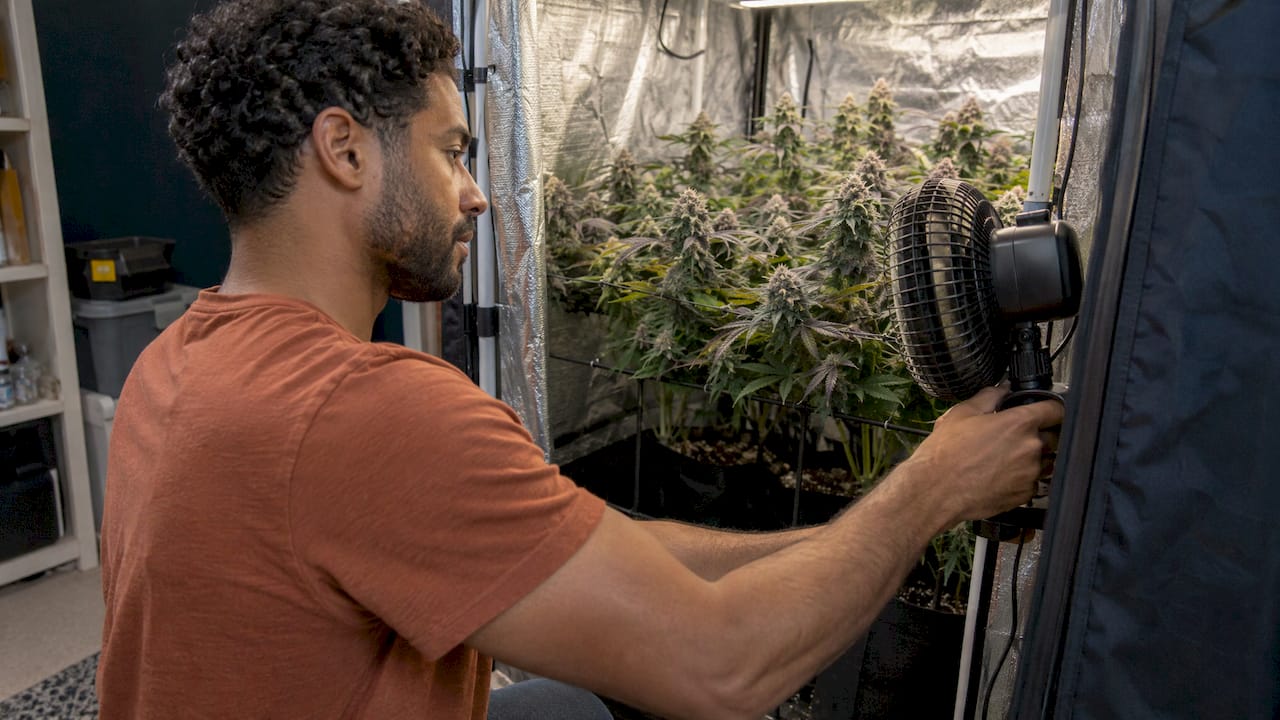
GDP builds heavy, dense flowers. Dense buds hold moisture, and moisture held against a bud is how mold starts. Health Canada's home-growing page specifically recommends adequate ventilation for indoor grows to prevent mold, and that advice applies with extra force to a strain known for compact, resinous colas. Prune lower growth that never reaches light, keep leaves from crowding the flowers, and keep air moving through the canopy at all times, including when the lights are off.
Plan the plant's size before the flip
Because a photoperiod plant can stretch after the switch to the flowering light cycle, the plant should be flipped well below the height of the tent. Shaping methods such as topping and low-stress training are explained in their own posts on the store blog, so they are not repeated here. The point for GDP is simply that an even, wide canopy exposes more bud sites to light and airflow than one tall central stem.
Watch the feed in late flower
Heavy flowering plants draw hard on nutrients, and leaf discolouration in the last weeks is not always a problem, since fading is part of normal ripening. Telling the two apart is easier with a reference: the store's guide to cannabis deficiencies and its pest and deficiency chart cover the symptoms in detail.
Pests and mold: prevention comes first
Health Canada states that no pesticides are currently registered specifically for cannabis grown at home, and that even products labelled for use on all plants have not been determined safe for cannabis. Growers with questions are directed to the Pest Management Information Service. In practice this makes prevention the whole strategy: clean tools, a clean tent, dry soil surfaces and regular inspection of leaf undersides.
Two common problems are worth knowing by name. Fungus gnats, small flies whose larvae live in damp soil, are addressed in the store's four-week IPM plan for fungus gnats, and chewing damage on outdoor or greenhouse plants is covered in the guide to caterpillars on cannabis. Catching either early is far easier than treating it in late flower.
Colour, THC and what the label cannot tell a grower
Published potency for GDP is inconsistent. Leafly's profile lists about 17% THC and no CBD. Cannigma's strain profile gives 20% THC, and notes that third-party lab results under this name have ranged from 12% to 27%. Some sellers quote higher still.
The spread has simple causes. Phenotype, growing conditions, harvest timing and curing all change the finished flower, and a strain name is a family, not a guarantee. A plant grown at home will test differently from a licensed producer's batch, and neither tells the other's story.
Colour deserves the same caution. Violet leaves and buds look impressive, but they say little about potency. For those comparing products and wanting to understand cannabinoid and terpene content instead of relying on a name or appearance, this guide to finding the right strain match explains what lab information to look for.
Safe use
GDP is widely described as sedating, and Leafly's user data lists sleepy, relaxed and hungry among its top effects. Higher-potency THC carries greater risk of adverse effects, and the Canadian Coalition for Seniors' Mental Health guidelines note that older adults can be more susceptible to dose-related problems such as falls, cognitive impairment, anxiety and psychosis. Anyone using cannabis for a medical reason, or taking other medication, should speak with a physician or pharmacist before use.
Know the rules before germinating
Federal law sets the baseline: adults of legal age may grow up to four plants per household, and share up to 30 grams of personally grown dried cannabis with other adults. Selling without a Health Canada licence is illegal and can lead to imprisonment, according to Health Canada.
Provinces and territories can add their own conditions, including the minimum age and whether home cultivation is allowed at all. The picture can change: Manitoba's cannabis authority states that, as of May 1, 2025, adults 19 and over may grow up to four plants at home. Before ordering seeds, check the current rules of the province or territory of residence, along with municipal rules on zoning, fire and electrical safety, which Health Canada also asks home growers to follow.
Medical growers follow a separate path. Health Canada's medical production guidance explains that growing begins only after a registration certificate is issued, that producers must stay within the limits on it, and that the cannabis cannot be shared or sold. Anyone starting from a medical document should confirm those terms with their health care practitioner and Health Canada's registration process. For a plain overview of sourcing legal cannabis products in Canada, this cannabis buying guide is a useful companion.
Our perspective
Most of the trouble first-time GDP growers meet starts before the first leaf: an uncertain seed, an unsexed plant taking up one of four legal places, or a strain chosen for a photo instead of a space.
We curate genetics with Canadian growing conditions in mind, and we publish detailed product information so a grower knows what a plant is likely to do before it is planted. Our feminized GDP is offered so that each of the plants allowed in a household has a reason to be there, and our germination guarantee is there for the seed stage.
Our support team understands local growing challenges, from short outdoor seasons to winter indoor humidity, and we would rather a customer ask a question in week one than lose a harvest in week nine.
Dino Grow Master
Where to start
For growers in provinces that permit home cultivation, Montreal Cannabis Seeds carries Granddaddy Purple feminized seeds, with fast, discreet shipping across Canada and detailed product information on the page. Those who want to compare genetics first can browse the full feminized seed range, or see the store's list of top strains for first-time growers.
FAQ
How long does Granddaddy Purple take to flower?
Published profiles commonly give about 60 days of indoor flowering, which fits the 8 to 10 weeks that the University of Saskatchewan gives for indica-type plants. Individual plants can finish earlier or later depending on phenotype and conditions. Trichome colour under magnification is a more dependable harvest signal than the calendar.
Is Granddaddy Purple good for beginners?
Its moderate size and short flowering window make it manageable for a first photoperiod grow, provided airflow and humidity are managed in late flower, when dense buds are most prone to mold. Starting from feminized seed also removes the need to identify and remove males.
Will my plants turn purple?
Not always. Purple colouring depends on the phenotype and on growing conditions, so two plants from the same pack can finish differently. Colour is a cosmetic trait and does not by itself indicate potency.
How many Granddaddy Purple plants can I grow in Canada?
Federal law allows four plants per household, but provinces and territories set their own conditions and some restrict home cultivation. Check the rules for the province or territory of residence before ordering seeds.
Sources
- Granddaddy Purple strain profile, Leafly
- Leafly Strain Madness 2019 champion
- Cannabis, Gardening at USask
- Growing cannabis at home safely, Health Canada
- Guidance on personal production of cannabis for medical purposes, Health Canada
- Learn about cannabis laws, Liquor, Gaming and Cannabis Authority of Manitoba
- Granddaddy Purple strain profile, Cannigma
- Canadian Guidelines on Cannabis Use Disorder Among Older Adults
- Guide to finding the right cannabis strain
- Cannabis buying guide for Canada