
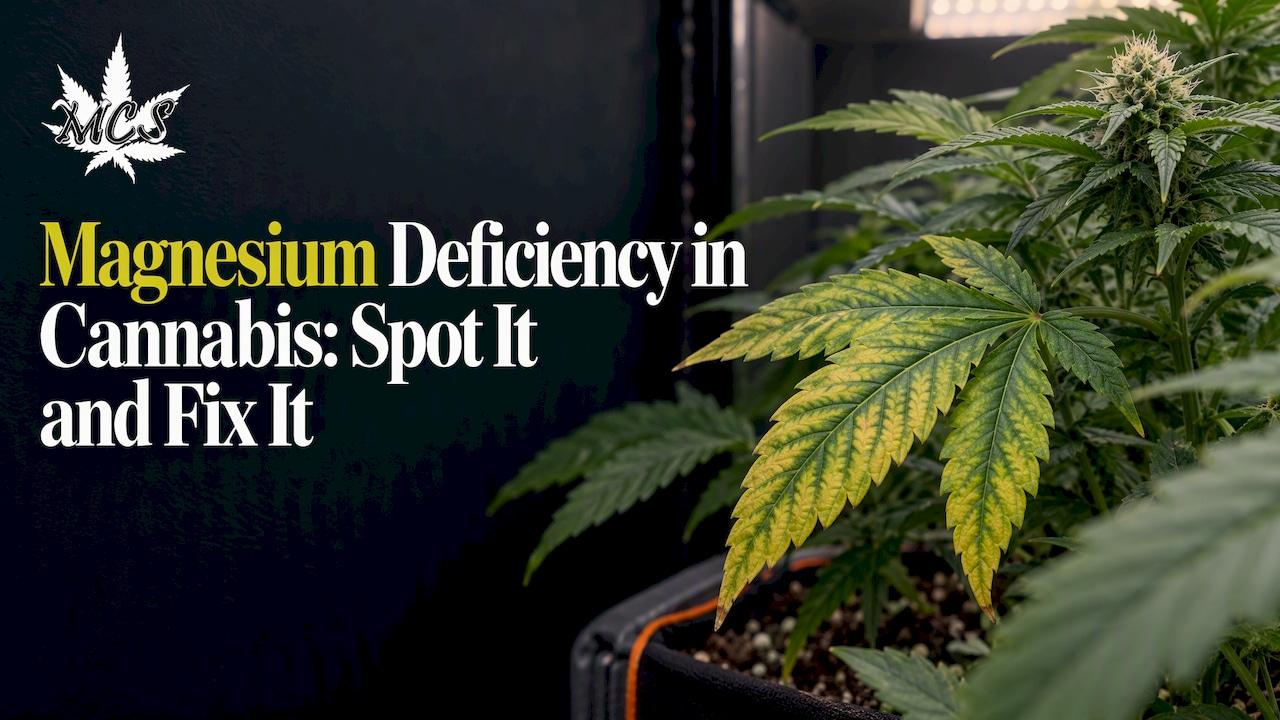
Magnesium deficiency in cannabis shows up as yellowing between the veins of the older, lower leaves, followed by rusty brown spots and curling edges as the damage advances. In most home grows the cause is not an empty bag of fertilizer but a root zone that cannot deliver magnesium: a pH that has drifted, calcium or potassium crowding it out, or water that carries almost none. This guide explains how to confirm the diagnosis, what to correct first, and how to tell whether the plant is truly recovering.
TL;DR
- Magnesium is mobile in the plant, so symptoms begin on older, lower leaves as interveinal yellowing, then brown necrotic spots and curl.
- Check pH before adding anything: a substrate range of roughly 5.8 to 6.2 keeps calcium and magnesium available.
- Excess potassium, calcium or ammonium, and soft or reverse-osmosis water, are the usual reasons magnesium runs short.
- A weak Epsom salt foliar spray or a calcium-magnesium supplement can help, but damaged leaves rarely turn green again. Recovery shows in new growth.
- Magnesium also affects cannabinoid and terpene production, so correcting it early protects the harvest, not just the foliage.
Table of Contents
- Why magnesium matters to a cannabis plant
- What magnesium deficiency looks like
- Magnesium deficiency or something else?
- What actually causes it
- Confirming the diagnosis before treating
- How to correct it
- Recognizing recovery
- Preventing a repeat
- Perspective: where genetics fit in
- Choosing seeds that suit your setup
- FAQ
- Sources
Why magnesium matters to a cannabis plant
Magnesium sits at the centre of the chlorophyll molecule, which is why a shortage reads first as lost green colour. It also activates many enzymes and helps the plant move other nutrients, including phosphorus, around its tissues. Penn State extension material on potassium and magnesium mimics is not needed to see the point: a plant that cannot build chlorophyll cannot photosynthesize at full capacity, and growth slows.
The quality side is less well known. A 2025 study from Israel found that magnesium is required for key enzymes in cannabinoid and terpene biosynthesis, and that a low supply of 2 to 20 mg/L restricted production of both. A related study on vegetative-stage medical cannabis identified 35 to 70 mg/L of magnesium as the optimal supply range, with the lower inputs impairing development and function. For a grower, the lesson is that a mild, untreated shortage costs more than appearance.
The Cannabis Business Times nutrient report adds that cannabis may have a higher magnesium demand than many plant species, which helps explain why the problem appears so often in otherwise well-run gardens.
What magnesium deficiency looks like
Because magnesium is a mobile nutrient, the plant relocates it from old tissue to new growth when supply is short. Ontario's agriculture ministry notes in its hemp guide that deficiency therefore appears first on older leaves, with interveinal chlorosis or reddening, then marginal necrosis, curling and necrotic patches. Academic work on hemp describes the same sequence: interveinal chlorosis on older leaves that progresses to necrosis.
The progression, stage by stage
- Early: the tissue between the veins on the lowest fan leaves turns pale green. The veins themselves stay green, giving a marbled or striped look.
- Developing: the pale areas turn yellow and the pattern climbs to middle-aged leaves. Leaf edges may begin to curl upward.
- Advanced: rust-coloured or brown dead spots appear between the veins, and leaf margins turn crisp. In hemp, advanced deficiency can progress from chlorosis to brown dead tissue, and curling is common.
- Severe: whole lower leaves yellow, die and drop, leaving the plant with a reduced photosynthetic surface during the weeks when flowers are building.
In flower, demand rises, and the symptom often appears or worsens around the third or fourth week of bloom. That timing leads many growers to assume the plant is simply ripening. A fan leaf that yellows while the rest of the canopy is still vigorous, and that shows a green vein skeleton, is a nutrient problem, not senescence.
Magnesium deficiency or something else?
Several problems produce yellow leaves, and treating the wrong one wastes weeks. Location and pattern are the most reliable guides.
| Problem | Where it starts | What it looks like |
|---|---|---|
| Magnesium deficiency | Older, lower leaves | Yellow between green veins, then rusty spots, upward curl |
| Nitrogen deficiency | Older, lower leaves | Uniform pale yellow across the whole leaf, including veins |
| Manganese deficiency | Younger, upper leaves | Interveinal yellowing on new growth |
| Nutrient burn | Leaf tips of any age | Burnt, crisped tips, often with dark green leaves |
| Potassium deficiency | Older leaves | Scorched edges and tips more than interveinal striping |
The distinction from manganese deficiency rests on timing: the Ontario guide states that magnesium deficiency starts on older leaves, while manganese deficiency usually appears first on younger leaves.
Two look-alikes deserve a closer read on the store blog. Nitrogen starvation also begins low in the plant, but the whole leaf fades evenly; the guide to diagnosing and fixing nitrogen deficiency shows the difference. Burnt tips with dark foliage point to excess salts rather than shortage, and the post on testing EC before flushing for nutrient burn explains how to confirm it. Phosphorus problems, which can also darken and mottle lower leaves, are covered in the phosphorus deficiency guide.
Both problems can also occur together. A plant fed too strongly can lock out magnesium, so tip burn and interveinal striping appear on the same plant. In that case the order of operations matters, as described below.
What actually causes it
A true shortage of magnesium in the medium is the least common explanation. More often something prevents the roots from taking it up.
pH out of range
Cannabis Business Times reports that substrate pH below 5.5 or above 6.5 can cause nutritional problems, that low pH can hinder calcium and magnesium availability, and that 5.8 to 6.2 is a recommended range for cannabis substrates. Leafly Canada gives 5.8 to 6.8 for soil and 5.5 to 6.5 for hydroponics and advises checking water and medium pH before diagnosing any deficiency. Over-fertilizing can itself push pH off and create lockout even when nutrients are present.
Soil growers should note that organic mixes buffer differently from bottled-nutrient programs; the store's piece on organic soil basics and pH covers what to expect.
Competition from other nutrients
Nutrients compete at the root surface. Cannabis Business Times explains that excess potassium commonly produces calcium or magnesium deficiency symptoms, and excess calcium can also limit magnesium uptake. The same source describes a general potassium to calcium to magnesium target of 4:2:1, about 200 ppm, 100 ppm and 50 ppm, for commercial cannabis. That ratio is a useful reference point, not a rule for every garden, but it shows why a heavy bloom booster high in potassium can trigger the problem.
CANNA Canada adds that excess potassium, ammonia or calcium relative to magnesium can inhibit uptake, with calcium-rich tap water and clay soils high in calcium as examples. Many Canadian municipal supplies are moderately hard, so a grower on hard water who adds a calcium supplement may be compounding the imbalance.
Water that carries little or none
The opposite problem affects growers using reverse-osmosis or very soft water. The nutrient report notes that deficiency can occur where irrigation water supplies little or no magnesium, and that frequent irrigation can leach magnesium from the substrate, particularly in mother plants watered often. Filtered water needs calcium and magnesium added back, because the filter removes what the tap supplied.
Cold, wet and crowded roots
CANNA Canada identifies the condition as an uptake problem that can follow a very wet, cold or acidic root environment, a limited root system, heavy plant demand, or high EC. This matters in Canada, where basements, garages and outdoor beds in spring and fall can run cold at the root zone. A plant in a small pot that has outgrown it, sitting in saturated mix at low temperature, is a classic candidate.
Confirming the diagnosis before treating
Symptoms alone can mislead. An academic study of hemp nutrition concluded that cultivators should take an integrated approach to diagnosis, because symptoms may not correspond to foliar nutrient analysis. A practical sequence:
- Measure runoff pH and EC. If pH sits outside the ranges above, correct it first. High EC points toward lockout from salts.
- Review the feed schedule. Note any recent increase in potassium-heavy products or calcium supplements.
- Check the water. Know whether it is tap, well or filtered. A municipal water report, or a simple TDS meter reading, tells a great deal.
- Map the damage. Confirm it started on older leaves and follows the interveinal pattern.
- Consider tissue testing. Extension specialists at Alabama Cooperative Extension recommend periodic leaf tissue tests to catch hidden hunger, where a crop needs more nutrients despite showing no visible symptoms. For hemp, the sufficiency range for magnesium in mature vegetative leaf tissue is 0.40 to 0.81% by dry weight, a figure the cannabis nutrient report echoes for cannabis.
Tissue testing is rarely necessary for a single home plant, but it is worth considering when several plants behave differently under identical care.
How to correct it
The order below follows the logic of the causes: remove the obstacle first, then supply magnesium.

Step 1: bring pH into range
Adjust the feed water so that the root zone lands inside the substrate range for the medium. In soil, avoid sudden large swings; make small corrections over several waterings. In hydroponics, CANNA suggests temporarily using a nutrient solution at pH 6.5, which favours magnesium uptake.
Step 2: rebalance calcium, potassium and ammonium
If the schedule is potassium-heavy, ease it. If a calcium supplement was added without magnesium, switch to a product that contains both, or add magnesium separately. For soil below pH 5, CANNA recommends magnesium-containing calcium fertilizers. The store's overview of what makes a good cannabis fertilizer helps when reviewing a feed program.
Step 3: supply magnesium
Two routes are common. A cal-mag supplement mixed into irrigation water addresses the root zone, and is the practical choice for growers using filtered water. For a faster visible response, a foliar spray of Epsom salt (magnesium sulfate) is widely used; CANNA's guidance is a 2% Epsom salt solution sprayed every 4 to 5 days for about a week. Apply it when the lights are off or dimmed so droplets do not scorch leaves, and avoid spraying open flowers, since moisture on dense buds invites mold.

A foliar spray is a bridge, not a cure. If the root-zone cause persists, the deficiency returns once spraying stops.
Step 4: do not overcorrect
More magnesium is not better. Excess magnesium can in turn interfere with calcium uptake, and the research aimed at medical cannabis defines an optimal range, not a minimum to exceed. Correct in small steps, then watch.
Recognizing recovery
Damaged leaves seldom regain full colour. The reliable signs of success are that yellowing stops spreading to additional older leaves, and that new growth emerges healthy and evenly green. As one grower resource puts it, the aim is to halt progression rather than expect damaged leaves to turn fully green. Allow roughly a week or two of watching new growth before deciding the correction failed; stacking more additives during that window is a common way to create a second problem.
Heavily damaged lower leaves can be removed once they are mostly dead, which improves airflow and lets the plant stop supporting tissue that no longer works.
Preventing a repeat
- Measure pH at every feeding, at least until a routine is stable.
- Use a feed with a balanced calcium-to-magnesium supply, particularly when watering with filtered water.
- Match pot size to plant size, so roots are not cramped and waterlogged.
- Keep the root zone warm enough, since cold slows uptake.
- Avoid large jumps in bloom-stage potassium.
- Record what was fed and when. A log makes the next diagnosis a matter of minutes.
The store blog's pest and deficiency chart and its wider blog are useful for cross-checking symptoms in the same session.
Perspective: where genetics fit in
We see magnesium problems less as a single mistake than as the point where a grow's small imbalances finally become visible. Growers who write to us with yellowing lower leaves have almost always, on inspection, been dealing with pH drift, filtered water or a heavy potassium schedule, and rarely with an absence of magnesium itself. Our advice is to correct the environment before reaching for another bottle.
Genetics also play a part. Plants differ in how hungry they are, and fast-growing, heavy-flowering varieties tend to show a shortage earlier because demand outpaces supply. Starting with seeds selected for Canadian conditions, and with clear product information about vigour and flowering behaviour, lets a grower plan feeding to the plant, not the reverse. Autoflowers have a short life cycle, so there is less time to recover from an early mistake, and they reward a steady, moderate feed from the first week.
For medicinal growers, we would add that consistency matters: a plant held in its optimal magnesium range is one more likely to express the cannabinoid and terpene profile the genetics promise.
— Dino Grow Master
Choosing seeds that suit your setup
Growers who want a forgiving start can browse our feminized seeds, which remove the guesswork of sexing plants, or our autoflower seeds for compact plants with a short cycle. Every order is backed by our germination guarantee and shipped discreetly across Canada, and our support team can talk through feeding and growing conditions. The full range is on the Montreal Cannabis Seeds home page.
FAQ
How do I fix magnesium deficiency in cannabis quickly?
Check and correct root-zone pH first, since low pH blocks magnesium uptake. Then supply magnesium through a cal-mag supplement in the water or a weak Epsom salt foliar spray, applied when lights are off. Watch new growth over the following week or two to confirm the correction.
Will yellow leaves turn green again after treatment?
Usually not. Tissue that has already lost chlorophyll rarely recovers fully. Success shows as yellowing that stops spreading and new leaves that grow in healthy.
Can I use Epsom salt every watering?
It is better used as a short corrective measure than a standing habit. Ongoing excess magnesium can interfere with calcium uptake, so return to a balanced feed once symptoms stabilize.
Is it magnesium deficiency or nutrient burn?
Look at where it starts. Magnesium problems begin on older, lower leaves as interveinal yellowing, while burn shows at the tips of leaves, often on dark green growth. High runoff EC supports burn, and the two can occur together.
Sources
- From deficiency to toxicity: Magnesium increases cannabinoid and terpene production
- Response of Medical Cannabis to Magnesium Supply
- Nutrient Deficiency ID Guide for Hemp, OMAFRA
- Visual symptoms of N, P, K, and Mg deficiency in hemp
- NUTRIENT report, Cannabis Business Times
- 3 Tips to Avoid Nutrient Lockout, Cannabis Business Times
- Cannabis nutrient deficiencies and leaf symptoms, Leafly Canada
- Magnesium deficiency guide, CANNA Canada
- Magnesium deficiency guide, CANNA Australia and New Zealand
- Foliar Symptomology, Nutrient Content, Yield, and Secondary Metabolites
- Leaf Tissue Testing for Hemp, Alabama Cooperative Extension
- How to fix Cannabis Magnesium Deficiency