
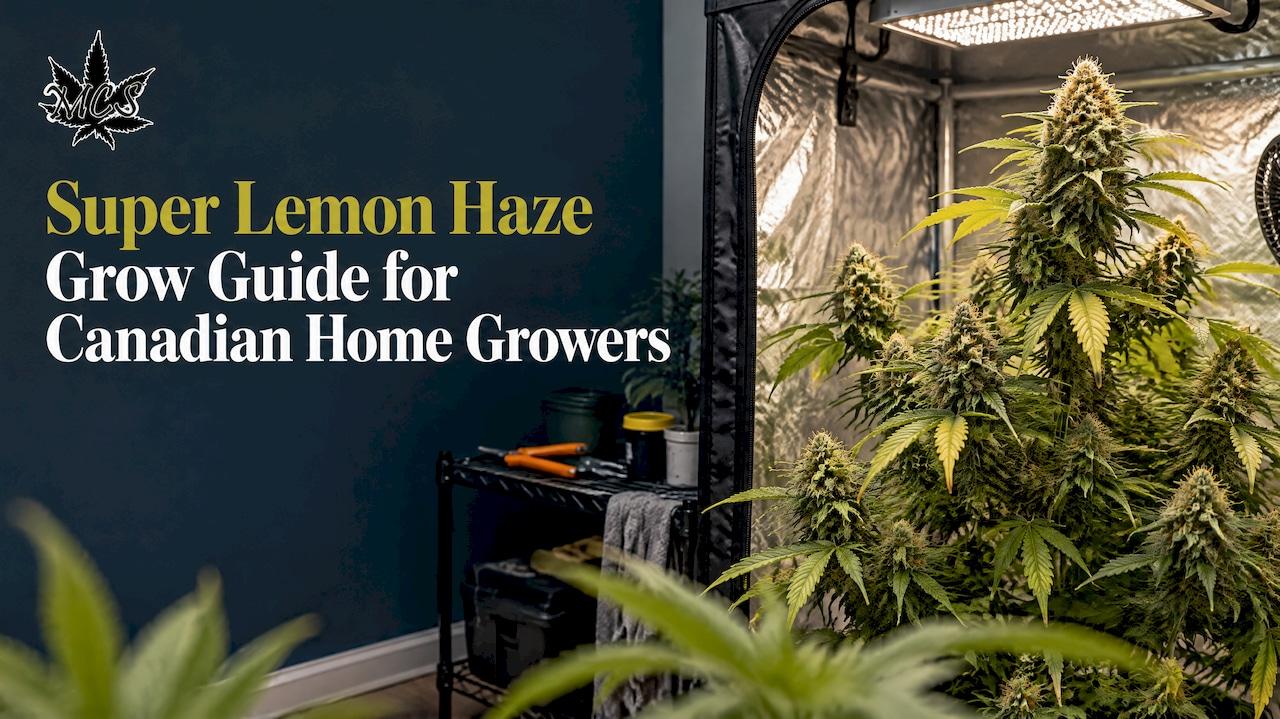
Super Lemon Haze is a tall, branchy, sativa-leaning plant that flowers for roughly 9 to 12 weeks, so a good grow depends on vertical space, a strictly controlled light cycle and a realistic view of the Canadian season. It is usually rated moderate in difficulty rather than beginner-friendly. Most problems trace back to stretch, light leaks and a harvest that arrives too late outdoors. Home cultivation is also regulated differently from one province to the next, so the legal baseline comes first.
TL;DR
- Super Lemon Haze is reported to flower in about 10 weeks indoors, with some growers seeing 9 to 12 weeks, and is generally described as a moderate-difficulty strain.
- Plants stretch hard after the switch to 12/12, so flip to flowering while the canopy fills only 40 to 50% of the available height.
- Outdoors, the long flowering period makes a cool Canadian autumn the main risk, and harvest is typically mid-October or later.
- Federal law allows four plants per household, but Quebec prohibits home cultivation and other provinces add their own rules.
- Keep the dark period truly dark: light interruptions are linked to stress and hermaphroditism in this strain.
Table of Contents
- Check the home-grow rules before buying seeds
- What Super Lemon Haze is and why growers choose it
- Growing conditions that suit Super Lemon Haze
- Seedlings and the first weeks
- Managing stretch: the real work of this strain
- Light discipline during flowering
- How long Super Lemon Haze takes to flower
- Growing Super Lemon Haze outdoors in Canada
- Feeding and watering: keep it steady
- Harvest timing, drying and curing
- Our perspective on growing haze in Canada
- Choosing seeds for a haze-style grow
- Find your next seeds at Montreal Cannabis Seeds
- FAQ
- Sources
Check the home-grow rules before buying seeds
The federal Cannabis Act exempts personal cultivation of up to four plants per dwelling-house from its prohibitions, and the Supreme Court of Canada described this framework in Murray-Hall v. Quebec. The same decision confirms that Quebec law completely prohibits possessing cannabis plants and cultivating them for personal purposes in a dwelling-house. The Canadian Centre on Substance Use and Addiction summarizes the picture: the four-plant household limit is federal, and provinces and territories can set their own permissions.
Rules also move. Manitoba, for example, changed its approach in 2025, allowing adults over 19 to grow up to four plants indoors, out of reach of anyone under 19. Readers in Quebec can review the situation in our guide to growing cannabis in Quebec, which covers the law, medical permits and timing. Anywhere else, the provincial cannabis authority's current page is the final word on plant counts, indoor requirements and storage.
What Super Lemon Haze is and why growers choose it
Super Lemon Haze is a sativa-dominant cross best known for a sharp lemon-candy aroma and an energetic, uplifting profile. It has a reputation as a cup-winning strain, and the citrus character is the reason most growers pursue it. That character comes from terpenes, the aromatic compounds in the flowers, and it is easiest to preserve when the plant is grown without stress and finished slowly.
The trade-off is typical of haze genetics: a taller plant, a longer flowering window and a lower tolerance for sloppy light control. Growers who have already completed one or two simpler runs are in the best position to get the most from it. For a first run, our step-by-step beginner guide covers the fundamentals, and the Amnesia Haze grow guide applies many of the same haze principles to another well-known strain.
Growing conditions that suit Super Lemon Haze
Leafly's cultivation notes give an ideal range of 68 to 80°F (20 to 27°C) and say the plant tolerates 45 to 55% relative humidity during flowering. That is a comfortable window for most Canadian basements, closets and tents, provided the room does not drop sharply overnight in winter.
A practical way to apply those numbers:
| Stage | Temperature target | Humidity note |
|---|---|---|
| Vegetative growth | 68 to 80°F (20 to 27°C) | Moderate, higher than flower is acceptable |
| Flowering | 68 to 80°F (20 to 27°C) | Around 45 to 55% RH |
| Dark period | Avoid big drops below the range | Keep air moving to limit damp air around buds |
Winter grows in Canadian homes often struggle with low humidity in the heating season and cold floors in basements. A thermometer and hygrometer at canopy height, not at floor level, give the real numbers. Equipment questions such as tents, lights and fans are covered in our Canada grow supplies guide.
Seedlings and the first weeks
Haze plants are not demanding at the start, but a weak seedling becomes a weak tall plant. Moisture, gentle light and patience matter more than feeding. Our cannabis seedling care guide walks through those first weeks for Canadian conditions. For the step before that, the basics of germinating weed seeds apply to any strain, including this one.
Because Super Lemon Haze is photoperiod, the plant will not flower until the light schedule changes, and the grower decides how long vegetative growth lasts. That choice is the single biggest lever on final height, which leads to the strain's defining challenge.
Managing stretch: the real work of this strain
Haze phenotypes are known for stretch. According to Prime Cuts Nursery's grow guide, the plant can double or triple in height during the first two to three weeks after the flip to 12/12. The same guide advises flipping only when the canopy takes up no more than 40 to 50% of the vertical space available, and tucking branches through a net aggressively during those first three weeks of flower.
That gives a simple planning rule. Measure the distance from the pots to the light, or to the tent ceiling, and decide the flip height from it:
- Work out the usable height, from pot rim to the point where the light must stay to avoid burn.
- Multiply by 0.4 to 0.5. That is the plant height at which to start 12/12.
- Keep training during stretch so branches reach the same level instead of racing to the top.
As a worked example, a tent with 120 cm of usable height above the pot suggests flipping at around 48 to 60 cm. Whether that is achievable depends on the vegetative period, so a grower with a short tent may simply flip earlier and accept a smaller plant. A smaller plant that fits is more productive than a large one pressed against the light.
Training methods themselves, such as low-stress training, topping and screen-of-green setups, are covered in separate posts on our store blog, so this guide only applies them to the haze stretch. The principle for this strain is to build an even canopy before the flip, then keep adjusting through stretch.
Light discipline during flowering
Prime Cuts Nursery stresses a strict 12/12 schedule with no light leaks, because this strain is described as sensitive to hermaphroditism when stressed or when the dark period is interrupted. In practice:
- Check the tent for pinholes with the room light on and the grow light off.
- Cover indicator LEDs on fans, timers and power strips.
- Do not open the tent during the dark period. Use a green-safe approach only if entry is unavoidable, and keep it brief.
- Put the lights on a reliable timer, and check it after any power cut.
Hermaphrodite plants, how they appear and what to do about them are covered in a separate post on our store blog. For this strain the point is prevention: a stable, boring environment is the cheapest insurance.
How long Super Lemon Haze takes to flower
The common answer is about 10 weeks. Leafly reports a 10-week flowering time and a moderate difficulty level, while Grandcannabis.ca puts the indoor timeline at around 9 to 12 weeks to reach full potential. Differences come from the phenotype, the environment and how the grower judges ripeness.
A useful way to plan the calendar for an indoor grow:
| Phase | Typical length | Notes |
|---|---|---|
| Seedling | 1 to 2 weeks | Gentle light, careful watering |
| Vegetative | 4 to 6 weeks, set by the grower | Longer veg means a taller plant |
| Flowering | 9 to 12 weeks | Stretch in the first 3 weeks |
| Drying | Roughly 1 to 2 weeks | Slow and cool |
| Curing | Several weeks | Jars, opened regularly |
Adding these together, a full cycle from seed to cured flower commonly takes close to five to six months. One published growlog on Grow with Jane recorded a run of 33 weeks from seedling to the start of curing, a reminder that real-world grows with long flower periods run well past textbook figures. These are single-grower examples, not guarantees, so plan with margin.
Growing Super Lemon Haze outdoors in Canada
Grandcannabis.ca notes that the plant grows indoors and outdoors, can exceed 78 inches (roughly 2 m), and is often ready for outdoor harvest around mid-October or a little later. In most of Canada, that is the problem. Leafly points out that the long flowering period can make it hard to finish outdoors in colder climates, where fall weather arrives before the buds mature.
For outdoor growers in provinces where it is permitted, this suggests a few rules:
- Start plants early and harden them off before moving them out, so the vegetative phase happens in good weather.
- Choose a spot with the longest possible direct sun, sheltered from wind, and consider one that allows a cover if frost or heavy rain arrives.
- Watch the forecast in September and October. Cold, wet nights raise the risk of bud rot in dense flowers.
- Accept that a haze with a very long finish may not complete in northern or short-season regions.
Growers who want a lemony, hazy experience with a calendar that fits a Canadian season often look at faster-finishing photoperiod options instead. Our Fast Versions range is built around quicker harvests, and our autoflower seeds flower on age rather than light schedule. Our dedicated store-blog posts on outdoor growing cover the season in more depth.
Feeding and watering: keep it steady
Haze plants tend to reward a measured feeding routine. Heavy feeding in late flower can push harsh-tasting buds and mask the citrus aroma, while underfeeding over a long flowering period can show up as fading lower leaves. Rather than following a rigid chart, growers do better observing leaf color and adjusting gradually. The store blog's nutrient deficiency overview and soil posts explain how to read those signs, so this guide leaves the details there.
Watering follows the same logic: water when the pot has become noticeably lighter, give runoff only as needed, and avoid keeping the root zone constantly wet in a cool room. Overwatering is the common mistake that slows a plant already facing a long schedule.
Harvest timing, drying and curing
Ripeness is judged by the flowers, not the calendar. Growers typically examine the trichomes, the tiny resin glands on the buds, with a loupe or small microscope and harvest according to their preferred balance of clear, cloudy and amber heads. Because a 10-week label is only an average, a plant at week nine can still be unfinished, and one at week twelve may be ready.

After harvest, haze terpenes are delicate. A slow, cool, dim dry followed by patient jar curing is the approach most growers use to protect the lemon aroma, and rushing it is the quickest way to lose it. Our store blog has a full post on drying and curing, so the detail is best taken from there.
Our perspective on growing haze in Canada
Haze genetics reward preparation more than any other group of strains. Most disappointing haze grows we hear about are not failures of the seed. They are the result of a canopy that outgrew the space, a light leak in the dark period or an outdoor plant that met October frost before it was ready.
This is why we select and describe genetics with Canadian conditions in mind. Detailed product information, a germination guarantee and a support team that understands local growing conditions matter most when a strain asks for a long, controlled run. A grower who knows the flowering time, the likely height and the climate trade-offs before ordering makes better decisions at every stage.
For growers who love the citrus-haze profile but have limited height or a short season, we point toward our feminized, fast-version and autoflower ranges, which are built around quicker harvests and easier management. The goal is the same: a healthy plant and a harvest that finishes on time.
Dino Grow Master
Choosing seeds for a haze-style grow
A grower planning a Super Lemon Haze style run should decide three things before ordering: the available height, the length of the season and the grower's experience. Feminized seeds remove the need to sex plants, which matters when plant counts are limited by law. Our feminized seeds are sold for that reason, and our germination guarantee is there to give new growers confidence at the start.
Growers still unsure can browse our full seed collection or try a mix pack to compare growth habits side by side where plant limits allow. We ship quickly and discreetly across Canada.
Find your next seeds at Montreal Cannabis Seeds
Montreal Cannabis Seeds is a Canadian online seed bank offering feminized, autoflower, CBD, fast-version and regular seeds, with detailed product information, strain guidance and a germination guarantee. Our team understands local growing conditions and can help match a strain to the space and season available.

Browse the full catalog on the Montreal Cannabis Seeds homepage to find genetics suited to a Canadian grow.
FAQ
How long does Super Lemon Haze take to flower?
About 10 weeks is the figure most often reported, and some sources cite 9 to 12 weeks indoors. The exact length depends on the phenotype and the environment. Judge readiness by trichome color rather than a fixed date.
How tall does Super Lemon Haze get?
It is a tall plant. One Canadian strain review reports heights over 78 inches (roughly 2 m), and growers describe strong stretch after the switch to 12/12. Flipping to flower while the plant fills only 40 to 50% of the available height leaves room for that growth.
Can Super Lemon Haze finish outdoors in Canada?
It can in warm, long-season locations, with harvest typically around mid-October or later. In colder regions the long flowering period often runs into autumn weather first. Check provincial rules first, since Quebec prohibits home cultivation.
How many plants can I legally grow?
The federal Cannabis Act sets a limit of four plants per household, but provinces and territories can add restrictions or prohibit home growing. Quebec does not permit it. Confirm the current rules with the provincial cannabis authority before buying seeds.
Sources
- Tips for growing Super Lemon Haze cannabis, Leafly
- Strain Review: Super Lemon Haze, Grandcannabis.ca
- Super Lemon Haze Strain Grow Guide, Prime Cuts Nursery
- Super Lemon Haze growlog, Grow with Jane
- Murray-Hall v. Quebec (Attorney General), 2023 SCC 10
- Cannabis Legalization: Home Cultivation, CCSA
- Changes on homegrown pot rules, CBC News