
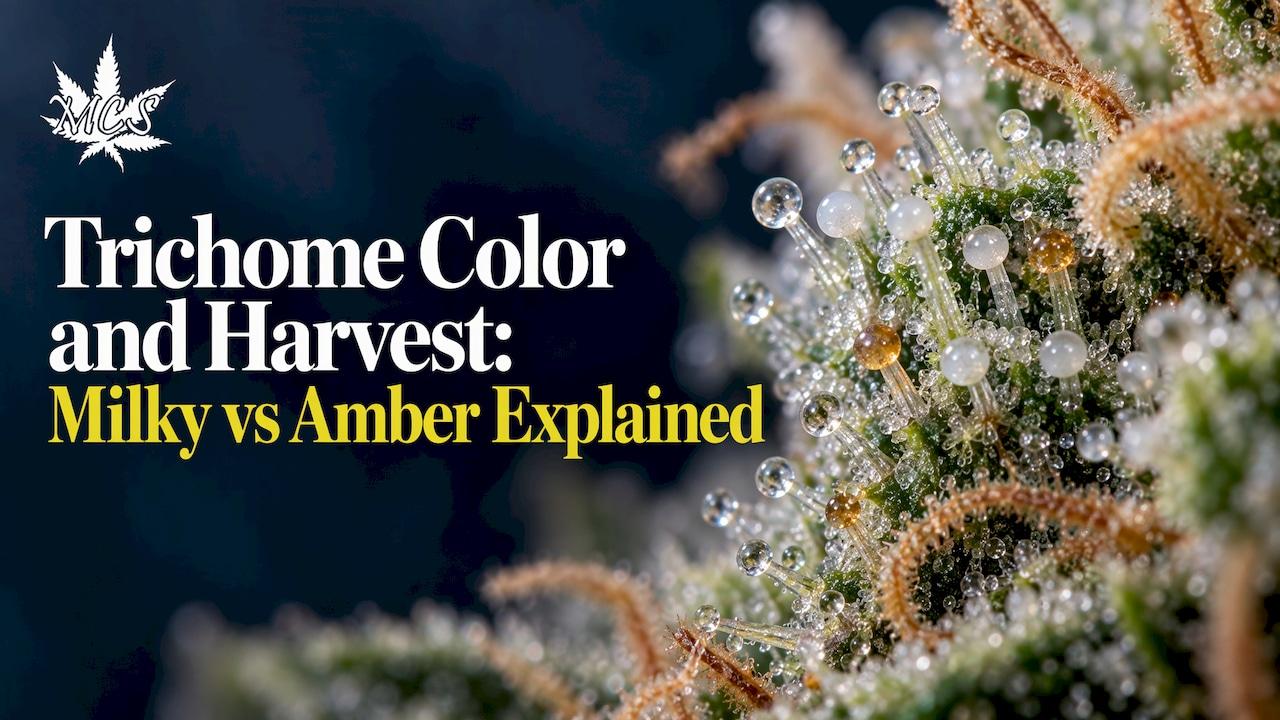
Trichome color is the most practical signal for timing a cannabis harvest: clear heads are unfinished, milky heads mark the point of peak ripeness, and amber heads show that the resin has begun to age. Reading those colors with a magnifier, on the right part of the plant, lets a grower choose a harvest day deliberately instead of trusting a calendar. For growers starting from quality, climate-suited genetics, such as the feminized and autoflower lines in the Montreal Cannabis Seeds catalog, that skill is what turns a good seed into a good harvest.
TL;DR
- Trichomes are the resin glands on flowers. Their heads shift from clear, to cloudy (milky white), to amber as the plant matures.
- Most guides target mostly milky heads with a small share of amber for balanced potency; more amber gives a heavier, more sedating effect.
- Check the calyxes on the buds, not the sugar leaves, at 30x to 60x magnification, and sample top, middle and lower buds.
- Trichome color is a proxy for maturity, not a lab result, and strain, light and outdoor conditions all shift the timing.
- Breeder flowering times are a guide for when to start looking; the trichomes decide the day.
Table of Contents
- What trichomes are and why their color changes
- Clear, milky and amber: what each stage means
- Milky vs amber: choosing a harvest window
- How to inspect trichomes correctly
- Timing: when to begin looking
- Why color is a proxy, not a measurement
- Strain, light and outdoor conditions
- Common mistakes when reading trichomes
- Our perspective
- Choosing seeds with the harvest in mind
- FAQ
- Sources
What trichomes are and why their color changes
Trichomes are tiny, glandular structures that cover flowers and nearby leaves. The mushroom-shaped ones that matter for harvest are the capitate-stalked trichomes: a thin stalk topped by a rounded head where cannabinoids such as THC and CBD, along with aromatic terpenes, are produced and stored. The head is what the grower inspects.
As the flower matures, the head changes appearance. The University of Saskatchewan's harvest-timing guide notes that capitate-stalked heads move from clear to cloudy to amber orange, and that studies show peak cannabinoid content coincides with mostly cloudy trichomes. A 2023 Canadian study of licensed plants measured the same progression with color analysis: translucency dropped and a red or brown score rose between weeks 3 and 7 of flowering, with many heads visibly brown by week 8.
The same study found that the number of trichomes and how quickly they mature depend on genotype and plant age. That is the first reason a single universal date does not exist.
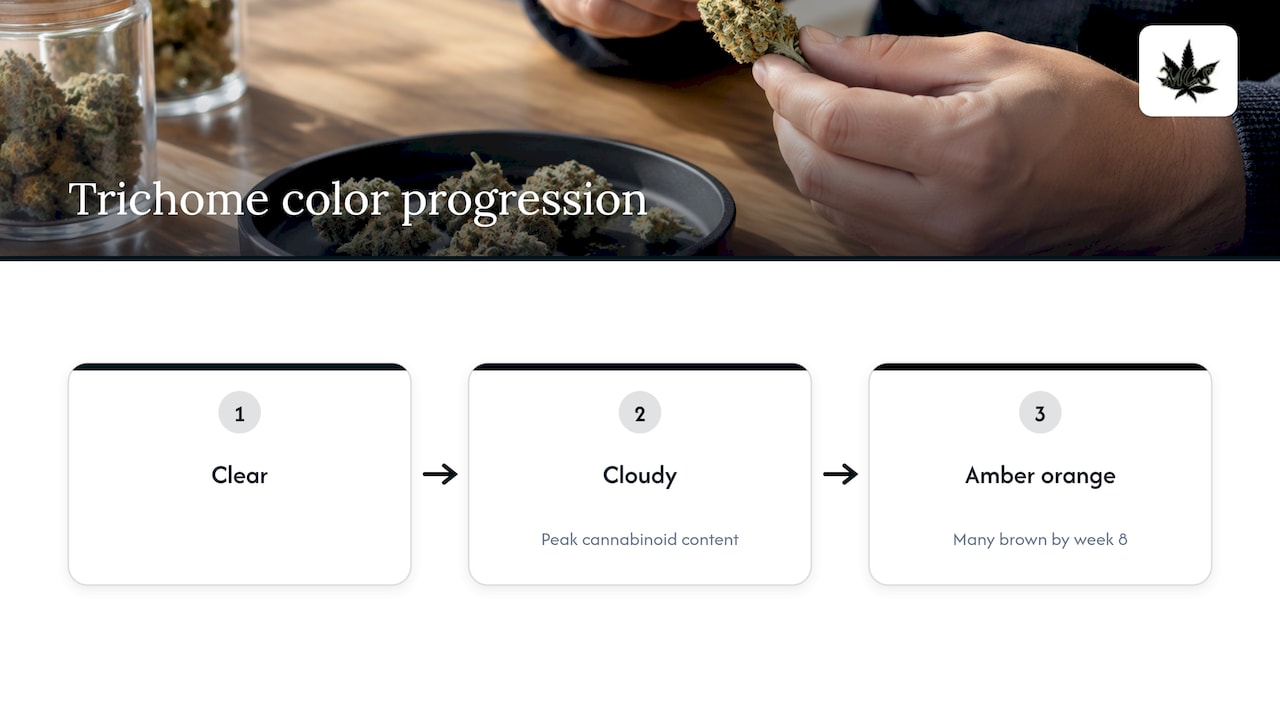
Clear, milky and amber: what each stage means
Clear trichomes
Clear heads look glassy and transparent. Cannabinoid and terpene production is still under way, so a plant cut at this stage is typically lower in potency and flavor. Herb.co's trichome guide describes it as interrupting the chemistry before it finished. Clear heads are normal through the early and middle weeks of flowering and mean the plant needs more time.
Milky (cloudy) trichomes
Milky heads turn opaque white, like frosted glass. This is the stage most associated with peak THC and with a clear, cerebral, more energetic effect. Leafly Canada's harvest guide describes ripe trichomes as sticky and milky white, and advises looking for that color before cutting.
Amber trichomes
Amber heads take on a golden to orange tone. According to Technology Networks, as trichomes turn amber the glands produce slightly less THC while holding more CBN, a cannabinoid that forms as older THC degrades. In practice, a higher amber share is associated with a heavier, more body-centered and sedating effect.
A fourth stage exists beyond amber: dark, shriveled, collapsed heads that signal the resin is deteriorating. Reaching it means harvest is overdue.
Milky vs amber: choosing a harvest window
The question most growers face is not whether to harvest at milky or amber, but how much amber to allow. Published ratios differ slightly between sources, which reflects preference rather than disagreement about the biology. The table collects ranges reported in the research.
| Target | Approximate trichome mix | Typical effect described |
|---|---|---|
| Energetic, clear-headed | Mostly milky, little or no amber | Cerebral, daytime-style |
| Balanced | Mostly milky with roughly 10 to 20% amber (per Herb.co) | Mix of head and body effect |
| Heavier, evening-style | About 30 to 50% amber (per Herb.co) | Pronounced body effect, suited to sleep or pain relief |
| Overripe | Above 50% amber | Heavily relaxing, creeping toward degraded resin |
Other guides place the balanced mark lower, at roughly 5 to 15% amber, and the Ed Rosenthal guide calls mostly milky with a small amber share the usual standard. Practically, a grower new to this can start with mostly milky and a few amber heads, then adjust the next run toward more or less amber after tasting the result.
Two further points help with the decision:
- Oxidation continues after the cut. Resin keeps aging during drying, so a harvest with some amber will finish with slightly more amber character than the last loupe reading suggested. Cutting a touch earlier than the desired final profile is reasonable.
- Indica and sativa tendencies. Technology Networks notes that some cultivators harvest indica-type plants while trichomes are milky but before any turn amber, and wait for around 30% amber on sativas or hybrids. For the differences between those types, see our guide to sativa, indica and hybrid cannabis.
How to inspect trichomes correctly
Color reading goes wrong far more often because of how the plant is inspected than because of the ratios. A reliable routine looks like this.
- Get proper magnification. Naked eyes cannot judge head color. The University of Saskatchewan recommends a hand lens or jeweler's loupe of at least 16x, or a digital USB microscope. Many growers use 30x to 60x, which shows the head clearly, and a phone macro lens can also work.
- Look at the buds, not the sugar leaves. Sugar leaves are the small leaves poking out of the flowers. Ed Rosenthal's guide advises inspecting the buds themselves and the heads of the glands, since leaf trichomes can look further along than the flower.
- Sample several sites. Tops ripen before lower branches. A McGill University master's thesis on cultivars grown commercially in Québec found that on one cultivar over half the trichomes on the bottom inflorescence were still transparent at harvest, while the rest of the plant had over 65% milky-white trichomes. The top of that plant already showed a slight rise in amber. Checking a top cola, a middle bud and a lower bud gives a fairer average.
- Use neutral light. Colored grow-light spectra can distort what is seen. Natural or white light gives a truer color, a point also made in Rosenthal's guide.
- Estimate in rough proportions. Counting individual heads is unnecessary. Judging in thirds or in tens of percent is accurate enough for a decision.
- Repeat, and note dates. Start checking when the plant approaches the end of the breeder's stated flowering time, then look every day or two. Photographs taken at the same magnification make changes easier to compare.
Timing: when to begin looking
The University of Saskatchewan states that most cannabis varieties are ready 8 to 10 weeks after flowering begins. Counting starts when photoperiod plants are switched to a 12-hour light, 12-hour dark cycle, or when pre-flowering turns to visible flower. Autoflowers follow a different clock, covered in our guide on when to harvest autoflower. For a complete view of how the weeks fit together from germination, the seed to harvest timeline for cannabis in Canada is a useful map.
The McGill thesis illustrates how cultivar-specific the clock is. One cultivar was harvested at 59 days of flowering with few trichomes senescing, another at 63 days with few amber bulbs, and a third began turning amber in small numbers at 57 days, with obvious changes between days 61 and 63. Breeder-stated flowering times are therefore the cue to begin checking, not the date to cut.
The peak itself is short. The Saskatchewan guide describes roughly a five-day window of peak ripeness before trichomes degrade and cannabinoid levels begin to fall. That is why daily checks near the end are worth the effort.
Why color is a proxy, not a measurement
The McGill study is a useful reminder of what trichome color can and cannot say. The shift from transparent to opaque milky white was a consistent sign of an aging plant, but THC content did not show a statistically significant trend across the three cultivars studied. Visual analysis therefore indicates maturity, not an exact cannabinoid level.
That does not make the loupe less useful. It means the decision should combine several signs: trichome color across the plant, the state of the pistils (the small hair-like strands, which darken and curl back as the flower ripens), bud swelling and the strain's expected timing. For anyone who wants to know what the finished flower really contains, laboratory results are the only measure, and a short explanation of why a single percentage can mislead is available in this piece on total THC and lab testing.
Strain, light and outdoor conditions
Genetics matter. A 2023 study in the Journal of Cannabis Research, using plants grown under Health Canada licence, found significantly more capitate trichomes and longer stalks in the Space Queen genotype than in Moby Dick at 3 and 6 weeks of development. Two strains under the same lamp can therefore look very different on the same day.
Environment matters as well:
- Outdoors in Canada. The University of Saskatchewan notes that outdoor plants tend to show amber earlier than indoor ones because of harsher conditions, so bud swelling and general senescence may be better maturity signals than resin color alone. Exposed trichomes degrade faster, which is another reason to average readings across the plant. Leafly's season guide adds that a strain starting to flower in early July in California or Colorado should not flower until August in Canada, and that late harvests face rising risks from mold, mildew, frost and storms.
- Indoors. Weak light, cold nights, stress or deficiencies can slow ripening, so a plant may finish one to two weeks later than the sheet suggests.
- Accidental early bloom. Plants that start flowering ahead of schedule shift the whole calendar; the causes are explained in our post on why a cannabis plant flowers too soon.
Growers choosing genetics for a short northern season often start with faster-finishing lines. Our autoflower seeds and fast version seeds are the categories built around quicker harvests.
Common mistakes when reading trichomes
- Judging by sugar leaves. Their resin ages earlier than the flower and tends to cause an early harvest.
- Checking only the top cola. The top is the first part to ripen, so it gives the most optimistic reading.
- Reading under colored light. Colors shift, and amber can be misjudged.
- Harvesting on a date. A strain sheet is a plan; trichomes are the evidence.
- Waiting for "just a bit more." With a window of about five days at peak, delay quietly converts potency into CBN.
- Ignoring the plan for use. A grower who wants a daytime flower and one who wants a night-time flower should cut at different amber ratios.
Our perspective
Across the Canadian growers we hear from, the most common harvest regret is cutting by the calendar. A seed carries a flowering range, and the room, the season and the phenotype decide where inside that range the plant lands.
That is why we describe each strain with its expected flowering time and grow notes, and why we pair our catalog with cultivation guides. Genetics that suit Canadian conditions finish more predictably, which gives a grower a clearer harvest window to read with a loupe.
Our germination guarantee and our support team exist so that the part of the job a grower cannot control, the seed, is settled early. The trichomes, and the choice between milky and amber, then become a matter of the effect the grower wants.
Dino Grow Master
Choosing seeds with the harvest in mind
Harvest quality starts at the seed. Our feminized seeds produce female plants, so every plant in the tent or garden builds resin worth inspecting. Growers who want a clear idea of flowering behaviour before buying can read a strain page such as the Black Gold photoperiod grow guide, which lays out flowering time, yield and tips. For medicinal growers, the CBD seeds range offers CBD-focused genetics in feminized and autoflower options.
Montreal Cannabis Seeds ships discreetly and quickly across Canada, and the catalog also includes our Quebec line, mix packs, outdoor genetics and regular seeds.
Browse the full range on the Montreal Cannabis Seeds homepage and pick the genetics that match your space and season.
FAQ
Should cannabis be harvested at milky or amber trichomes?
Milky trichomes mark peak ripeness and a more energetic, cerebral effect. A small share of amber is the usual balanced target, and a larger share, around 30 to 50%, leans toward a heavier, sedating effect. The choice depends on the effect wanted.
What happens if cannabis is harvested while trichomes are still clear?
Clear heads mean the plant is still building THC and terpenes. Flower cut at that point tends to be less potent and have less developed flavor, so the better move is to wait for the heads to cloud over.
What magnification is needed to see trichome color?
A loupe of at least 16x is the minimum named by the University of Saskatchewan, and many growers use 30x to 60x. A digital USB microscope or a phone macro lens is a convenient alternative, and photos let you compare readings from day to day.
Do all strains turn amber at the same time?
No. Research on licensed Canadian plants found that trichome development and maturation vary with genotype and plant age. Outdoor plants also tend to show amber earlier than indoor plants, so readings should be taken on the actual plants and several buds.
Sources
- Harvest Timing, University of Saskatchewan Gardening
- Glandular trichome development, morphology, and maturation (Journal of Cannabis Research, 2023)
- Monitoring of trichome morphology and THC content of 3 cultivars (McGill University thesis, 2024)
- Trichome Stages: How to Read Trichomes (Herb.co)
- When & How to Harvest Marijuana (Leafly Canada)
- What Are Cannabis Trichomes? (Technology Networks)
- Judging Cannabis Ripeness by Trichomes (Ed Rosenthal)
- When Is Your Cannabis in Season? (Leafly)