
A cannabis plant takes roughly 10 to 32 weeks to go from seed to harvest, and the gap between those numbers comes almost entirely from two choices: the type of seed and how long the plant is kept in vegetative growth. Leafly puts the full range at 10–32 weeks, while many autoflowering plants are ready in 70–90 days according to the University of Saskatchewan. For Canadian growers, where the outdoor season is short, choosing genetics with a predictable schedule is the first step in the timeline, and it is the reason our catalog is built around autoflower seeds and fast version photoperiod seeds as well as classic feminized lines.
TL;DR
- Total time from seed to harvest runs from about 10 to 32 weeks, depending on genetics, light schedule and how long the plant vegetates.
- Autoflowers commonly finish in 70 to 90 days; photoperiod plants need at least 8 weeks of flowering after the light is switched to 12 hours of darkness.
- Indoors, the grower controls the calendar. Outdoors in Canada, daylight and frost set it.
- Harvest is judged by the plant, not the calendar: trichome color, pistil color and swelling flowers are the signs to watch.
- Adult home cultivation is capped at four plants per household under federal rules, and provinces add their own conditions.
Table of Contents
- The four stages that make up the timeline
- Germination: days 1 to 7
- Seedling stage: weeks 1 to 3
- Vegetative growth: the stage that sets the calendar
- Flowering: weeks 8 to 10 for most varieties
- Autoflower timeline: 70 to 90 days
- Indoor and outdoor timelines in Canada
- Knowing when the plant is actually ready
- Planning a first grow around the timeline
- Our perspective
- Choose seeds that fit your calendar
- FAQ
- Sources
The four stages that make up the timeline
Every cannabis plant passes through the same sequence: germination, seedling, vegetative growth and flowering. The stages are fixed in order, but only some of them are fixed in length. Germination and flowering are fairly predictable for a given variety. The seedling stage is short and steady. Vegetative growth is where the schedule stretches or shrinks, and Leafly identifies it as the stage with the greatest variability in total grow time.
The table below combines the figures published by the University of Saskatchewan and by Cannabis Business News into a working range.
| Stage | Typical length | What happens |
|---|---|---|
| Germination | 2 to 7 days | The seed splits and a taproot emerges |
| Seedling | 2 to 3 weeks | First sets of true leaves and a small root system develop |
| Vegetative | 3 to 4 weeks indoors for photoperiod plants; 3 to 5 weeks for autoflowers | Stems, branches and leaves build the frame that will carry the flowers |
| Flowering | 8 to 10 weeks for most commercial varieties | Buds form, swell and ripen |
Add these up and a photoperiod plant on a compact schedule lands near 15 to 18 weeks, while a plant allowed a long vegetative period can take much longer. The sections below take each stage in turn.
Germination: days 1 to 7
The University of Saskatchewan states that healthy, viable seeds planted about 1 cm deep in growing media usually germinate within 2 to 7 days. Sources differ slightly at the edges, with Leafly allowing up to 10 days, so a seed that has not surfaced by day four is not yet a cause for concern.
Two things determine whether the seed stays within that window: freshness and storage. Seeds kept cool and dry hold their germination rate far longer. Research by Agriculture and Agri-Food Canada scientists found that seed at 11% moisture stored at 20°C lost all germinability in under 18 months, while 6% moisture or storage at 5°C preserved it for 66 months. Our guide to keeping cannabis seeds fresh covers the practical side, and our germination guarantee exists so that a first-time grower is not left with a stalled start.
Seedling stage: weeks 1 to 3
Once the seed has sprouted, the plant spends about three weeks as a seedling. Master Gardeners of Ontario give 2 to 3 weeks on average from seed to established seedling. Growth looks slow because the energy goes below the surface into roots. A plant that seems to be doing little in week two is usually building the foundation for the vegetative surge that follows.
This stage is the same for autoflowers and photoperiod plants, which is why the two types only diverge once vegetative growth begins.
Vegetative growth: the stage that sets the calendar
In vegetative growth the plant adds stems, nodes and leaf area. The University of Saskatchewan reports that indoor growers typically keep photoperiod plants in vegetative growth for 3 to 4 weeks, while autoflowers usually vegetate for three to five weeks.
The reason the two differ is the light trigger. A photoperiod plant stays vegetative for as long as it receives long days, then begins flowering when it gets about 12 hours of uninterrupted darkness. Indoors, that means moving from an 18/6 schedule (18 hours of light, 6 of dark) to 12/12. Master Gardeners of Ontario note that indoors the vegetative stage can last as long as the grower wants. Leafly describes the trade-off: switching early gives smaller plants and more harvests per year, switching late gives larger plants and fewer harvests, with roughly similar total yield over time.
An autoflower follows its own internal clock and begins flowering by age rather than by light cycle. Our explanation of what autoflower means goes deeper, and the autoflower light schedule guide compares 18/6, 20/4 and 24/0.
Flowering: weeks 8 to 10 for most varieties
Flowering is the longest fixed block in the timeline. Most commercially available varieties finish in 8 to 10 weeks, according to the University of Saskatchewan, with indica-type plants maturing in as little as 7 to 8 weeks and long-flowering sativa-types needing 20 weeks or more. The same source divides flowering into two parts:
- Early flowering: about 3 weeks for most common varieties, as the plant stretches and the first flower sites appear. Some sativas need 6 weeks or more.
- Late flowering: about 4 to 6 weeks for most common varieties, as flowers swell and ripen. Exotic sativas can take more than 10 weeks.
This is why the flowering time listed on a seed pack deserves attention. A strain that flowers in 8 weeks and one that flowers in 14 differ by more than a month before a single day of drying has begun. Our fast version seeds are photoperiod genetics selected for quicker harvests, which shortens this block.
Autoflower timeline: 70 to 90 days
Because an autoflower skips the light trigger, its schedule is compact. The University of Saskatchewan notes that many autoflowering plants are ready to harvest in 70 to 90 days. A typical sequence looks like this:
| Week | Autoflower stage |
|---|---|
| 1 | Germination and emergence |
| 2 to 3 | Seedling |
| 3 to 7 | Vegetative growth |
| 5 to 8 | Flowers begin to form |
| 8 to 12 | Flower swelling and ripening |
| 10 to 13 | Harvest window |
This is an illustrative layout built from the 70 to 90 day range, and individual varieties vary by a week or two either way. For growers asking how long autoflowers take, the practical answer is about 10 to 13 weeks from sprouting, against 15 to 20 or more for photoperiod plants on a standard schedule. Our post on why many growers choose autoflowers lays out the reasons, and the autoflower vs. feminized comparison looks at cost per square foot for Canadian growers.
Indoor and outdoor timelines in Canada
Indoors, every date is a decision. Light hours, temperature and the moment of the 12/12 switch are controlled, so a grower can plan back from a target harvest date. Cannabis Business News notes that indoor cultivation offers more timeline control than outdoor growing.
Outdoors, the sun makes the decisions. Leafly Canada says outdoor growers in the Northern Hemisphere usually germinate seeds by the end of April, have plants in the ground by the end of June, and harvest between September and November depending on local climate.
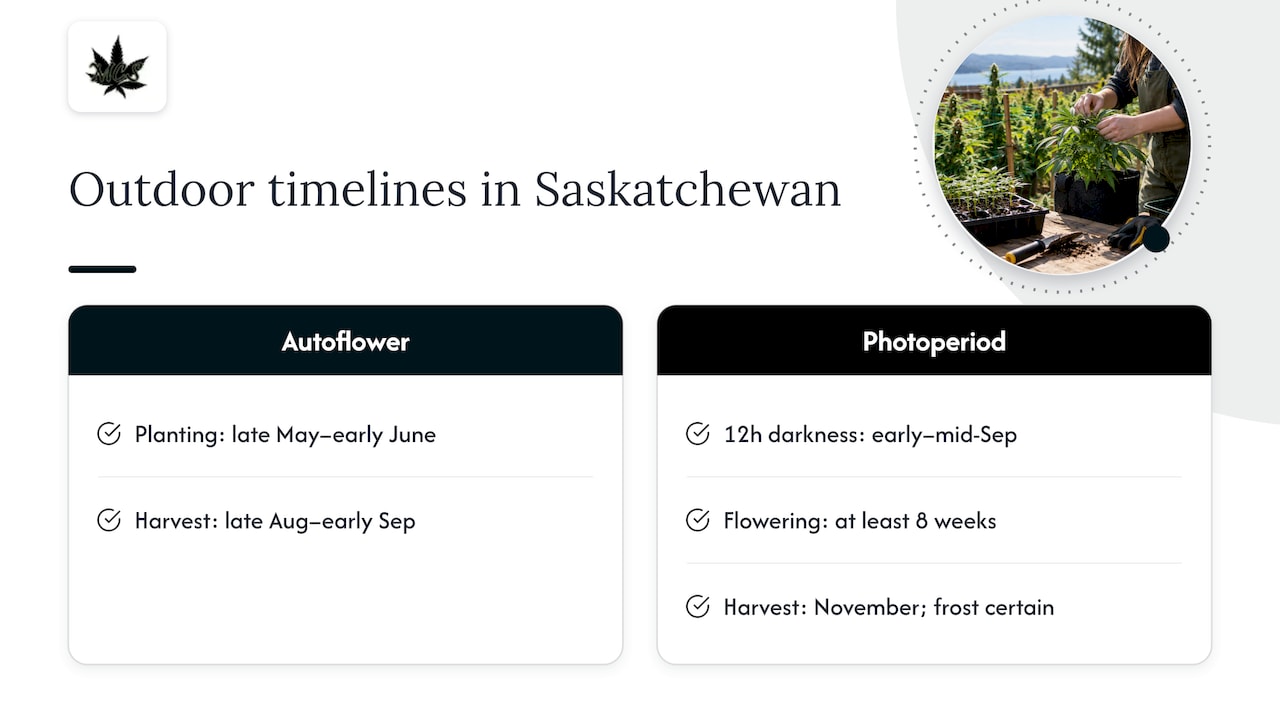
The Prairies show the constraint clearly. In Saskatchewan, according to the University of Saskatchewan, photoperiod plants only receive the required 12 hours of darkness around early to mid-September. With at least 8 weeks of flowering still needed, harvest would fall in November, when frost is certain. The same guide recommends planting autoflowers in late May to early June, for a harvest in late August to early September.
A simple way to use this: count backward from the first expected frost in your area. Subtract the flowering time listed for the variety, then the vegetative period, then three weeks for seedling and germination. If the resulting planting date is already behind you, the variety is too slow for the site. Our outdoor and early-finishing genetics are chosen with that arithmetic in mind.
Knowing when the plant is actually ready
The calendar gives an estimate, and the plant gives the answer. The University of Saskatchewan advises harvesting at peak weight, trichome density and cannabinoid maturity, and notes that in the last couple of weeks new flower growth slows while existing flowers swell. Trichomes are the tiny resin glands covering the buds, and they are the most reliable indicator.
With a jeweler's loupe or small magnifier, check for these signs:
- Trichomes: the Hawaii Department of Health's registry newsletter describes the best harvest time as when trichomes shift from clear to milky white with some amber.
- Pistils: the small hairs change from white to reddish-orange.
- Leaves: sugar leaves begin to yellow and wilt, and water uptake slows, as the University of Saskatchewan also observes.
For plants with a short schedule, the post on when to harvest autoflowers shows what ripeness looks like in practice. Harvest is not the end of the timeline either: drying and curing add further weeks before the flower is ready to use, and some growers then explore finished products such as cannabis chili lime peanuts to see what the end of a cannabis process can look like.
Planning a first grow around the timeline
For a first-time grower, three decisions fix most of the schedule:
- Seed type. Autoflowers give the shortest and most predictable calendar. Feminized photoperiod seeds give control over plant size. Fast versions sit in between.
- Setting. Indoors allows year-round planning; outdoors, the planting date must be matched to local frost.
- Variety. Read the flowering time on the product page before ordering, since it is the largest fixed block in the timeline.
A legal point belongs in the plan as well. Under federal rules, adults growing for non-medical purposes may grow a maximum of four plants per household, not per person. Provinces and territories add their own conditions, so confirm the rules where you live before planting. Medical patients with a registration or authorization follow their own limits.
Our perspective
Most timeline questions we hear come down to one worry: will this plant finish before the weather turns? That is a seed selection question long before it is a lighting or feeding question.
Canadian growers work with a short outdoor season and, indoors, with a spare room or a tent where every week has a cost. We curate the catalog around that reality. Autoflowers give a harvest in about 70 to 90 days, fast version photoperiod genetics shorten flowering, and feminized lines suit growers who want to control the size of each plant.
Our product pages carry detailed information on each strain so the flowering time is visible before you buy, and our germination guarantee and support team are there so the first week of the timeline goes as planned. A schedule is only as reliable as the seed it starts with.
Dino Grow Master
Choose seeds that fit your calendar
Once the planting window is clear, the next step is matching genetics to it. Our autoflower seeds suit short outdoor seasons and compact indoor schedules, feminized seeds suit growers who plan longer vegetative periods, and every order ships quickly and discreetly across Canada.
You can browse the full range, including the Quebec line, mix packs and outdoor genetics, on the Montreal Cannabis Seeds home page.
FAQ
How long does cannabis take to grow from seed to harvest?
About 10 to 32 weeks, according to Leafly. Most of the difference comes from vegetative growth and flowering time. A compact photoperiod grow commonly lands in the range of 15 to 20 weeks, and autoflowers are usually shorter.
How long do autoflowers take?
Many autoflowering plants are ready in 70 to 90 days, which is roughly 10 to 13 weeks from germination. The exact length depends on the variety, so check the listed flowering time before choosing.
When should autoflowers be planted outdoors in Canada?
The University of Saskatchewan recommends late May to early June for its short growing season, giving a harvest from late August to early September. Milder regions allow more flexibility, but the principle is the same: finish before frost.
How can I tell the harvest is close?
Look at the trichomes with a loupe. When most have turned from clear to milky white with some amber, and the pistils have darkened, the plant is near its peak. Slowing water uptake and yellowing sugar leaves point the same way.
Sources
- 4 Stages of Marijuana Plant Growth, Leafly
- 4 Stages of Marijuana Plant Growth, Leafly Canada
- How to Grow Marijuana Indoors, Leafly
- How Long Does It Take to Grow Cannabis From Seed to Harvest?, Cannabis Business News
- Cannabis, Gardening at USask
- Vegetative Growth, Gardening at USask
- Flowering, Gardening at USask
- Cannabis fact sheet, Master Gardeners of Ontario
- Temperature and moisture content for storage of cannabis seed, Journal of Natural Fibers
- OMCCR November 2024 Newsletter, Hawaii Department of Health
- Growing cannabis at home safely, Health Canada