
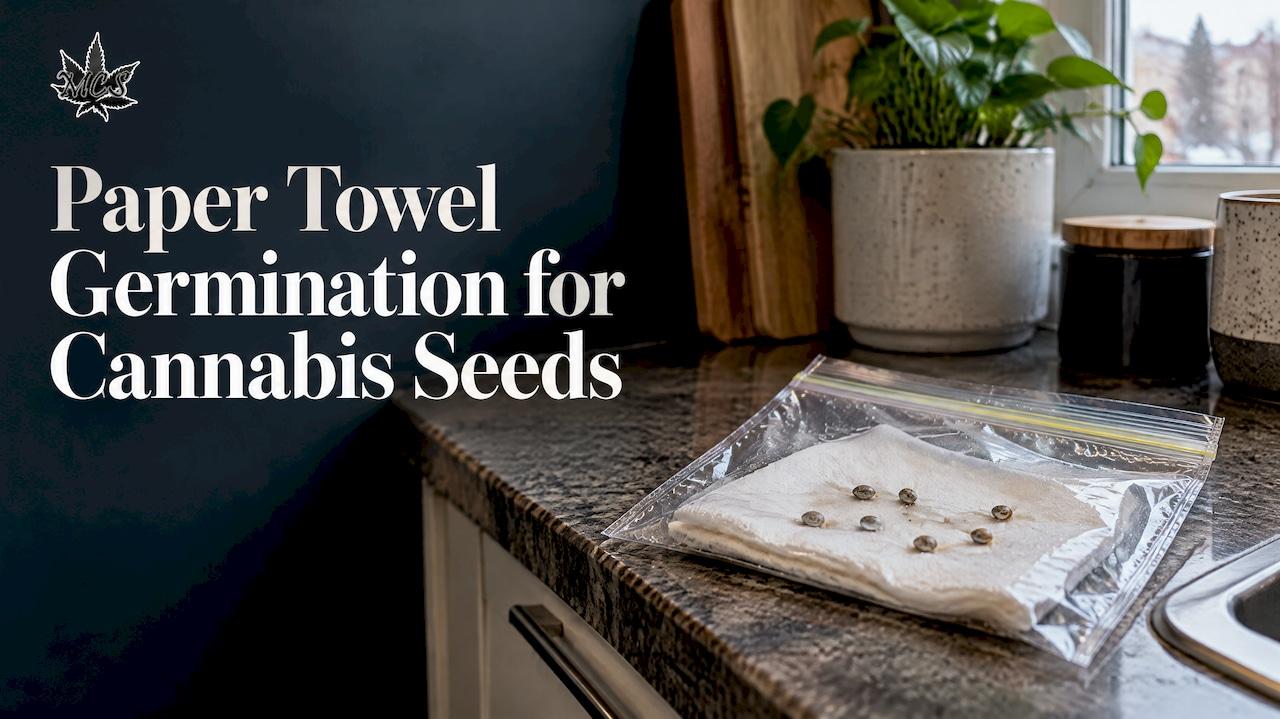
Paper towel germination works for cannabis seeds, and it is best understood as a way to watch a seed wake up before it goes into soil. Seeds sit between folded, damp (never soaked) paper towels in a warm, dark, enclosed space, and viable seeds split and send out a white taproot within a day or two, according to the University of Saskatchewan's cannabis germination guide. The method gives you control over moisture, warmth and air, and it shows you which seeds are alive before you commit a pot, a tray or a place under the lights. This guide focuses on the details that decide success: how damp is damp, how to read the results, and how to move a sprouted seed without breaking it.
TL;DR
- Keep the towel damp, not wet: if water pools at the bottom of the container, it is too wet and the seed can rot.
- Use a sealed bag or two plates in a warm, dark spot, and check daily so the towel never dries out.
- Many viable seeds show a taproot in one to two days. Move them to medium as soon as the root is visible, using tweezers and a gentle touch.
- Soak for 12 to 16 hours at most before the towel stage, and never beyond 24 hours.
- If a seed does not sprout, that is useful information about the seed or the conditions: check temperature and dampness first.
Table of Contents
- Why growers use a paper towel
- What you need
- Step-by-step paper towel germination
- How damp is damp: a quick reference
- Reading your results
- Moving a sprouted seed to growing medium
- When the shell stays on the seedling
- Common mistakes, and the fix
- Our perspective
- Start with seeds chosen for Canada
- FAQ
- Sources
Why growers use a paper towel
In soil, germination is invisible. The root emerges first and stays hidden until the seed leaves push through the surface, so a grower waits days without knowing whether anything is happening. Elizabeth Spence of North Shore Gardening Life makes this point: the towel method lets you see the radicle emerge, and it puts moisture, warmth and oxygen, the three things every seed needs, under your direct control.
The University of Saskatchewan's Chase Boucher describes the method as a viability check, comparable to a baker proofing yeast before using it. A seed that fails to sprout in a towel has cost a few days. A seed that fails in soil can cost a week or more of waiting and a spot in the tent.
That makes the towel especially useful in three situations:
- Older seeds. Seeds kept for a season or more may have lost vigor. If yours have been stored a while, our guide to keeping cannabis seeds fresh explains the conditions that preserve them.
- Small, valuable batches. When you have only a few seeds of a strain you care about, seeing each one sprout before planting removes guesswork.
- First grows. Beginners learn what a healthy taproot looks like, and what damp actually feels like, in a setting where mistakes are cheap.
The store blog already covers general germination in depth, including soil and other approaches, in How to Germinate Cannabis Seeds: A Canadian Guide. This article stays narrower: the towel itself.
One note on rules before you start. Home cultivation is regulated differently from province to province in Canada, so confirm what applies where you live before germinating anything.
What you need
The kit is simple, and the quality of each item matters more than the quantity.
- Plain paper towels. Choose unscented, undyed sheets. Fragrances and dyes are not something a new root should sit in. Thicker towels hold moisture longer and are less likely to dry out overnight.
- Clean water. Room temperature, so you do not chill the seeds. Use a spray bottle if you have one: it moistens evenly and is easy to correct.
- A container. A resealable plastic bag, a lidded food container or two dinner plates (one inverted over the other) all work. The University of Saskatchewan lists each of these options.
- Clean tweezers. Fingers carry oils and press too hard. Tweezers let you lift a sprouted seed by its shell.
- A warm, dark, draft-free place. The top of a refrigerator, a shelf near (not on) a heat source or a cupboard works. The University of Manitoba's botanical garden advises keeping the container away from drafts, because cold air pulls heat and moisture out.
- A marker and labels. If you are germinating more than one strain, write the name on the bag or on a corner of the towel before the seeds go in.
Wash your hands and wipe the plates or container first. Damp, warm conditions are ideal for germination and just as good for mold.
Step-by-step paper towel germination
1. Soak the seeds briefly (optional)
The University of Saskatchewan's guide recommends soaking seeds for 12 to 16 hours, and says never longer than 24 hours, since extended soaking can damage the seedling. A glass of room-temperature water is enough. Seeds that sink are taking up water; some float for hours, and a gentle stir or tap usually settles them. Do not leave a glass sitting for a day "just in case": the 24-hour limit is a ceiling, not a target.

If you skip the soak, the towel alone still works. It simply asks the seed coat to take up water more slowly.
2. Dampen the towel
Fold a paper towel and moisten it until it is evenly damp, then squeeze or blot away anything beyond that. The University of Saskatchewan's germination test guide calls for a towel that is moist but not soppy. North Shore Gardening Life suggests wringing out a towel that is dripping.
The reason is physiological. The University of Saskatchewan's germination tips explain that moisture opens the seed coat and releases dormancy, but a saturated environment can suffocate a seed or invite damping-off, a fungal rot that kills seeds and seedlings. A quick check: press a dry fingertip on the towel. It should feel cool and damp, and no water should film on your skin.
3. Place the seeds
Lay the seeds on one half of the towel with space between them, then fold the other half over. Spacing matters because roots grow quickly and tangle. Space also lets you lift each seed individually later. Labeling each position is smart if you are growing more than one strain.
Do not press the seed into the fabric. Resting it lightly is enough, and a pointed end facing sideways is fine; the root finds its own way.
4. Enclose and keep warm
Slide the folded towel into a bag, partly sealed so a little air can move, or sandwich it between two plates. For temperature, The Province's gardening columnist Helen Chesnut suggests a warm spot at around 21 °C. Cannabis seeds are often kept slightly warmer, and our guide to germination temperature for cannabis in Canada goes into the range in detail. The point for towel work is stability: a steady temperature beats a spot that swings between warm days and chilly nights.
Keep the container in the dark. Roots do not need light, and the University of Saskatchewan recommends a dark environment at this stage.
5. Check every day
Open the bag once a day and look at the towel and the seeds. You are checking two things: the towel is still damp, and nothing has gone moldy. Mist lightly if it is drying. If you see standing water at the bottom, pour it off and blot the towel. North Shore Gardening Life suggests misting every couple of days when the paper starts to dry, and daily checks are the safer habit for a beginner.
Resist the urge to unfold the towel ten times a day. Each opening lets heat and humidity escape.
6. Spot the taproot
After a day or two, viable seeds crack open and a pale taproot appears, according to the University of Saskatchewan. Other sources give a wider window for ordinary garden seeds: Garden Therapy says 3 to 10 days or as indicated for the variety. For cannabis, check the days-to-germinate figure published with your seeds and wait at least that long before deciding anything.
How damp is damp: a quick reference
Moisture is where most paper towel attempts go wrong, so it is worth a closer look.
| What you see | What it means | What to do |
|---|---|---|
| Towel feels cool, slightly damp, no water on a fingertip | Right range | Leave it |
| Towel pale, stiff or curling at the edges | Drying out | Mist lightly and reseal |
| Water beads on the bag or pools at the bottom | Too wet | Drain, blot, reduce moisture |
| Seed coat soft and dark, sour smell | Rot setting in | Remove that seed and replace the towel |
| Fuzzy white or green growth on the towel | Mold | Discard the towel, clean the container, start fresh |
One more principle from the University of Saskatchewan's team: repeated wet and dry cycles are poorly tolerated. It is better to keep moisture steady than to let a towel dry out and then soak it.
Reading your results
Timing and counts give you real information, provided you read them for what they are.
A seed that has not sprouted at day two is not dead. Some seeds need a few more days. Check the packet for the days-to-germination figure and use that as your benchmark, as the University of Saskatchewan advises.
Think in percentages. If you germinate several seeds, the share that sprouts shows how the batch is doing. For garden seeds, Helen Chesnut offers a simple rule from ten test seeds: fewer than five sprouting suggests buying new seeds, five to seven means seeding a little more thickly than usual, and above that you can sow as normal. Cannabis packs are usually small, so use this as a way of thinking rather than a strict cutoff.

Look at conditions first. When seeds do not sprout, the cause is more often a cold spot, a towel that dried out or a soaked towel than the seed itself. Our guide to what to do when seeds are not germinating walks through diagnosis in order.
Gardeners sometimes also remove seeds that have not sprouted after the stated window. If you want to run another round, use fresh towels and a clean container rather than recycling the old setup.
Moving a sprouted seed to growing medium
The taproot is delicate, and this is the moment where damage happens. The University of Saskatchewan's steps are clear:
- Lift the seed carefully with tweezers, holding the shell and never the root.
- Place it about 1 cm (roughly half an inch) deep in a pre-moistened medium, with the taproot pointing down.
- Cover lightly, and place it under low to moderate light.
- Keep the medium moist but not soaked until the seedling emerges.
Timing matters. North Shore Gardening Life advises moving the seedling once the radicle emerges and before much top growth appears, because a longer root in a towel is more likely to tangle in the paper. If a root has grown into the fibers, Garden Therapy suggests cutting the towel around the seed and planting it with the paper attached instead of pulling. A small square of towel rots away in damp medium far more safely than a torn root heals.
For the next stage, germinating seeds in soil covers medium and temperature, and cannabis seedling care covers the first weeks. If you want to see where those first weeks lead, a week-by-week growing timeline shows the stages from seedling through harvest.
When the shell stays on the seedling
Sometimes a seedling pushes up with the seed shell still clamped over its first leaves, often called helmet head or bucket head. It tends to happen when the shell dries or the seed was planted unevenly. North Shore Gardening Life's helmet head guide suggests matching the response to how stuck the shell is:
| Situation | Suggested response |
|---|---|
| Shell fresh, small and loose | Wait and let the seedling shed it |
| Shell stuck but not tight | Mist, wait a few hours, then use gentle tweezers |
| Shell tightly encasing the seed leaves | Re-cover with medium and mist for 6 to 24 hours |
| Still stuck after that | As a last resort, split it very gently with tools and moisture |
Most seedlings free themselves if the environment is humid enough, so patience is usually the first step.
Common mistakes, and the fix
- Too wet. Wring out the towel. Water standing in the container is the clearest sign.
- Too cold. A windowsill in a Canadian November can be well below germination range overnight. Choose an interior spot.
- Too long a soak. Stay under 24 hours.
- Leaving the sprout too long. A long root tangles in the fibers. Move it early.
- Handling with fingers. Use tweezers, and hold the shell.
- Light exposure. Keep the container dark until the seed is in medium.
- Unlabeled strains. Write names down before seeds go in.
Our perspective
Germination is the one stage where a grower sees exactly how a seed behaves, and a paper towel is the clearest window onto it. We build our catalog around Canadian conditions: a short outdoor season, cold shoulders on either side of summer and homes that swing from warm to chilly. Starting seeds in a controlled, damp, warm space suits that reality.
Our feminized, autoflower, fast-version and CBD genetics are chosen for growers who want dependable results, and we back our seeds with a germination guarantee. We pair that with detailed product information so a first-time grower knows what a strain needs before the seed ever touches a towel.
Our support team understands local growing conditions, and a question about damp towels, temperatures or a stuck shell is exactly what it is there for.
Dino Grow Master
Start with seeds chosen for Canada
A well-run towel gives any seed its best chance, and good genetics give the whole grow its best chance. Montreal Cannabis Seeds offers feminized seeds, autoflower seeds, fast versions and CBD seeds, with a germination guarantee, discreet shipping across Canada and detailed product information for each strain. You can browse the full range on the Montreal Cannabis Seeds store.

FAQ
Can I germinate cannabis seeds in a paper towel?
Yes. The University of Saskatchewan's cannabis guide presents the method as a common way to confirm seeds are viable before planting. Moisten folded towels, place the seeds between them in a sealed container or between two plates, and keep them warm and dark. Viable seeds typically sprout a taproot within a day or two.
How wet should the paper towel be?
Damp, never soaked. If water collects at the bottom of the container, the towel is too wet, and the extra water can suffocate seeds or encourage rot. The towel should feel cool and moist, and a fingertip pressed on it should come away dry.
When do I move the seed out of the paper towel?
Move it once the taproot is visible and before much top growth appears. Lift it with tweezers, set it about 1 cm deep in moist medium with the taproot pointing down, and cover it lightly. If the root has grown into the paper, cut around the seed and plant the paper with it.
How long should I wait for a seed to sprout?
Many viable seeds show a taproot in a day or two, but give them at least the days-to-germination figure published for the seed, checking daily. Cold or dry towels slow things down, so correct those before concluding a seed will not sprout.
Sources
- Germination, University of Saskatchewan Gardening
- Germination test, University of Saskatchewan Gardening
- Germination tips, University of Saskatchewan Gardening
- Propagating Seeds, University of Manitoba Botanical Garden guide
- Easy way to test if seeds are still viable, The Province
- Seed Germination: The Paper Towel Method, North Shore Gardening Life
- Helmet Head on Seedlings, North Shore Gardening Life
- How to Germinate Seeds, Garden Therapy
- THCA Flower Growing Timeline