
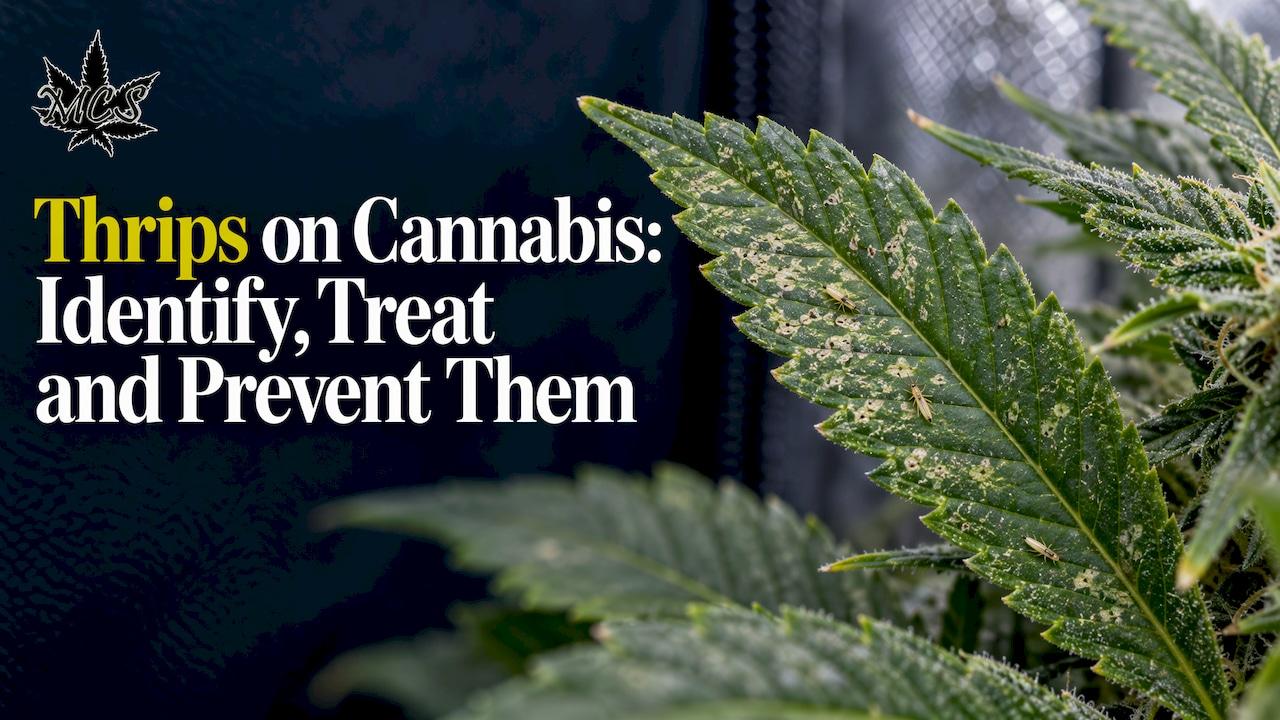
Thrips are slender insects about 1 to 1.5 mm long that scrape and suck the surface cells of cannabis leaves, leaving silvery patches and black specks, and they are far easier to prevent than to remove. The most reliable defence for a Canadian home grower is a clean start: seeds germinated in fresh medium, weekly inspection with a hand lens, and a response matched to the growth stage. That is the reasoning behind starting from feminized or autoflower seeds rather than bringing in outside plants that may already carry pests.
TL;DR
- Thrips feed by piercing leaf cells, which produces pale stippling, a silver sheen, black dots of excrement and distorted new growth.
- Confirm them before treating: use a hand lens, sticky traps and the tap-over-white-paper test, because mites and deficiencies can look similar.
- Prevention does most of the work: fresh potting mix, screened vents, a quarantine for any new plant and weekly checks.
- Biological controls need time to work, so they belong in the vegetative stage, not the last weeks of flower.
- In Canada, only use a product whose label lists the crop and pest, and follow that label exactly.
Table of Contents
- What thrips are and why they target cannabis
- What thrips damage looks like on cannabis leaves
- How to confirm and monitor thrips
- Prevention: the cheapest control
- Biological control: beneficial insects and mites
- Changing the approach from vegetative growth to flower
- Canadian label rules: what can be used
- Are thrips harmful to people?
- A worked example: a four-week routine
- Starting clean with seeds from Montreal Cannabis Seeds
- FAQ
- Sources
What thrips are and why they target cannabis
Thrips are tiny, slender-bodied insects. According to the British Columbia government's integrated pest management manual for commercial cannabis, adults are about 1 to 1.5 mm long with fringed wings, the larvae are wingless, and the eggs are laid inside plant tissue where they cannot be seen. Western flower thrips (Frankliniella occidentalis) are the species most often found in B.C. facilities.
Identifying the exact species is difficult even for professionals. Ontario's provincial guide to thrips in greenhouse crops notes that adults are generally yellowish-brown and that colour varies enough, and the insects are small enough, that telling western flower, eastern flower and onion thrips apart is hard. Colorado State University reports that onion thrips (Thrips tabaci) is the main confirmed thrips pest on indoor cannabis, while western flower thrips are common in greenhouse crops. For a home grower the species matters less than the life cycle: eggs in the leaf, larvae feeding on the surface, pupae in the growing medium, then flying adults that start the cycle again.
That last stage explains why thrips return after a spray. A treatment that reaches only the insects on the leaf misses the eggs inside the tissue and the pupae in the soil, which is why every reliable method repeats on a schedule rather than relying on one application.

What thrips damage looks like on cannabis leaves
Thrips have piercing and sucking mouthparts. They remove the contents of the outer leaf cells, and the emptied cells fill with air. The BC manual lists the resulting signs as pale stippling or flecking, black dots of excrement, a silver sheen on the leaf surface, and scarred or twisted leaves when feeding happens on young, tender growth.
Two details help with diagnosis:
- Scattered, irregular marks. A University of Guelph thesis on cannabis pest management notes that thrips feeding marks are more irregular and scattered than the small, circular marks of two-spotted spider mites, and that thrips leave dark spots of excrement on the plant.
- Location. University of Maryland Extension reports that thrips feed on young leaves, leaf margins, main veins and flower buds, and that heavy populations can cause deformed or discolored leaves, bud blast and reduced growth.
The damage is permanent. Scarred tissue does not heal, so the goal of treatment is to protect new growth, not to restore what is already marked.
Thrips or something else?
Silvery speckling is not exclusive to thrips. The table below sets out the most common confusions.
| Problem | What it looks like | Key difference |
|---|---|---|
| Thrips | Irregular silver or bronze patches, black dots, distorted new growth | Visible slender insects when a leaf is tapped over white paper |
| Spider mites | Fine, uniform yellow or white stippling, small circular marks | Fine webbing on leaf undersides in heavier infestations |
| Calcium deficiency | Even brown spots, often on new growth | No black specks and no insects |
| Aphids | Clustered soft-bodied insects, sticky residue | Insects visible without magnification |
For the look-alikes, the store guides on spider mites, aphids and calcium deficiency show what each one looks like in detail. The BC manual stresses that a pest must be correctly identified before a control is chosen, because a treatment aimed at the wrong problem wastes time while the real one spreads.
How to confirm and monitor thrips
The BC manual recommends three simple tools, all within reach of a home grower:
- A hand lens. A 10x to 20x lens shows larvae and adults on the underside of leaves and near new growth. The BC homegrown cannabis guidance describes thrips as slender insects whose colour can range from translucent through yellow-brown to black, so look for shape and movement, not one colour.
- Sticky traps. The BC manual says to monitor adults with yellow or blue sticky traps. Colorado State University advises blue traps over yellow for thrips. Koppert Canada suggests at least four yellow cards in a grow room, roughly one card per 20 to 40 square metres, which for a small tent means placing cards at canopy height and checking them weekly.
- The tap test. Hold a sheet of white paper under a branch and tap it. Thrips dislodge and show as small moving slivers.
Traps tell you adults are present, not how large the problem is, and the number caught is a trend to compare week to week. The BC manual recommends weekly inspection so that decisions are made on data rather than on the first visible damage. A short log of trap counts and leaf checks is enough.
Prevention: the cheapest control
Indoors, the natural enemies that keep thrips down outdoors are largely absent. Colorado State University entomologists observe that in indoor plantings thrips populations can build and persist, causing cumulative leaf scarring, which is why exclusion matters more indoors. The practical measures from the BC and Colorado guidance are:
- Do not reuse potting mix. Thrips pupate in the growing medium, so used mix can carry the next generation.
- Screen vents and intakes. The BC manual advises screening vents, and Colorado State recommends fine mesh.
- Inspect everything that enters the room. The BC manual lists inspection of incoming plant material as a core measure. Colorado State recommends quarantining new plants for one month.
- Break the cycle between crops. A host-free period of three to four weeks starves out the remaining thrips.
- Watch what comes in on clothing and cut flowers. Thrips are common on garden flowers and vegetables, so moving straight from the garden into the grow space carries them in.
This is where the starting material matters. A plant brought in from elsewhere needs a month of quarantine and close inspection, while a seed begins its life in fresh medium inside the grow space. For a first-time grower, beginning with seed removes one of the most common routes pests take into a room. The store's pest and deficiency guides gather the related pests in one place, and the guide to fungus gnats covers another pest that lives in the medium and shares several of the same preventive habits.
Biological control: beneficial insects and mites
The BC commercial manual describes a set of living controls, and the same logic works at home scale where suppliers sell small quantities:
- Predatory mites (Amblyseius cucumeris and A. swirskii) attack the larvae.
- Minute pirate bugs (Orius insidiosus) attack the adults.
- Soil predators and Steinernema feltiae nematode drenches target thrips that pupate in the soil.
- Lacewings feed on soft-bodied pests, including thrips.
- Beauveria bassiana, a fungus that infects insects, where a registered product is available. Colorado State notes that products of this type can give some control, and that high humidity matters for the fungus to work.
Timing decides whether this works. Koppert Canada points out that most beneficial products need a two to four week cutoff before harvest, so releasing predatory mites in week six of an eight-week flowering cycle leaves them almost no time to establish. The vegetative stage is the window to build a preventive population, before buds form and before any residue question arises.
Changing the approach from vegetative growth to flower
Vegetative stage
This is when the widest range of options is open. Establish predators early, inspect weekly, and treat the first sign of damage on new growth immediately. Thrips feed on the tender tips, so early catches protect the top of the plant, which will later carry the buds.
Flowering stage
Once flowers form, thrips hide in dense buds and anything sprayed can remain where the harvest will be. Several points follow from the guidance:
- Rely on measures already in place: predators released in vegetative growth, traps, and sanitation.
- Prefer products whose label specifically permits use on flowering cannabis. Health Canada's Pest Management Regulatory Agency (PMRA) concluded in its 2025 proposed re-evaluation that potassium salts of fatty acids, the active ingredient in insecticidal soaps, are registered for cannabis grown indoors in greenhouses or other enclosed structures, with application permitted in both vegetative and flowering stages. The PMRA reasoned that some of these fatty acids also occur naturally in cannabis. The same document proposes label updates, including personal protective equipment and restricted-entry interval statements.
- Keep the repeat schedule. Because eggs hatch after a treatment, one application is not enough; repeat applications a few days apart, as directed on the label, are what break the cycle.
Canadian label rules: what can be used
In Canada the label is the law. OMAFRA, the Ontario agriculture ministry, explains that a pest control product must be registered under the federal Pest Control Products Act, with Health Canada's PMRA doing the registering, and in Ontario also classified under the provincial Pesticides Act. The same page states that off-label use is prohibited and the most current label must be followed. A label names the crops and pests a product may be used on.
For a grower, that gives a simple rule: read the label of any product, including oils, soaps and biological products, and use it only if cannabis is listed as a crop and thrips (or a group that includes them) as a target. Home remedies and products sold for ornamental plants do not become permitted for cannabis because they are natural or familiar. Neem oil comes up in this question often: Colorado State notes that azadirachtin products can provide some control, but in Canada the deciding factor is whether the specific product in hand has a label that covers cannabis. Registrations and labels are revised, as the 2025 PMRA proposal shows, so check the current label and the PMRA's online product information before buying.
Provincial rules for personal cultivation differ, so a grower in Quebec, Ontario or British Columbia should also confirm the home-cultivation rules that apply where they live.
Are thrips harmful to people?
Thrips are a plant problem rather than a health one. Texas A&M's entomology extension says that thrips occasionally land on skin and bite, causing temporary, minor irritation with no visible welts, which washing the area resolves. They are not known to transmit human disease. Colorado State also reports that the plant viruses thrips are known for spreading, the tospoviruses, are not known to affect cannabis.
A worked example: a four-week routine
Consider a small tent with plants in week three of vegetative growth, where a grower finds a few silver patches on the youngest leaves.
- Day 1. Tap a branch over white paper and examine the leaf undersides with a hand lens. Slivers on the paper confirm thrips, and their absence points toward mites or a deficiency.
- Day 1. Place blue sticky cards at canopy height and remove any severely scarred leaves from the room in a sealed bag.
- Days 1 to 7. Apply a registered product whose label covers cannabis, following the label's rate and interval, and release predatory mites where practical.
- Days 7 to 21. Repeat as the label directs, keep checking cards weekly, and compare counts.
- Day 28. If cards stay clean and new growth emerges unmarked, return to a weekly routine of inspection and keep the screens and quarantine habits in place.
The point of the schedule is the overlap: each step targets a different life stage, which is why a single spray so often fails.
Starting clean with seeds from Montreal Cannabis Seeds
Prevention begins before the first leaf. Montreal Cannabis Seeds is a Canadian online seed bank whose catalog is curated for Canadian growing conditions and backed by a germination guarantee, with fast and discreet shipping across Canada. The range covers feminized seeds, autoflowers and fast versions, and the support team can help match a strain to a home setup. The full catalog is on the Montreal Cannabis Seeds home page.

Growers who want a shorter window of exposure can look at fast-finishing genetics, since less time in the room means fewer weeks in which a pest can establish.
Our view on thrips
Most thrips problems we hear described begin the same way: a pest arrives with something brought into the room, goes unnoticed for a few weeks, and is first seen as silver damage on the top of the plant. We think the sound order of operations is to start from seed in clean medium, keep the room simple, and look closely every week.
That is why our catalog is built around seeds suited to Canadian conditions, with detailed product information so a grower knows what to expect from a strain, and a germination guarantee so the start of the cycle is reliable. A healthy, vigorous plant that is growing on schedule is easier to inspect and easier to protect, and a shorter-cycle autoflower or fast version spends fewer weeks exposed.
Our support team understands local growing conditions and can help a first-time grower choose genetics that fit their space, so the plan for pests is made before the first seed is planted.
Dino Grow Master
FAQ
What do thrips do to cannabis plants?
Thrips pierce the leaf surface and suck out the contents of the cells, which leaves pale or silvery patches, black specks of excrement and distorted new growth. Heavy infestations can also affect flower buds and slow growth. The scarring is permanent, so early detection protects the tissue that is still developing.
Can thrips be treated during flowering?
Yes, but the options narrow. Predatory insects need weeks to establish, so they are best released in the vegetative stage. For direct treatment, use only a product whose Canadian label permits use on flowering cannabis, such as fatty-acid insecticidal soaps registered for indoor and enclosed-structure cannabis under PMRA's 2025 proposed re-evaluation, and follow the label's interval and rate.
Can neem oil be sprayed on cannabis in Canada?
That depends on the specific product label. Canadian rules prohibit off-label use, so a product is only an option if its label lists cannabis as a crop and thrips as a target. Read the label and check PMRA's product information before applying anything, and apply only at the stage the label allows.
Are thrips harmful to humans?
Not seriously. Thrips may occasionally bite skin and cause minor, temporary irritation that washing resolves, and they are not known to cause human disease.
Sources
- Thrips in greenhouse crops: biology, damage and management (Ontario)
- Thrips (Colorado State University)
- Integrated Pest Management Strategies for Cannabis (University of Guelph)
- Thrips in Home Gardens (University of Maryland Extension)
- Timing Beneficial Insect Releases During the Cannabis Grow Cycle (Koppert Canada)
- Proposed Re-evaluation Decision PRVD2025-05 (Health Canada)
- Pest Control Products for Specialty Crops (OMAFRA)
- Diagnosing Mysterious Bug Bites (Texas A&M)