
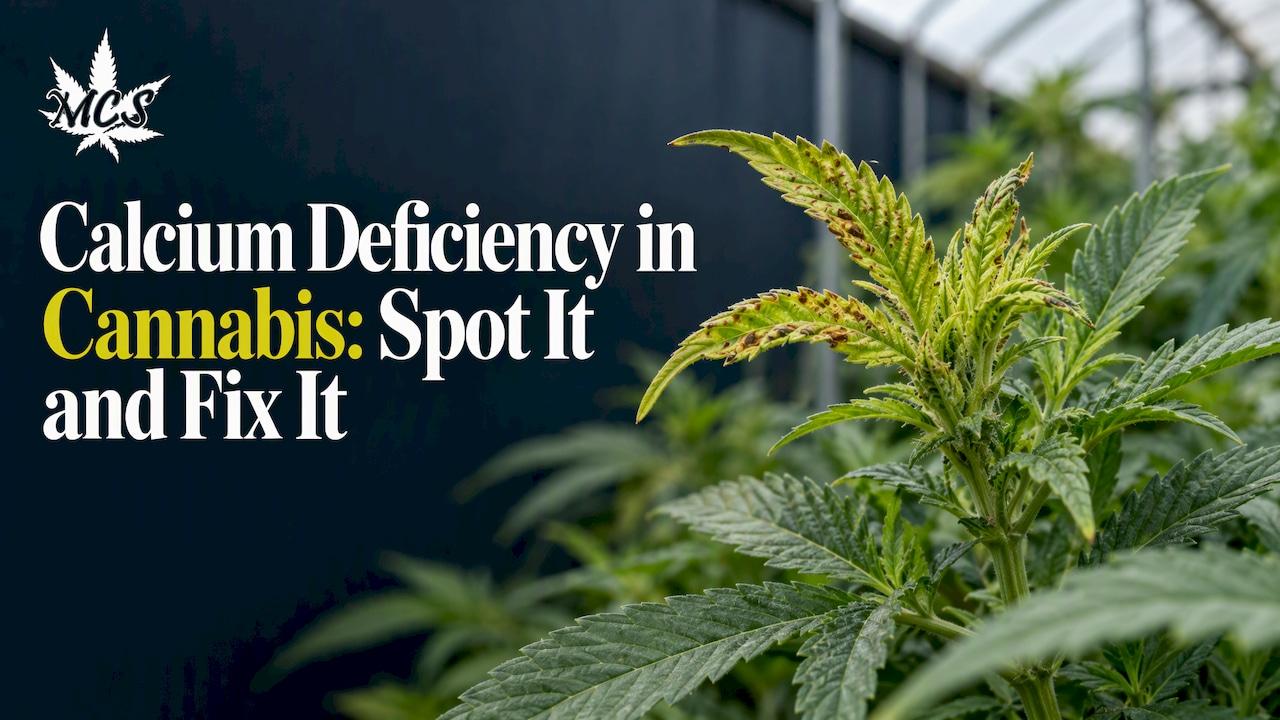
Calcium deficiency in cannabis appears first on the youngest growth: new leaves come in pale, spotted, curled or distorted, while older leaves stay comparatively normal. The reason is that calcium does not move readily within the plant, so the plant cannot pull it from old tissue to feed new tissue. In most home grows the cause is not a lack of calcium in the pot but something that blocks its delivery: water with almost no minerals, an unbuffered coco coir, a nutrient imbalance, a drifting root-zone pH or a room that is too humid for the plant to transpire properly. Correcting the cause comes before adding any product.
TL;DR
- Calcium deficiency shows on new growth first: pale leaves, yellow-brown spots between the veins, curling, and in severe cases dead growing tips.
- Calcium travels through the plant with transpiration water, so humid, stagnant air can cause a deficiency even when the medium holds plenty of calcium.
- Reverse osmosis (RO) water and coco coir are the two most common setups where Cal-Mag is genuinely needed; in soil, check pH and balance with magnesium and potassium first.
- Cal-Mag corrects new growth within days to about a week, but damaged leaves do not recover.
- Prevent the problem with a buffered medium, balanced feeding, steady airflow and a pH check at the root zone, and choose fertilizers that meet Canadian federal standards.
Table of Contents
- Why calcium matters to a cannabis plant
- Signs of calcium deficiency on cannabis leaves
- What actually causes it
- A step-by-step way to diagnose and correct it
- Using Cal-Mag well
- How fast should the plant recover?
- Preventing calcium problems from the start
- Our perspective
- Start with genetics suited to your space
- FAQ
- Sources
Why calcium matters to a cannabis plant
Calcium is classed as a secondary nutrient, alongside magnesium and sulfur. It is a building block of cell walls, which is why a plant short of it grows slowly and becomes structurally weak. Calcium is also involved in the growth of root tips and new shoots, which explains why the first damage appears where cells are dividing fastest.
Research from Niagara College, reported by the Canadian growing resource Growdoc, illustrates how much is at stake. In controlled studies on calcium and magnesium deficiency, calcium-deficient plants showed up to a 60% reduction in height and severely limited biomass. A mild shortage may not cut yield that dramatically, but the study shows why the problem deserves attention early rather than at harvest.
The key behavior to understand is mobility. According to the Ontario government's Nutrient Deficiency ID Guide for Hemp, calcium is immobile in the plant and deficiency symptoms particularly affect new growth. The Ontario Ministry of Agriculture's crop diagnostics page adds that calcium enters the plant through the transpiration stream, the flow of water from roots to leaves, rather than being redistributed from leaf to leaf. Two practical consequences follow: a plant needs a steady supply, and anything that slows water movement slows calcium delivery.

Signs of calcium deficiency on cannabis leaves
The Ontario hemp guide describes the typical picture: slow growth, young leaves turning pale and developing yellow-brown spots between the veins, tissue death (necrosis) and curling. If the shortage continues, leaves can become distorted and the growing points can die.
In practice, growers look for the following:
- New leaves that are twisted, cupped or crinkled, often with ragged margins.
- Small rusty or brown spots scattered across the leaf blade, usually starting at the edges and between veins.
- Leaf tips that curl or die back at the newest nodes.
- Stunted tops, with growth that stalls while older fan leaves look fairly normal.
- Weak stems that bend under the weight of the canopy, particularly in flower.
Because the damage sits on new tissue, a plant that has been shorted for a week or two can show a clear divide: healthy lower foliage and a damaged crown. That pattern is the single most useful clue.
How it differs from other problems
Several issues mimic calcium deficiency, and mixing them up leads to the wrong fix.
| Problem | Where it starts | What distinguishes it |
|---|---|---|
| Calcium deficiency | New growth at the top | Spots and curling at leaf margins and between veins; older leaves mostly fine |
| Magnesium deficiency | Older, lower leaves | Yellowing between veins on mature foliage; see the magnesium deficiency guide |
| Nitrogen deficiency | Lower leaves first | Uniform pale yellow that climbs the plant; see the nitrogen deficiency guide |
| Phosphorus deficiency | Older leaves | Dark, dull leaves with purple tones; see the phosphorus deficiency guide |
| Nutrient burn | Leaf tips across the plant | Crispy tips from overfeeding; see the nutrient burn guide |
| Septoria leaf spot | Damp inner leaves | Grey-centred spots with tiny black dots |
Weedmaps notes in its pest and disease identification guide that calcium deficiency can look like Septoria, a fungal leaf spot. The tell is location and moisture: Septoria favors crowded, damp leaves, while calcium problems concentrate in the newest tissue. Magnesium and calcium are often confused because they are fed together and both cause spotting, but magnesium damage appears on older leaves, calcium damage on new ones. The store's deficiency chart and pest guides help compare photos side by side.
When the picture remains unclear, leaf tissue analysis is one of the best diagnostic methods for nutrient disorders, according to Cannabis Business Times. A lab report separates true shortages from lockout, which saves guesswork on a crop that took months to grow.
What actually causes it
The question is rarely whether calcium is in the pot. It is whether the plant can take it up. The common causes fall into five groups.
Restricted transpiration
Because calcium rides the transpiration stream, anything that slows evaporation from leaves slows delivery. Cannabis Business Times reports that calcium deficiency can occur even when soil calcium is adequate if humidity is high, vapor-pressure deficit (VPD) is low or airflow is poor. VPD is the gap between how much moisture the air holds and how much it could hold at that temperature; a low value means the air is already saturated and leaves transpire slowly.
This matters in Canadian grows. A sealed tent in a basement during a cold, damp stretch, or a closet with no exhaust, can sit at high humidity for days. Small oscillating fans, an exhaust matched to the space and a humidity target suited to the growth stage help. Humidity needs differ sharply between stages, as the guide to seedling humidity levels explains.

Competing nutrients
The Ontario hemp guide notes that calcium uptake is depressed by ammonium-based nitrogen and by excessive potassium, magnesium, manganese and aluminum. Cations compete at the root surface, so a heavy dose of one can push another out. A grower who treats a suspected magnesium shortage with large repeated doses can end up inducing calcium deficiency instead.
Water and medium
Two setups deserve particular care:
- RO or very soft water. Reverse osmosis strips most dissolved minerals, so the plant receives almost no calcium unless it is added back. The AmpAc guide to growing with RO water states that RO water has negligible calcium and that growers must compensate through their feed. Anyone with a filtered tap or an RO unit should assume the water is empty.
- Coco coir. Coir naturally holds onto calcium and magnesium. Grow With Jane explains that coco must be buffered with calcium and magnesium, otherwise it strips them from the feed solution and causes a deficiency. Pre-buffered coir avoids this, so check the label before buying.
Municipal tap water in many Canadian cities is moderately hard and supplies some calcium, but it varies by region and season. A water report from the local utility shows what a plant receives before any feed is added.
Root-zone pH
Often what looks like a shortage is a pH problem. Grow With Jane observes that many nutrient disorders come from imbalanced root-zone pH rather than a true deficiency or excess. The Canadian Certified Crop Advisers' paper Calcium Nutrition in Plants adds that soil pH alone is not always the best indicator of calcium availability: the balance of calcium, magnesium and potassium and the soil's cation exchange capacity matter too. Measuring runoff pH and EC, rather than only the input water, gives a more accurate view.
Root health
Damaged or waterlogged roots cannot move water or calcium, whatever the feed holds. Overwatering, cold root zones and pests such as fungus gnat larvae all reduce uptake. Inspect roots and drainage before adding anything.
A step-by-step way to diagnose and correct it
- Confirm the pattern. Look at the crown. Damage on new growth with healthy older leaves points toward calcium; damage on older leaves points elsewhere.
- Check the environment. Measure temperature and humidity at canopy height. If the air is damp and still, improve airflow and ventilation first.
- Measure the root zone. Test the pH and EC of the runoff. If EC is very high, flush with plain water, acidified if needed, to reset the medium. Do not flush blindly: the nutrient burn guide on testing EC before flushing explains the order of operations.
- Review the feed. Look for heavy potassium or magnesium, ammonium-heavy nitrogen sources and any recent changes to the schedule.
- Supplement if the water or medium calls for it. For RO water or coco, add a calcium and magnesium supplement. For soil, a long-term fix can involve amendments such as dolomitic lime or gypsum, while quick corrections use liquid calcium nitrate or Cal-Mag products, as Grow With Jane describes.
- Reassess in a week. Watch only new growth. Damaged leaves stay damaged.
Using Cal-Mag well
Cal-Mag is a liquid supplement that supplies calcium and magnesium together. It earns its place when the water is soft or filtered, or when coco is the medium. In soil with decent water, it is often unnecessary, and adding it can unbalance magnesium and potassium.
A few principles keep use safe:
- Follow the product label. Dilution rates differ widely between brands, so the label for the specific product is the authority, not a rule of thumb from a forum.
- Add it to the water first. Calcium supplements can precipitate when mixed with concentrated phosphates and sulfates, so they go into the water before other nutrients, and pH is adjusted after everything is mixed.
- Treat it as a correction, not a permanent addition. Once new growth looks healthy, return to the regular feed schedule or the amount the water actually needs.
- Watch the ratio. One commonly cited guideline from Grow With Jane is a potassium to calcium to magnesium ratio of about 4:2:1, which helps avoid antagonism. Treat it as a starting reference and adjust by observing the plant.
Canadian growers should also know that fertilizers and supplements used in cannabis cultivation are regulated. The Canadian Food Inspection Agency lists calcium among the secondary nutrients and explains that fertilizers and supplements used in cannabis cultivation must meet standards for content, composition, contaminants and micronutrient tolerances. The agency also points out that cannabis plants accumulate heavy metals readily, so products should meet its standards for heavy metals and other contaminants. Choosing a registered or compliant product protects both plants and whoever consumes the harvest, particularly for medicinal growers.
How fast should the plant recover?
Once calcium is properly available, new growth should return to normal within a few days to a week, according to Grow With Jane. Because calcium is immobile, spotted or twisted leaves will not heal. They may stay marked until they drop. Judge success by the next leaves emerging clean, not by the old ones.
If new growth is still damaged after two weeks, the cause probably lies elsewhere: pH drift, humidity, root problems or an antagonist nutrient. Adding more calcium at that point risks toxicity and lockout of magnesium, potassium or other elements rather than solving anything.
Preventing calcium problems from the start
Prevention costs less than correction, and most of it is about setup.
- Know the water. Soft or RO water needs calcium and magnesium added from the first watering. Hard water may need little or none.
- Buy buffered coir or buffer it yourself before planting.
- Keep ventilation steady. A gentle breeze through the canopy and humidity suited to each stage maintain transpiration.
- Avoid extremes in feeding. Large doses of a single nutrient, particularly potassium, magnesium and ammonium-based nitrogen, compete with calcium.
- Check runoff regularly. Trends in pH and EC reveal trouble days before leaves do.
- Match the strain to the space. Compact, fast-finishing plants place different demands on feed and airflow than tall photoperiod plants, so choosing genetics suited to the grow room reduces stress from the outset.
Our perspective
At Montreal Cannabis Seeds, we see calcium problems as setup problems more often than genetics problems. Canadian growers work with a wide range of conditions: cold basements, dry winter air, soft or heavily treated tap water and short outdoor seasons. Our catalog is curated with those realities in mind, and our support team is familiar with the local growing conditions that lead to these questions.
We design our descriptions to be detailed so growers can choose plants for their space. A compact autoflower suits a small tent where airflow is limited and feeding should stay simple. A feminized photoperiod plant gives more room to manage the feed over a longer cycle. Medicinal growers who need dependable plants often turn to our CBD seeds, where steady, balanced feeding matters as much as the strain. Our germination guarantee exists so that growers start from a reliable footing and can diagnose later problems in the environment rather than doubting the seed.
Our advice is simple: fix the environment, measure the root zone, and supplement only what the water and medium lack.
— Dino Grow Master
Start with genetics suited to your space
A grower who has sorted out water, medium and airflow still benefits from plants that fit the room. Our catalog covers feminized, autoflower, fast-version, CBD and regular seeds, with detailed product information on each page and fast, discreet shipping across Canada. Browse the full range on the Montreal Cannabis Seeds home page.

For those still equipping a first grow, the Canada grow supplies guide lists starter equipment, including the airflow and monitoring tools that help prevent the problems described above.
FAQ
Is Cal-Mag the same as calcium?
No. Cal-Mag supplies both calcium and magnesium, which are usually short together in RO water and in unbuffered coco. If only one element is lacking, a combined product can add more of the other than the plant needs, so identify the symptoms first.
Can too much calcium harm cannabis?
Yes. An excess does not usually show as obvious burn. It tends to block uptake of magnesium and other nutrients, producing deficiency signs elsewhere. Keeping calcium, magnesium and potassium in balance, and testing runoff rather than guessing, avoids the problem.
Why do my plants show calcium deficiency in soil?
Soil often contains calcium, so look at delivery. High humidity, weak airflow, drifting pH, competing nutrients and unhealthy roots all limit uptake. The Ontario hemp guide lists ammonium and excess potassium or magnesium as common culprits. Correct those before adding supplements.
Will damaged leaves turn green again?
No. Calcium does not move within the plant, so existing spots and curls remain. Recovery shows in new growth, which should look normal within days to about a week once the cause is fixed.
Do I need Cal-Mag with tap water?
Not always. Moderately hard tap water already supplies some calcium and magnesium, and extra Cal-Mag can unbalance the feed. A local water report or a test of the water's EC shows what is already there.
Sources
- Nutrient Deficiency ID Guide for Hemp, Ontario government
- Macro and Secondary Nutrients, Ontario Crop IPM
- Fertilizers and supplements used in cannabis cultivation, CFIA
- Calcium Nutrition in Plants, Certified Crop Advisers
- Calcium and magnesium deficiency report, Niagara College via Growdoc
- The Dangers of Calcium Deficiency in Cannabis Crops, Cannabis Business Times
- Prevent and Solve Nutrition Problems with Leaf Tissue Analysis, Cannabis Business Times
- Guide to Common Cannabis Pests and Diseases, Weedmaps
- Growing Cannabis with Reverse Osmosis Water, AmpAc
- Calcium Deficiency and Toxicity, Grow With Jane