
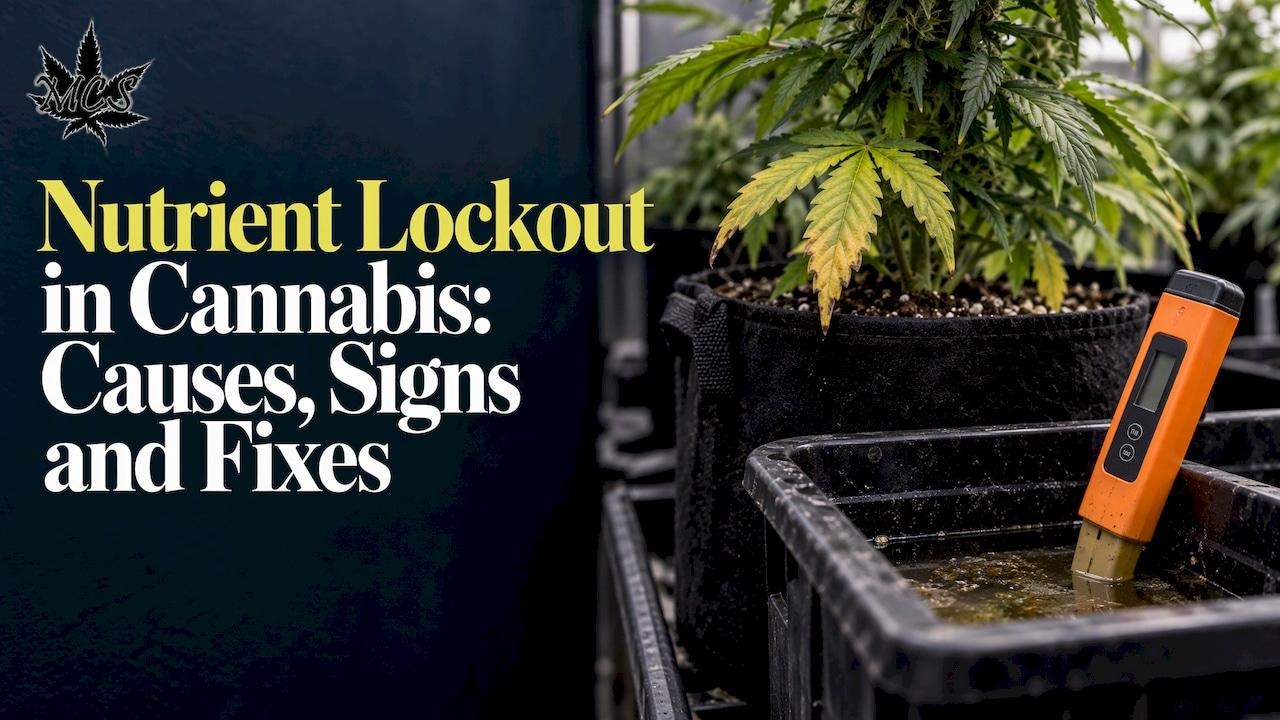
Nutrient lockout happens when a cannabis plant cannot absorb nutrients that are physically present in the pot, the reservoir or the feed water. The usual culprits are a root-zone pH outside the productive range and a buildup of fertilizer salts. The fix is rarely another bottle of fertilizer. It is to measure pH and runoff, stop feeding, flush with pH-adjusted water if the readings call for it, and reintroduce nutrients gradually once the roots recover.
This guide sets out how lockout develops, how to separate it from a true deficiency, what to measure in soil, coco and hydroponic setups, and how to handle the common question of late-flower flushing.
TL;DR
- Lockout is an availability problem, not a shortage: nutrients are present, but pH, salt buildup or damaged roots keep the plant from taking them up.
- Measure before you act. Check the pH of your water and runoff, and compare runoff EC with feed EC, before changing the feed.
- If readings confirm lockout, stop nutrients, flush with plain pH-balanced water, let the medium dry back, then resume at a lower strength.
- Mixed, spreading symptoms that do not respond to extra feeding point to lockout rather than a single deficiency.
- In late flower, flushing is a judgment call: it fixes real salt buildup but is not proven to improve the finished flower.
Table of Contents
- What nutrient lockout actually is
- How pH controls what the roots can reach
- Salt buildup and the second route to lockout
- Lockout or deficiency? How to tell
- How to check for lockout in soil, coco and hydro
- How to reverse nutrient lockout
- Lockout in late flower: flush, or let it ride?
- Preventing lockout next time
- Start with genetics suited to your setup
- FAQ
- Sources
What nutrient lockout actually is
The term is grower shorthand rather than a formal plant-science diagnosis. It describes a plant that shows deficiency symptoms even though the nutrients may already be in the fertilizer, water, soil or growing medium. A nutrient can be unavailable because its chemical form is unsuitable, because pH changes its solubility, because another ion competes with it for uptake, or because unhealthy roots cannot absorb it, as one cultivation reference on lockout explains.
The practical question, then, is not which bottle will fix a yellow leaf. It is what evidence shows that the root zone is blocking normal uptake.
Leafly Canada names two primary causes: oversaturation with nutrients, particularly high-salt chemical fertilizers, and unsuitable pH in the soil, water or nutrient solution. Most other triggers, such as poor mixing, overwatering, root damage or cold root zones, work by pushing one of those two factors out of range.

How pH controls what the roots can reach
Every nutrient dissolves best within a certain pH window. Outside it, the same fertilizer delivers less of some elements and too much of others. In research trials at North Carolina State University, a substrate pH of 5.8 to 6.2 was recommended, and levels below 5.5 or above 6.5 can lead to lockout. At elevated pH, interveinal chlorosis can appear on the youngest leaves even when the fertilizer supplies adequate iron.
A pH-to-lockout table for Canadian growers gives a useful picture of what drifts out of reach:
| Root-zone pH | Nutrients restricted | What you may see |
|---|---|---|
| Below 5.0 | Calcium, magnesium, molybdenum | Brown leaf edges, brittle leaves |
| 5.0 to 5.5 | Some calcium and magnesium | Mild interveinal yellowing |
| 6.2 to 6.5 | Iron and manganese begin to drop | Light interveinal yellowing on new leaves |
| 6.5 to 7.0 | Iron, manganese, zinc | Pronounced yellow new leaves with green veins |
Target ranges differ slightly by medium, which is why you should aim for the range that fits your setup rather than a single universal number:
- Soil: Leafly Canada cites 5.8 to 6.8 for soil pH, with 5.5 to 6.5 for hydroponics.
- Coco and hydroponics: a Canadian hydroponics guide gives 5.8 to 6.2 in the reservoir, checked daily in DWC and NFT systems.
- Organic soil: biology buffers a good deal of pH movement, which is covered in our living soil basics and pH guide.
One detail catches many growers: a correctly mixed feed can still cause lockout if the medium's pH drifts, and pH should be adjusted after the nutrients go in, because nutrients change the pH of the water.
Salt buildup and the second route to lockout
Roots take up water and dissolved nutrients by osmosis. When fertilizer salts accumulate around the roots, that gradient weakens, and the plant struggles to take in water and nutrients even though the medium is full of them. EPM Earth lists pH imbalance, salt buildup, nutrient imbalance and biofilms that clog irrigation lines as common contributing factors.
Salt buildup tends to come from a few habits:
- Feeding at full label strength to young plants or autoflowers with small root systems.
- Topping up with nutrients repeatedly without running plain water through the pot.
- Small containers that cannot dilute what the roots do not use.
- Stacking supplements and boosters on top of a base nutrient line.
If you grow autoflowers, our autoflower feeding schedule, which starts at one-eighth strength and follows plant cues, is designed to keep salts low from the start. For the related problem of scorched tips, see our guide on testing EC before flushing nutrient burn.
The type of medium matters too. Peat-based substrates are naturally acidic, typically pH 3.0 to 5.0, according to Atami Canada, which is outside the ideal range for uptake unless it is buffered. Cation exchange capacity, which governs how much a medium holds onto nutrients, also varies: Rx Green Technologies ranks peat highest, then vermiculite, coco coir, clay pebbles, rockwool and perlite.
Lockout or deficiency? How to tell
Symptoms overlap heavily. Yellowing, curling, rusty spots and slow growth can also come from underfeeding, overfeeding, watering errors, root disease, pests, light stress and normal senescence late in flower. A few patterns help separate them.

A true deficiency usually follows a recognizable pattern. Nitrogen shortage, for instance, yellows the oldest leaves first and then moves up the plant. If that is what you see, our nitrogen deficiency guide walks through the diagnosis. The same applies to magnesium, calcium and phosphorus.
Lockout tends to look messy. A pH problem often looks like several deficiencies at once, with mixed symptoms that do not improve despite extra fertilizer, which argues against a genuine magnesium, iron or calcium deficiency. In flowering plants, lockout often appears as generalized yellowing across several parts of the plant instead of just the lowest leaves.
A quick comparison:
| Clue | Likely deficiency | Likely lockout |
|---|---|---|
| Pattern | One clear, predictable pattern | Several patterns at once |
| Response to feeding | Improves within days | Stays the same or worsens |
| Runoff pH | In range | Outside the range for your medium |
| Runoff EC vs feed EC | Similar or lower | Noticeably higher |
| Leaf posture | Normal | Pale, limp or shriveled, similar to underwatering |
If the plant looks droopy, finger-test the medium before assuming anything. Lockout can resemble underwatering, and adding water or nutrients to the wrong diagnosis makes it worse.
How to check for lockout in soil, coco and hydro
Measure in this order, before changing anything.
- Check your input water pH. Leafly Canada suggests starting with the water itself, which should be 6.0 to 7.0, then moving to the medium.
- Check runoff pH. In soil and coco, water until a little drains out, and measure what comes through. In hydro, measure the reservoir.
- Compare runoff EC with feed EC. Druid Nutrients notes that if runoff EC is significantly higher than the feed EC, the medium has accumulated salts, and the dose should be reduced after a flush. If EC is in range but the plant looks unwell, pH is the next suspect.
- Inspect the roots and the pot. Dark, slimy or smelly roots, a waterlogged pot or a cold root zone all slow uptake regardless of what the meter says.
One caution: a low reading in the drainage does not automatically prove the plant is deficient, and a high one does not automatically prove lockout. Treat the numbers together with how the plant looks and behaves. For hemp and cannabis growers in Ontario, the provincial agriculture ministry's nutrient deficiency ID guide was produced in response to grower inquiries and uses a solution corrected to pH 6.5 to show symptoms in plants with every nutrient available, which makes it a handy reference for what a deficiency alone looks like.
How to reverse nutrient lockout
Once the readings point to lockout, the recovery steps are simple and should be done calmly. Adding more fertilizer to a crop that already cannot take it up usually increases the pressure.
- Stop feeding. Pause nutrients and additives.
- Flush with pH-adjusted water. Leafly Canada recommends flooding the pots with fresh, pH-balanced water to break up salt buildup and clear the pathways for uptake.
- Let the medium dry back. After the flush, the soil needs to dry before the next watering so the roots can breathe and avoid rot.
- Water plain for a few more cycles, then reintroduce nutrients at a reduced strength.
- Correct pH deliberately. Use commercial pH up (potassium hydroxide) or pH down (phosphoric acid), never household vinegar or baking soda. A single millilitre of pH down can move a 10 L reservoir by a full unit, so add it in small steps and re-measure.
- Consider re-potting if the medium is badly over-fertilized. Atami Canada lists transplanting alongside flushing and pH correction, and gives a recovery window of about 7 to 10 days.
New growth is the best sign of success. Damaged leaves do not turn green again, so judge recovery by the leaves that emerge after the correction, not by the ones that were already affected.
Lockout in late flower: flush, or let it ride?
This is the question growers ask most often when a plant a couple of weeks from harvest starts yellowing or fading. The answer depends on what you find.
- If runoff EC is far above feed EC or pH is clearly off, a pH-balanced flush is justified. It removes the accumulated salts and gives the roots a chance to work again, which supports the final weeks of ripening.
- If the readings are normal, the fading is probably natural senescence. Late-flower plants draw down their own reserves and yellow from the bottom up. Flushing in this case adds stress without solving anything.
- Ease off feeding either way. Many growers reduce or stop feeding in the last one to two weeks. It is common practice, though not universal.
It is worth knowing that the benefit of a routine pre-harvest flush is debated. A trial by a cultivation-products manufacturer, reported by High Times, found no significant change in the flower's mineral content across different flush times, and blind testers tended to prefer flower that had not been flushed. That is a single trial in coco, so treat it as a data point rather than a rule. It does not change the case for a corrective flush when readings show a real problem.
If you do flush late, keep the water pH-adjusted, avoid drowning the pot, and give the medium time to dry between waterings. Judge harvest timing by trichomes, not by the flush schedule.
Preventing lockout next time
Prevention is mostly routine:
- Measure pH after mixing nutrients, every time. A monitoring habit beats any rescue plan. For Canadian soil growers, IncrediGrow puts soil pH at 6.0 to 7.0 and hydro at 5.5 to 6.5, and advises checking EC regularly.
- Aim for the sweet spot of your medium. For soil feed water, GrowGuide suggests 6.0 to 6.8 (best at 6.2 to 6.5), and 5.5 to 6.5 for coco and hydro (best at 5.8 to 6.2).
- Start light. Seedlings and autoflowers do better at a fraction of label strength, increased only when the plant asks for it.
- Run a plain-water watering now and then in containers so salts do not stack up.
- Calibrate your pH pen and keep it in storage solution. A drifting meter causes more lockout than most nutrient mistakes.
- Keep a log. Write down input pH, runoff pH, EC and what the plant looked like. Patterns show up quickly.
For a wider look at spotting problems before they escalate, our cannabis pest and deficiency chart collects the visual signs in one place.
Our perspective on lockout
Most of the lockout cases we hear about from Canadian growers start with enthusiasm rather than a mistake in knowledge: a little more feed, a bigger dose of booster, a pH pen that was not recalibrated. We think the better habit is restraint. Begin low, measure often and let the plant show you what it needs.
Genetics are part of the equation as well. Our catalog is curated with Canadian growing conditions in mind, and we describe each strain in detail so growers can match plant size, flowering style and feeding appetite to their space. A compact autoflower in a small pot has very different needs from a large photoperiod plant in a big container, and choosing the right one reduces the temptation to overfeed.
If a problem does appear, our support team understands local growing conditions and can help you think through what you are seeing.
Dino Grow Master
Start with genetics suited to your setup
A plant that suits your space and experience level is easier to feed correctly. If you want compact plants with a fast cycle, browse our autoflower seeds. If you prefer to control the vegetative stage, our feminized seeds are a natural starting point. Every order is backed by our germination guarantee, with fast and discreet shipping across Canada.

You can explore the full range, including our Quebec line, mix packs and outdoor options, on the Montreal Cannabis Seeds home page.
FAQ
How do you reverse nutrient lockout?
Stop feeding, measure runoff pH and EC, then flush with plain, pH-balanced water to clear built-up salts. Let the medium dry back before the next watering, and reintroduce nutrients at reduced strength after a few plain-water cycles. Atami Canada gives a typical recovery window of 7 to 10 days.
When should you stop feeding cannabis?
There is no single date. Many growers reduce or stop feeding one to two weeks before harvest, but the timing depends on the strain, the medium and the plant's appearance. Stop immediately at any stage if runoff EC runs well above feed EC or pH is out of range.
Is a one-week flush enough?
For correcting salt buildup, one week of plain pH-balanced water, with proper drying between waterings, is often enough to bring runoff EC back toward the feed level. Confirm with a runoff reading rather than the calendar. Heavily over-fertilized pots may need re-potting instead.
Does potassium make buds bigger?
Potassium supports flowering, but adding more does not guarantee larger buds and an excess can compete with calcium and magnesium for uptake, which is itself a route to lockout. Feed to the plant's stage and verify with pH and EC readings.
Sources
- Cannabis Nutrient Lockout: Causes, Diagnosis, and Recovery
- Leafly Canada: Cannabis nutrient deficiencies and leaf symptoms
- Cannabis Business Times: 3 Tips to Avoid Nutrient Lockout
- GrowersGuide.ca: pH for Hydroponics Canada
- GrowGuide: Nutrient Schedule for Cannabis
- EPM Earth: What is Cannabis Nutrient Lockout?
- Atami Canada: Cannabis Nutrient Lockout Guide
- CannaSelection: Identify pH Problems in Cannabis
- Kind Green Buds: Yellow Leaves During Flowering
- Druid Nutrients: EC Explained
- Ontario Ministry of Agriculture: Nutrient Deficiency ID Guide for Hemp
- Plant Life Co: How to Prevent Nutrient Lockout in Cannabis
- IncrediGrow Garden Centre: Troubleshooting Cannabis Plants
- High Times: New Research Shows Flushing Plants Before Harvest May Be Unnecessary