
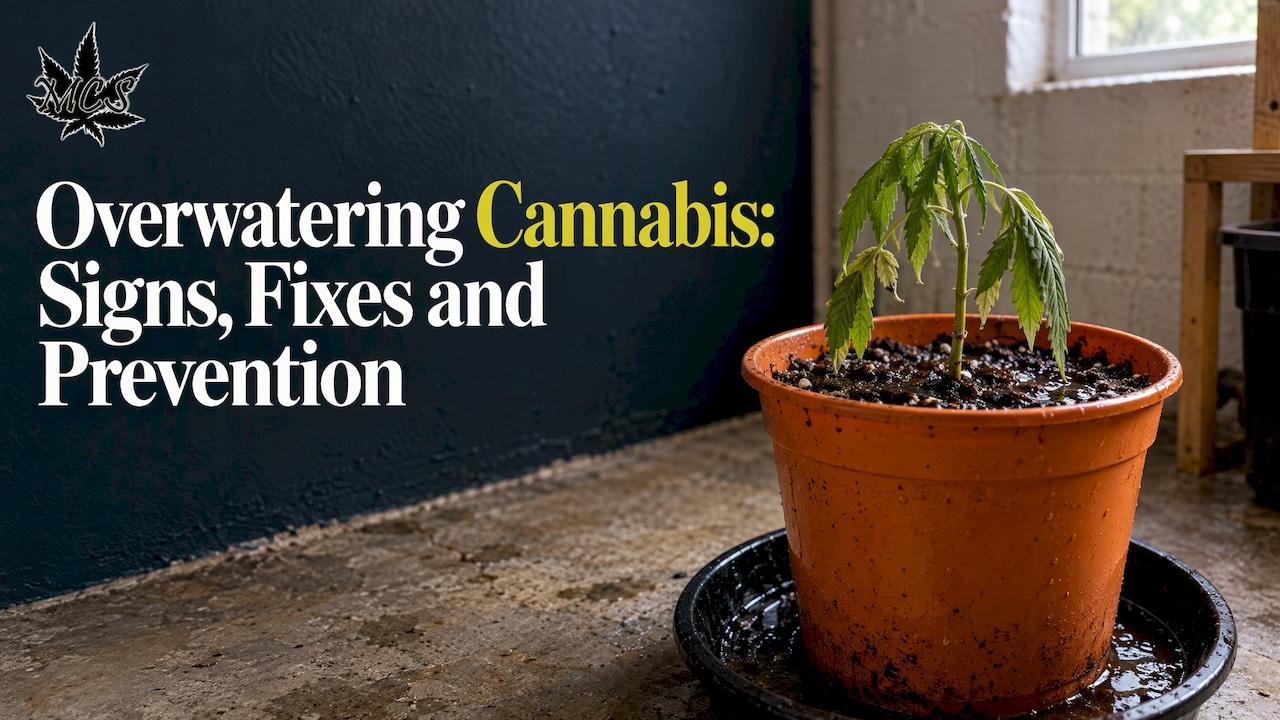
Overwatering cannabis means the growing medium stays wet for too long, so roots lose access to oxygen and the plant droops even though it is surrounded by water. The fix is rarely more care, but less frequent, better-timed watering: let the pot become lighter, check the top inch or two of medium, and water only when the plant actually needs it. This guide explains how to recognize the problem, how to separate it from underwatering, how to handle seedlings and autoflowers, and how to recover a plant that has already been drowned.
TL;DR
- Overwatered cannabis shows drooping, soggy medium that stays wet for days, and a pot that remains heavy long after watering.
- Underwatered plants look similar at first glance, but the pot is very light and the plant perks up soon after a drink.
- Seedlings need a damp-sponge medium, not a soaked one: small amounts, more often, rather than large volumes at once.
- Autoflowers have a short life cycle and little time to recover from root stress, so pot size, drainage and pot weight matter from day one.
- Recovery means letting the medium dry back, restoring airflow around the pot and resuming a measured routine, not adding nutrients.
Table of Contents
- Why too much water harms cannabis
- Signs of overwatered cannabis
- Overwatering versus underwatering
- Watering cannabis seedlings
- Watering autoflowers
- How to fix an overwatered cannabis plant
- Preventing overwatering
- Our perspective
- Start with genetics suited to your space
- FAQ
- Sources
Why too much water harms cannabis
Roots breathe. A healthy root zone holds both water and air in the spaces between particles of soil or coco, and when those spaces stay filled with water, the roots can no longer take in oxygen. The University of Saskatchewan notes that too much water can drown cannabis roots and promote diseases such as root rot. The Canadian Food Inspection Agency's biology overview points the same way: cannabis needs soil moisture, but it performs poorly in heavy, waterlogged soil.
The paradox is that the plant looks thirsty. Leaves hang, growth slows and the grower, seeing a wilting plant, adds more water. That loop is the most common reason a promising seedling stalls.
Overwatering is not only about volume. A medium can be kept too wet by watering for too long, too often, or both. A small plant in a large pot is the classic case: the roots occupy a fraction of the medium, so most of the water has nowhere to go and sits there.

Signs of overwatered cannabis
No single symptom is conclusive, so it is best to look for a cluster:
- Drooping, heavy-looking leaves. The leaves curl downward and look swollen or glossy rather than dry. They stay that way even after watering, which is the opposite of what a thirsty plant does.
- Medium that stays wet. The surface remains dark and soggy for several days, and the pot feels heavy.
- Yellowing lower leaves. Roots that cannot breathe cannot feed the plant, so older growth fades first.
- Slow or stalled growth. New leaves are small, and the plant seems stuck for a week or more.
- Surface algae, a musty smell or fungus gnats. A constantly wet top layer invites all three. Our guide to slow seedling growth covers other causes of a stalled seedling if watering does not explain it.
Yellowing and spotting can also come from nutrient problems, and the two are easily confused. Before adding anything, check moisture first. If the medium has been wet for days, treat water as the cause, then consult the comprehensive guide to cannabis deficiencies once the root zone has recovered. Phosphorus problems in particular often appear when cold, wet roots cannot absorb what is available, as explained in our article on fixing phosphorus deficiency in Canada.
Overwatering versus underwatering
Both extremes produce a drooping plant, which is why growers misdiagnose them. The most reliable separator is weight. According to Gardening at USask, pot weight is one of the most reliable indicators: overwatered pots stay noticeably heavy long after watering, while underwatered pots are very light.
| Check | Overwatered | Underwatered |
|---|---|---|
| Pot weight | Heavy, even days after watering | Very light |
| Medium | Soggy, dark, slow to dry | Dry, may pull away from the pot edge |
| Leaves | Swollen, curled down, droop persists | Thin, papery, droop improves after watering |
| Growth | Stalled, yellowing lower leaves | Stunted, crisp or curling tips |
| Response to water | Gets worse or does not change | Recovers within hours |
The lift test takes ten seconds. Pick up the pot right after a thorough watering and again when you think it needs water. Learning the difference in feel between those two weights is worth more than any schedule.
Underwatering deserves equal respect. Growers who have been warned off overwatering sometimes swing too far, and underwatering becomes a problem of its own for them. Dry plants wilt, and the medium often shrinks away from the container wall. The aim is a rhythm of wet then partly dry, never constantly one or the other.
Watering cannabis seedlings
Seedlings are the most vulnerable stage, because the root system is tiny and any error shows quickly. The University of Saskatchewan describes the target as a medium that feels like a damp sponge: wet but not dripping or saturated. It also advises giving small amounts more often rather than large amounts at once.
That guidance cuts both ways. A seedling that lacks water can have its tiny root system dry out and become damaged, which can stunt or kill it. So the practical routine is:
- Start with a pre-moistened medium at germination, so no heavy watering is needed in the first days. Our guide to germinating seeds in soil covers the temperature range and setup.
- Water in a small circle around the stem, not across the whole pot. The root zone is only a few centimeters wide, and the rest of the soil will simply stay wet.
- Widen the circle as roots grow. Each week, water slightly further from the stem so roots are encouraged outward.
- Check before each watering. Press a finger into the top of the medium and lift the container. If it is still damp and heavy, wait.
- Watch the air as well as the water. Humidity that is too high slows evaporation and keeps the surface wet, so pair your watering with the ranges in our seedling humidity guide.
Signs of an underwatered seedling
An underwatered seedling looks droopy and limp, and the medium around it is clearly dry, sometimes pulling away from the container edges. Unlike an overwatered seedling, it responds quickly: within an hour or two of a small drink, the stem firms up. If it does not, the cause is probably elsewhere, such as heat, light distance or root damage.
Watering autoflowers
Autoflowers move from seedling to flower on a fixed timeline regardless of the light schedule, so a setback in the first three weeks cannot be made up later the way it can with a photoperiod plant that is simply kept in vegetative growth longer. This is why overwatering is such a common complaint among autoflower growers, and why early habits matter. If you are still choosing between types, the comparison of photoperiod, autoflower and fast version strains explains the trade-offs.
Four variables decide how often an autoflower needs water:
- Pot size. Small pots dry quickly and large pots hold water for a long time. A seedling should not sit in a pot far larger than its root ball, so many growers step up the container size in stages or choose a final size that suits the plant's expected height.
- Medium. Coco and airy mixes dry faster than dense soil. Container-grown media can also drift in pH over time, while garden soil buffers and adjusts it, according to Gardening at USask. Most plants, cannabis included, grow best between a pH of 6.2 and 7.0 according to the same page.
- Plant size and stage. A larger plant with a dense root system drinks far more than a seedling, and its needs rise through the vegetative phase.
- Climate. Warm, dry, breezy rooms and outdoor beds in summer wind dry the medium faster. Cool, humid rooms slow it. Outdoors in Saskatchewan, most cannabis plants need about 2.5 cm (1 inch) of water per week, which is a useful reference point, though your own region, soil and rainfall will shift it.
Because autoflowers are compact, they suit careful, observation-based watering. Learn the weight of your pot dry and wet, and let that guide you, not a calendar. For a living-soil approach that buffers moisture swings, see our notes on organic soil and pH.
How to fix an overwatered cannabis plant
Recovery is mostly a matter of patience and airflow. The steps below follow the general principle that roots need to dry back and breathe again.
- Stop watering. Do not water again until the pot is clearly lighter and the top inch or two of medium is dry.
- Improve drainage. Confirm the container has holes and that it is not sitting in a tray of water. The University of Saskatchewan specifically warns that standing containers in trays of water can damage roots.
- Increase air movement. A gentle fan across the canopy and the medium surface speeds evaporation from both the leaves and the pot. Keep it from blowing directly on a small seedling.
- Keep the temperature steady. Cold, wet roots are the slowest to recover, so avoid placing pots on cold floors or in drafty spots.
- Hold off on nutrients. A stressed root system cannot use a stronger feed, and extra salts can compound the damage.
- Resume with smaller, more careful waterings. When the pot is light again, water until a little runs out of the bottom, then wait for the cycle to repeat.
- Look at the roots only if the plant fails to recover. Brown, mushy, foul-smelling roots signal root rot. In a severe case, a mature plant may need transplanting into fresh, well-draining medium, which is a delicate step. Our store blog covers the general process of transplanting seedlings.
A seedling that has been waterlogged for only a day or two usually bounces back within a few days of drying out. Plants with advanced rot rarely return to full vigor, and in those cases, starting a fresh seed is often the better use of time.
Preventing overwatering
Prevention is a set of habits rather than a single trick:
- Use containers with good drainage. Leafly's watering guidance puts drainage first, together with checking the top 1 to 2 inches of soil and the pot weight, and adjusting as the plant and climate change.
- Water until a little drains out. Applying water slowly until 10 to 20 percent runs off ensures the entire root zone is wetted and helps prevent harmful salt accumulation. Empty the saucer afterwards.
- Use a simple rule for timing. One grower guide suggests watering when about 50 percent of the water applied last time is gone, which again comes down to weighing the pot.
- Avoid watering at night. The same guide discourages it and recommends adjusting irrigation to the first or last half-hour of the light cycle.
- Match the pot to the plant. Seedlings do best in small containers that are stepped up as the roots fill the space.
- Keep the root zone airy. A well-aerated mix drains quickly, and the same principle of moisture management and healthy roots appears in guidance on what hemp needs to grow.
A simple weekly routine
For a seedling in a small pot, check the medium daily, but water only when the pot has lightened. Many growers find that this means a small drink every two to three days at first, and a full watering every few days once the plant is established. Treat those numbers as a starting point, not a rule: a warm room will dry faster, a cool one slower.
Our perspective
Most overwatering problems we hear about from Canadian growers start with the same two things: a pot that is too big for a young plant and a routine set by the calendar instead of by the plant. Canadian homes and grow spaces vary widely, from dry winter basements to humid summer balconies, and no fixed schedule can account for that.
That is one reason we curate genetics with Canadian conditions in mind and publish detailed product information for every strain. A grower who knows how a variety is designed to grow, whether it is an autoflower with a short life cycle or a feminized photoperiod plant with more time to recover, can plan pot size, medium and watering accordingly. Our germination guarantee exists so that a first-time grower can start with confidence and focus on learning the rhythm of wet and dry.
Our support team answers questions about local growing conditions, including watering. If a seedling looks unwell, send a description and a photo of the pot, and we will help you work out whether it is a water, climate or nutrient issue.
Dino Grow Master
Start with genetics suited to your space
A good watering routine begins with a plant that germinates reliably and grows steadily. Our catalog includes autoflower seeds for growers who want a compact plant and a short cycle, and feminized seeds for those who prefer to control the length of the vegetative stage. Every order ships across Canada in discreet packaging and is covered by our germination guarantee.

New to growing? Our guide to the top cannabis strains for first-time growers is a good place to match a variety to your experience, and you can browse the full range on the Montreal Cannabis Seeds home page.
FAQ
Can you overwater an autoflower?
Yes, and autoflowers are especially sensitive because their short life cycle leaves little time to recover. Keep them in appropriately sized pots with good drainage, and water by pot weight rather than by schedule. If the medium is still damp one to two inches down, wait.
How do I know if my cannabis seedling is underwatered?
The seedling droops, and the medium is clearly dry and may pull away from the pot edge. The key difference from overwatering is that the pot is very light and the plant recovers soon after a small drink. Keep the medium like a damp sponge rather than letting it dry out completely.
How often should I water cannabis seedlings?
There is no fixed number of days, because room temperature, pot size and medium change the answer. Give small amounts of water, more often than you would a mature plant, and check the top of the medium and the weight of the pot before each watering. Water when the pot has lightened, not simply because a day has passed.
Can an overwatered cannabis plant recover?
Usually yes, if the problem is caught early. Stop watering until the pot is light, improve airflow, avoid feeding, and then resume with smaller waterings. Plants with mushy, brown roots from advanced rot are much harder to save.
Does the pH of my water matter for overwatering?
It matters for how well the plant can use what it is given. Most plants, cannabis included, grow best with a pH between 6.2 and 7.0, and container media can drift over time. A waterlogged root zone absorbs poorly whatever the pH, so fix the moisture first.
Sources
- Watering your Cannabis Plants, Gardening at USask
- Seedlings, Gardening at USask
- The Biology of Cannabis sativa L., Canadian Food Inspection Agency
- Ten Watering Rules of Thumb
- How to Water & Flush Marijuana Plants, Leafly
- Common Cannabis Seedling Problems & Mistakes
- Underwatering Cannabis Plants Symptoms & Solutions
- What Does Hemp Need to Grow? Essential Requirements