
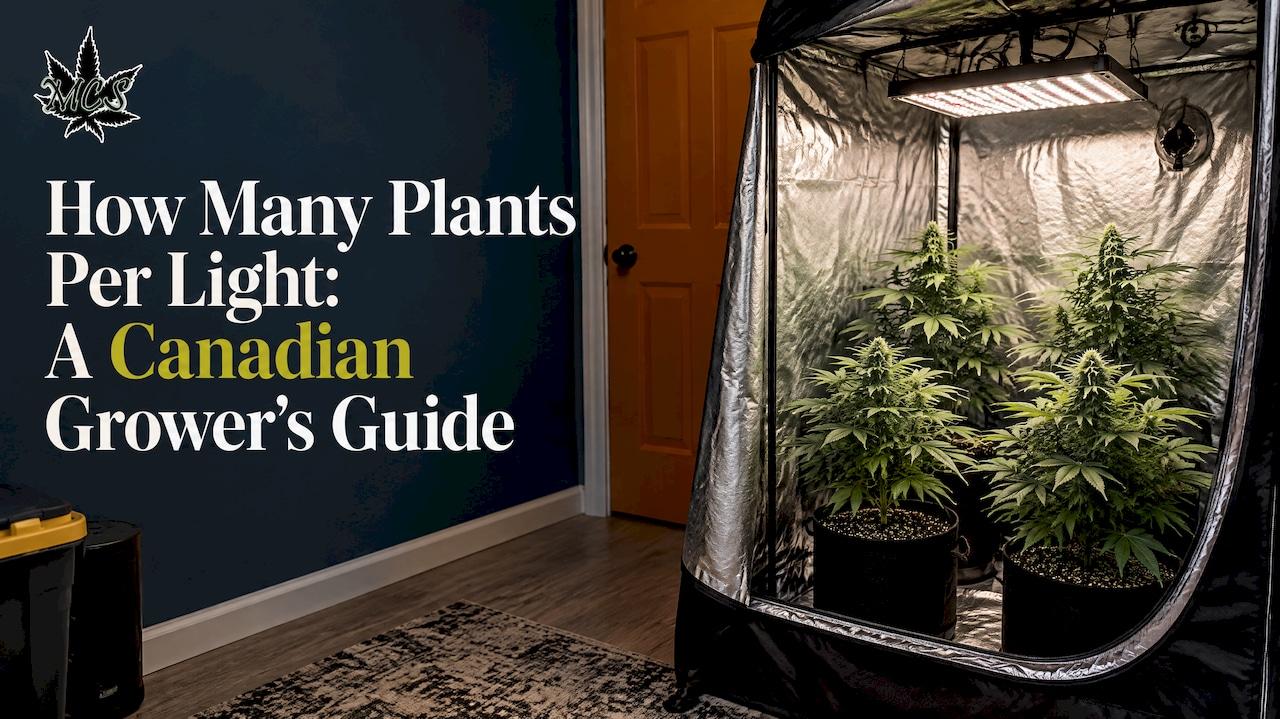
For most Canadian home growers, the answer is four or fewer, and the light decides how large those four plants can become. Federal law caps home cultivation at four plants per household, so the useful question is how to give four plants the right light, space and training. A well-chosen light, a sensible pot size and seeds picked for the plan matter more than adding plants. Our catalog is organized around that logic: feminized seeds and autoflower seeds that fit a defined canopy, backed by a germination guarantee.
TL;DR
- Canada allows a maximum of 4 plants per household, not per person, subject to provincial, territorial and municipal rules, and seedlings count toward that number.
- Light coverage, not wattage on the box, sets the plant count: a 3x3 ft tent usually suits 2 to 4 plants, and a 1000W-class LED covers roughly 4x4 to 5x5 ft in flower.
- Judge a light by its true power draw and published PPFD map (the amount of usable light reaching the canopy), not by "equivalent" wattage.
- Training and pot size change how many plants fit: fewer, larger, trained plants often match the yield of a crowded tent.
- Plan the seed count before you plan the light, so every plant you start has a place under it.
Table of Contents
- Start with the legal ceiling
- What actually sets the number under one light
- A worked example: four plants, one light
- How many plants fit in a 3x3 tent?
- How many plants can a 1000W LED grow
- Training changes the count, not the legal limit
- Match the seeds to the light
- Spacing and airflow
- From seed to a lit canopy
- FAQ
- Sources
Start with the legal ceiling
Before any lighting math, the law sets the upper bound. Health Canada states that, subject to provincial, territorial and municipal restrictions, adults of legal age can grow a maximum of four cannabis plants per household. The limit applies to the household, so two adults sharing an address still share four plants.
Seedlings count as plants. Leafly Canada's beginner guide gives the example that sprouting four seeds while four plants are near maturity equals eight plants, double the allowance. The same guide noted that Quebec, Manitoba and Nunavut restrict home growing at the provincial level, so confirm your province's current rules before you buy equipment. Our guide on how many seeds to plant walks through the seed-count side of this in detail.
Where home growing is allowed, this is good news for lighting. Four plants need far less light than the hundreds in the commercial rooms that most people picture. University of Guelph environmental science professor Mike Dixon told CBC News that a single LED of about 200 watts is sufficient to light four plants without upgrading the electrical panel, and that four plants produce too little moisture to encourage mould.
What actually sets the number under one light
A light does not support a fixed number of plants. Three things interact: the area it covers at a useful intensity, the size each plant reaches, and how you train the plants.
Coverage and intensity
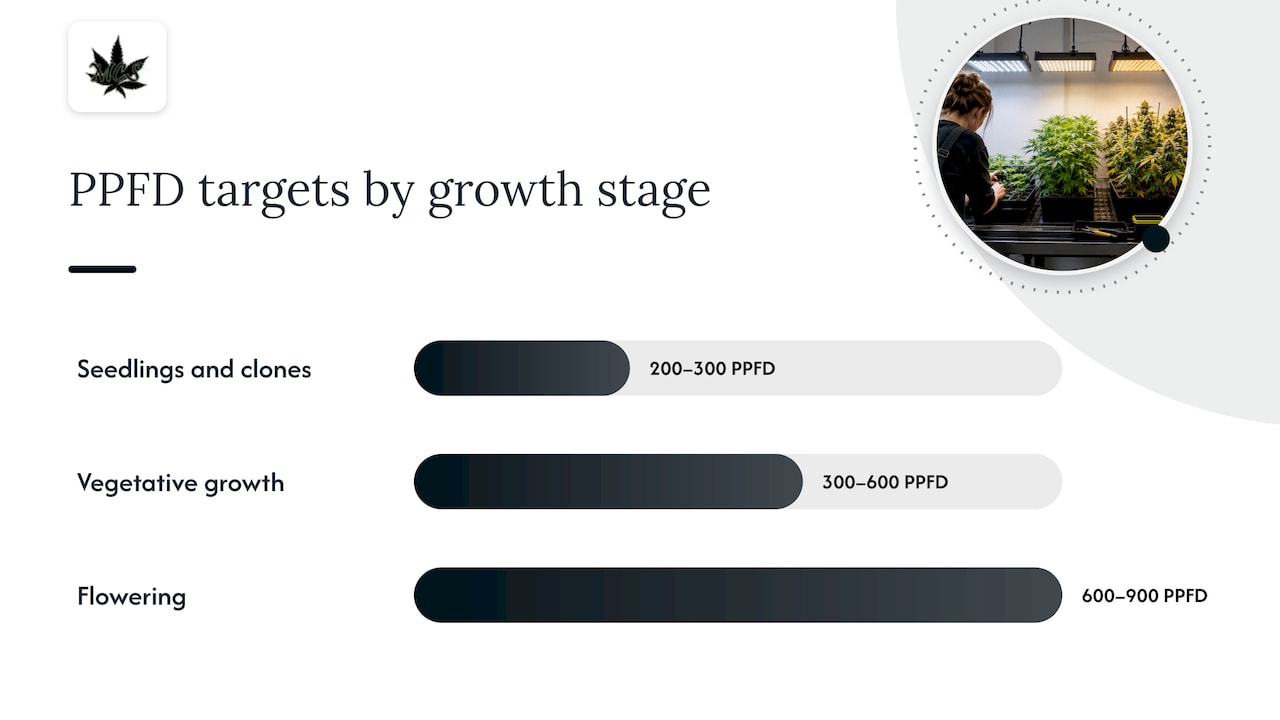
Coverage is the footprint where the light is strong enough to flower a plant well. The closer the fixture hangs, the smaller and more intense that footprint becomes. One equipment guide explains that LEDs tend to give strong centre coverage and weaker edges, so plants can be packed closer together, while HID lamps are stronger at the edges and weaker in the middle. The same guide gives PPFD targets (PPFD measures the light that reaches the plants, in micromoles per square metre per second): 200 to 300 for seedlings and clones, 300 to 600 for vegetative growth, and 600 to 900 for flowering. Above 900 risks light stress, and below 200 encourages stretching.
This is why a plant in the corner of a tent may yield far less than one in the centre. A strong centre reading on a PPFD map can hide weak corners, and extra plants placed there will not return useful yield.
True watts, not the label
LED marketing often quotes an HID-equivalent figure. A growers' lighting guide warns that a "1000W equivalent" LED drawing 100 W is a 100 W light, and recommends judging fixtures by true draw, efficacy of 2.5 µmol/J or better and published PPFD maps. That matters in Canada, where electricity costs add up over a 12-hour flowering cycle.
A Canadian retailer's help centre recommends 40 to 60 watts of LED per square foot and gives a clear example: a "1000W" unit that really draws 400 W suits about 10 square feet at 40 W per square foot. Another tent guide, built on member reports, puts real LED draw at roughly 27 to 37 watts per square foot, with the high end in small tents. The ranges overlap enough to give a planning band of about 30 to 50 true watts per square foot for flowering.
Plant size and training
Indoors, total yield depends mainly on light and space rather than plant count. A Canadian grow guide notes that one plant or four in the same light and space give comparable yields, so fewer, better-trained plants are often the stronger choice. A tent guide from a Canadian equipment brand makes the related warning that overcrowding can give the same harvest from 3 to 4 plants as from 1 to 2, when the light is too weak for the crowd.
A worked example: four plants, one light
Take a household growing the legal four plants in a 3x3 ft tent, about 9 square feet of floor.
- Choose the wattage band: 9 sq ft at 30 to 37 true watts per square foot is roughly 270 to 330 W of real draw. A growers' LED guide lists 200 to 300 true watts for flowering in a 3x3, which sits at the lower end of that band.
- Give each plant about 2 sq ft of canopy. Four plants then fill the tent without touching walls, leaving airflow between them.
- Match pot size to the plan. Four plants in 3 to 5 gallon pots suit a 3x3, and our guide to autoflower pot size explains how to match 3 to 5 gallons to space and strain.
- Hang the light so the flowering canopy sits in the 600 to 900 PPFD range, raising it as the plants stretch.
That plan is deliberately modest. It matches the household limit, the footprint and the electrical load, which is where first harvests tend to succeed.
How many plants fit in a 3x3 tent
A 3x3 tent is the most common first setup, and sources agree on a narrow range. A Canadian grow-light retailer's tent calculator lists a 3x3 ft tent as fitting 2 to 4 medium plants with a 250 to 300 W light. Another Canadian grower guide gives up to 4 plants for a 3x3, with each plant needing 2 to 6 sq ft depending on technique.
Pot size and method explain the spread. One tent maker's guide breaks a 3x3 down this way:
| Method | Plants in a 3x3 |
|---|---|
| Sea of green, small pots | 9 to 12 |
| Traditional growing | 4 to 6 |
| Screen of green (SCROG), trained | 1 to 4 |
| Monster cropping | 1 to 2 |
The same guide pairs pot size with plant size: 1 to 2 gallon pots for 9 to 12 small plants, 3 gallons for 4 to 6 medium plants, 5 gallons for 2 to 4 larger ones, and 7 gallons or more for 1 to 2 maximum-size plants. Its higher counts exceed Canada's household limit, so a Canadian home grower should read the lower end of each range. One more detail: "3x3" is not a fixed size. Most tents measure about 35.4 in (90 cm) square, and one maker's is 39 in, so check the interior dimensions before you plan.
For a deeper look at tent layout, see our complete guide to growing weed in a tent and the piece on growing cannabis in tight spaces.
How many plants can a 1000W LED grow
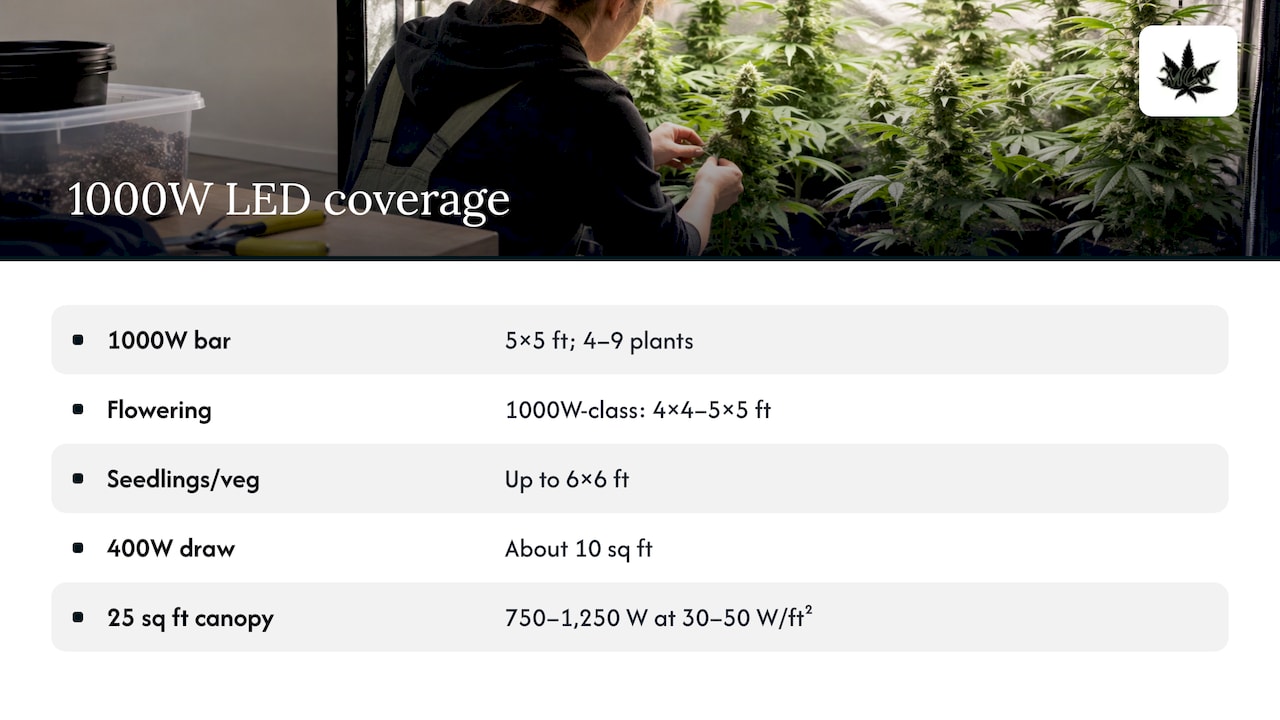
A "1000W" LED is the most searched example, and the honest answer is a range, because the label does not tell you the true draw or the spread. A Canadian vendor states that a single 1000W bar light covers a 5x5 ft canopy and accommodates 4 to 9 plants, depending on training and container size, with more plants in sea-of-green setups and fewer with larger SCROG plants.
Another guide puts the flowering footprint of a 1000W-class LED at about 4x4 to 5x5 ft, and up to 6x6 ft for seedlings and vegetative plants. A 5x5 ft canopy is 25 square feet, which at 30 to 50 true watts per square foot means a light drawing roughly 750 to 1,250 W. If your fixture draws 400 W, treat it as a 400 W light that covers about 10 sq ft, whatever the name says.
Under Canadian law, that coverage supports four plants, grown large. The extra area is better used by letting each plant fill out than by adding plants. Lighting heat and electrical load also matter: a public health review notes that high-wattage lamps of 500 to 1000 W produce enough heat to cause serious burns and draw large amounts of power, raising shock and fire risks, and it suggests lower-risk equipment such as LEDs, which cut energy use and heat output. Use a qualified electrician for any wiring beyond a standard outlet.
Training changes the count, not the legal limit
Training lets a small number of plants occupy the whole light footprint. Two well-known canopy strategies illustrate the trade-off: sea of green packs many small plants with little vegetative time, while screen of green grows a few plants longer so that every bud site sits at a similar distance from the light. Because Canadian households are capped at four plants, the screen approach is the natural fit. Our comparison of SCROG and SOG and the article on SCROG versus sea of green cover the methods, and our piece on topping and untopped plants shows how pruning spreads a plant sideways.
Vegetative time is the hidden variable. One tent guide notes that 2 to 3 weeks of veg allows 6 to 9 plants, while 7 or more weeks suits 1 to 2. Short veg means small plants and more of them, and long veg means few, large ones. For a four-plant household, a moderate veg of a few weeks with light training is a reasonable middle.
Seedling stage also needs care, since young plants need a gentler intensity than flowering ones. See our note on seedling light distance for why a fixed starting height is only a starting point.
Match the seeds to the light
The seed type decides how predictable the plan is. Feminized seeds are bred to produce female plants, so every plant you start is one that can flower under your light and none of your four slots goes to a male. Autoflowers finish on a fixed timeline and stay compact, which suits a small tent with a modest light. Our fast versions are photoperiod genetics that flower faster, a useful option when you want a shorter run under the same light.
If you grow for CBD, the same coverage logic applies, with plants spaced for airflow and an even canopy. Our CBD seeds come in feminized and autoflower options, and growers planning hemp-type plants can read more on organic hemp growing standards.
To choose the light itself, our guide to the best grow light for indoor cannabis covers the options in depth.
Spacing and airflow
Even four plants need room between leaves. A Canadian tent guide advises leaving space for airflow between plants to prevent humidity pockets and mould, especially in humid summers. Four plants produce little moisture on their own, as Professor Dixon told CBC, but a tent packed wall to wall can still hold damp air around dense foliage. Keep a gap between canopies and a fan moving air through the plants.
The NCCEH report also observes that indoor air quality impacts scale with plant number, which is another reason low plant limits suit home spaces.
From seed to a lit canopy
Our Mix Packs, Quebec line, outdoor and regular seeds sit alongside the feminized, autoflower, fast version and CBD categories, so you can choose genetics for the canopy you have designed. Seeds are curated for Canadian growing conditions and come with a germination guarantee, with fast and discreet shipping across Canada and a support team that knows local conditions.

If you have settled on a four-plant layout, a feminized pack is the straightforward way to fill it, and the product pages give detailed information on each strain so you can pick plants that fit your tent height.
Our view on plant count
Growers often ask us how many plants a light can carry, and our answer is to flip the question: decide on the plants you can legally keep, then size the light and the genetics around them. A canopy of four evenly trained plants under a light that really delivers its rated output will serve a home grower better than a crowded tent under a light that only looks powerful on the box.
That is why our catalog is built around Canadian growers. Feminized seeds let every plant earn its place, autoflowers keep the footprint compact, and detailed product information lets you match height and flowering time to your tent. Our germination guarantee exists so that the plants you count on actually come up.
Our support team understands local growing conditions, from cold basements to humid summers, and can help you think through a layout before you order.
Dino Grow Master
FAQ
How many plants can I grow under one light in Canada?
Federal rules allow a maximum of four plants per household, subject to provincial, territorial and municipal restrictions, and seedlings count toward that number. A single suitable light, such as the roughly 200 W LED Professor Dixon described for four plants, can cover that many. Check your province's rules first.
How many plants fit in a 3x3 tent?
Most guides land on 2 to 4 plants in a standard program, with 250 to 330 W of true LED draw. Larger pots and heavier training mean fewer plants, while smaller pots allow more, though counts above four exceed the household limit in Canada.
Does a 1000W LED grow more plants than a 400W LED?
Not automatically. What counts is the true draw and the canopy the light covers at 600 to 900 PPFD in flower. A fixture sold as 1000W that draws 400 W behaves like a 400 W light, and a legal four-plant grow is usually well served by a smaller true wattage.
Will more plants give a bigger yield?
Not indoors. Yield depends mainly on the light and space available, and a few trained plants can match a crowded tent. Overcrowding or an underpowered light can leave you with the same harvest from more plants.
Sources
- Growing cannabis at home safely, Health Canada
- How to Grow Cannabis Indoors: A Beginner's Guide, Leafly Canada
- Will it damage my home and other questions about growing cannabis, CBC News
- Growing at home: health and safety concerns for personal cannabis cultivation, NCCEH
- How Many Plants Can Fit Under a Grow Light?
- LED Grow Lights for Grow Tents in Canada
- Grow Tent Size Calculator
- GrowDaddy Canada help center
- What Size Grow Tent Do I Need?
- How many plants should I grow?
- How to Choose the Right Size Grow Tent
- How Many Plants in a 3x3 Grow Tent
- 800W to 1000W LED Grow Lights
- Answers to Top 5 Questions About 1000W LED Grow Lights