
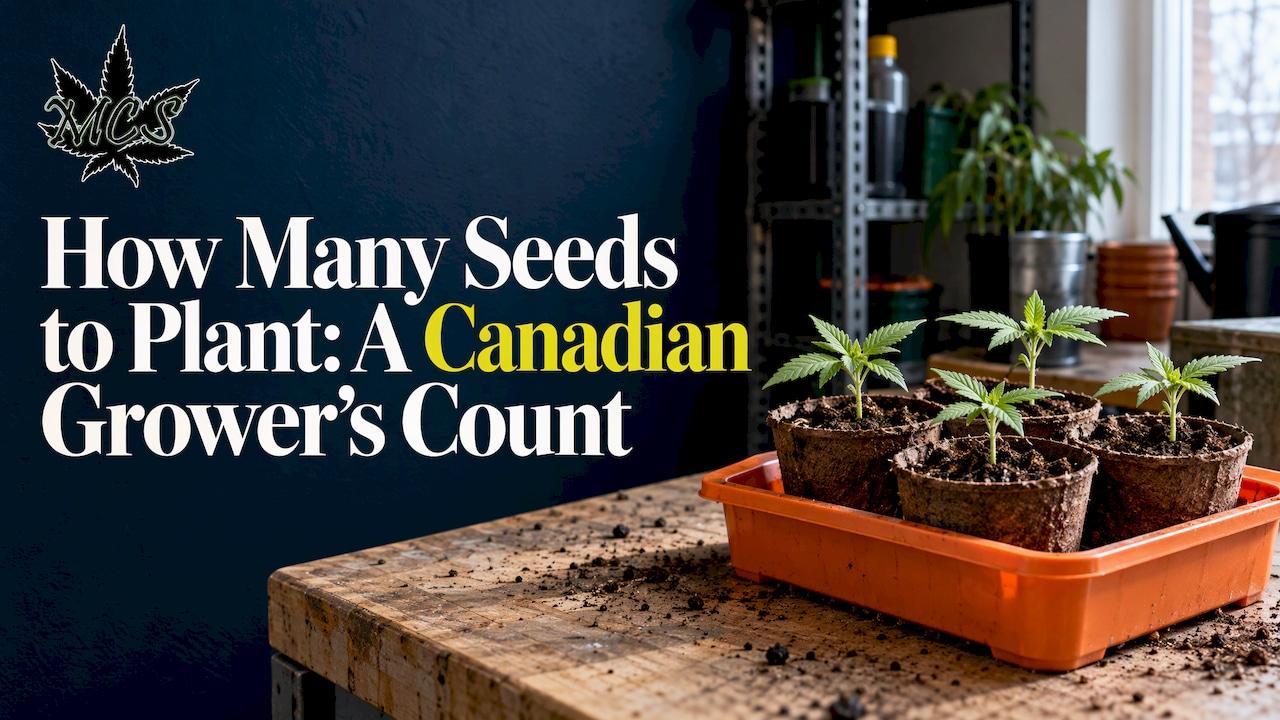
For most Canadian home growers the answer is one seed per pot and one or two seeds more than the number of plants wanted. That means five to six feminized seeds for a four-plant household, and a larger number for regular seeds, because roughly half of those will be male. The count depends on three things: the seed type, how reliable the seed lot is, and the legal ceiling that applies where you live. This guide sets out each in turn, with worked examples. The feminized and autoflower ranges at Montreal Cannabis Seeds are the natural starting point for a first grow, since both types make the arithmetic simple.
TL;DR
- Federal rules allow up to four plants per household, not per person, subject to provincial and municipal rules. Plan the seed count around that ceiling.
- Plant one seed per starter container. Extra seeds in the same pot compete, and roots tangle within two or three weeks.
- Feminized seeds: start one or two more than the plants you want. Regular seeds: roughly double, because about half are male.
- Quebec prohibits personal cultivation, and Manitoba requires indoor growing, so check the provincial rule before buying seeds.
- Medical patients registered with Health Canada may order three seeds per authorized plant from a licensed producer.
Table of Contents
- Start with the plant limit, not the packet size
- One seed per container
- How many seeds by seed type
- Worked examples
- When two seeds share a pot, and how to thin
- Medical patients: seeds per authorized plant
- Where to buy the seeds you count
- Our view on seed counts
- FAQ
- Sources
Start with the plant limit, not the packet size
Seed packs come in 1, 3, 5, 10 or more, and it is tempting to plant the whole pack. The better habit is to decide how many mature plants the household can legally and physically keep, and work backward from that number.
Health Canada states that, subject to provincial, territorial and municipal restrictions, adults of legal age may grow up to four cannabis plants per household. The limit applies to the household, so two adults sharing a home share the four plants. The federal rules also require that the seeds come from a licensed source, a point set out in Health Canada's Cannabis Act backgrounder.
The four-plant ceiling is the target for keepers, not for the number of seeds that go into the medium. A seed that never sprouts is not a plant. A seedling that is thinned out early is a plant that lived for days, not months. The practical rule is to keep the number of living plants at or under four from the moment the household has more than a handful of seedlings, and to thin promptly rather than letting surplus seedlings grow on.
A 2022 study of home cultivation across Canadian provinces found that the median number of plants grown was between 3.1 and 3.5 in each year from 2018 to 2020, with most growers inside the four-plant limit. Most people, in other words, aim for three or four plants and plan the seed count to match.
Provincial rules change the answer
The federal figure is a ceiling that provinces may lower.
- Quebec. The province's cannabis act (C-5.3) prohibits personal cultivation, including planting seeds, with fines of $250 to $750 for a first offence involving four or fewer plants in a residence. The Supreme Court of Canada unanimously upheld that ban in Murray-Hall c. Québec, confirming that provinces may be stricter than the federal floor. Our overview of growing cannabis in Quebec explains the medical-permit route and what applies to a Quebec reader.
- Manitoba. Since May 1, 2025, adults 19 and older may grow up to four plants per household indoors, in a place young people cannot reach. Landlords and condominium boards may also restrict home growing.
- Elsewhere. Provinces and territories add their own conditions, such as the age of majority and whether plants may be visible from a public space. Confirm the rule in your province before the seeds go in the ground, and check a lease or condo bylaws as well.
One seed per container
The single most useful rule in this article is simple: plant one seed in each starter container. It is common to see gardening advice for vegetables recommending two or three seeds per hole and thinning later. That works for lettuce and beans, where thinning costs a few pennies. Cannabis seeds are priced individually and each plant occupies a share of a four-plant household allowance, so the logic runs the other way. A single seed in each container gives a clean root system, an obvious winner and nothing to cull.
There is a second reason. When two seeds share a pot, the seedlings race for light and root space from the first week. By the second or third week the roots may be intertwined, and pulling the weaker plant out can damage the one you want to keep. If a pot does hold two sprouts, the safer method is to snip the weaker one at the soil line with scissors instead of pulling it.
Start small, then move up
The container matters as much as the count. Leafly Canada notes that growers typically start many seeds in small 4-inch or 1-gallon pots because not every seed germinates and not every plant turns out female. Survivors are then moved to larger pots as the roots fill the space. That is the reason to avoid dropping one seed into a final 5-gallon pot: a tiny seedling cannot use that much wet medium, and the result is often overwatering. Our guide to overwatering cannabis shows the signs and the fixes.
The University of Saskatchewan's gardening guide for Canadian residents suggests planting seeds about 1 cm deep, with germination usually taking 2 to 7 days for healthy, viable seeds. The same page recommends 3 to 4 gallon (12 to 16 L) containers for a typical indoor grow of four plants. For the germination method itself, see our Canadian guide to germinating cannabis seeds, and for moving seedlings on, when to transplant cannabis seedlings.
How many seeds by seed type
The seed type changes the count more than anything else, because it decides how many sprouts end up as plants you can keep.
| Seed type | Plants wanted | Seeds to start | Why |
|---|---|---|---|
| Feminized | 4 | 5 to 6 | Nearly every healthy sprout is a keeper; the spare covers a failed seed or a weak seedling |
| Autoflower (feminized) | 4 | 5 to 6 | Same arithmetic, but there is little time to recover from a setback, so a spare matters |
| Regular | 4 | 10 to 12 | About half will be male, so eight seeds only gives four females on average |
| Fast version (feminized) | 4 | 5 to 6 | Behaves like any feminized seed during the seedling stage |
These ranges are practical planning figures, not guarantees, and they assume fresh seed from a reliable source stored properly. Our guide on storing seeds covers keeping them viable; this article concerns the count.
Feminized seeds
The University of Saskatchewan explains that feminized seeds produce only female plants, and that they are the most useful type for making the most of the four-plant limit. Since there are no males to remove, every healthy seedling is a candidate keeper. Starting one or two more than your target is therefore enough. If all of them sprout and thrive, you choose the four strongest, which is a pleasant problem to have.
The feminized seeds at Montreal Cannabis Seeds are sold for exactly this use, and the shop backs its seeds with a germination guarantee. That policy is the reason a spare seed is enough rather than a whole second batch.
Regular seeds
Regular seeds carry a 50/50 chance of producing a male or a female plant. USask notes that, with a four-plant limit, growers may have to discard males, and that telling the sexes apart takes about four weeks without lab testing. The sums are straightforward. For four females you need about eight seeds on average, and because chance does not split evenly, ten to twelve gives a margin. That also means more pots, more space under the light and four weeks of tending plants that may be removed.

For a household with a fixed four-plant allowance, that cost is hard to justify unless the grower has a specific breeding goal. Our paper towel test for seeds, seedlings and sex explains how growers identify what they have; the difference between regular and feminized seeds already has its own page in our blog.
Autoflowers
Autoflowers do not wait for a change in the light cycle: they flower on their own schedule, and stress in the first weeks costs them more than it costs a photoperiod plant. Plant one seed per pot, and consider placing it in its final container, or a mid-sized one, earlier than you would with a photoperiod plant. Our guide to autoflower pot size helps match a 3 to 5 gallon pot to your space and strain. The autoflower seeds range is feminized, so the five-or-six-for-four rule applies.
Worked examples
Example 1: a first grow, four plants, feminized seeds. The household wants four plants and buys a pack of five feminized seeds. All five go into separate small starter pots. If all five sprout, the grower chooses the four most vigorous, and the fifth is removed with scissors at the soil line before it competes for light. If one seed fails, the grower has exactly four plants, no more, no less.
Example 2: a two-tent plan, mixed varieties. A grower wants two photoperiod plants and two autoflowers. A three-seed feminized pack and a three-seed autoflower pack give a spare of each type. Spares are kept only until the first true leaves show which seedlings are the healthiest.
Example 3: regular seeds for four females. Ten regular seeds are planted in ten small pots. Suppose six turn out female and four male. The males are removed once sex is clear, and the grower keeps the four strongest females. If only three turn out female, the household simply grows three. Planting a dozen would have reduced that risk, at the cost of more pots to manage.
These are illustrations of the arithmetic, not predictions: results vary with seed quality, temperature, moisture and handling.

When two seeds share a pot, and how to thin
Some growers plant two seeds in one starter pot as insurance, especially with older seed whose viability is less certain. If you do, the method is the same each time.
- Wait until the seedlings are about a week old, or until one is clearly healthier than the other.
- Choose the keeper by vigour: thicker stem, evenly green leaves and a good pair of true leaves.
- Cut the other at the soil line with clean scissors. Do not pull it.
- Leave the keeper to settle for a few days before any transplanting.
The Halton Region Master Gardeners, writing for Ontario growers, report that most cannabis seeds germinate in 2 to 5 days and that seedlings with at least one pair of true leaves can be potted on individually. That is the signal for the thinning decision: once the true leaves appear, the weak plant is usually obvious. Waiting beyond the second week makes the cut riskier for the plant you want to keep.
One seed per pot makes all four steps unnecessary, which is why we treat double-seeding as a fallback and not a routine. For day-to-day care in the first weeks, our cannabis seedling care guide is written for Canadian conditions.
Medical patients: seeds per authorized plant
The rules differ for patients registered with Health Canada to grow their own medical cannabis. The department states that a registered patient may order 3 marijuana seeds for each authorized plant from a licensed producer. With five authorized plants, for example, the maximum is 15 seeds. Plants and seeds can only be shipped to the production or storage site named on the registration certificate. Patients should plan their seed count from the number on their own registration, and ask their health care practitioner or Health Canada about anything unclear in it.
Where to buy the seeds you count
Once the number is settled, the order is straightforward. Montreal Cannabis Seeds is a Canadian online seed bank that sells feminized, autoflower, CBD and photoperiod seeds, as well as mix packs and fast versions, with fast, discreet shipping across Canada and a germination guarantee. Mix packs are a practical way to get two or three varieties in the right quantity for a four-plant household: the feminized mix pack suits photoperiod growers, and the autoflower mix pack suits a faster, smaller setup. For equipment such as pots and starter media, see the Canada grow supplies guide. The full catalog is on the Montreal Cannabis Seeds home page.

Our view on seed counts
Most seed-count mistakes we hear about come from one habit: treating the packet as a planting instruction. A pack of five is a unit of sale. The planting plan comes from the household's plant limit and the seed type.
That is why our catalog leans on feminized and autoflower genetics, curated for Canadian growing conditions. When a seed is feminized, the arithmetic is short: your target number plus a spare. When the seed lot also comes with a germination guarantee and detailed product information, the spare is a precaution and not a second crop.
Our advice to first-time growers is to pick one variety, plant one seed per small pot, and give the seedlings the attention that a crowded tray would divide. Four well-grown plants in a Canadian household will almost always beat six crowded ones.
Dino Grow Master
FAQ
Can I plant a whole pack of cannabis seeds at once?
Only if the pack size does not push you past your plant limit once the seeds sprout. In most provinces the federal ceiling is four plants per household, so a pack of ten is a reserve, not a planting instruction. Start the number you need plus a spare, and keep the rest of the pack stored for later.
How many seeds should a beginner plant to get four plants?
With feminized seeds, five or six is enough, each in its own small pot. With regular seeds, plan on ten to twelve, because about half will be male. Beginners generally have an easier first grow with feminized seeds, since there is no sexing step.
Should I plant two seeds in the same pot?
One seed per pot is the better default. If you do plant two, thin to the stronger seedling at about a week old by cutting the weaker one at the soil line. After two or three weeks the roots may be tangled, and removing one can harm the other.
How deep should cannabis seeds go?
About 1 cm deep in a light, moist growing medium, according to the University of Saskatchewan's cannabis gardening guide. Healthy, viable seeds usually sprout in 2 to 7 days.
Does the four-plant limit apply everywhere in Canada?
No. It is the federal maximum, and provinces may set stricter rules. Quebec prohibits personal cultivation, and Manitoba requires plants to be grown indoors. Check your province's rules and any lease or condo restrictions before you plant.
Sources
- Growing cannabis at home safely, Health Canada
- The Cannabis Act: The Facts, Health Canada
- Cannabis starting materials and interim supply, Health Canada
- Loi encadrant le cannabis (C-5.3), Légis Québec
- Murray-Hall c. Québec (2023 CSC 10), CanLII
- Cannabis in Manitoba: growing at home, Province of Manitoba
- Cannabis, Gardening at USask
- Home cultivation across Canadian provinces after cannabis legalization, ScienceDirect
- Cannabis, Halton Region Master Gardeners
- How & When to Transplant Cannabis Plants, Leafly Canada